CLASS11- MOTION IN A STRAIGH
LINE
BY- VIVEK TOMAR
CLASS 11- MOTION IN A STAIGHT LINE
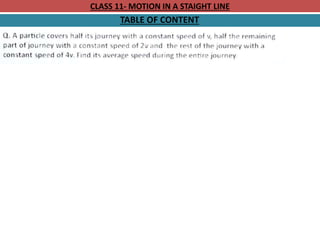
TABLE OF CONTENT
• DISTANCE AND DISPACEMENT
• AVERAGE VELOCITY
• AVERAGE SPEED
• INSTANTANEOUS VELOCITY AND SPEED
• ACCELERATION
• KINEMATICS EQUATION FOR UNIFORMLY ACCELERATED MOTION
• RELATIVE VELOCITY
CLASS 11- MOTION IN A STAIGHT LINE
INTRODUCTION
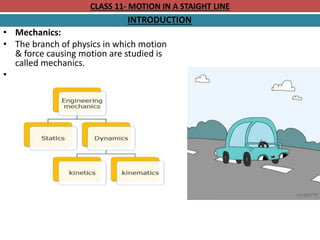
• Mechanics:
• The branch of physics in which motion
& force causing motion are studied is
called mechanics.
•
CLASS 11- MOTION IN A STAIGHT LINE
MECHANICS
• Kinematics:
• The study of motion without going into
the causes of motion is called as
kinematics.
•
• Rest & Motion:
• If a body changes its position with time
it is said to be moving i.e motion and if
it does not change its position with
time it is said to be in rest.
• No body can exist in state of absolute
rest or of absolute motion, rest and
motion of a body depends on a
reference frame.
•
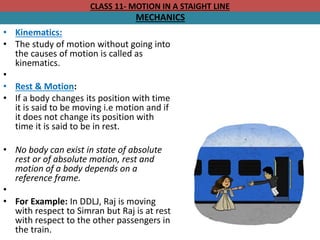
• For Example: In DDLJ, Raj is moving
with respect to Simran but Raj is at rest
with respect to the other passengers in
the train.
CLASS 11- MOTION IN A STAIGHT LINE
FRAME OF REFERENCE
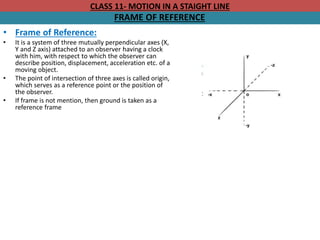
• Frame of Reference:
• It is a system of three mutually perpendicular axes (X,
Y and Z axis) attached to an observer having a clock
with him, with respect to which the observer can
describe position, displacement, acceleration etc. of a
moving object.
• The point of intersection of three axes is called origin,
which serves as a reference point or the position of
the observer.
• If frame is not mention, then ground is taken as a
reference frame
CLASS 11- MOTION IN A STAIGHT LINE
Path Length (Distance) Vs. Displacement
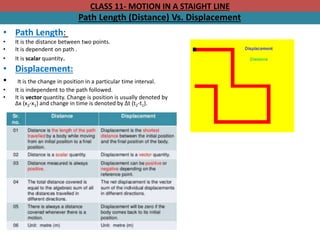
• Path Length:
• It is the distance between two points.
• It is dependent on path .
• It is scalar quantity.
• Displacement:
• It is the change in position in a particular time interval.
• It is independent to the path followed.
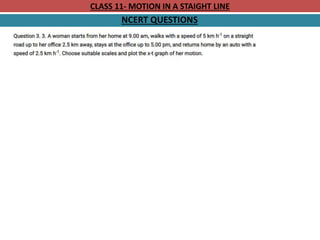
• It is vector quantity. Change is position is usually denoted by
Δx (x2-x1) and change in time is denoted by Δt (t2-t1).
CLASS 11- MOTION IN A STAIGHT LINE
TABLE OF CONTENT
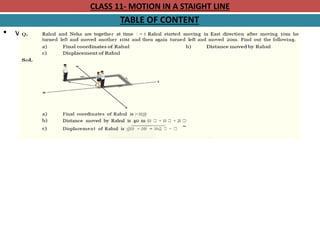
• v
CLASS 11- MOTION IN A STAIGHT LINE
TYPES OF MOTION
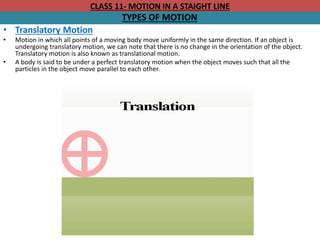
• Translatory Motion
• Motion in which all points of a moving body move uniformly in the same direction. If an object is
undergoing translatory motion, we can note that there is no change in the orientation of the object.
Translatory motion is also known as translational motion.
• A body is said to be under a perfect translatory motion when the object moves such that all the
particles in the object move parallel to each other.
CLASS 11- MOTION IN A STAIGHT LINE
TYPES OF MOTION
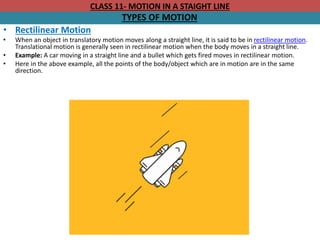
• Rectilinear Motion
• When an object in translatory motion moves along a straight line, it is said to be in rectilinear motion.
Translational motion is generally seen in rectilinear motion when the body moves in a straight line.
• Example: A car moving in a straight line and a bullet which gets fired moves in rectilinear motion.
• Here in the above example, all the points of the body/object which are in motion are in the same
direction.
CLASS 11- MOTION IN A STAIGHT LINE
TYPES OF MOTION
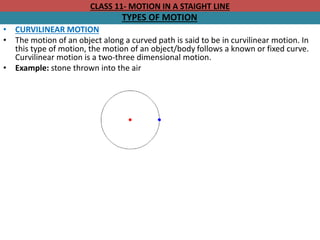
• CURVILINEAR MOTION
• The motion of an object along a curved path is said to be in curvilinear motion. In
this type of motion, the motion of an object/body follows a known or fixed curve.
Curvilinear motion is a two-three dimensional motion.
• Example: stone thrown into the air
CLASS 11- MOTION IN A STAIGHT LINE
CIRCULAR MOTION
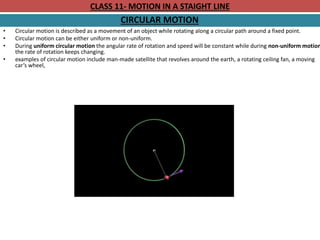
• Circular motion is described as a movement of an object while rotating along a circular path around a fixed point.
• Circular motion can be either uniform or non-uniform.
• During uniform circular motion the angular rate of rotation and speed will be constant while during non-uniform motion
the rate of rotation keeps changing.
• examples of circular motion include man-made satellite that revolves around the earth, a rotating ceiling fan, a moving
car’s wheel,
CLASS 11- MOTION IN A STAIGHT LINE
TYPES OF MOTION
• ROTATORY MOTION
• Rotatory motion is the motion that occurs when a body rotates on its own axis. A few examples of
the rotatory motion are as follows:
• The motion of the earth about its own axis around the sun is an example of rotary motion.
• While driving a car, the motion of wheels and the steering wheel about its own axis is an example
of rotatory motion.
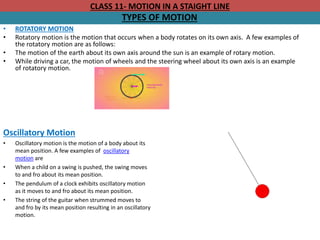
Oscillatory Motion
• Oscillatory motion is the motion of a body about its
mean position. A few examples of oscillatory
motion are
• When a child on a swing is pushed, the swing moves
to and fro about its mean position.
• The pendulum of a clock exhibits oscillatory motion
as it moves to and fro about its mean position.
• The string of the guitar when strummed moves to
and fro by its mean position resulting in an oscillatory
motion.
CLASS 11- MOTION IN A STAIGHT LINE
TABLE OF CONTENT
CLASS 11- MOTION IN A STAIGHT LINE
VELOCITY AND SPEED
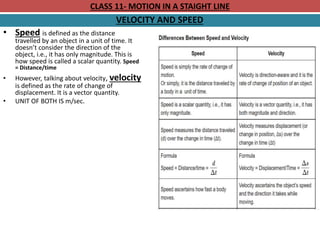
• Speed is defined as the distance
travelled by an object in a unit of time. It
doesn’t consider the direction of the
object, i.e., it has only magnitude. This is
how speed is called a scalar quantity. Speed
= Distance/time
• However, talking about velocity, velocity
is defined as the rate of change of
displacement. It is a vector quantity.
• UNIT OF BOTH IS m/sec.
CLASS 11- MOTION IN A STAIGHT LINE
AVERAGE VELOCITY AND SPEED
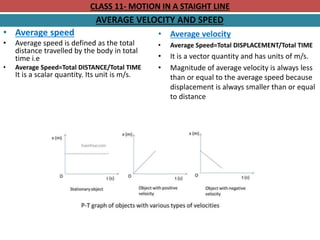
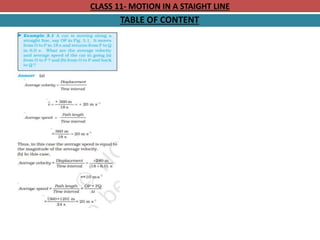
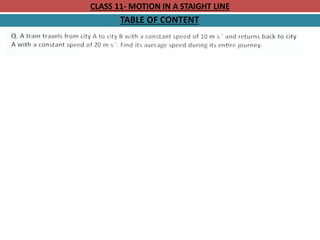
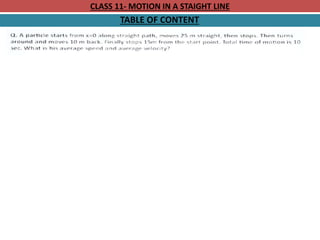
• Average speed
• Average speed is defined as the total
distance travelled by the body in total
time i.e
• Average Speed=Total DISTANCE/Total TIME
It is a scalar quantity. Its unit is m/s.
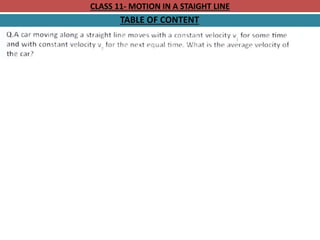
• Average velocity
• Average Speed=Total DISPLACEMENT/Total TIME
• It is a vector quantity and has units of m/s.
• Magnitude of average velocity is always less
than or equal to the average speed because
displacement is always smaller than or equal
to distance
CLASS 11- MOTION IN A STAIGHT LINE
TABLE OF CONTENT
CLASS 11- MOTION IN A STAIGHT LINE
TABLE OF CONTENT
CLASS 11- MOTION IN A STAIGHT LINE
TABLE OF CONTENT
CLASS 11- MOTION IN A STAIGHT LINE
TABLE OF CONTENT
CLASS 11- MOTION IN A STAIGHT LINE
TABLE OF CONTENT
CLASS 11- MOTION IN A STAIGHT LINE
SOME BASIC CONCEPTS OF MATHS.
CLASS 11- MOTION IN A STAIGHT LINE
Instantaneous Velocity and Instantaneous Speed
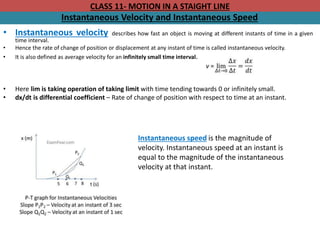
• Instantaneous velocity describes how fast an object is moving at different instants of time in a given
time interval.
• Hence the rate of change of position or displacement at any instant of time is called instantaneous velocity.
• It is also defined as average velocity for an infinitely small time interval.
• Here lim is taking operation of taking limit with time tending towards 0 or infinitely small.
• dx/dt is differential coefficient – Rate of change of position with respect to time at an instant.
Instantaneous speed is the magnitude of
velocity. Instantaneous speed at an instant is
equal to the magnitude of the instantaneous
velocity at that instant.
CLASS 11- MOTION IN A STAIGHT LINE
UNIFORM VELOCITY AND SPE
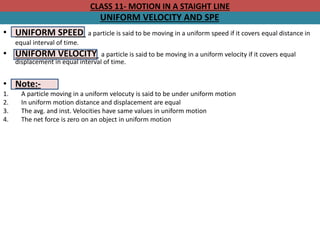
• UNIFORM SPEED a particle is said to be moving in a uniform speed if it covers equal distance in
equal interval of time.
• UNIFORM VELOCITY a particle is said to be moving in a uniform velocity if it covers equal
displacement in equal interval of time.
• Note:-
1. A particle moving in a uniform velocuty is said to be under uniform motion
2. In uniform motion distance and displacement are equal
3. The avg. and inst. Velocities have same values in uniform motion
4. The net force is zero on an object in uniform motion
CLASS 11- MOTION IN A STAIGHT LINE
Acceleration
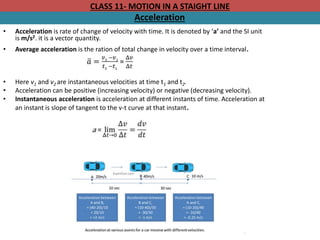
• Acceleration is rate of change of velocity with time. It is denoted by ‘a’ and the SI unit
is m/s2. it is a vector quantity.
• Average acceleration is the ration of total change in velocity over a time interval.
• Here v1 and v2 are instantaneous velocities at time t1 and t2.
• Acceleration can be positive (increasing velocity) or negative (decreasing velocity).
• Instantaneous acceleration is acceleration at different instants of time. Acceleration at
an instant is slope of tangent to the v-t curve at that instant.
CLASS 11- MOTION IN A STAIGHT LINE
TABLE OF CONTENT
CLASS 11- MOTION IN A STAIGHT LINE
Acceleration
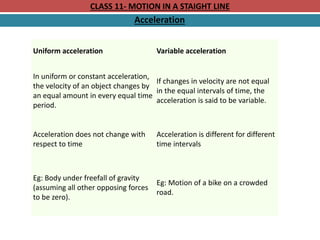
Uniform acceleration Variable acceleration
In uniform or constant acceleration,
the velocity of an object changes by
an equal amount in every equal time
period.
If changes in velocity are not equal
in the equal intervals of time, the
acceleration is said to be variable.
Acceleration does not change with
respect to time
Acceleration is different for different
time intervals
Eg: Body under freefall of gravity
(assuming all other opposing forces
to be zero).
Eg: Motion of a bike on a crowded
road.​
CLASS 11- MOTION IN A STAIGHT LINE
ACCELERATION
• IMPORTANT POINTS
CLASS 11- MOTION IN A STAIGHT LINE
TABLE OF CONTENT
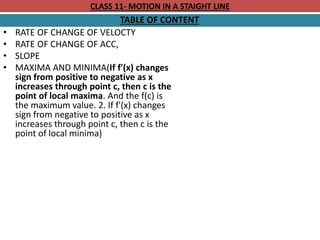
• RATE OF CHANGE OF VELOCTY
• RATE OF CHANGE OF ACC,
• SLOPE
• MAXIMA AND MINIMA(If f'(x) changes
sign from positive to negative as x
increases through point c, then c is the
point of local maxima. And the f(c) is
the maximum value. 2. If f'(x) changes
sign from negative to positive as x
increases through point c, then c is the
point of local minima)
CLASS 11- MOTION IN A STAIGHT LINE
TABLE OF CONTENT
CLASS 11- MOTION IN A STAIGHT LINE
TABLE OF CONTENT
CLASS 11- MOTION IN A STAIGHT LINE
TABLE OF CONTENT
CLASS 11- MOTION IN A STAIGHT LINE
TABLE OF CONTENT
CLASS 11- MOTION IN A STAIGHT LINE
TABLE OF CONTENT
CLASS 11- MOTION IN A STAIGHT LINE
TABLE OF CONTENT
CLASS 11- MOTION IN A STAIGHT LINE
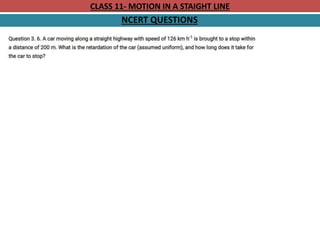
NCERT QUESTIONS
CLASS 11- MOTION IN A STAIGHT LINE
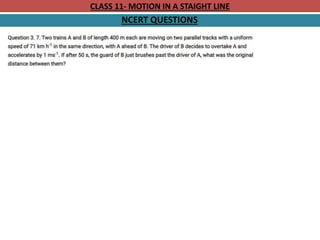
NCERT QUESTIONS
CLASS 11- MOTION IN A STAIGHT LINE
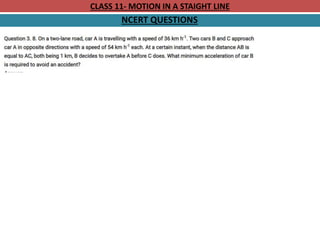
NCERT QUESTIONS
CLASS 11- MOTION IN A STAIGHT LINE
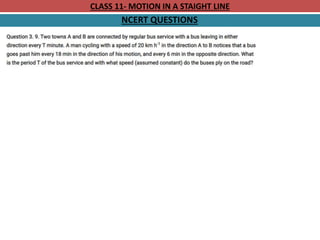
NCERT QUESTIONS
CLASS 11- MOTION IN A STAIGHT LINE
NCERT QUESTIONS
CLASS 11- MOTION IN A STAIGHT LINE
NCERT QUESTIONS
CLASS 11- MOTION IN A STAIGHT LINE
NCERT QUESTIONS
CLASS 11- MOTION IN A STAIGHT LINE
NCERT QUESTIONS
CLASS 11- MOTION IN A STAIGHT LINE
EQUATIONS FOR MOTION
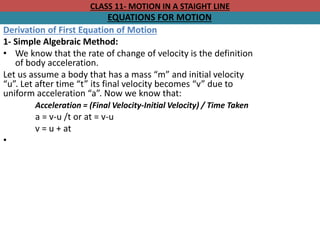
Derivation of First Equation of Motion
1- Simple Algebraic Method:
• We know that the rate of change of velocity is the definition
of body acceleration.
Let us assume a body that has a mass “m” and initial velocity
“u”. Let after time “t” its final velocity becomes “v” due to
uniform acceleration “a”. Now we know that:
Acceleration = (Final Velocity-Initial Velocity) / Time Taken
a = v-u /t or at = v-u
v = u + at
•
CLASS 11- MOTION IN A STAIGHT LINE
EQUATIONS FOR MOTION
Graphical Method
OD = u; OC = v and OE = DA = t.
Initial velocity = u
Uniform acceleration= a
Final velocity= v
First Equation of Motion:
Let, OE = time (t)
From the graph:
BE = AB + AE
V = DC + OD (AB = DC & AE = OD)
V = DC + u [OD = u]
V = DC + u … (1)
Now,
a = (v – u)/ t
a = (OC – OD)/ t = DC/ t
at = DC … (2)
By substituting DC from (2) in (1):
We get:
V = at + u
V = u + at
CLASS 11- MOTION IN A STAIGHT LINE
EQUATIONS FOR MOTION
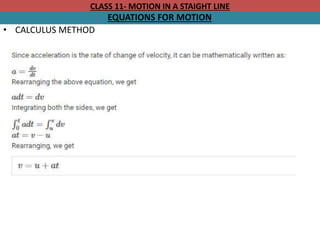
• CALCULUS METHOD
CLASS 11- MOTION IN A STAIGHT LINE
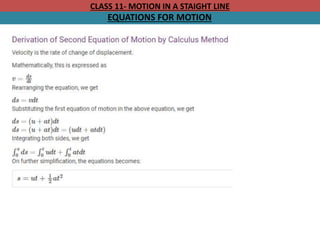
Derivation of Second Equation of Motion
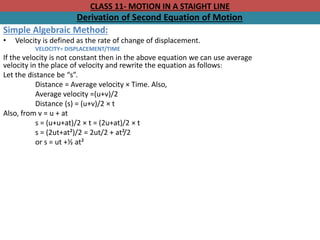
Simple Algebraic Method:
• Velocity is defined as the rate of change of displacement.
VELOCITY= DISPLACEMENT/TIME
If the velocity is not constant then in the above equation we can use average
velocity in the place of velocity and rewrite the equation as follows:
Let the distance be “s”.
Distance = Average velocity × Time. Also,
Average velocity =(u+v)/2
Distance (s) = (u+v)/2 × t
Also, from v = u + at
s = (u+u+at)/2 × t = (2u+at)/2 × t
s = (2ut+at²)/2 = 2ut/2 + at²/2
or s = ut +½ at²
CLASS 11- MOTION IN A STAIGHT LINE
EQUATIONS FOR MOTION
• Graphical Method
OD = u, OC = v and OE = DA = t.
Initial velocity = u
Uniform acceleration= a
Final velocity= v
Distance covered in the given time “t” is the area of the trapezium
ABDOE.
Let in the given time (t), the distance covered = s
The area of trapezium, ABDOE.
Distance (s) = Area of ΔABD + Area of ADOE.
s = ½ x AB x AD + (OD x OE)
s = ½ x DC x AD + (u x t) [∵ AB = DC]
s = ½ x at x t + ut [∵ DC = at]
s = ½ x at x t + ut
s = ut + ½ at².
CLASS 11- MOTION IN A STAIGHT LINE
EQUATIONS FOR MOTION
CLASS 11- MOTION IN A STAIGHT LINE
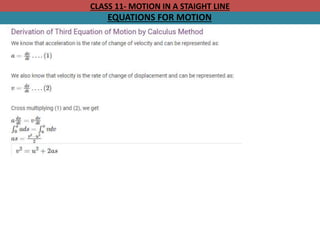
Derivation of Third Equation of Motion
Simple Algebraic Method
We have, v = u + at.
Hence, we can write t = (v-u)/a
Also, we know that, Distance = average velocity × Time
Therefore, for constant acceleration we can write:
Average velocity = (final velocity + initial velocty)/2 = (v+u)/2
Hence, Distance (s) = [(v+u)/2] × [(v-u)/a]
s = (v² – u²)/2a
2as = v² – u²
v² = u² + 2as
CLASS 11- MOTION IN A STAIGHT LINE
EQUATIONS FOR MOTION
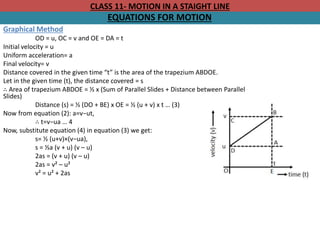
Graphical Method
OD = u, OC = v and OE = DA = t
Initial velocity = u
Uniform acceleration= a
Final velocity= v
Distance covered in the given time “t” is the area of the trapezium ABDOE.
Let in the given time (t), the distance covered = s
∴ Area of trapezium ABDOE = ½ x (Sum of Parallel Slides + Distance between Parallel
Slides)
Distance (s) = ½ (DO + BE) x OE = ½ (u + v) x t … (3)
Now from equation (2): a=v−ut,
∴ t=v−ua … 4
Now, substitute equation (4) in equation (3) we get:
s= ½ (u+v)×(v−ua),
s = ½a (v + u) (v – u)
2as = (v + u) (v – u)
2as = v² – u²
v² = u² + 2as
CLASS 11- MOTION IN A STAIGHT LINE
EQUATIONS FOR MOTION
CLASS 11- MOTION IN A STAIGHT LINE
EQUATIONS FOR MOTION
CLASS 11- MOTION IN A STAIGHT LINE
EQUATIONS FOR MOTION
CLASS 11- MOTION IN A STAIGHT LINE
EQUATIONS FOR MOTION
CLASS 11- MOTION IN A STAIGHT LINE
EQUATIONS FOR MOTION
CLASS 11- MOTION IN A STAIGHT LINE
EQUATIONS FOR MOTION
CLASS 11- MOTION IN A STAIGHT LINE
EQUATIONS FOR MOTION
CLASS 11- MOTION IN A STAIGHT LINE
EQUATIONS FOR MOTION
CLASS 11- MOTION IN A STAIGHT LINE
EQUATIONS FOR MOTION
CLASS 11- MOTION IN A STAIGHT LINE
EQUATIONS FOR MOTION
CLASS 11- MOTION IN A STAIGHT LINE
EQUATIONS FOR MOTION
CLASS 11- MOTION IN A STAIGHT LINE
EQUATIONS FOR MOTION
CLASS 11- MOTION IN A STAIGHT LINE
EQUATIONS FOR MOTION
CLASS 11- MOTION IN A STAIGHT LINE
EQUATIONS FOR MOTION
CLASS 11- MOTION IN A STAIGHT LINE
EQUATIONS FOR MOTION
CLASS 11- MOTION IN A STAIGHT LINE
EQUATIONS FOR MOTION
CLASS 11- MOTION IN A STAIGHT LINE
EQUATIONS FOR MOTION
CLASS 11- MOTION IN A STAIGHT LINE
EQUATIONS FOR MOTION
CLASS 11- MOTION IN A STAIGHT LINE
EQUATIONS FOR MOTION
CLASS 11- MOTION IN A STAIGHT LINE
EQUATIONS FOR MOTION
CLASS 11- MOTION IN A STAIGHT LINE
EQUATIONS FOR MOTION
CLASS 11- MOTION IN A STAIGHT LINE
EQUATIONS FOR MOTION

MOTION IN A STRAIGHT LINE'.pptx

  • 1.
    CLASS11- MOTION INA STRAIGH LINE BY- VIVEK TOMAR
  • 2.
    CLASS 11- MOTIONIN A STAIGHT LINE TABLE OF CONTENT • DISTANCE AND DISPACEMENT • AVERAGE VELOCITY • AVERAGE SPEED • INSTANTANEOUS VELOCITY AND SPEED • ACCELERATION • KINEMATICS EQUATION FOR UNIFORMLY ACCELERATED MOTION • RELATIVE VELOCITY
  • 3.
    CLASS 11- MOTIONIN A STAIGHT LINE INTRODUCTION • Mechanics: • The branch of physics in which motion & force causing motion are studied is called mechanics. •
  • 4.
    CLASS 11- MOTIONIN A STAIGHT LINE MECHANICS • Kinematics: • The study of motion without going into the causes of motion is called as kinematics. • • Rest & Motion: • If a body changes its position with time it is said to be moving i.e motion and if it does not change its position with time it is said to be in rest. • No body can exist in state of absolute rest or of absolute motion, rest and motion of a body depends on a reference frame. • • For Example: In DDLJ, Raj is moving with respect to Simran but Raj is at rest with respect to the other passengers in the train.
  • 5.
    CLASS 11- MOTIONIN A STAIGHT LINE FRAME OF REFERENCE • Frame of Reference: • It is a system of three mutually perpendicular axes (X, Y and Z axis) attached to an observer having a clock with him, with respect to which the observer can describe position, displacement, acceleration etc. of a moving object. • The point of intersection of three axes is called origin, which serves as a reference point or the position of the observer. • If frame is not mention, then ground is taken as a reference frame
  • 6.
    CLASS 11- MOTIONIN A STAIGHT LINE Path Length (Distance) Vs. Displacement • Path Length: • It is the distance between two points. • It is dependent on path . • It is scalar quantity. • Displacement: • It is the change in position in a particular time interval. • It is independent to the path followed. • It is vector quantity. Change is position is usually denoted by Δx (x2-x1) and change in time is denoted by Δt (t2-t1).
  • 7.
    CLASS 11- MOTIONIN A STAIGHT LINE TABLE OF CONTENT • v
  • 8.
    CLASS 11- MOTIONIN A STAIGHT LINE TYPES OF MOTION • Translatory Motion • Motion in which all points of a moving body move uniformly in the same direction. If an object is undergoing translatory motion, we can note that there is no change in the orientation of the object. Translatory motion is also known as translational motion. • A body is said to be under a perfect translatory motion when the object moves such that all the particles in the object move parallel to each other.
  • 9.
    CLASS 11- MOTIONIN A STAIGHT LINE TYPES OF MOTION • Rectilinear Motion • When an object in translatory motion moves along a straight line, it is said to be in rectilinear motion. Translational motion is generally seen in rectilinear motion when the body moves in a straight line. • Example: A car moving in a straight line and a bullet which gets fired moves in rectilinear motion. • Here in the above example, all the points of the body/object which are in motion are in the same direction.
  • 10.
    CLASS 11- MOTIONIN A STAIGHT LINE TYPES OF MOTION • CURVILINEAR MOTION • The motion of an object along a curved path is said to be in curvilinear motion. In this type of motion, the motion of an object/body follows a known or fixed curve. Curvilinear motion is a two-three dimensional motion. • Example: stone thrown into the air
  • 11.
    CLASS 11- MOTIONIN A STAIGHT LINE CIRCULAR MOTION • Circular motion is described as a movement of an object while rotating along a circular path around a fixed point. • Circular motion can be either uniform or non-uniform. • During uniform circular motion the angular rate of rotation and speed will be constant while during non-uniform motion the rate of rotation keeps changing. • examples of circular motion include man-made satellite that revolves around the earth, a rotating ceiling fan, a moving car’s wheel,
  • 12.
    CLASS 11- MOTIONIN A STAIGHT LINE TYPES OF MOTION • ROTATORY MOTION • Rotatory motion is the motion that occurs when a body rotates on its own axis. A few examples of the rotatory motion are as follows: • The motion of the earth about its own axis around the sun is an example of rotary motion. • While driving a car, the motion of wheels and the steering wheel about its own axis is an example of rotatory motion. Oscillatory Motion • Oscillatory motion is the motion of a body about its mean position. A few examples of oscillatory motion are • When a child on a swing is pushed, the swing moves to and fro about its mean position. • The pendulum of a clock exhibits oscillatory motion as it moves to and fro about its mean position. • The string of the guitar when strummed moves to and fro by its mean position resulting in an oscillatory motion.
  • 13.
    CLASS 11- MOTIONIN A STAIGHT LINE
  • 14.
    CLASS 11- MOTIONIN A STAIGHT LINE TABLE OF CONTENT
  • 15.
    CLASS 11- MOTIONIN A STAIGHT LINE VELOCITY AND SPEED • Speed is defined as the distance travelled by an object in a unit of time. It doesn’t consider the direction of the object, i.e., it has only magnitude. This is how speed is called a scalar quantity. Speed = Distance/time • However, talking about velocity, velocity is defined as the rate of change of displacement. It is a vector quantity. • UNIT OF BOTH IS m/sec.
  • 16.
    CLASS 11- MOTIONIN A STAIGHT LINE AVERAGE VELOCITY AND SPEED • Average speed • Average speed is defined as the total distance travelled by the body in total time i.e • Average Speed=Total DISTANCE/Total TIME It is a scalar quantity. Its unit is m/s. • Average velocity • Average Speed=Total DISPLACEMENT/Total TIME • It is a vector quantity and has units of m/s. • Magnitude of average velocity is always less than or equal to the average speed because displacement is always smaller than or equal to distance
  • 17.
    CLASS 11- MOTIONIN A STAIGHT LINE TABLE OF CONTENT
  • 18.
    CLASS 11- MOTIONIN A STAIGHT LINE TABLE OF CONTENT
  • 19.
    CLASS 11- MOTIONIN A STAIGHT LINE TABLE OF CONTENT
  • 20.
    CLASS 11- MOTIONIN A STAIGHT LINE TABLE OF CONTENT
  • 21.
    CLASS 11- MOTIONIN A STAIGHT LINE TABLE OF CONTENT
  • 22.
    CLASS 11- MOTIONIN A STAIGHT LINE SOME BASIC CONCEPTS OF MATHS.
  • 23.
    CLASS 11- MOTIONIN A STAIGHT LINE Instantaneous Velocity and Instantaneous Speed • Instantaneous velocity describes how fast an object is moving at different instants of time in a given time interval. • Hence the rate of change of position or displacement at any instant of time is called instantaneous velocity. • It is also defined as average velocity for an infinitely small time interval. • Here lim is taking operation of taking limit with time tending towards 0 or infinitely small. • dx/dt is differential coefficient – Rate of change of position with respect to time at an instant. Instantaneous speed is the magnitude of velocity. Instantaneous speed at an instant is equal to the magnitude of the instantaneous velocity at that instant.
  • 24.
    CLASS 11- MOTIONIN A STAIGHT LINE UNIFORM VELOCITY AND SPE • UNIFORM SPEED a particle is said to be moving in a uniform speed if it covers equal distance in equal interval of time. • UNIFORM VELOCITY a particle is said to be moving in a uniform velocity if it covers equal displacement in equal interval of time. • Note:- 1. A particle moving in a uniform velocuty is said to be under uniform motion 2. In uniform motion distance and displacement are equal 3. The avg. and inst. Velocities have same values in uniform motion 4. The net force is zero on an object in uniform motion
  • 25.
    CLASS 11- MOTIONIN A STAIGHT LINE Acceleration • Acceleration is rate of change of velocity with time. It is denoted by ‘a’ and the SI unit is m/s2. it is a vector quantity. • Average acceleration is the ration of total change in velocity over a time interval. • Here v1 and v2 are instantaneous velocities at time t1 and t2. • Acceleration can be positive (increasing velocity) or negative (decreasing velocity). • Instantaneous acceleration is acceleration at different instants of time. Acceleration at an instant is slope of tangent to the v-t curve at that instant.
  • 26.
    CLASS 11- MOTIONIN A STAIGHT LINE TABLE OF CONTENT
  • 27.
    CLASS 11- MOTIONIN A STAIGHT LINE Acceleration Uniform acceleration Variable acceleration In uniform or constant acceleration, the velocity of an object changes by an equal amount in every equal time period. If changes in velocity are not equal in the equal intervals of time, the acceleration is said to be variable. Acceleration does not change with respect to time Acceleration is different for different time intervals Eg: Body under freefall of gravity (assuming all other opposing forces to be zero). Eg: Motion of a bike on a crowded road.​
  • 28.
    CLASS 11- MOTIONIN A STAIGHT LINE ACCELERATION • IMPORTANT POINTS
  • 29.
    CLASS 11- MOTIONIN A STAIGHT LINE TABLE OF CONTENT • RATE OF CHANGE OF VELOCTY • RATE OF CHANGE OF ACC, • SLOPE • MAXIMA AND MINIMA(If f'(x) changes sign from positive to negative as x increases through point c, then c is the point of local maxima. And the f(c) is the maximum value. 2. If f'(x) changes sign from negative to positive as x increases through point c, then c is the point of local minima)
  • 30.
    CLASS 11- MOTIONIN A STAIGHT LINE TABLE OF CONTENT
  • 31.
    CLASS 11- MOTIONIN A STAIGHT LINE TABLE OF CONTENT
  • 32.
    CLASS 11- MOTIONIN A STAIGHT LINE TABLE OF CONTENT
  • 33.
    CLASS 11- MOTIONIN A STAIGHT LINE TABLE OF CONTENT
  • 34.
    CLASS 11- MOTIONIN A STAIGHT LINE TABLE OF CONTENT
  • 35.
    CLASS 11- MOTIONIN A STAIGHT LINE TABLE OF CONTENT
  • 36.
    CLASS 11- MOTIONIN A STAIGHT LINE NCERT QUESTIONS
  • 37.
    CLASS 11- MOTIONIN A STAIGHT LINE NCERT QUESTIONS
  • 38.
    CLASS 11- MOTIONIN A STAIGHT LINE NCERT QUESTIONS
  • 39.
    CLASS 11- MOTIONIN A STAIGHT LINE NCERT QUESTIONS
  • 40.
    CLASS 11- MOTIONIN A STAIGHT LINE NCERT QUESTIONS
  • 41.
    CLASS 11- MOTIONIN A STAIGHT LINE NCERT QUESTIONS
  • 42.
    CLASS 11- MOTIONIN A STAIGHT LINE NCERT QUESTIONS
  • 43.
    CLASS 11- MOTIONIN A STAIGHT LINE NCERT QUESTIONS
  • 44.
    CLASS 11- MOTIONIN A STAIGHT LINE EQUATIONS FOR MOTION Derivation of First Equation of Motion 1- Simple Algebraic Method: • We know that the rate of change of velocity is the definition of body acceleration. Let us assume a body that has a mass “m” and initial velocity “u”. Let after time “t” its final velocity becomes “v” due to uniform acceleration “a”. Now we know that: Acceleration = (Final Velocity-Initial Velocity) / Time Taken a = v-u /t or at = v-u v = u + at •
  • 45.
    CLASS 11- MOTIONIN A STAIGHT LINE EQUATIONS FOR MOTION Graphical Method OD = u; OC = v and OE = DA = t. Initial velocity = u Uniform acceleration= a Final velocity= v First Equation of Motion: Let, OE = time (t) From the graph: BE = AB + AE V = DC + OD (AB = DC & AE = OD) V = DC + u [OD = u] V = DC + u … (1) Now, a = (v – u)/ t a = (OC – OD)/ t = DC/ t at = DC … (2) By substituting DC from (2) in (1): We get: V = at + u V = u + at
  • 46.
    CLASS 11- MOTIONIN A STAIGHT LINE EQUATIONS FOR MOTION • CALCULUS METHOD
  • 47.
    CLASS 11- MOTIONIN A STAIGHT LINE Derivation of Second Equation of Motion Simple Algebraic Method: • Velocity is defined as the rate of change of displacement. VELOCITY= DISPLACEMENT/TIME If the velocity is not constant then in the above equation we can use average velocity in the place of velocity and rewrite the equation as follows: Let the distance be “s”. Distance = Average velocity × Time. Also, Average velocity =(u+v)/2 Distance (s) = (u+v)/2 × t Also, from v = u + at s = (u+u+at)/2 × t = (2u+at)/2 × t s = (2ut+at²)/2 = 2ut/2 + at²/2 or s = ut +½ at²
  • 48.
    CLASS 11- MOTIONIN A STAIGHT LINE EQUATIONS FOR MOTION • Graphical Method OD = u, OC = v and OE = DA = t. Initial velocity = u Uniform acceleration= a Final velocity= v Distance covered in the given time “t” is the area of the trapezium ABDOE. Let in the given time (t), the distance covered = s The area of trapezium, ABDOE. Distance (s) = Area of ΔABD + Area of ADOE. s = ½ x AB x AD + (OD x OE) s = ½ x DC x AD + (u x t) [∵ AB = DC] s = ½ x at x t + ut [∵ DC = at] s = ½ x at x t + ut s = ut + ½ at².
  • 49.
    CLASS 11- MOTIONIN A STAIGHT LINE EQUATIONS FOR MOTION
  • 50.
    CLASS 11- MOTIONIN A STAIGHT LINE Derivation of Third Equation of Motion Simple Algebraic Method We have, v = u + at. Hence, we can write t = (v-u)/a Also, we know that, Distance = average velocity × Time Therefore, for constant acceleration we can write: Average velocity = (final velocity + initial velocty)/2 = (v+u)/2 Hence, Distance (s) = [(v+u)/2] × [(v-u)/a] s = (v² – u²)/2a 2as = v² – u² v² = u² + 2as
  • 51.
    CLASS 11- MOTIONIN A STAIGHT LINE EQUATIONS FOR MOTION Graphical Method OD = u, OC = v and OE = DA = t Initial velocity = u Uniform acceleration= a Final velocity= v Distance covered in the given time “t” is the area of the trapezium ABDOE. Let in the given time (t), the distance covered = s ∴ Area of trapezium ABDOE = ½ x (Sum of Parallel Slides + Distance between Parallel Slides) Distance (s) = ½ (DO + BE) x OE = ½ (u + v) x t … (3) Now from equation (2): a=v−ut, ∴ t=v−ua … 4 Now, substitute equation (4) in equation (3) we get: s= ½ (u+v)×(v−ua), s = ½a (v + u) (v – u) 2as = (v + u) (v – u) 2as = v² – u² v² = u² + 2as
  • 52.
    CLASS 11- MOTIONIN A STAIGHT LINE EQUATIONS FOR MOTION
  • 53.
    CLASS 11- MOTIONIN A STAIGHT LINE EQUATIONS FOR MOTION
  • 54.
    CLASS 11- MOTIONIN A STAIGHT LINE EQUATIONS FOR MOTION
  • 55.
    CLASS 11- MOTIONIN A STAIGHT LINE EQUATIONS FOR MOTION
  • 56.
    CLASS 11- MOTIONIN A STAIGHT LINE EQUATIONS FOR MOTION
  • 57.
    CLASS 11- MOTIONIN A STAIGHT LINE EQUATIONS FOR MOTION
  • 58.
    CLASS 11- MOTIONIN A STAIGHT LINE EQUATIONS FOR MOTION
  • 59.
    CLASS 11- MOTIONIN A STAIGHT LINE EQUATIONS FOR MOTION
  • 60.
    CLASS 11- MOTIONIN A STAIGHT LINE EQUATIONS FOR MOTION
  • 61.
    CLASS 11- MOTIONIN A STAIGHT LINE EQUATIONS FOR MOTION
  • 62.
    CLASS 11- MOTIONIN A STAIGHT LINE EQUATIONS FOR MOTION
  • 63.
    CLASS 11- MOTIONIN A STAIGHT LINE EQUATIONS FOR MOTION
  • 64.
    CLASS 11- MOTIONIN A STAIGHT LINE EQUATIONS FOR MOTION
  • 65.
    CLASS 11- MOTIONIN A STAIGHT LINE EQUATIONS FOR MOTION
  • 66.
    CLASS 11- MOTIONIN A STAIGHT LINE EQUATIONS FOR MOTION
  • 67.
    CLASS 11- MOTIONIN A STAIGHT LINE EQUATIONS FOR MOTION
  • 68.
    CLASS 11- MOTIONIN A STAIGHT LINE EQUATIONS FOR MOTION
  • 69.
    CLASS 11- MOTIONIN A STAIGHT LINE EQUATIONS FOR MOTION
  • 70.
    CLASS 11- MOTIONIN A STAIGHT LINE EQUATIONS FOR MOTION
  • 71.
    CLASS 11- MOTIONIN A STAIGHT LINE EQUATIONS FOR MOTION
  • 72.
    CLASS 11- MOTIONIN A STAIGHT LINE EQUATIONS FOR MOTION
  • 73.
    CLASS 11- MOTIONIN A STAIGHT LINE EQUATIONS FOR MOTION