
MOTION

1. SCALAR AND VECTORIAL MAGNITUDES

       A magnitude is a body's property that can be measured and it is used to study and describe
them. There are two types of magnitudes: scalar and vectorial.

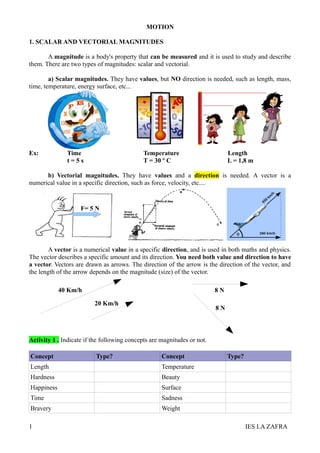
        a) Scalar magnitudes. They have values, but NO direction is needed, such as length, mass,
time, temperature, energy surface, etc...


Ex:            Time                          Temperature                      Length
               t=5s                          T = 30 º C                       L = 1,8 m

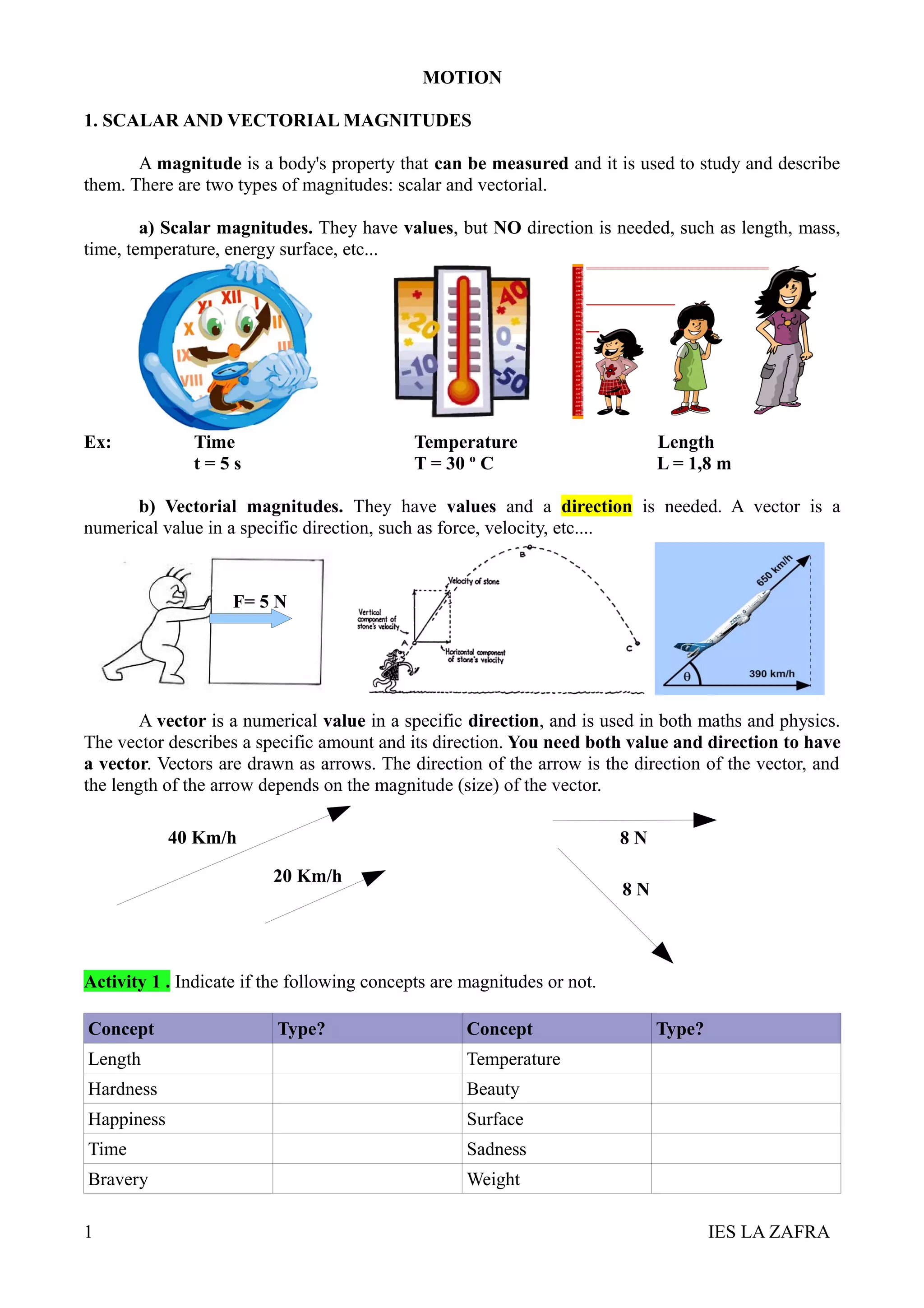
      b) Vectorial magnitudes. They have values and a direction is needed. A vector is a
numerical value in a specific direction, such as force, velocity, etc....


                    F= 5 N


        A vector is a numerical value in a specific direction, and is used in both maths and physics.
The vector describes a specific amount and its direction. You need both value and direction to have
a vector. Vectors are drawn as arrows. The direction of the arrow is the direction of the vector, and
the length of the arrow depends on the magnitude (size) of the vector.

            40 Km/h                                                      8N

                         20 Km/h
                                                                         8N


Activity 1 . Indicate if the following concepts are magnitudes or not.

Concept                   Type?                     Concept                   Type?
Length                                              Temperature
Hardness                                            Beauty
Happiness                                           Surface
Time                                                Sadness
Bravery                                             Weight

1                                                                                     IES LA ZAFRA
Activity 2 . Indicate if the following magnitudes are scalar or vectorial.
Magnitude                   Type ?                  Magnitude                Type ?
Length                                               Acceleration
Surface                                              Temperature
Force                                                Velocity
Time                                                 Mass


Activity 3 . Indicate if the following vectors are equal or not:
                                                   4N
          4N

     2N
                                              4N                              7N
            4N


2. FRAME OF REFERENCE
       Motion is one of the key topics in physics. Everything in the universe moves. Don't forget
that even if you appear to be standing still, the Earth is moving around the Sun, and the Sun is
moving around our galaxy. The movement never stops. Motion is one part of what physicists call
mechanics.

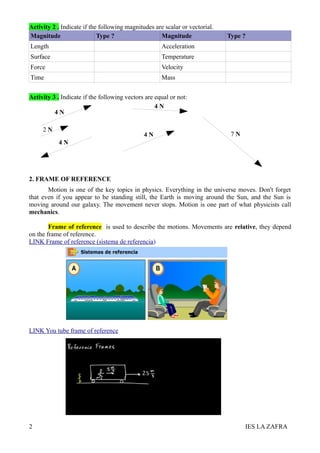
        Frame of reference is used to describe the motions. Movements are relative, they depend
on the frame of reference.
LINK Frame of reference (sistema de referencia)


LINK You tube frame of reference


2                                                                                  IES LA ZAFRA
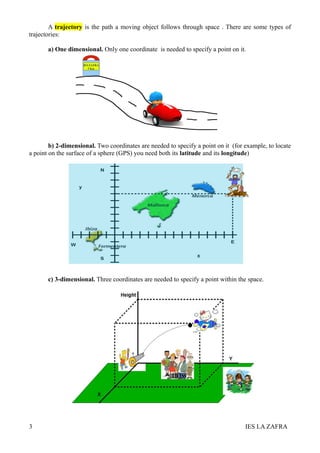
A trajectory is the path a moving object follows through space . There are some types of
trajectories:

       a) One dimensional. Only one coordinate is needed to specify a point on it.


        b) 2-dimensional. Two coordinates are needed to specify a point on it (for example, to locate
a point on the surface of a sphere (GPS) you need both its latitude and its longitude)


       c) 3-dimensional. Three coordinates are needed to specify a point within the space.


3                                                                                  IES LA ZAFRA
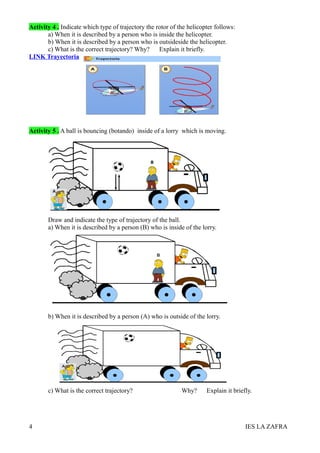
Activity 4 . Indicate which type of trajectory the rotor of the helicopter follows:
       a) When it is described by a person who is inside the helicopter.
       b) When it is described by a person who is outsideside the helicopter.
       c) What is the correct trajectory? Why?      Explain it briefly.
LINK Trayectoria


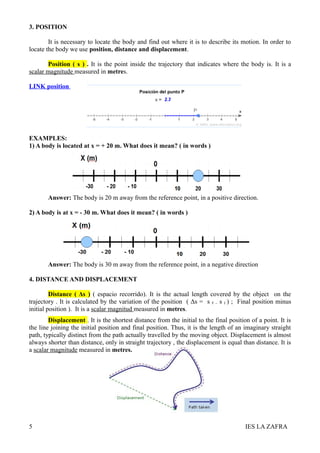
Activity 5 . A ball is bouncing (botando) inside of a lorry which is moving.


       Draw and indicate the type of trajectory of the ball.
       a) When it is described by a person (B) who is inside of the lorry.


       b) When it is described by a person (A) who is outside of the lorry.


       c) What is the correct trajectory?                    Why?      Explain it briefly.


4                                                                                      IES LA ZAFRA
3. POSITION

        It is necessary to locate the body and find out where it is to describe its motion. In order to
locate the body we use position, distance and displacement.

       Position ( s ) . It is the point inside the trajectory that indicates where the body is. It is a
scalar magnitude measured in metres.

LINK position


EXAMPLES:
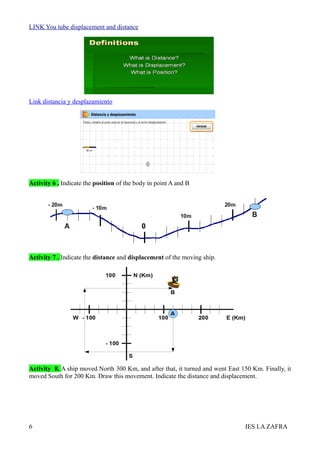
1) A body is located at x = + 20 m. What does it mean? ( in words )


       Answer: The body is 20 m away from the reference point, in a positive direction.

2) A body is at x = - 30 m. What does it mean? ( in words )


       Answer: The body is 30 m away from the reference point, in a negative direction

4. DISTANCE AND DISPLACEMENT

         Distance ( Δs ) ( espacio recorrido). It is the actual length covered by the object on the
trajectory . It is calculated by the variation of the position ( Δs = s F – s I ) ; Final position minus
initial position ). It is a scalar magnitud measured in metres.
        Displacement . It is the shortest distance from the initial to the final position of a point. It is
the line joining the initial position and final position. Thus, it is the length of an imaginary straight
path, typically distinct from the path actually travelled by the moving object. Displacement is almost
always shorter than distance, only in straight trajectory , the displacement is equal than distance. It is
a scalar magnitude measured in metres.


5                                                                                       IES LA ZAFRA
LINK You tube displacement and distance


Link distancia y desplazamiento


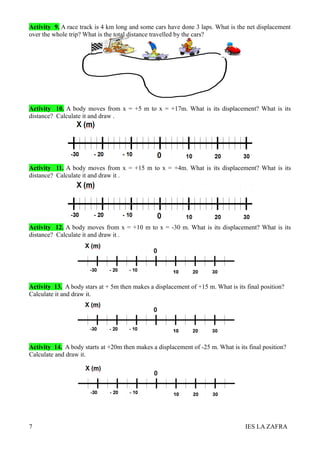
Activity 6 . Indicate the position of the body in point A and B


Activity 7 . Indicate the distance and displacement of the moving ship.


Activity 8. A ship moved North 300 Km, and after that, it turned and went East 150 Km. Finally, it
moved South for 200 Km. Draw this movement. Indicate the distance and displacement.


6                                                                               IES LA ZAFRA
Activity 9. A race track is 4 km long and some cars have done 3 laps. What is the net displacement
over the whole trip? What is the total distance travelled by the cars?


Activity 10. A body moves from x = +5 m to x = +17m. What is its displacement? What is its
distance? Calculate it and draw .


Activity 11. A body moves from x = +15 m to x = +4m. What is its displacement? What is its
distance? Calculate it and draw it .


Activity 12. A body moves from x = +10 m to x = -30 m. What is its displacement? What is its
distance? Calculate it and draw it .


Activity 13. A body stars at + 5m then makes a displacement of +15 m. What is its final position?
Calculate it and draw it.


Activity 14. A body starts at +20m then makes a displacement of -25 m. What is its final position?
Calculate and draw it.


7                                                                                 IES LA ZAFRA
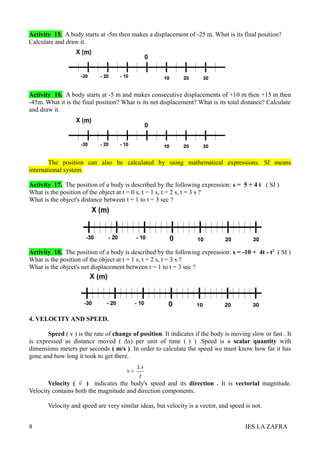
Activity 15. A body starts at -5m then makes a displacement of -25 m. What is its final position?
Calculate and draw it.


Activity 16. A body starts at -5 m and makes consecutive displacements of +10 m then +15 m then
-45m. What it is the final position? What is its net displacement? What is its total distance? Calculate
and draw it.


        The position can also be calculated by using mathematical expressions. SI means
international system.

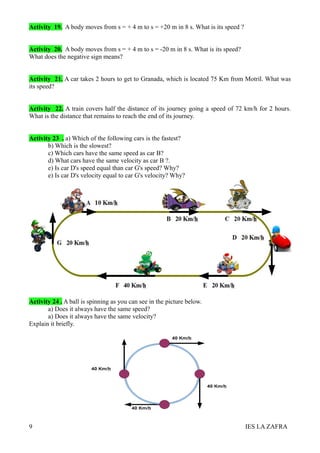
Activity 17. The position of a body is described by the following expression: s = 5 + 4 t ( SI )
What is the position of the object at t = 0 s, t = 1 s, t = 2 s, t = 3 s ?
What is the object's distance between t = 1 to t = 3 sec ?


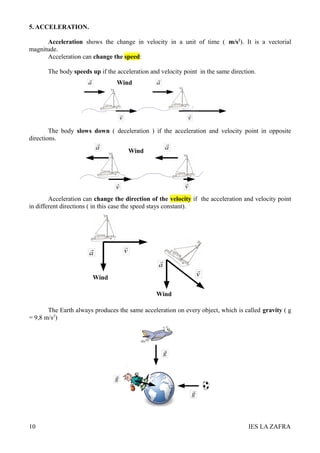
Activity 18. The position of a body is described by the following expression: s = -10 + 4t - t2 ( SI )
What is the position of the object at t = 1 s, t = 2 s, t = 3 s ?
What is the object's net displacement between t = 1 to t = 3 sec ?


4. VELOCITY AND SPEED.

       Speed ( v ) is the rate of change of position. It indicates if the body is moving slow or fast . It
is expressed as distance moved ( Δs) per unit of time ( t ) .Speed is a scalar quantity with
dimensions meters per seconds ( m/s ). In order to calculate the speed we must know how far it has
gone and how long it took to get there.
                                         ∆s
                                       v=
                                          t
                   
       Velocity ( v ) indicates the body's speed and its direction . It is vectorial magnitude.
Velocity contains both the magnitude and direction components.

       Velocity and speed are very similar ideas, but velocity is a vector, and speed is not.


8                                                                                      IES LA ZAFRA
Activity 19. A body moves from s = + 4 m to s = +20 m in 8 s. What is its speed ?


Activity 20. A body moves from s = + 4 m to s = -20 m in 8 s. What is its speed?
What does the negative sign means?


Activity 21. A car takes 2 hours to get to Granada, which is located 75 Km from Motril. What was
its speed?


Activity 22. A train covers half the distance of its journey going a speed of 72 km/h for 2 hours.
What is the distance that remains to reach the end of its journey.


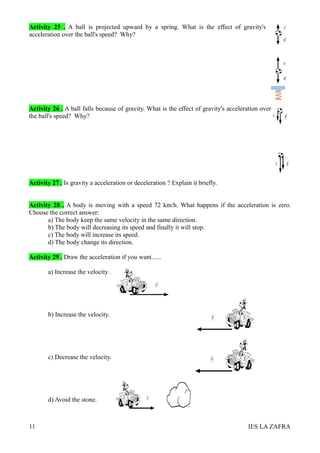
Activity 23 . a) Which of the following cars is the fastest?
       b) Which is the slowest?
       c) Which cars have the same speed as car B?
       d) What cars have the same velocity as car B ?.
       e) Is car D's speed equal than car G's speed? Why?
       e) Is car D's velocity equal to car G's velocity? Why?


a) Calculate the amount of energy that requires 30 kg of water to increase its temperature from 10 ° C
to 40 ° C. Indicate the type of energy received.


Over the years, scientists have discovered several rules or laws that explain motion and the causes of
changes in motion. There are also special laws when you reach the speed of light or when physicists
look at very small things like atoms.


Activity 24 . A ball is spinning as you can see in the picture below.
       a) Does it always have the same speed?
       a) Does it always have the same velocity?
Explain it briefly.


9                                                                                   IES LA ZAFRA
5. ACCELERATION.

      Acceleration shows the change in velocity in a unit of time ( m/s2). It is a vectorial
magnitude.
      Acceleration can change the speed:

       The body speeds up if the acceleration and velocity point in the same direction.
                                 Wind


        The body slows down ( deceleration ) if the acceleration and velocity point in opposite
directions.
                                     Wind


        Acceleration can change the direction of the velocity if the acceleration and velocity point
in different directions ( in this case the speed stays constant).


                        Wind

                                                Wind

       The Earth always produces the same acceleration on every object, which is called gravity ( g
= 9,8 m/s2)


10                                                                                  IES LA ZAFRA
Activity 25 . A ball is projected upward by a spring. What is the effect of gravity's
acceleration over the ball's speed? Why?


Activity 26 . A ball falls because of gravity. What is the effect of gravity's acceleration over
the ball's speed? Why?


Activity 27 . Is gravity a acceleration or deceleration ? Explain it briefly.


Activity 28 . A body is moving with a speed 72 km/h. What happens if the acceleration is zero.
Choose the correct answer:
       a) The body keep the same velocity in the same direction.
       b) The body will decreasing its speed and finally it will stop.
       c) The body will increase its speed.
       d) The body change its direction.

Activity 29 . Draw the acceleration if you want......

       a) Increase the velocity .


       b) Increase the velocity.


       c) Decrease the velocity.


       d) Avoid the stone.


11                                                                                    IES LA ZAFRA
LINKS:
a) http://www.physics4kids.com/files/motion_intro.html
b) http://hsphysicslab.blogspot.com/search/label/kinematics
c) http://zonalandeducation.com/mstm/physics/mechanics/kinematics/1DMotion/1DMotion1.html
d) http://www.slideshare.net/ericvincent/kinematics-review-answers
e) http://library.thinkquest.org/10796/ch3/ch3.htm


12                                                                           IES LA ZAFRA
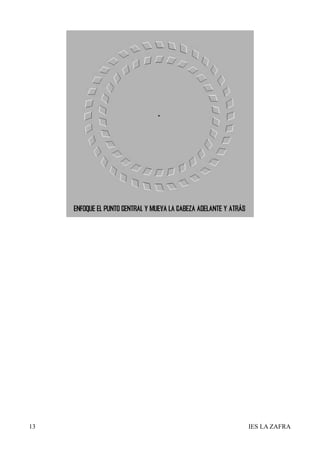
13   IES LA ZAFRA
A stone is released from a height of 20 m and allowed to fall in a straight line towards the ground.
Ignoring air resistance, calculate


14                                                                                 IES LA ZAFRA

Motion

  • 1.
    MOTION 1. SCALAR ANDVECTORIAL MAGNITUDES A magnitude is a body's property that can be measured and it is used to study and describe them. There are two types of magnitudes: scalar and vectorial. a) Scalar magnitudes. They have values, but NO direction is needed, such as length, mass, time, temperature, energy surface, etc... Ex: Time Temperature Length t=5s T = 30 º C L = 1,8 m b) Vectorial magnitudes. They have values and a direction is needed. A vector is a numerical value in a specific direction, such as force, velocity, etc.... F= 5 N A vector is a numerical value in a specific direction, and is used in both maths and physics. The vector describes a specific amount and its direction. You need both value and direction to have a vector. Vectors are drawn as arrows. The direction of the arrow is the direction of the vector, and the length of the arrow depends on the magnitude (size) of the vector. 40 Km/h 8N 20 Km/h 8N Activity 1 . Indicate if the following concepts are magnitudes or not. Concept Type? Concept Type? Length Temperature Hardness Beauty Happiness Surface Time Sadness Bravery Weight 1 IES LA ZAFRA
  • 2.
    Activity 2 .Indicate if the following magnitudes are scalar or vectorial. Magnitude Type ? Magnitude Type ? Length Acceleration Surface Temperature Force Velocity Time Mass Activity 3 . Indicate if the following vectors are equal or not: 4N 4N 2N 4N 7N 4N 2. FRAME OF REFERENCE Motion is one of the key topics in physics. Everything in the universe moves. Don't forget that even if you appear to be standing still, the Earth is moving around the Sun, and the Sun is moving around our galaxy. The movement never stops. Motion is one part of what physicists call mechanics. Frame of reference is used to describe the motions. Movements are relative, they depend on the frame of reference. LINK Frame of reference (sistema de referencia) LINK You tube frame of reference 2 IES LA ZAFRA
  • 3.
    A trajectory isthe path a moving object follows through space . There are some types of trajectories: a) One dimensional. Only one coordinate is needed to specify a point on it. b) 2-dimensional. Two coordinates are needed to specify a point on it (for example, to locate a point on the surface of a sphere (GPS) you need both its latitude and its longitude) c) 3-dimensional. Three coordinates are needed to specify a point within the space. 3 IES LA ZAFRA
  • 4.
    Activity 4 .Indicate which type of trajectory the rotor of the helicopter follows: a) When it is described by a person who is inside the helicopter. b) When it is described by a person who is outsideside the helicopter. c) What is the correct trajectory? Why? Explain it briefly. LINK Trayectoria Activity 5 . A ball is bouncing (botando) inside of a lorry which is moving. Draw and indicate the type of trajectory of the ball. a) When it is described by a person (B) who is inside of the lorry. b) When it is described by a person (A) who is outside of the lorry. c) What is the correct trajectory? Why? Explain it briefly. 4 IES LA ZAFRA
  • 5.
    3. POSITION It is necessary to locate the body and find out where it is to describe its motion. In order to locate the body we use position, distance and displacement. Position ( s ) . It is the point inside the trajectory that indicates where the body is. It is a scalar magnitude measured in metres. LINK position EXAMPLES: 1) A body is located at x = + 20 m. What does it mean? ( in words ) Answer: The body is 20 m away from the reference point, in a positive direction. 2) A body is at x = - 30 m. What does it mean? ( in words ) Answer: The body is 30 m away from the reference point, in a negative direction 4. DISTANCE AND DISPLACEMENT Distance ( Δs ) ( espacio recorrido). It is the actual length covered by the object on the trajectory . It is calculated by the variation of the position ( Δs = s F – s I ) ; Final position minus initial position ). It is a scalar magnitud measured in metres. Displacement . It is the shortest distance from the initial to the final position of a point. It is the line joining the initial position and final position. Thus, it is the length of an imaginary straight path, typically distinct from the path actually travelled by the moving object. Displacement is almost always shorter than distance, only in straight trajectory , the displacement is equal than distance. It is a scalar magnitude measured in metres. 5 IES LA ZAFRA
  • 6.
    LINK You tubedisplacement and distance Link distancia y desplazamiento Activity 6 . Indicate the position of the body in point A and B Activity 7 . Indicate the distance and displacement of the moving ship. Activity 8. A ship moved North 300 Km, and after that, it turned and went East 150 Km. Finally, it moved South for 200 Km. Draw this movement. Indicate the distance and displacement. 6 IES LA ZAFRA
  • 7.
    Activity 9. Arace track is 4 km long and some cars have done 3 laps. What is the net displacement over the whole trip? What is the total distance travelled by the cars? Activity 10. A body moves from x = +5 m to x = +17m. What is its displacement? What is its distance? Calculate it and draw . Activity 11. A body moves from x = +15 m to x = +4m. What is its displacement? What is its distance? Calculate it and draw it . Activity 12. A body moves from x = +10 m to x = -30 m. What is its displacement? What is its distance? Calculate it and draw it . Activity 13. A body stars at + 5m then makes a displacement of +15 m. What is its final position? Calculate it and draw it. Activity 14. A body starts at +20m then makes a displacement of -25 m. What is its final position? Calculate and draw it. 7 IES LA ZAFRA
  • 8.
    Activity 15. Abody starts at -5m then makes a displacement of -25 m. What is its final position? Calculate and draw it. Activity 16. A body starts at -5 m and makes consecutive displacements of +10 m then +15 m then -45m. What it is the final position? What is its net displacement? What is its total distance? Calculate and draw it. The position can also be calculated by using mathematical expressions. SI means international system. Activity 17. The position of a body is described by the following expression: s = 5 + 4 t ( SI ) What is the position of the object at t = 0 s, t = 1 s, t = 2 s, t = 3 s ? What is the object's distance between t = 1 to t = 3 sec ? Activity 18. The position of a body is described by the following expression: s = -10 + 4t - t2 ( SI ) What is the position of the object at t = 1 s, t = 2 s, t = 3 s ? What is the object's net displacement between t = 1 to t = 3 sec ? 4. VELOCITY AND SPEED. Speed ( v ) is the rate of change of position. It indicates if the body is moving slow or fast . It is expressed as distance moved ( Δs) per unit of time ( t ) .Speed is a scalar quantity with dimensions meters per seconds ( m/s ). In order to calculate the speed we must know how far it has gone and how long it took to get there. ∆s v= t  Velocity ( v ) indicates the body's speed and its direction . It is vectorial magnitude. Velocity contains both the magnitude and direction components. Velocity and speed are very similar ideas, but velocity is a vector, and speed is not. 8 IES LA ZAFRA
  • 9.
    Activity 19. Abody moves from s = + 4 m to s = +20 m in 8 s. What is its speed ? Activity 20. A body moves from s = + 4 m to s = -20 m in 8 s. What is its speed? What does the negative sign means? Activity 21. A car takes 2 hours to get to Granada, which is located 75 Km from Motril. What was its speed? Activity 22. A train covers half the distance of its journey going a speed of 72 km/h for 2 hours. What is the distance that remains to reach the end of its journey. Activity 23 . a) Which of the following cars is the fastest? b) Which is the slowest? c) Which cars have the same speed as car B? d) What cars have the same velocity as car B ?. e) Is car D's speed equal than car G's speed? Why? e) Is car D's velocity equal to car G's velocity? Why? a) Calculate the amount of energy that requires 30 kg of water to increase its temperature from 10 ° C to 40 ° C. Indicate the type of energy received. Over the years, scientists have discovered several rules or laws that explain motion and the causes of changes in motion. There are also special laws when you reach the speed of light or when physicists look at very small things like atoms. Activity 24 . A ball is spinning as you can see in the picture below. a) Does it always have the same speed? a) Does it always have the same velocity? Explain it briefly. 9 IES LA ZAFRA
  • 10.
    5. ACCELERATION. Acceleration shows the change in velocity in a unit of time ( m/s2). It is a vectorial magnitude. Acceleration can change the speed: The body speeds up if the acceleration and velocity point in the same direction. Wind The body slows down ( deceleration ) if the acceleration and velocity point in opposite directions. Wind Acceleration can change the direction of the velocity if the acceleration and velocity point in different directions ( in this case the speed stays constant). Wind Wind The Earth always produces the same acceleration on every object, which is called gravity ( g = 9,8 m/s2) 10 IES LA ZAFRA
  • 11.
    Activity 25 .A ball is projected upward by a spring. What is the effect of gravity's acceleration over the ball's speed? Why? Activity 26 . A ball falls because of gravity. What is the effect of gravity's acceleration over the ball's speed? Why? Activity 27 . Is gravity a acceleration or deceleration ? Explain it briefly. Activity 28 . A body is moving with a speed 72 km/h. What happens if the acceleration is zero. Choose the correct answer: a) The body keep the same velocity in the same direction. b) The body will decreasing its speed and finally it will stop. c) The body will increase its speed. d) The body change its direction. Activity 29 . Draw the acceleration if you want...... a) Increase the velocity . b) Increase the velocity. c) Decrease the velocity. d) Avoid the stone. 11 IES LA ZAFRA
  • 12.
    LINKS: a) http://www.physics4kids.com/files/motion_intro.html b) http://hsphysicslab.blogspot.com/search/label/kinematics c)http://zonalandeducation.com/mstm/physics/mechanics/kinematics/1DMotion/1DMotion1.html d) http://www.slideshare.net/ericvincent/kinematics-review-answers e) http://library.thinkquest.org/10796/ch3/ch3.htm 12 IES LA ZAFRA
  • 13.
    13 IES LA ZAFRA
  • 14.
    A stone isreleased from a height of 20 m and allowed to fall in a straight line towards the ground. Ignoring air resistance, calculate 14 IES LA ZAFRA