Copyright EC-Council 2020. All Rights Reserved.​
Certified Application
Security Engineer (CASE)
Most Common Application Level Attacks
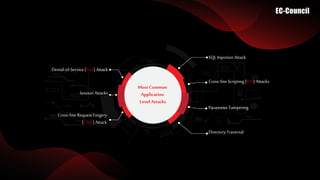
SQL Injection Attack
Cross-Site Scripting (XSS) Attacks
Parameter Tampering
DirectoryTraversal
Denial-of-Service (DoS) Attack
Session Attacks
Cross-Site Request Forgery
(CSRF) Attack
Most Common
Application
Level Attacks
SQL Injection Attack:
Most of the prominent data breaches that occur
today have been the outcomes of an SQL
Injection attack, which has led to regulatory penalties
and reputational damages. An effective SQL
Injection attack can lead to unapproved access to
delicate data, including credit card information, PINs,
or other private information regarding a customer.
Cross-Site Scripting
(XSS) Attack:
This attack disrupts the interaction between users and
vulnerable applications. It is based on client-side code
injection. The attacker inserts malicious scripts into a
legit application to alter its original intention.
Web parameter tampering attack is based on the
manipulation of parameters exchanged between
client and server in order to modify application data,
such as user credentials and permissions, price and
quantity of products, etc.
Parameter Tampering
File path traversal is also known as directory traversal or
backtracking. The primary objective of this web application
attack is to access files and directories which are not placed
under the ‘root directory’.
Directory Traversal
It is a type of cyberattack that occurs when an attacker
seeks to render a computer or other networks inaccessible
to its authorized users by momentarily or permanently
interrupting the normal operations of a host linked to the
Internet.
Denial-of-Service (DoS) Attack
DoS
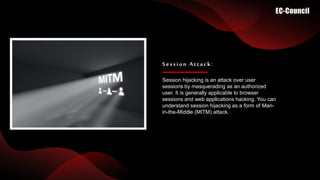
Session hijacking is an attack over user
sessions by masquerading as an authorized
user. It is generally applicable to browser
sessions and web applications hacking. You can
understand session hijacking as a form of Man-
in-the-Middle (MITM) attack.
Session Attack:
Cross site request forgery — also known as CSRF or
XSRF — is one of the web-related security threats on
the OWASP top-ten list. The main principle behind a
CSRF attack is exploitation of a site’s trust for a
particular user, clandestinely utilizing the user’s
authentication data.
Cross-Site Request forgery ( CSRF) Attack:
To Learn More,
Visit -
https://www.eccouncil.org/programs/certified-application-security-engineer-case/
THANK YOU!

Most Common Application Level Attacks

  • 1.
    Copyright EC-Council 2020.All Rights Reserved.​ Certified Application Security Engineer (CASE) Most Common Application Level Attacks
  • 2.
    SQL Injection Attack Cross-SiteScripting (XSS) Attacks Parameter Tampering DirectoryTraversal Denial-of-Service (DoS) Attack Session Attacks Cross-Site Request Forgery (CSRF) Attack Most Common Application Level Attacks
  • 3.
    SQL Injection Attack: Mostof the prominent data breaches that occur today have been the outcomes of an SQL Injection attack, which has led to regulatory penalties and reputational damages. An effective SQL Injection attack can lead to unapproved access to delicate data, including credit card information, PINs, or other private information regarding a customer.
  • 4.
    Cross-Site Scripting (XSS) Attack: Thisattack disrupts the interaction between users and vulnerable applications. It is based on client-side code injection. The attacker inserts malicious scripts into a legit application to alter its original intention.
  • 5.
    Web parameter tamperingattack is based on the manipulation of parameters exchanged between client and server in order to modify application data, such as user credentials and permissions, price and quantity of products, etc. Parameter Tampering
  • 6.
    File path traversalis also known as directory traversal or backtracking. The primary objective of this web application attack is to access files and directories which are not placed under the ‘root directory’. Directory Traversal
  • 7.
    It is atype of cyberattack that occurs when an attacker seeks to render a computer or other networks inaccessible to its authorized users by momentarily or permanently interrupting the normal operations of a host linked to the Internet. Denial-of-Service (DoS) Attack DoS
  • 8.
    Session hijacking isan attack over user sessions by masquerading as an authorized user. It is generally applicable to browser sessions and web applications hacking. You can understand session hijacking as a form of Man- in-the-Middle (MITM) attack. Session Attack:
  • 9.
    Cross site requestforgery — also known as CSRF or XSRF — is one of the web-related security threats on the OWASP top-ten list. The main principle behind a CSRF attack is exploitation of a site’s trust for a particular user, clandestinely utilizing the user’s authentication data. Cross-Site Request forgery ( CSRF) Attack:
  • 10.
    To Learn More, Visit- https://www.eccouncil.org/programs/certified-application-security-engineer-case/
  • 11.