Archaeal
Cell Structure
1
4
Copyright © McGraw-Hill Global Education Holdings, LLC. Permission required for reproduction or display.
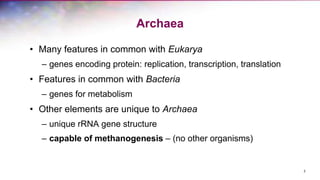
Archaea
• Many features in common with Eukarya
– genes encoding protein: replication, transcription, translation
• Features in common with Bacteria
– genes for metabolism
• Other elements are unique to Archaea
– unique rRNA gene structure
– capable of methanogenesis – (no other organisms)
2
Archaea
• Highly diverse with respect to morphology, physiology,
reproduction, and ecology
• Best known for growth in anaerobic, hypersaline, pH
extremes, and high-temperature habitats
• Also found in marine arctic temperature and tropical waters
3
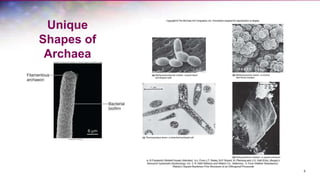
Archaeal size, shape,
arrangement
• Much like bacteria, cocci and rods are common shapes
• Other shapes can also exist
– no spirochetes or mycelial forms yet
– branched/flat shapes
• Sizes vary (typically 1-2 x 1-5 μm for rods, 1-5 μm in diameter for
cocci)
• Smallest observed is 0.2 μm in diameter
• Largest is a multicellular form that can reach 30 mm in length
4
Unique
Shapes of
Archaea
5
6
7
Archaeal Cell Envelopes
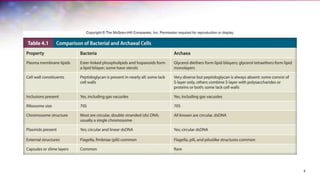
• Differ from bacterial envelopes in the
molecular makeup and organization
– S layer may be only component outside
plasma membrane
– some lack cell wall
– capsules and slime layers are rare
8
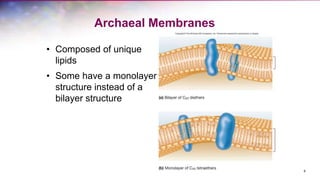
Archaeal Membranes
• Composed of unique
lipids
• Some have a monolayer
structure instead of a
bilayer structure
9
Archaea
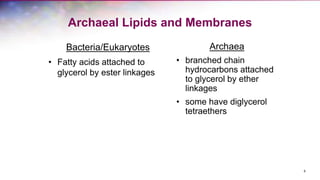
• branched chain
hydrocarbons attached
to glycerol by ether
linkages
• some have diglycerol
tetraethers
Archaeal Lipids and Membranes
Bacteria/Eukaryotes
• Fatty acids attached to
glycerol by ester linkages
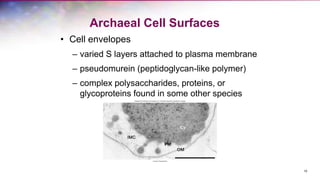
Archaeal Cell Surfaces
• Cell envelopes
– varied S layers attached to plasma membrane
– pseudomurein (peptidoglycan-like polymer)
– complex polysaccharides, proteins, or
glycoproteins found in some other species
10
11
Archaeal Cell Walls Differ from
Bacterial Cell Walls
• Lack peptidoglycan
• Most common cell wall is S layer
• May have protein sheath external to
S layer
• S layer may be outside membrane and
separated by pseudomurein
• Pseudomurein may be outermost layer –
similar to Gram-positive microorganisms
Archaeal cells and nutrient uptake
• Archaeal cells use many of the same mechanisms for nutrient
uptake exhibited in bacteria
– facilitated diffusion
– active transport (primary and secondary)
12
Archaeal vs. bacterial cytoplasm
• Very similar – lack of membrane-enclosed
organelles
• May contain inclusion bodies (e.g. gas
vesicles for buoyancy control)
• All the usual components
– ribosomes
– nucleoid region
– inclusion bodies
• Some structures may be different,
however… 13
14
Ribosomes
• Complex structures, sites of protein synthesis
– consisting of protein/RNA
• Entire ribosome
– bacterial/archaeal ribosome = 70S
– eukaryotic (80S) S = Svedburg unit
• Bacterial and archaeal ribosomal RNA
– 16S small subunit
– 23S and 5S in large subunit
– archaea have additional 5.8S (also seen in
eukaryotic large subunit)
• Proteins vary
– archaea more similar to eukarya than to bacteria
15
The Nucleoid
• Irregularly shaped region in bacteria and
archaea
• Usually not membrane bound (few
exceptions)
• Location of chromosome and associated
proteins
• Usually 1
• Supercoiling and nucleoid proteins
Archaeal external structures:
• Pili
– not well understood as of yet
– some composed of pilin protein and
homologous to bacterial pili proteins
– may be involved in archaeal adhesion
mechanisms
16
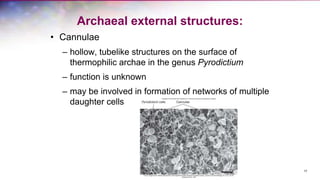
Archaeal external structures:
• Cannulae
– hollow, tubelike structures on the surface of
thermophilic archae in the genus Pyrodictium
– function is unknown
– may be involved in formation of networks of multiple
daughter cells
17
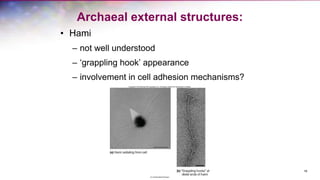
Archaeal external structures:
• Hami
– not well understood
– ‘grappling hook’ appearance
– involvement in cell adhesion mechanisms?
18
19
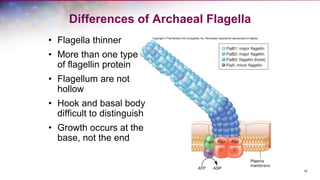
Differences of Archaeal Flagella
• Flagella thinner
• More than one type
of flagellin protein
• Flagellum are not
hollow
• Hook and basal body
difficult to distinguish
• Growth occurs at the
base, not the end
20

4. Archeal Cell Structure (Prescott).ppt

  • 1.
    Archaeal Cell Structure 1 4 Copyright ©McGraw-Hill Global Education Holdings, LLC. Permission required for reproduction or display.
  • 2.
    Archaea • Many featuresin common with Eukarya – genes encoding protein: replication, transcription, translation • Features in common with Bacteria – genes for metabolism • Other elements are unique to Archaea – unique rRNA gene structure – capable of methanogenesis – (no other organisms) 2
  • 3.
    Archaea • Highly diversewith respect to morphology, physiology, reproduction, and ecology • Best known for growth in anaerobic, hypersaline, pH extremes, and high-temperature habitats • Also found in marine arctic temperature and tropical waters 3
  • 4.
    Archaeal size, shape, arrangement •Much like bacteria, cocci and rods are common shapes • Other shapes can also exist – no spirochetes or mycelial forms yet – branched/flat shapes • Sizes vary (typically 1-2 x 1-5 μm for rods, 1-5 μm in diameter for cocci) • Smallest observed is 0.2 μm in diameter • Largest is a multicellular form that can reach 30 mm in length 4
  • 5.
  • 6.
  • 7.
    7 Archaeal Cell Envelopes •Differ from bacterial envelopes in the molecular makeup and organization – S layer may be only component outside plasma membrane – some lack cell wall – capsules and slime layers are rare
  • 8.
    8 Archaeal Membranes • Composedof unique lipids • Some have a monolayer structure instead of a bilayer structure
  • 9.
    9 Archaea • branched chain hydrocarbonsattached to glycerol by ether linkages • some have diglycerol tetraethers Archaeal Lipids and Membranes Bacteria/Eukaryotes • Fatty acids attached to glycerol by ester linkages
  • 10.
    Archaeal Cell Surfaces •Cell envelopes – varied S layers attached to plasma membrane – pseudomurein (peptidoglycan-like polymer) – complex polysaccharides, proteins, or glycoproteins found in some other species 10
  • 11.
    11 Archaeal Cell WallsDiffer from Bacterial Cell Walls • Lack peptidoglycan • Most common cell wall is S layer • May have protein sheath external to S layer • S layer may be outside membrane and separated by pseudomurein • Pseudomurein may be outermost layer – similar to Gram-positive microorganisms
  • 12.
    Archaeal cells andnutrient uptake • Archaeal cells use many of the same mechanisms for nutrient uptake exhibited in bacteria – facilitated diffusion – active transport (primary and secondary) 12
  • 13.
    Archaeal vs. bacterialcytoplasm • Very similar – lack of membrane-enclosed organelles • May contain inclusion bodies (e.g. gas vesicles for buoyancy control) • All the usual components – ribosomes – nucleoid region – inclusion bodies • Some structures may be different, however… 13
  • 14.
    14 Ribosomes • Complex structures,sites of protein synthesis – consisting of protein/RNA • Entire ribosome – bacterial/archaeal ribosome = 70S – eukaryotic (80S) S = Svedburg unit • Bacterial and archaeal ribosomal RNA – 16S small subunit – 23S and 5S in large subunit – archaea have additional 5.8S (also seen in eukaryotic large subunit) • Proteins vary – archaea more similar to eukarya than to bacteria
  • 15.
    15 The Nucleoid • Irregularlyshaped region in bacteria and archaea • Usually not membrane bound (few exceptions) • Location of chromosome and associated proteins • Usually 1 • Supercoiling and nucleoid proteins
  • 16.
    Archaeal external structures: •Pili – not well understood as of yet – some composed of pilin protein and homologous to bacterial pili proteins – may be involved in archaeal adhesion mechanisms 16
  • 17.
    Archaeal external structures: •Cannulae – hollow, tubelike structures on the surface of thermophilic archae in the genus Pyrodictium – function is unknown – may be involved in formation of networks of multiple daughter cells 17
  • 18.
    Archaeal external structures: •Hami – not well understood – ‘grappling hook’ appearance – involvement in cell adhesion mechanisms? 18
  • 19.
    19 Differences of ArchaealFlagella • Flagella thinner • More than one type of flagellin protein • Flagellum are not hollow • Hook and basal body difficult to distinguish • Growth occurs at the base, not the end
  • 20.