THE ROLE OF
OCEANS AS CARBON SINKS
Based on a survey by UNEP
SHIVANGI SINGH
M.Sc. ENVIRONMENTAL SCIENCE
VIVA COLLEGE,MUMBAI

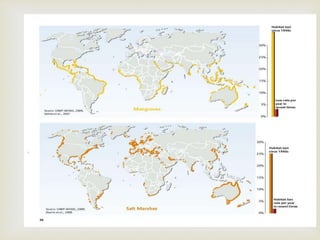
 Blue carbon is the carbon captured by the world's
oceans and coastal ecosystems.
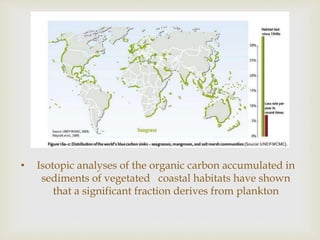
 The carbon captured by living organisms in oceans is
stored in the form of biomass and sediments from
mangroves, salt marshes and seagrasses.
WHAT IS BLUE CARBON?

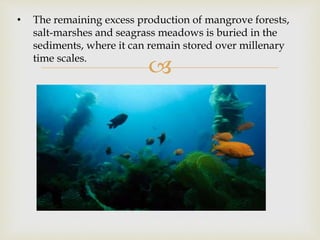
• The remaining excess production of mangrove forests,
salt-marshes and seagrass meadows is buried in the
sediments, where it can remain stored over millenary
time scales.

 Blue carbon sinks are strongly autotrophic, which
means that these ecosystems fix CO2 as organic
matter photosyntheticaly in excess of the CO2
respired back by biota thus removing CO2 from the
atmosphere.
 Some of this excess carbon is exported and subsidises
adjacent ecosystems, including open ocean and
beach ecosystems.
Blue Carbon Sink

 In addition to burying a fraction of their own
production, blue carbon sinks reduce flow, alter
turbulence and attenuate wave action, thereby
promoting sedimentation and reducing sediment
resuspension.
 The canopies of seagrass meadows trap particles
entrained in the flow, which lose momentum upon
impacting on the leaves, thereby promoting the
sedimentation of suspended material to the seafloor.
Role of Blue Carbon


• Isotopic analyses of the organic carbon accumulated in
sediments of vegetated coastal habitats have shown
that a significant fraction derives from plankton

 The capacity of vegetated coastal habitats to accumulate
materials in the seafloor is that they act as efficient
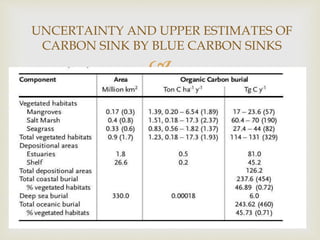
carbon sinks, globally responsible for the burial of 120–
329 Tg C yr–1, which accounts for at least half of the
lower estimate for global carbon burial in marine
sediments.
 Blue carbon sinks therefore play a major role in the
oceanic carbon cycle .

 Carbon burial in the ocean represents slightly over 10%
of the oceanic carbon sink capacity.
 This 2,000 Tg C year–1 is the carbon annually transferred
from the atmosphere to the oceans, where it is largely
stored as dissolved inorganic carbon.
 The long-term residence of anthropogenic CO2 in the
oceans is uncertain, as this carbon does not penetrate
deep enough to remain in the ocean over extended time
scales.

 Half of the anthropogenic carbon stored in ocean waters
is contained within the top 400 metres, where it may
equilibrate back to the atmosphere within a few decades,
and the amount present in the deep ocean – where it
may remain over much longer time scales – is below the
detection limit.
 Only a minute amount of the carbon taken up by the
oceans is preserved in the deep-sea sediments, where it
is effectively buried over long periods of time,
representing 6 Tg C yr–1, with a carbon burial per unit
area of seafloor 180 times lower than the rate for blue
carbon sink sediments.

 Blue carbon sinks, which cover less than 0.2% of the
seafloor, contribute about 50% (71% using maximum
estimates) of the total burial of organic carbon in ocean
sediments and therefore rank amongst the most intense
carbon sinks in the biosphere.
 Yet coastal vegetated habitats have been neglected from
accounts of the global carbon cycle and global
inventories of natural carbon sinks.
 Blue carbon sinks are built by plants and trees but the
coastal ocean also contains vast areas covered by algal
beds.

UNCERTAINTY AND UPPER ESTIMATES OF
CARBON SINK BY BLUE CARBON SINKS

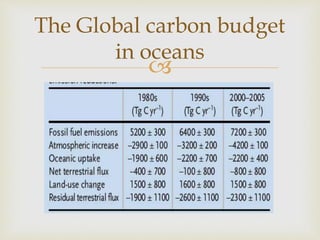
 Studies suggest that the oceans have taken up around
2,000–2,200 Tg C yr–1 over the past two decades.
 The uptake increased slightly from around an estimated
1800 in the 1980s, to 2,200 Tg C yr–1 in the 1990s and the
first half decade of the twenty-first century.
 Only a portion of this carbon is actually stored
permanently in the oceans, as much is recycled and
released back within a few decades.
Ocean carbon in the global cycle

The Global carbon budget
in oceans

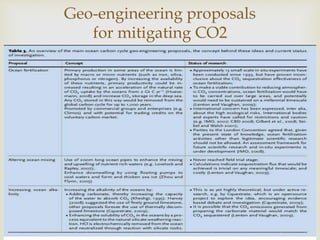
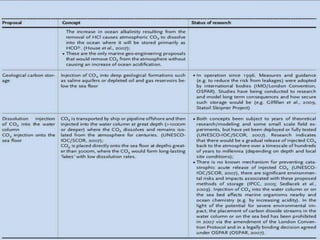
Geo-engineering proposals
for mitigating CO2


 Nellemann, Christian et al. (2009): Blue Carbon. The
Role of Healthy Oceans in Binding Carbon. A Rapid
Response Assessment. Arendal, Norway:
UNEP/GRID-Arendal
 Laffoley, Dan and Grimsditch, Gabriel (2009): The
Management of Natural Coastal Carbon Sinks.
Gland, Switzerland: IUCN
References

Thank you!

Blue carbon

  • 1.
    THE ROLE OF OCEANSAS CARBON SINKS Based on a survey by UNEP SHIVANGI SINGH M.Sc. ENVIRONMENTAL SCIENCE VIVA COLLEGE,MUMBAI
  • 2.
      Blue carbonis the carbon captured by the world's oceans and coastal ecosystems.  The carbon captured by living organisms in oceans is stored in the form of biomass and sediments from mangroves, salt marshes and seagrasses. WHAT IS BLUE CARBON?
  • 3.
     • The remainingexcess production of mangrove forests, salt-marshes and seagrass meadows is buried in the sediments, where it can remain stored over millenary time scales.
  • 4.
      Blue carbonsinks are strongly autotrophic, which means that these ecosystems fix CO2 as organic matter photosyntheticaly in excess of the CO2 respired back by biota thus removing CO2 from the atmosphere.  Some of this excess carbon is exported and subsidises adjacent ecosystems, including open ocean and beach ecosystems. Blue Carbon Sink
  • 5.
      In additionto burying a fraction of their own production, blue carbon sinks reduce flow, alter turbulence and attenuate wave action, thereby promoting sedimentation and reducing sediment resuspension.  The canopies of seagrass meadows trap particles entrained in the flow, which lose momentum upon impacting on the leaves, thereby promoting the sedimentation of suspended material to the seafloor. Role of Blue Carbon
  • 6.
  • 7.
     • Isotopic analysesof the organic carbon accumulated in sediments of vegetated coastal habitats have shown that a significant fraction derives from plankton
  • 8.
      The capacityof vegetated coastal habitats to accumulate materials in the seafloor is that they act as efficient carbon sinks, globally responsible for the burial of 120– 329 Tg C yr–1, which accounts for at least half of the lower estimate for global carbon burial in marine sediments.  Blue carbon sinks therefore play a major role in the oceanic carbon cycle .
  • 9.
      Carbon burialin the ocean represents slightly over 10% of the oceanic carbon sink capacity.  This 2,000 Tg C year–1 is the carbon annually transferred from the atmosphere to the oceans, where it is largely stored as dissolved inorganic carbon.  The long-term residence of anthropogenic CO2 in the oceans is uncertain, as this carbon does not penetrate deep enough to remain in the ocean over extended time scales.
  • 10.
      Half ofthe anthropogenic carbon stored in ocean waters is contained within the top 400 metres, where it may equilibrate back to the atmosphere within a few decades, and the amount present in the deep ocean – where it may remain over much longer time scales – is below the detection limit.  Only a minute amount of the carbon taken up by the oceans is preserved in the deep-sea sediments, where it is effectively buried over long periods of time, representing 6 Tg C yr–1, with a carbon burial per unit area of seafloor 180 times lower than the rate for blue carbon sink sediments.
  • 11.
      Blue carbonsinks, which cover less than 0.2% of the seafloor, contribute about 50% (71% using maximum estimates) of the total burial of organic carbon in ocean sediments and therefore rank amongst the most intense carbon sinks in the biosphere.  Yet coastal vegetated habitats have been neglected from accounts of the global carbon cycle and global inventories of natural carbon sinks.  Blue carbon sinks are built by plants and trees but the coastal ocean also contains vast areas covered by algal beds.
  • 12.
     UNCERTAINTY AND UPPERESTIMATES OF CARBON SINK BY BLUE CARBON SINKS
  • 13.
      Studies suggestthat the oceans have taken up around 2,000–2,200 Tg C yr–1 over the past two decades.  The uptake increased slightly from around an estimated 1800 in the 1980s, to 2,200 Tg C yr–1 in the 1990s and the first half decade of the twenty-first century.  Only a portion of this carbon is actually stored permanently in the oceans, as much is recycled and released back within a few decades. Ocean carbon in the global cycle
  • 14.
     The Global carbonbudget in oceans
  • 15.
  • 16.
  • 17.
      Nellemann, Christianet al. (2009): Blue Carbon. The Role of Healthy Oceans in Binding Carbon. A Rapid Response Assessment. Arendal, Norway: UNEP/GRID-Arendal  Laffoley, Dan and Grimsditch, Gabriel (2009): The Management of Natural Coastal Carbon Sinks. Gland, Switzerland: IUCN References
  • 18.