Tipologi Morpologi
Group 2
 Agustina Lestary
 Ninuk Krismanti
 Peny Kurniasih
 Rezqan Noor Farid
Discussion
 Introduction
 Types of Languages
 Morphological Operations
 Words Meaning
Introduction
What is “Morphology”?
What is “Typology”?
What is “Morphological Typology”?
Morphology Across Language.
Morphology
 How language users understand complex
 words and how they create new ones.

 The study of the patterning of morphemes
 within a word and how morphemes
 combine to form new complex words.
Typology
 Typology is the classification of languages
 on the basis of shared formal characteristics.

 The ultimate goals of typology are to
 ascertain the ways in which languages are
 similar in structure and to determine just
 how different human languages can be.
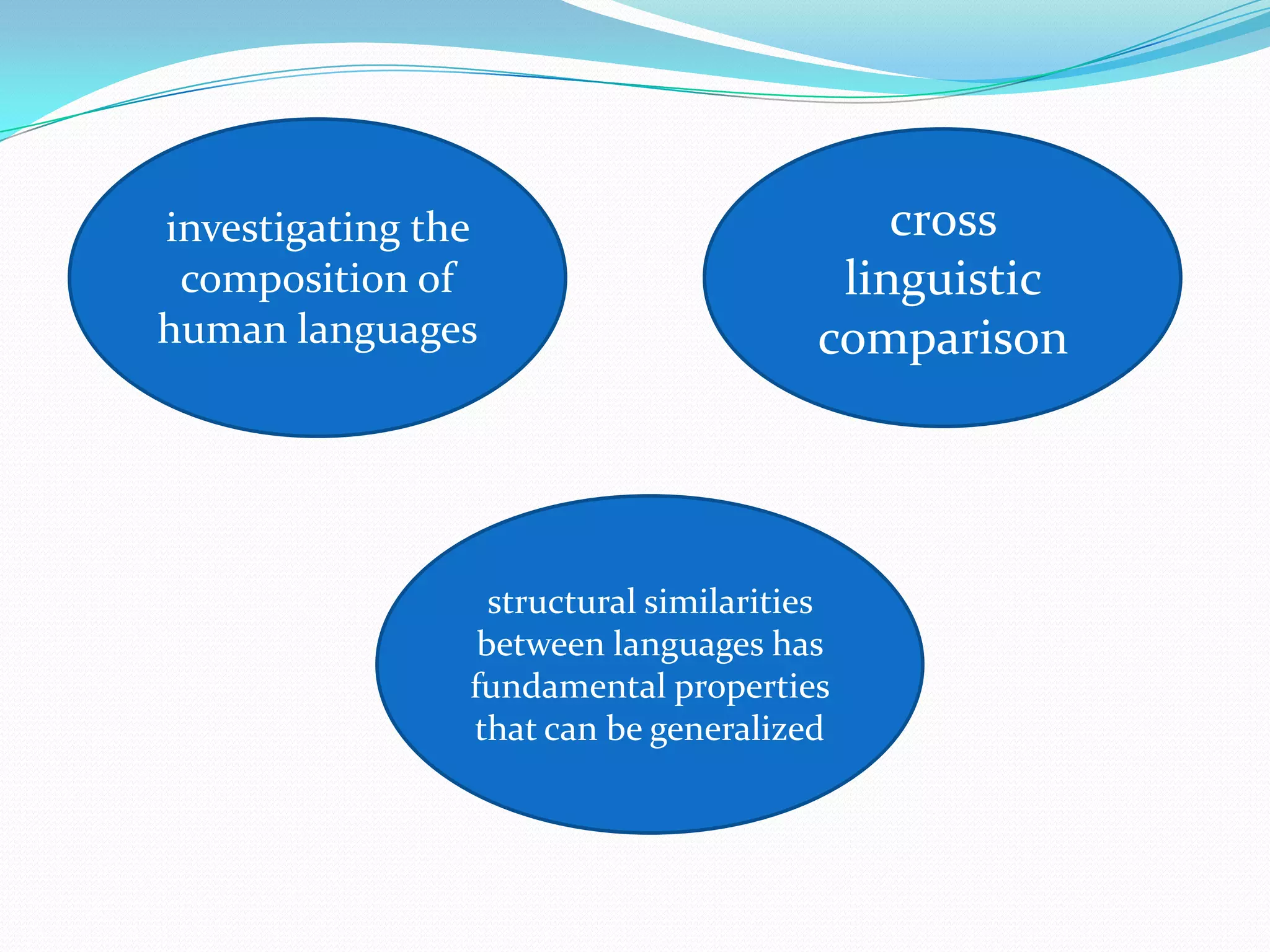
investigating the                           cross
 composition of                          linguistic
human languages                         comparison


                  structural similarities
                 between languages has
                fundamental properties
                that can be generalized
Morphological Typology
The study of differences among the
world’s languages relating to the ways in
which words are formed from smaller
meaningful units referred to as
‘morphemes’.
Morpology Across Languages
‘Isolating’ or ‘analytic’
‘Synthetic’
   ‘Agglutinating’
   ‘Fusional’
‘Polysynthetic’
1. Isolating (or analytic) language

An isolating language is a language in which almost
every word consists of a single morpheme.

An analytic language conveys grammatical
relationships syntactically — that is, via the use
of unbound morphemes, which are separate
words, rather than via bound morphemes, which
are inflectional prefixes, suffixes or infixes.
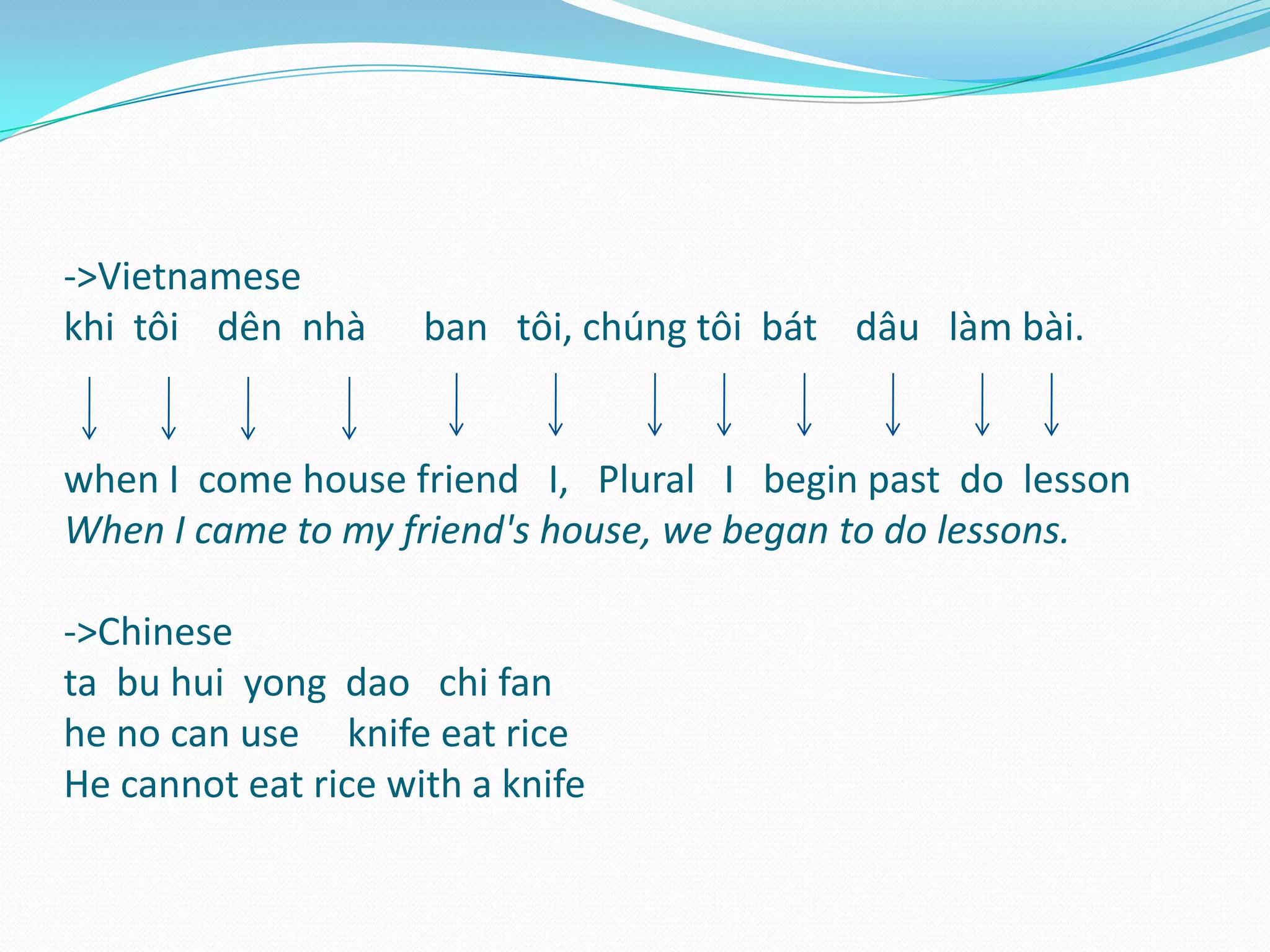
->Vietnamese
khi tôi dên nhà      ban tôi, chúng tôi bát dâu làm bài.


when I come house friend I, Plural I begin past do lesson
When I came to my friend's house, we began to do lessons.

->Chinese
ta bu hui yong dao chi fan
he no can use knife eat rice
He cannot eat rice with a knife
2. Inflectional (synthetic)

While isolating languages use only
independent words for grammatical
purposes, synthetic languages often use
affixes and internal modifications of roots for
those purposes.
• Agglutinating

In agglutinative languages, each affix typically represents
one unit of meaning (such as "diminutive", "past tense",
"plural", etc.), and bound morphemes are expressed by
affixes (and not by internal changes of the root of the
word, or changes in stress or tone).
In agglutinating languages, morphemes are strung
together to create complex words. Any number of
morphemes can be added in this way. All morphemes
have a single meaning and are easily recognizable.
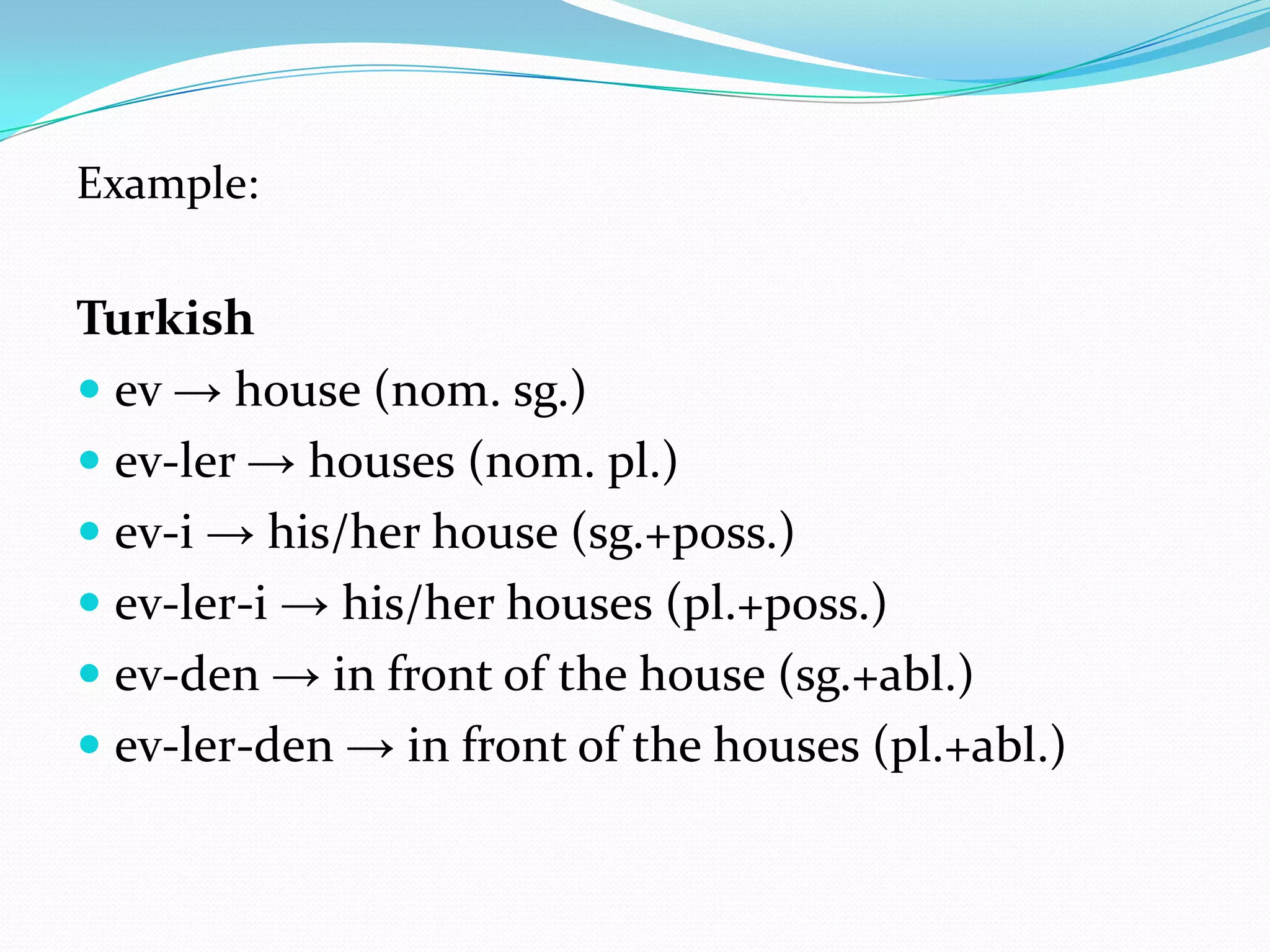
Example:

Turkish
 ev → house (nom. sg.)
 ev-ler → houses (nom. pl.)
 ev-i → his/her house (sg.+poss.)
 ev-ler-i → his/her houses (pl.+poss.)
 ev-den → in front of the house (sg.+abl.)
 ev-ler-den → in front of the houses (pl.+abl.)
• Fusional


Fusional languages combine affixes by
"squeezing" them together, often changing
them drastically in the process, and joining
several meanings in one affix. A fusional affix
can carry a single meaning or several, such as
person, gender and number
Example:
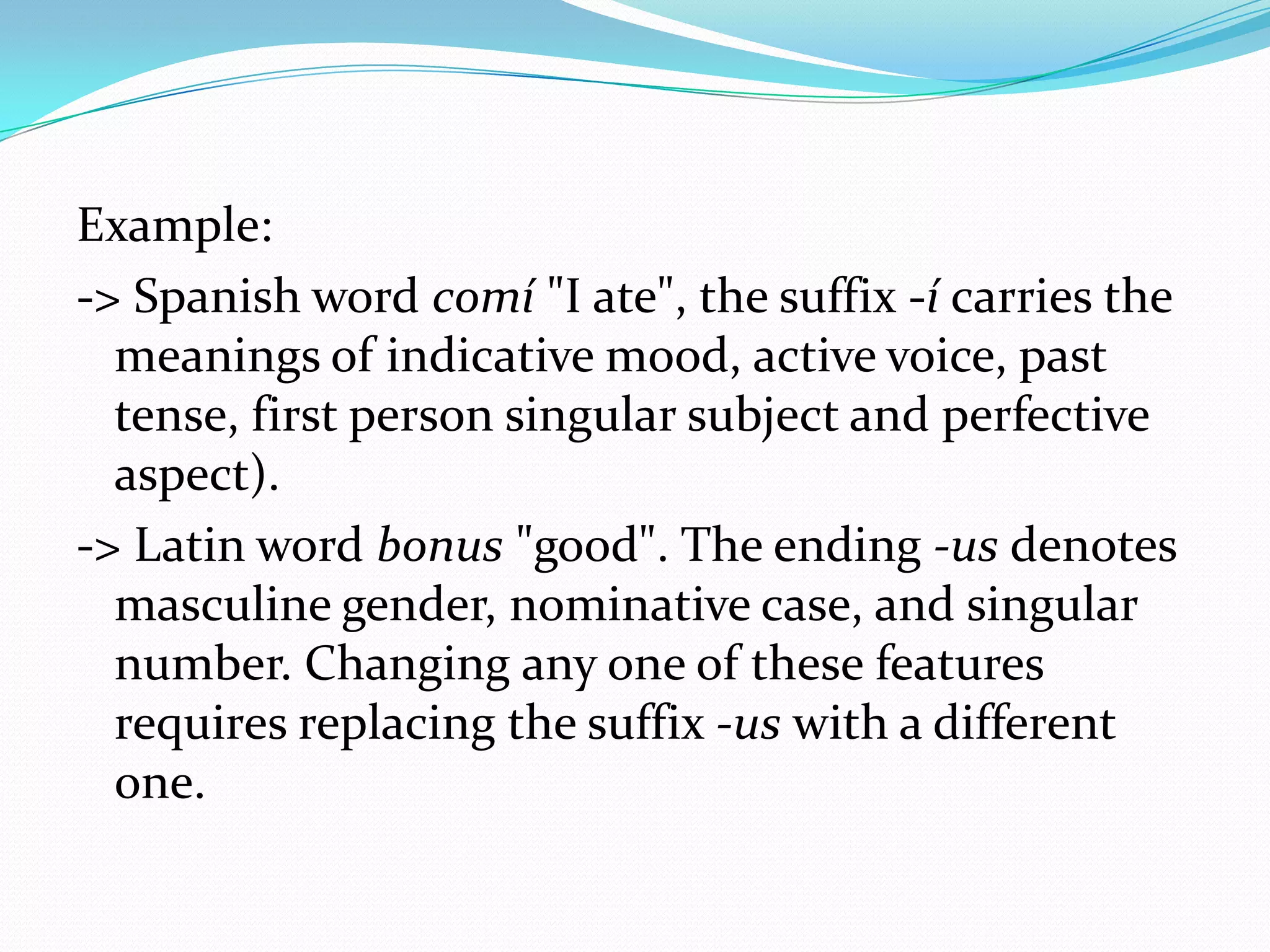
-> Spanish word comí "I ate", the suffix -í carries the
  meanings of indicative mood, active voice, past
  tense, first person singular subject and perfective
  aspect).
-> Latin word bonus "good". The ending -us denotes
  masculine gender, nominative case, and singular
  number. Changing any one of these features
  requires replacing the suffix -us with a different
  one.
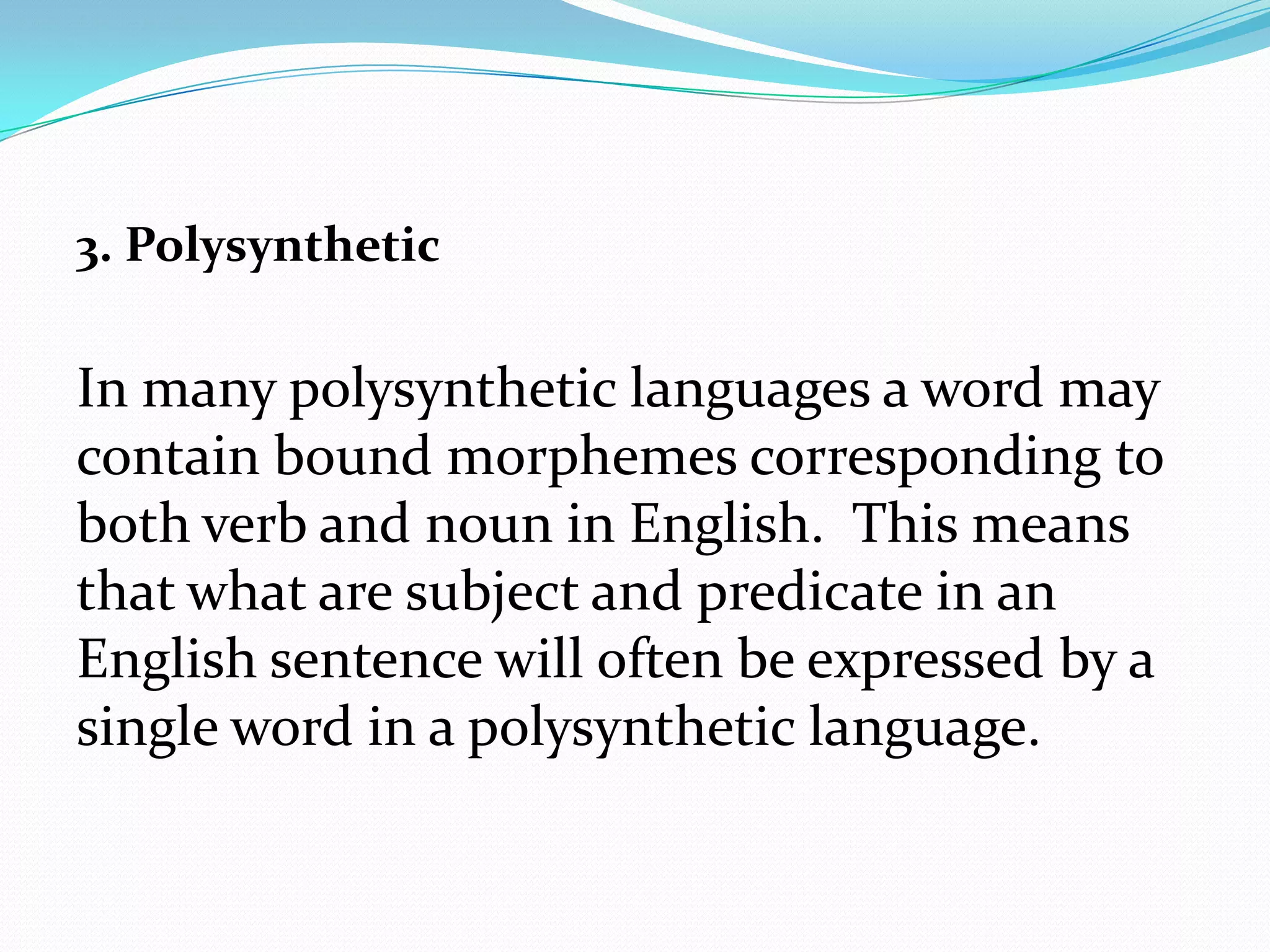
3. Polysynthetic

In many polysynthetic languages a word may
contain bound morphemes corresponding to
both verb and noun in English. This means
that what are subject and predicate in an
English sentence will often be expressed by a
single word in a polysynthetic language.
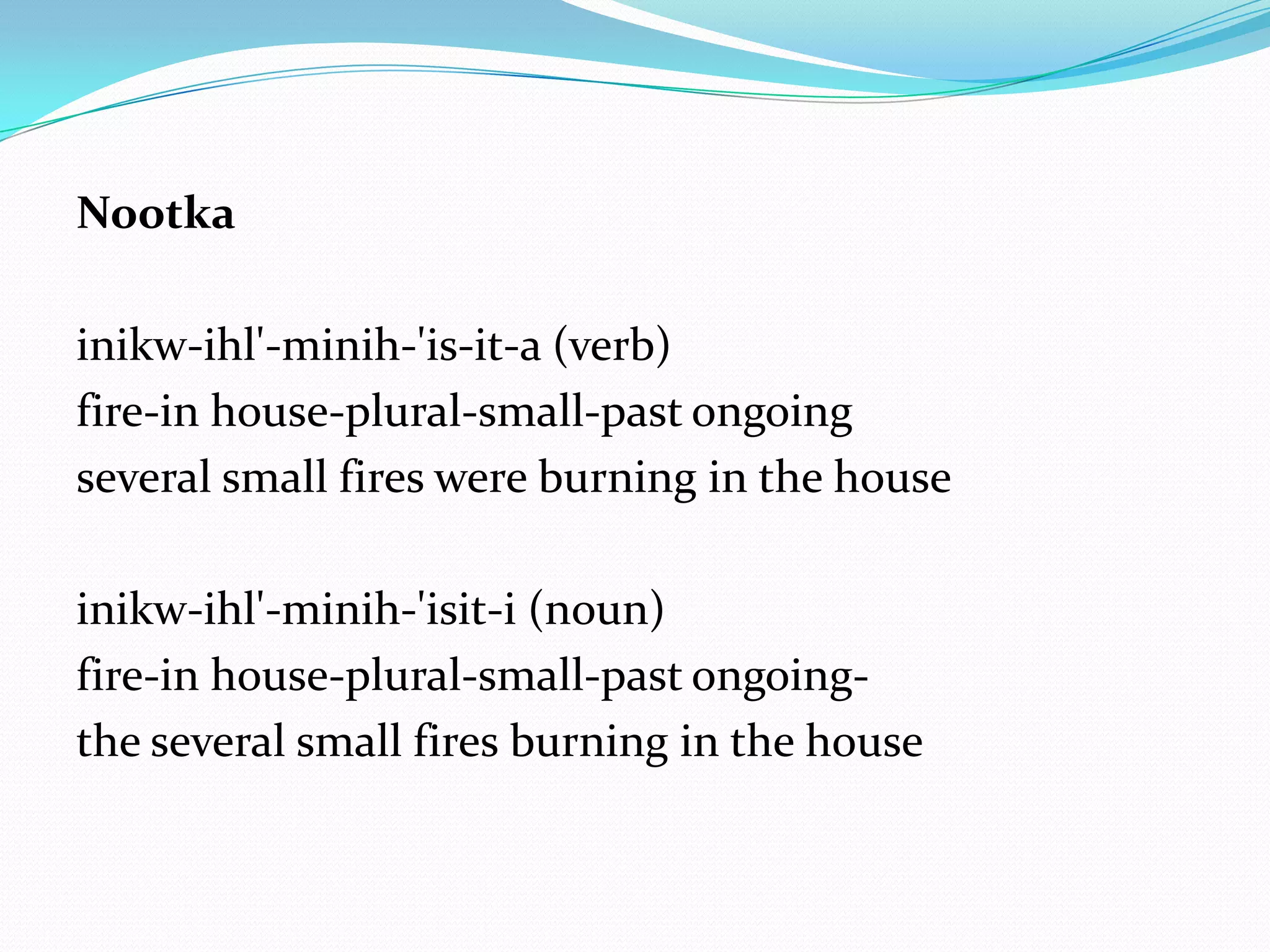
Nootka

inikw-ihl'-minih-'is-it-a (verb)
fire-in house-plural-small-past ongoing
several small fires were burning in the house

inikw-ihl'-minih-'isit-i (noun)
fire-in house-plural-small-past ongoing-
the several small fires burning in the house
Definition:

A morphological process is a means of
changing a stem to adjust its meaning to fit its
syntactic and communicational context.
Two ways of Morphological Process

1. concatenative morphology:
 putting morphemes together
2. non-concatenative:
 modifying internal structure of
 morphemes
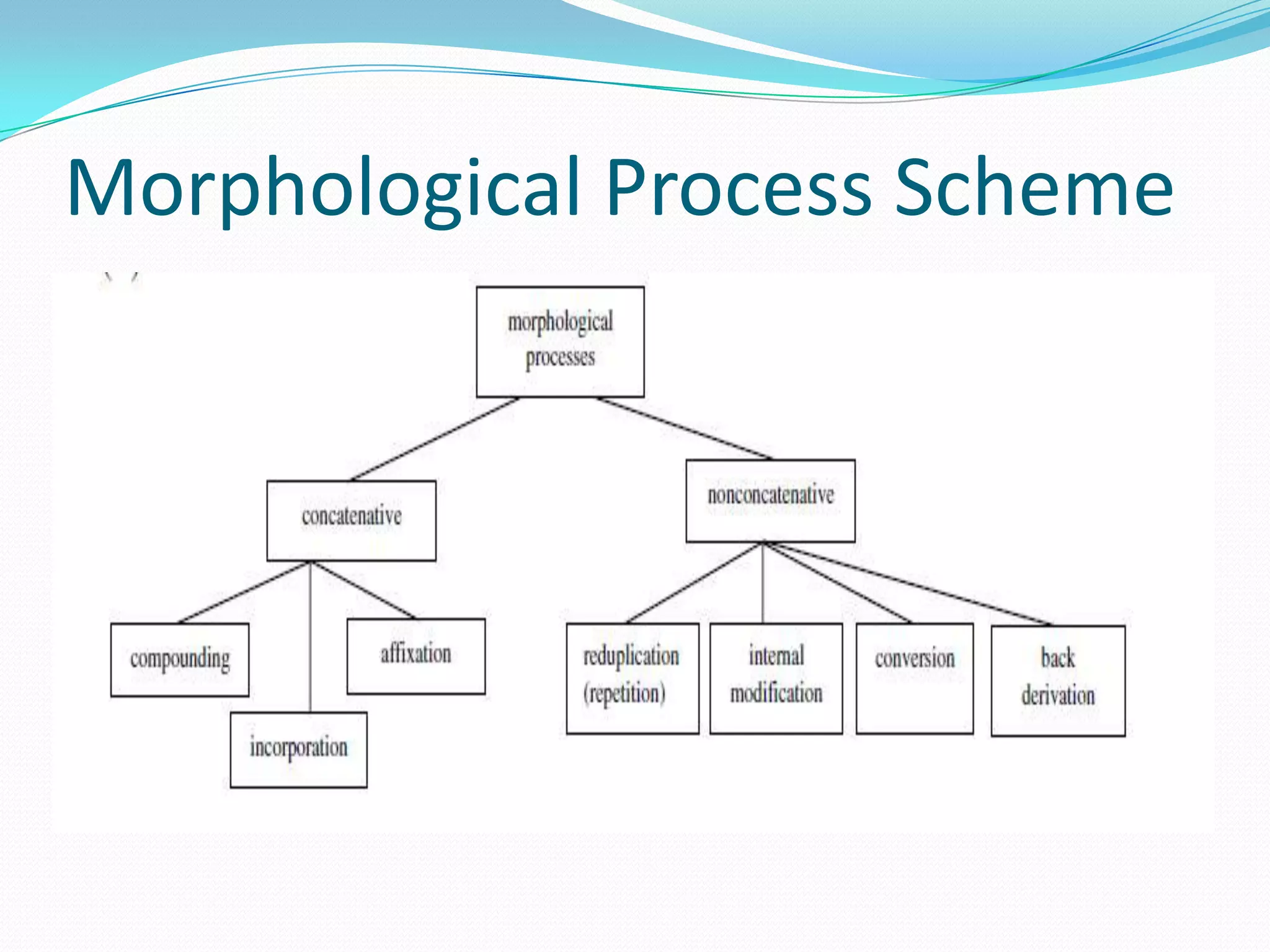
Morphological Process Scheme
CONCATENATIVE MORPHOLOGY
1. COMPOUNDING

English shares with many languages the
 ability to create
new words by combining old words.
Compounding can be analyzed through
 its constituents.
a. Endocentric: compound that has head

e.g.: ‘coffee table’
   coffee is modifier
   table is head

Coffee table is a kind of table
b. Exocentric: compound that has no
 head

e. g:
parent-teacher
white-collar
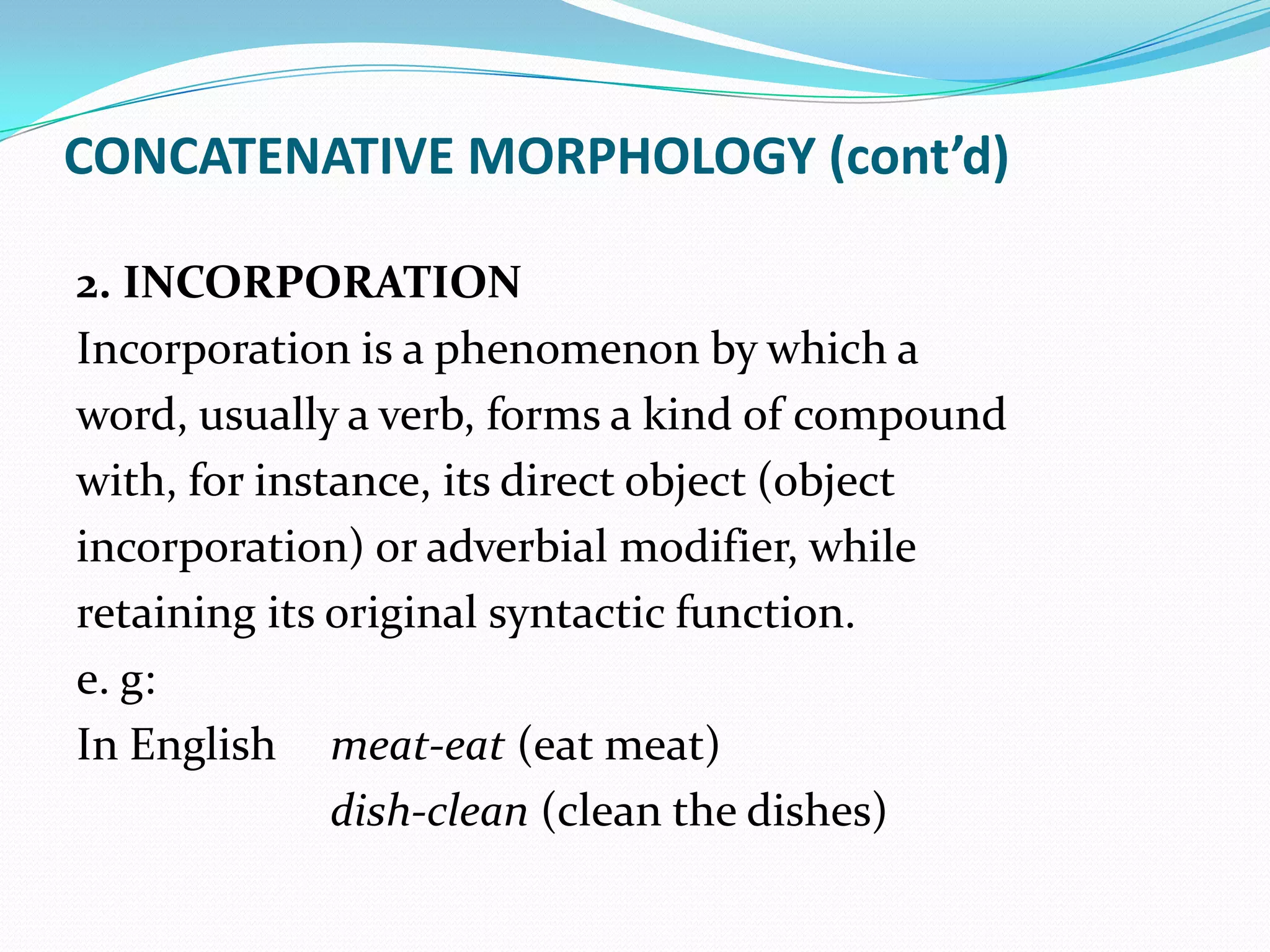
CONCATENATIVE MORPHOLOGY (cont’d)

2. INCORPORATION
Incorporation is a phenomenon by which a
word, usually a verb, forms a kind of compound
with, for instance, its direct object (object
incorporation) or adverbial modifier, while
retaining its original syntactic function.
e. g:
In English meat-eat (eat meat)
              dish-clean (clean the dishes)
CONCATENATIVE MORPHOLOGY (cont’d)

3. AFFIXES

a. Prefixes
b. Infixes
c. Suffixes
d. Confixes or Circumfixes
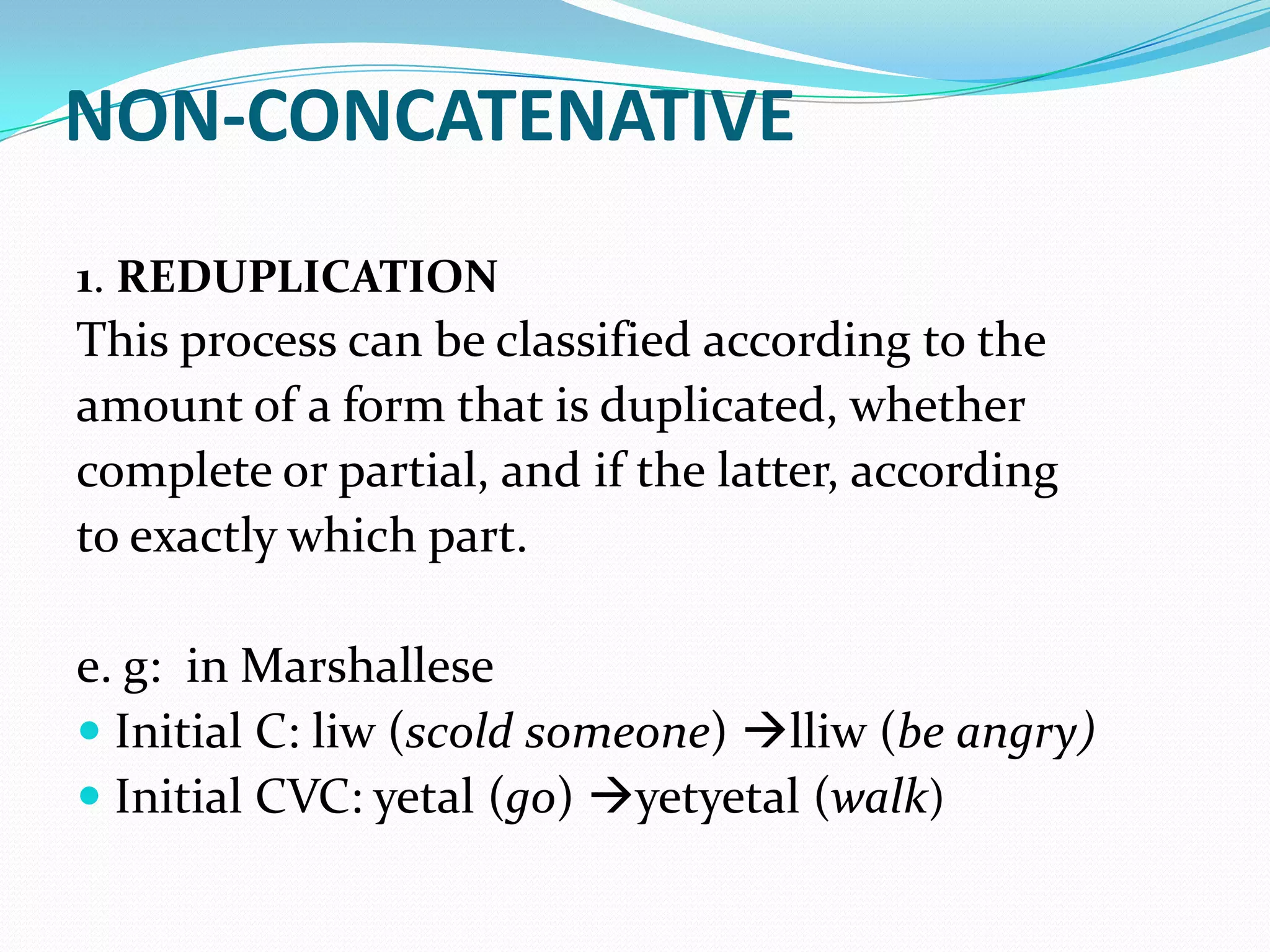
NON-CONCATENATIVE
1. REDUPLICATION
This process can be classified according to the
amount of a form that is duplicated, whether
complete or partial, and if the latter, according
to exactly which part.

e. g: in Marshallese
 Initial C: liw (scold someone) lliw (be angry)
 Initial CVC: yetal (go) yetyetal (walk)
NON-CONCATENATIVE (cont’d)

2. INTERNAL MODIFICATION

  a. Vowel Modification
  b. Ablaut and Umlaut
  c. Vowel Reversal
  d. Consonant Modification
  e. Tonal Modification
  f. Stress Modification
  g. Suppletion
NON-CONCATENATIVE (cont’d)

3. CONVERSION

Conversion is the way of forming a new word
merely by shifting the category or part of speech
of an already existing word without adding an
affix
e. g:
English     table to table
            bread to bread
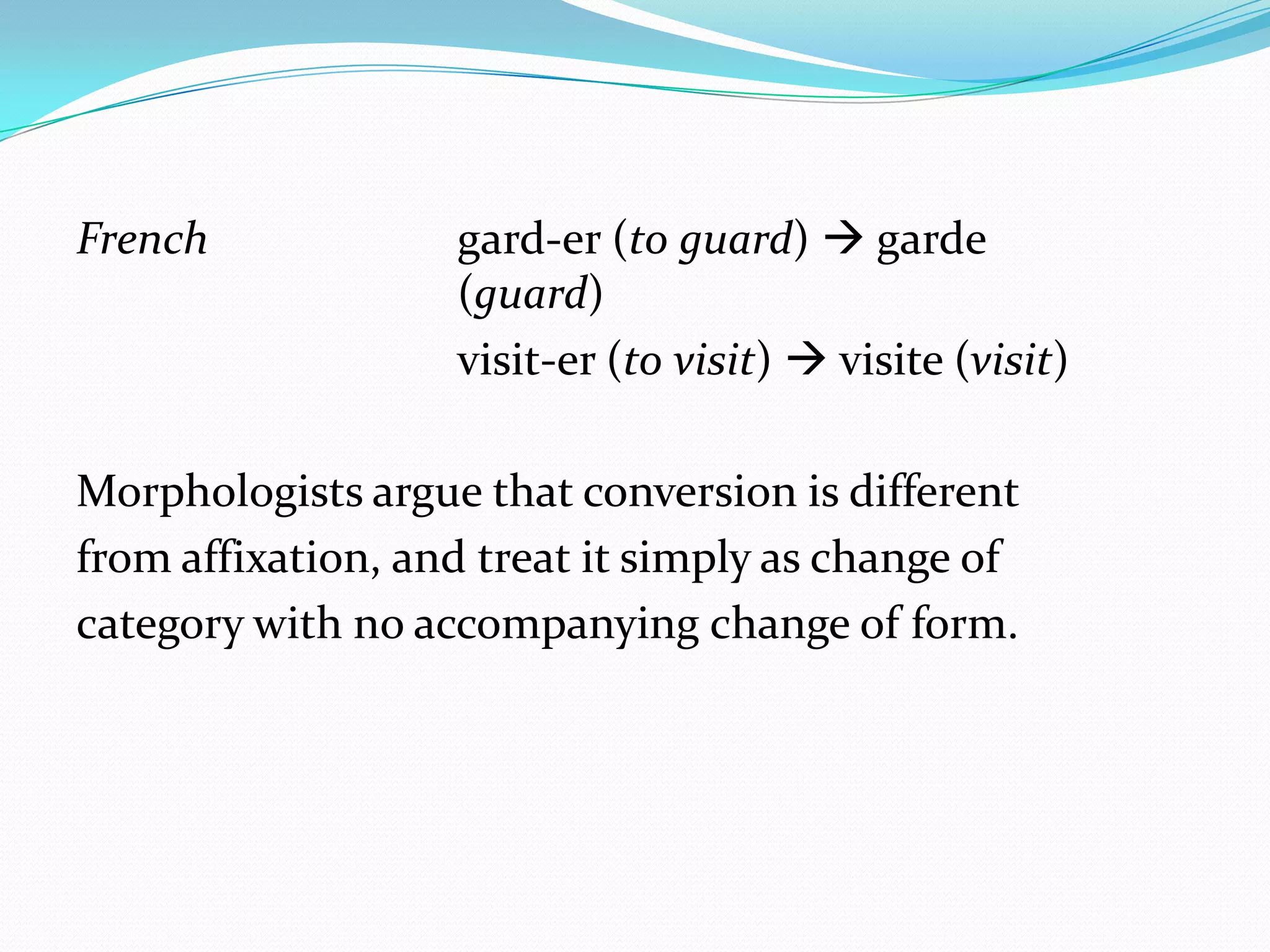
French             gard-er (to guard)  garde
                   (guard)
                   visit-er (to visit)  visite (visit)

Morphologists argue that conversion is different
from affixation, and treat it simply as change of
category with no accompanying change of form.
NON-CONCATENATIVE (cont’d)

4. BACK DERIVIATION

Back-formation is the word formation process in
which an actual or supposed derivational affix
detaches from the base form of a word to create
a new word.
e. g:
  donation – donate
  gambler – gamble
Dari referensi buku – buku linguistic,
word meaning mengacu pada arti atau
makna untuk yang bias ditemukan pada
kamus umum, kamus antar bahasa
misalnya bahasa Inggris ke bahasa
Indonesia, ataupun ensiklopedia.
Kata
Berdiri sendiri yang merupakan
unsur bahasa yg diucapkan atau
dituliskan yang perwujudan
kesatuan perasaan dan pikiran yg
dapat digunakan dalam berbahasa;
Kata
Suatu ujaran bunyi terkecil, atau juga dalam linguistic
morfem atau kombinasi morfem dianggap sebagai
satuan terkecil yg dapat diujarkan sebagai bentuk yang
bebas; satuan bahasa yg dapat berdiri sendiri, terjadi
dari morfem tunggal (misal batu, rumah, datang) atau
gabungan morfem (misal
pejuang, pancasila, mahakuasa).
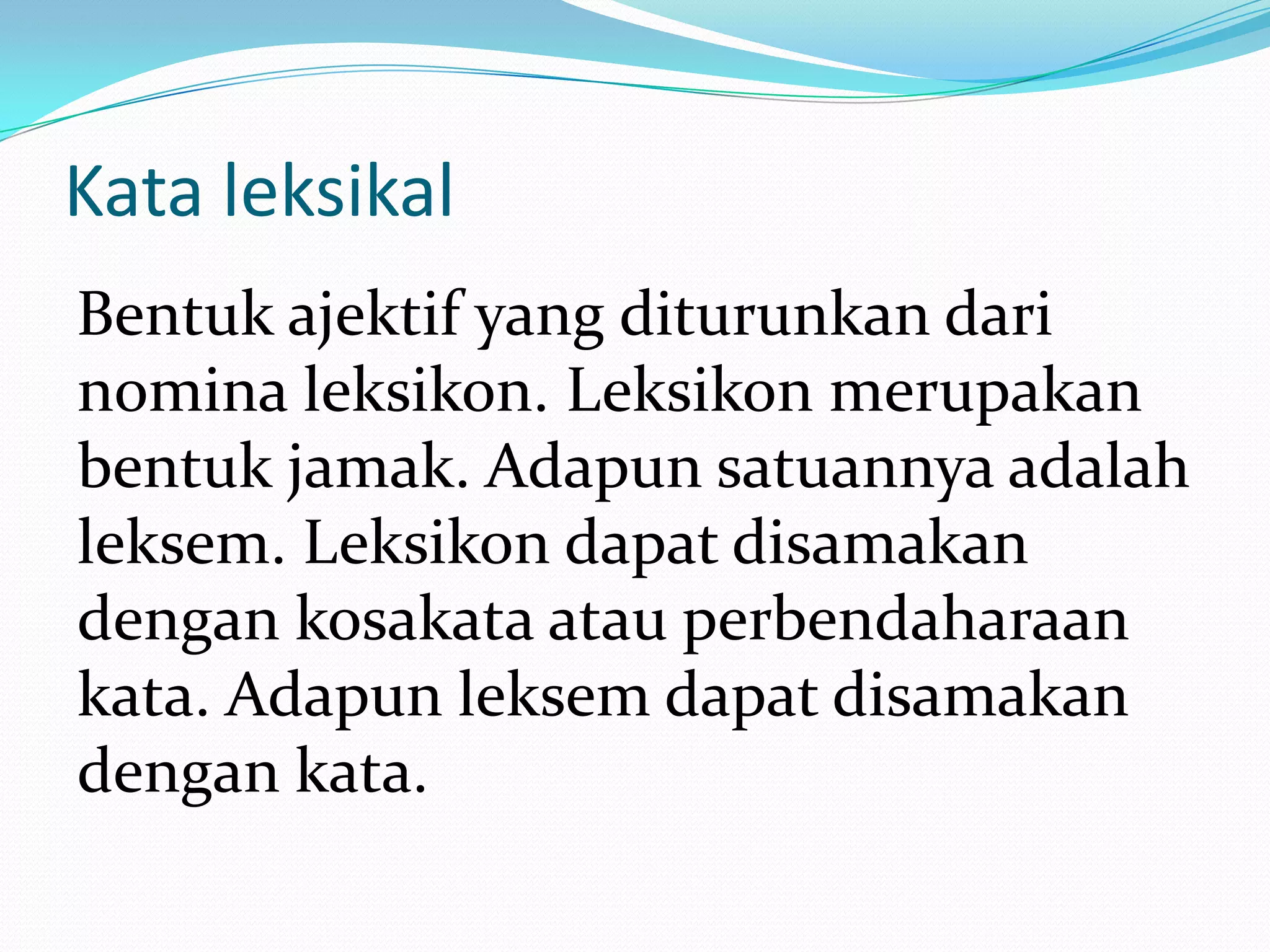
Kata leksikal
Bentuk ajektif yang diturunkan dari
nomina leksikon. Leksikon merupakan
bentuk jamak. Adapun satuannya adalah
leksem. Leksikon dapat disamakan
dengan kosakata atau perbendaharaan
kata. Adapun leksem dapat disamakan
dengan kata.
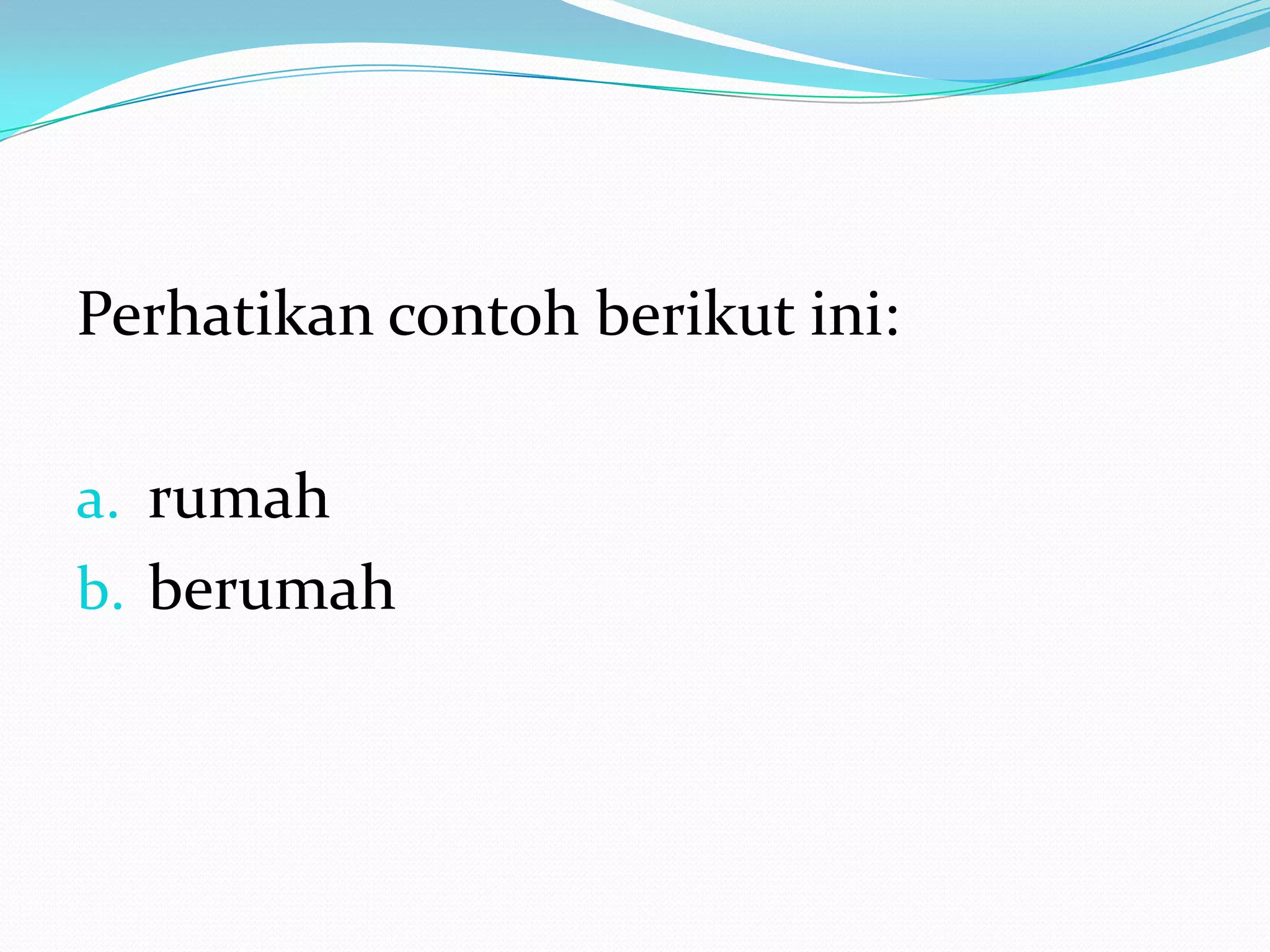
Perhatikan contoh berikut ini:

a. rumah
b. berumah
Kata bentuk
suara fonologi atau ortografi atau
penampilan dari sebuah kata yang
dapat digunakan untuk
menggambarkan atau
mengidentifikasi sesuatu.
Kata - Akar Kata
(linguistik) bentuk kata setelah
semua afiks yang dihilangkan.
linguistik - studi ilmiah bahasa

Deskriptor, bentuk, penanda, bentuk
kata - suara fonologi atau ortografi atau
penampilan dari sebuah kata yang dapat
digunakan untuk menggambarkan atau
mengidentifikasi sesuatu.
Makna Leksikal
Makna dasar yang terdapat pada setiap
kata atau leksikon. Maksudnya, makna
leksikal adalah makna yang sesuai
dengan acuan atau referennya atau
kamus. Soedjito (1986) menjelaskan
bahwa makna leksikal ialah makna kata
secara lepas, tanpa kaitan dengan kata
yang lain dalam sebuah konstruksi.
 Persepsi lain mengenai arti juga terdapat
  pada beberapa istilah seperti:
 Arti harfiah, makna harfiah atau arti/makna
  literal adalah arti kata secara leksikal atau
  arti yang paling mendasar. Bukan arti
  turunan (derivatif)
 kata makna - makna yang diterima dari arti word word
  - arti diterima kata
 Kata akal, akseptasi atau
  keterbeterimaan, menandakan, akal - arti sebuah kata
  atau ungkapan, cara di mana sebuah kata atau
  ungkapan atau situasi dapat diartikan, "kamus
  memberikan beberapa arti untuk kata", "penanda ini
  terkait dengan signified ".
Lexical Semantik
Sebuah teori linguistik yang meneliti makna kata. Teori
ini memahami bahwa arti kata sepenuhnya tercermin
konteksnya. Di sini, makna kata didasari oleh hubungan
kontekstualnya. Oleh karena itu, perbedaan antara
tingkat partisipasi serta mode partisipasi dibuat. Dalam
rangka untuk mencapai perbedaan ini setiap bagian dari
kalimat yang beruang arti dan menggabungkan dengan
makna konstituen lainnya diberi label sebagai
konstituen semantik. Konstituen semantik yang tidak
dapat dipecah menjadi konstituen dasar lebih dicap
sebagai konstituen semantik minimal
 Kamus adalah bagian utama dari deskripsi bahasa
 apapun. Sebuah kamus rumah tangga yang baik biasa
 biasanya memberikan (setidaknya) tiga jenis informasi
 tentang kata-kata, informasi fonologis tentang
 bagaimana kata tersebut diucapkan, tata bahasa
 (sintaksis dan morfologi) informasi tentang
 perusahaan pidato bagian od seperti kata benda, kata
 kerja, dan infleksi nomor contoh plural atau tegang
 dan semantik informasi masa lalu tentang makna kata
 itu
 Kamus, yaitu keterkaitan, penggunaan istilah teknis
 atau teoritis tertentu dan perangkat dan
 presisi, menunjukkan titik-titik kesamaan dan
 perbedaan antara pendekatan dari biasa kamus-
 penulis dan ahli ilmu semantik linguistik teoritis.
 Approah semantik lingustic ini ditandai dengan
 desakan ketat menjelaskan hanya properti-properti
 dari sebuah kata yang berhubungan dengan arti
 Arti adalah denotasi. Sedangkan makna adalah
 konotasi. Kadang-kadang "makna" itu selaras dengan
 "arti" dan kadang tidak selaras. Apabila makna sesuatu
 itu sama dengan arti sesuatu itu, maka makna tersebut
 disebut Makna Laras (Explicit Meaning). Apabila
 maknanya tidak selaras dengan "arti", maka sesuatu
 itu disebut memiliki Makna Kandungan (Implicit
 Meaning) atau Makna Lazim (Necessary Meaning).
References
Bussman, H. (ed). 2006. Routledge’s Dictionary of Language and Linguistics.
   New York: Routledge.
Lieber, Rochelle.2009. Introducing Morphology. Cambridge: Cambridge
   University Press.
Strazny, P (.ed). 2005. Fitzroy’s Encyclopedia of Linguistics. New York: Taylor
   and Francis Books, Inc
www.kul.pl/files/30/UW/06Morphology-class-handout.pdf
http://www2.hawaii.edu/~bender/process.html
http://en.wikipedia.org/wiki/Incorporation_%28linguistics%29
http://www.linguexperience.com/A_Linguistics_Experience/Morphology.ht
   ml
http://www.linguexperience.com/A_Linguistics_Experience/Morphology.ht
   ml
http://pandora.cii.wwu.edu/vajda/ling201/test1materials/typology.htm
http://www.sfs.unituebingen.de/~gjaeger/lehre/ws1011/languagesOfTheWorl
   d/morphologicalTypology.pdf

Morphological typology

  • 1.
  • 2.
    Group 2  AgustinaLestary  Ninuk Krismanti  Peny Kurniasih  Rezqan Noor Farid
  • 3.
    Discussion  Introduction  Typesof Languages  Morphological Operations  Words Meaning
  • 4.
    Introduction What is “Morphology”? Whatis “Typology”? What is “Morphological Typology”? Morphology Across Language.
  • 5.
    Morphology  How languageusers understand complex words and how they create new ones.  The study of the patterning of morphemes within a word and how morphemes combine to form new complex words.
  • 6.
    Typology  Typology isthe classification of languages on the basis of shared formal characteristics.  The ultimate goals of typology are to ascertain the ways in which languages are similar in structure and to determine just how different human languages can be.
  • 7.
    investigating the cross composition of linguistic human languages comparison structural similarities between languages has fundamental properties that can be generalized
  • 8.
    Morphological Typology The studyof differences among the world’s languages relating to the ways in which words are formed from smaller meaningful units referred to as ‘morphemes’.
  • 9.
    Morpology Across Languages ‘Isolating’or ‘analytic’ ‘Synthetic’  ‘Agglutinating’  ‘Fusional’ ‘Polysynthetic’
  • 11.
    1. Isolating (oranalytic) language An isolating language is a language in which almost every word consists of a single morpheme. An analytic language conveys grammatical relationships syntactically — that is, via the use of unbound morphemes, which are separate words, rather than via bound morphemes, which are inflectional prefixes, suffixes or infixes.
  • 12.
    ->Vietnamese khi tôi dênnhà ban tôi, chúng tôi bát dâu làm bài. when I come house friend I, Plural I begin past do lesson When I came to my friend's house, we began to do lessons. ->Chinese ta bu hui yong dao chi fan he no can use knife eat rice He cannot eat rice with a knife
  • 13.
    2. Inflectional (synthetic) Whileisolating languages use only independent words for grammatical purposes, synthetic languages often use affixes and internal modifications of roots for those purposes.
  • 14.
    • Agglutinating In agglutinativelanguages, each affix typically represents one unit of meaning (such as "diminutive", "past tense", "plural", etc.), and bound morphemes are expressed by affixes (and not by internal changes of the root of the word, or changes in stress or tone). In agglutinating languages, morphemes are strung together to create complex words. Any number of morphemes can be added in this way. All morphemes have a single meaning and are easily recognizable.
  • 15.
    Example: Turkish  ev →house (nom. sg.)  ev-ler → houses (nom. pl.)  ev-i → his/her house (sg.+poss.)  ev-ler-i → his/her houses (pl.+poss.)  ev-den → in front of the house (sg.+abl.)  ev-ler-den → in front of the houses (pl.+abl.)
  • 16.
    • Fusional Fusional languagescombine affixes by "squeezing" them together, often changing them drastically in the process, and joining several meanings in one affix. A fusional affix can carry a single meaning or several, such as person, gender and number
  • 17.
    Example: -> Spanish wordcomí "I ate", the suffix -í carries the meanings of indicative mood, active voice, past tense, first person singular subject and perfective aspect). -> Latin word bonus "good". The ending -us denotes masculine gender, nominative case, and singular number. Changing any one of these features requires replacing the suffix -us with a different one.
  • 18.
    3. Polysynthetic In manypolysynthetic languages a word may contain bound morphemes corresponding to both verb and noun in English. This means that what are subject and predicate in an English sentence will often be expressed by a single word in a polysynthetic language.
  • 19.
    Nootka inikw-ihl'-minih-'is-it-a (verb) fire-in house-plural-small-pastongoing several small fires were burning in the house inikw-ihl'-minih-'isit-i (noun) fire-in house-plural-small-past ongoing- the several small fires burning in the house
  • 21.
    Definition: A morphological processis a means of changing a stem to adjust its meaning to fit its syntactic and communicational context.
  • 22.
    Two ways ofMorphological Process 1. concatenative morphology: putting morphemes together 2. non-concatenative: modifying internal structure of morphemes
  • 23.
  • 24.
    CONCATENATIVE MORPHOLOGY 1. COMPOUNDING Englishshares with many languages the ability to create new words by combining old words. Compounding can be analyzed through its constituents.
  • 25.
    a. Endocentric: compoundthat has head e.g.: ‘coffee table’ coffee is modifier table is head Coffee table is a kind of table
  • 26.
    b. Exocentric: compoundthat has no head e. g: parent-teacher white-collar
  • 27.
    CONCATENATIVE MORPHOLOGY (cont’d) 2.INCORPORATION Incorporation is a phenomenon by which a word, usually a verb, forms a kind of compound with, for instance, its direct object (object incorporation) or adverbial modifier, while retaining its original syntactic function. e. g: In English meat-eat (eat meat) dish-clean (clean the dishes)
  • 28.
    CONCATENATIVE MORPHOLOGY (cont’d) 3.AFFIXES a. Prefixes b. Infixes c. Suffixes d. Confixes or Circumfixes
  • 29.
    NON-CONCATENATIVE 1. REDUPLICATION This processcan be classified according to the amount of a form that is duplicated, whether complete or partial, and if the latter, according to exactly which part. e. g: in Marshallese  Initial C: liw (scold someone) lliw (be angry)  Initial CVC: yetal (go) yetyetal (walk)
  • 30.
    NON-CONCATENATIVE (cont’d) 2. INTERNALMODIFICATION a. Vowel Modification b. Ablaut and Umlaut c. Vowel Reversal d. Consonant Modification e. Tonal Modification f. Stress Modification g. Suppletion
  • 31.
    NON-CONCATENATIVE (cont’d) 3. CONVERSION Conversionis the way of forming a new word merely by shifting the category or part of speech of an already existing word without adding an affix e. g: English table to table bread to bread
  • 32.
    French gard-er (to guard)  garde (guard) visit-er (to visit)  visite (visit) Morphologists argue that conversion is different from affixation, and treat it simply as change of category with no accompanying change of form.
  • 33.
    NON-CONCATENATIVE (cont’d) 4. BACKDERIVIATION Back-formation is the word formation process in which an actual or supposed derivational affix detaches from the base form of a word to create a new word. e. g: donation – donate gambler – gamble
  • 35.
    Dari referensi buku– buku linguistic, word meaning mengacu pada arti atau makna untuk yang bias ditemukan pada kamus umum, kamus antar bahasa misalnya bahasa Inggris ke bahasa Indonesia, ataupun ensiklopedia.
  • 36.
    Kata Berdiri sendiri yangmerupakan unsur bahasa yg diucapkan atau dituliskan yang perwujudan kesatuan perasaan dan pikiran yg dapat digunakan dalam berbahasa;
  • 37.
    Kata Suatu ujaran bunyiterkecil, atau juga dalam linguistic morfem atau kombinasi morfem dianggap sebagai satuan terkecil yg dapat diujarkan sebagai bentuk yang bebas; satuan bahasa yg dapat berdiri sendiri, terjadi dari morfem tunggal (misal batu, rumah, datang) atau gabungan morfem (misal pejuang, pancasila, mahakuasa).
  • 38.
    Kata leksikal Bentuk ajektifyang diturunkan dari nomina leksikon. Leksikon merupakan bentuk jamak. Adapun satuannya adalah leksem. Leksikon dapat disamakan dengan kosakata atau perbendaharaan kata. Adapun leksem dapat disamakan dengan kata.
  • 39.
    Perhatikan contoh berikutini: a. rumah b. berumah
  • 40.
    Kata bentuk suara fonologiatau ortografi atau penampilan dari sebuah kata yang dapat digunakan untuk menggambarkan atau mengidentifikasi sesuatu.
  • 41.
    Kata - AkarKata (linguistik) bentuk kata setelah semua afiks yang dihilangkan.
  • 42.
    linguistik - studiilmiah bahasa Deskriptor, bentuk, penanda, bentuk kata - suara fonologi atau ortografi atau penampilan dari sebuah kata yang dapat digunakan untuk menggambarkan atau mengidentifikasi sesuatu.
  • 43.
    Makna Leksikal Makna dasaryang terdapat pada setiap kata atau leksikon. Maksudnya, makna leksikal adalah makna yang sesuai dengan acuan atau referennya atau kamus. Soedjito (1986) menjelaskan bahwa makna leksikal ialah makna kata secara lepas, tanpa kaitan dengan kata yang lain dalam sebuah konstruksi.
  • 44.
     Persepsi lainmengenai arti juga terdapat pada beberapa istilah seperti:  Arti harfiah, makna harfiah atau arti/makna literal adalah arti kata secara leksikal atau arti yang paling mendasar. Bukan arti turunan (derivatif)
  • 45.
     kata makna- makna yang diterima dari arti word word - arti diterima kata  Kata akal, akseptasi atau keterbeterimaan, menandakan, akal - arti sebuah kata atau ungkapan, cara di mana sebuah kata atau ungkapan atau situasi dapat diartikan, "kamus memberikan beberapa arti untuk kata", "penanda ini terkait dengan signified ".
  • 46.
    Lexical Semantik Sebuah teorilinguistik yang meneliti makna kata. Teori ini memahami bahwa arti kata sepenuhnya tercermin konteksnya. Di sini, makna kata didasari oleh hubungan kontekstualnya. Oleh karena itu, perbedaan antara tingkat partisipasi serta mode partisipasi dibuat. Dalam rangka untuk mencapai perbedaan ini setiap bagian dari kalimat yang beruang arti dan menggabungkan dengan makna konstituen lainnya diberi label sebagai konstituen semantik. Konstituen semantik yang tidak dapat dipecah menjadi konstituen dasar lebih dicap sebagai konstituen semantik minimal
  • 47.
     Kamus adalahbagian utama dari deskripsi bahasa apapun. Sebuah kamus rumah tangga yang baik biasa biasanya memberikan (setidaknya) tiga jenis informasi tentang kata-kata, informasi fonologis tentang bagaimana kata tersebut diucapkan, tata bahasa (sintaksis dan morfologi) informasi tentang perusahaan pidato bagian od seperti kata benda, kata kerja, dan infleksi nomor contoh plural atau tegang dan semantik informasi masa lalu tentang makna kata itu
  • 48.
     Kamus, yaituketerkaitan, penggunaan istilah teknis atau teoritis tertentu dan perangkat dan presisi, menunjukkan titik-titik kesamaan dan perbedaan antara pendekatan dari biasa kamus- penulis dan ahli ilmu semantik linguistik teoritis. Approah semantik lingustic ini ditandai dengan desakan ketat menjelaskan hanya properti-properti dari sebuah kata yang berhubungan dengan arti
  • 49.
     Arti adalahdenotasi. Sedangkan makna adalah konotasi. Kadang-kadang "makna" itu selaras dengan "arti" dan kadang tidak selaras. Apabila makna sesuatu itu sama dengan arti sesuatu itu, maka makna tersebut disebut Makna Laras (Explicit Meaning). Apabila maknanya tidak selaras dengan "arti", maka sesuatu itu disebut memiliki Makna Kandungan (Implicit Meaning) atau Makna Lazim (Necessary Meaning).
  • 50.
    References Bussman, H. (ed).2006. Routledge’s Dictionary of Language and Linguistics. New York: Routledge. Lieber, Rochelle.2009. Introducing Morphology. Cambridge: Cambridge University Press. Strazny, P (.ed). 2005. Fitzroy’s Encyclopedia of Linguistics. New York: Taylor and Francis Books, Inc www.kul.pl/files/30/UW/06Morphology-class-handout.pdf http://www2.hawaii.edu/~bender/process.html http://en.wikipedia.org/wiki/Incorporation_%28linguistics%29 http://www.linguexperience.com/A_Linguistics_Experience/Morphology.ht ml http://www.linguexperience.com/A_Linguistics_Experience/Morphology.ht ml http://pandora.cii.wwu.edu/vajda/ling201/test1materials/typology.htm http://www.sfs.unituebingen.de/~gjaeger/lehre/ws1011/languagesOfTheWorl d/morphologicalTypology.pdf