2
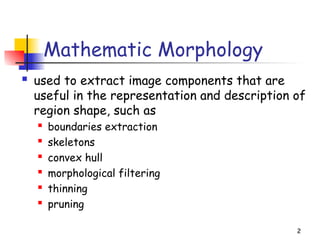
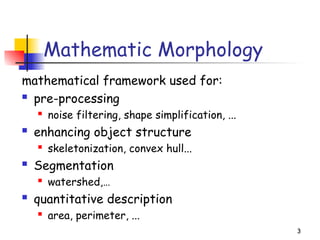
Mathematic Morphology
usedto extract image components that are
useful in the representation and description of
region shape, such as
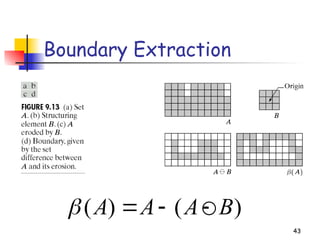
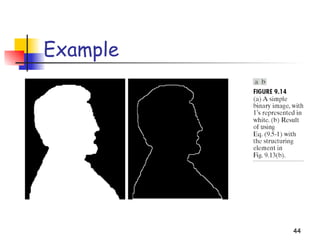
boundaries extraction
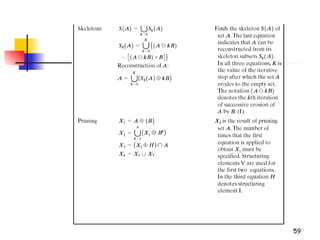
skeletons
convex hull
morphological filtering
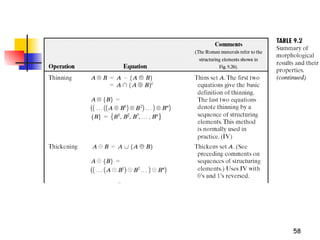
thinning
pruning
4
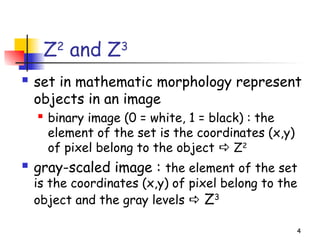
Z2
and Z3
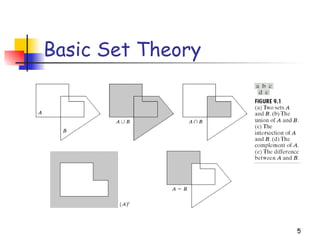
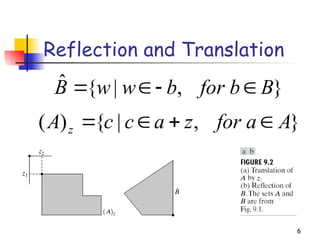
setin mathematic morphology represent
objects in an image
binary image (0 = white, 1 = black) : the
element of the set is the coordinates (x,y)
of pixel belong to the object Z2
gray-scaled image : the element of the set
is the coordinates (x,y) of pixel belong to the
object and the gray levels Z3
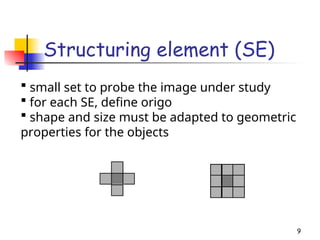
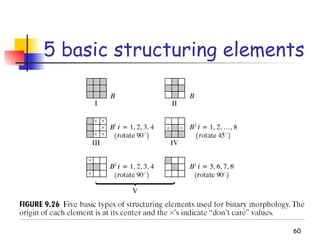
Structuring element (SE)
9
small set to probe the image under study
for each SE, define origo
shape and size must be adapted to geometric
properties for the objects
10.
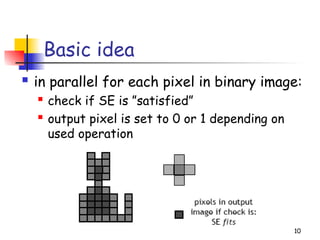
Basic idea
inparallel for each pixel in binary image:
check if SE is ”satisfied”
output pixel is set to 0 or 1 depending on
used operation
10
11.
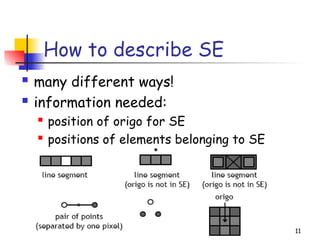
How to describeSE
many different ways!
information needed:
position of origo for SE
positions of elements belonging to SE
11
12.
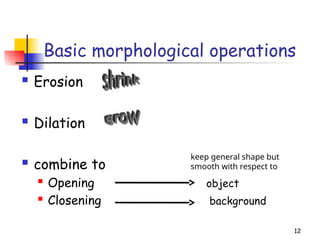
Basic morphological operations
Erosion
Dilation
combine to
Opening object
Closening background
12
keep general shape but
smooth with respect to
13.
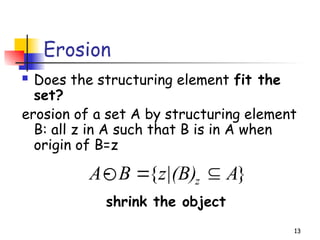
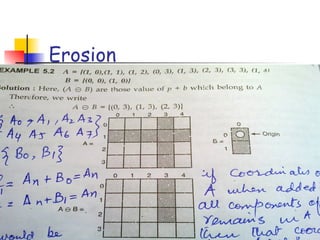
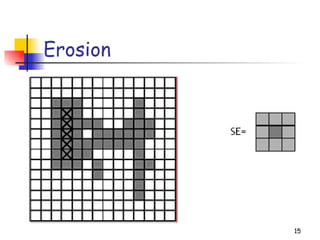
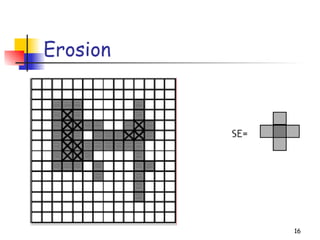
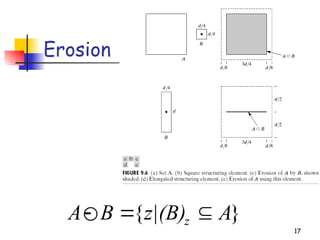
Erosion
Does thestructuring element fit the
set?
erosion of a set A by structuring element
B: all z in A such that B is in A when
origin of B=z
shrink the object
13
}
{ A
z|(B)
B
A z
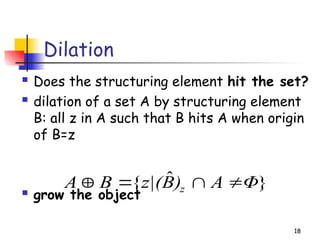
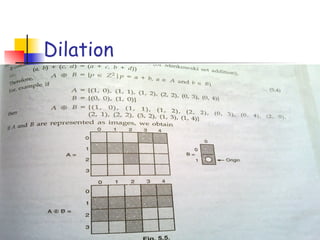
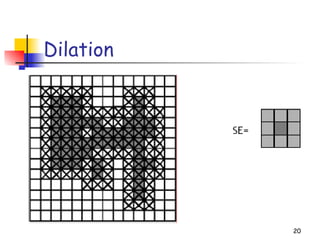
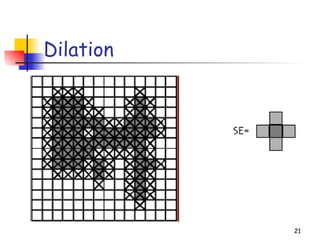
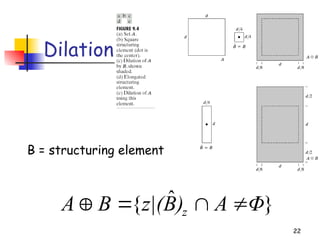
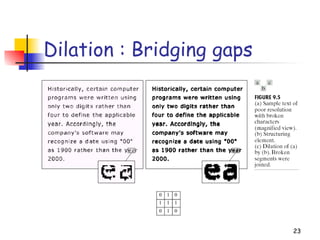
Dilation
Does thestructuring element hit the set?
dilation of a set A by structuring element
B: all z in A such that B hits A when origin
of B=z
grow the object
18
}
ˆ
{ Φ
A
)
B
z|(
B
A z
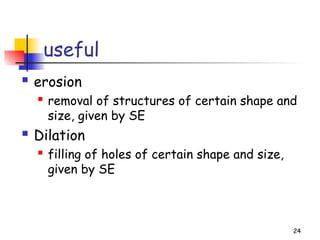
useful
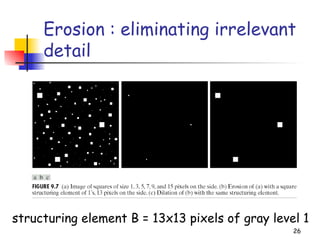
erosion
removalof structures of certain shape and
size, given by SE
Dilation
filling of holes of certain shape and size,
given by SE
24
25.
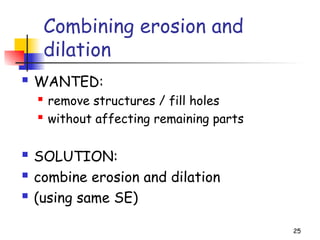
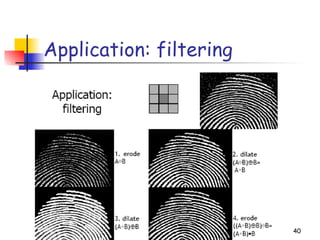
Combining erosion and
dilation
WANTED:
remove structures / fill holes
without affecting remaining parts
SOLUTION:
combine erosion and dilation
(using same SE)
25
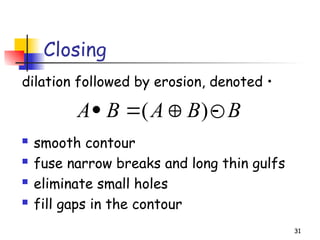
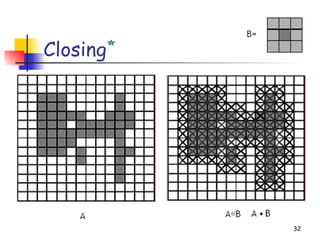
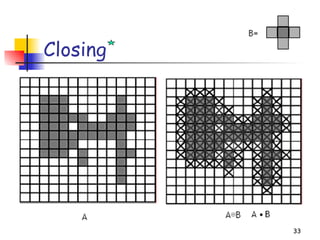
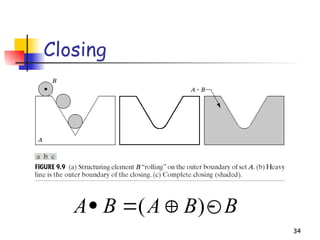
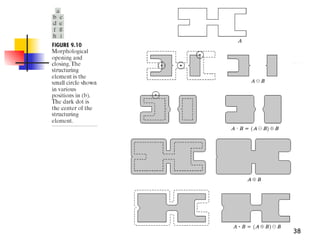
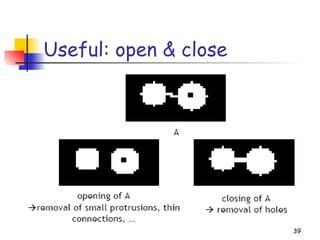
Closing
dilation followed byerosion, denoted •
smooth contour
fuse narrow breaks and long thin gulfs
eliminate small holes
fill gaps in the contour
31
B
B
A
B
A
)
(
35
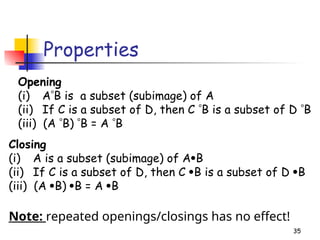
Properties
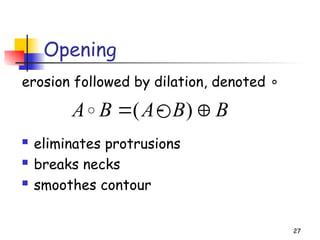
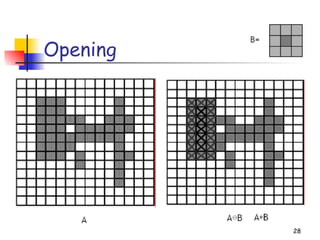
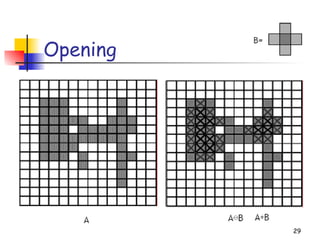
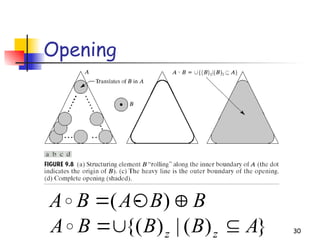
Opening
(i) AB isa subset (subimage) of A
(ii) If C is a subset of D, then C B is a subset of D B
(iii) (A B) B = A B
Closing
(i) A is a subset (subimage) of AB
(ii) If C is a subset of D, then C B is a subset of D B
(iii) (A B) B = A B
Note: repeated openings/closings has no effect!
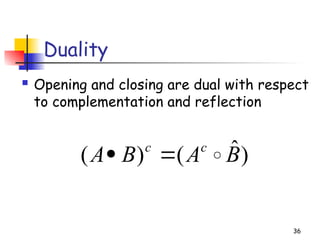
36.
Duality
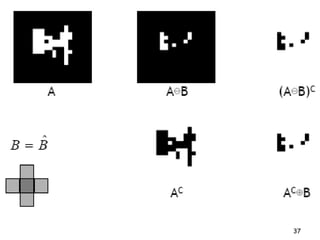
Opening andclosing are dual with respect
to complementation and reflection
36
)
ˆ
(
)
( B
A
B
A c
c
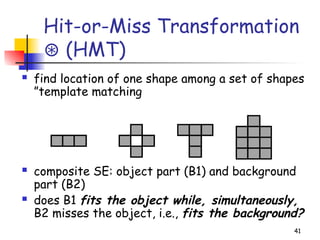
Hit-or-Miss Transformation
(HMT)
⊛
findlocation of one shape among a set of shapes
”template matching
composite SE: object part (B1) and background
part (B2)
does B1 fits the object while, simultaneously,
B2 misses the object, i.e., fits the background?
41
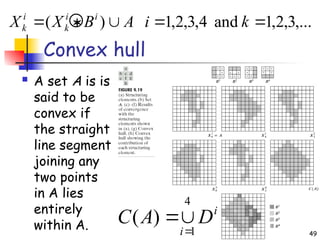
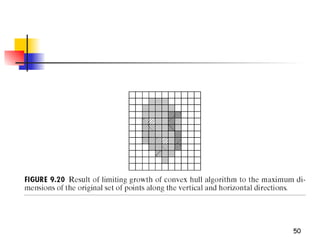
Convex hull
Aset A is is
said to be
convex if
the straight
line segment
joining any
two points
in A lies
entirely
within A.
i
i
D
A
C
4
1
)
(
,...
3
,
2
,
1
and
4
,
3
,
2
,
1
)
(
k
i
A
B
X
X i
i
k
i
k
49

![42
Hit-or-Miss Transformation
)]
(
[
)
( X
W
A
X
A
B
A c
](https://image.slidesharecdn.com/chapter9morphologicalimageprocessing-250511161651-4da8aad3/85/Chapter_9_Morphological_Image_Processing-ppt-42-320.jpg)


![Lec07-CH9-MORPHOL [Recovered].ppt](https://cdn.slidesharecdn.com/ss_thumbnails/lec07-ch9-morpholrecovered-220706082019-67054ec6-thumbnail.jpg?width=640&height=640&fit=bounds)


