This document provides an overview of Kohlberg's theory of moral development. It explains that the theory outlines six stages of moral reasoning individuals progress through as they develop an understanding of right and wrong. The stages are organized into three levels - pre-conventional, conventional, and post-conventional. At each stage, morality and decision-making are motivated by different factors, becoming less externally-focused and more internally principled at higher stages. Examples are given of how moral reasoning differs at some of the key stages.
T H EO R Y O F M O R A L
D E V E L O P M E N T
Mariya Francis
I sem Social work
2.
M O RA L
D E V E L O P M E N T
• Children’s reasoning
about morality their
attitude towards moral
lapses and their
behaviour when faced
with moral issues.
3.
K O HL B E R G ' S T H E O R Y O F M O R A L
D E V E L O P M E N T
• Lawrence Kohlberg (1927-1987)
• Adapted from Jean Piaget
theory of development
• It outlines the different levels and stages of moral
reasoning that individuals go through as they
develop their understanding of right or wrong.
4.
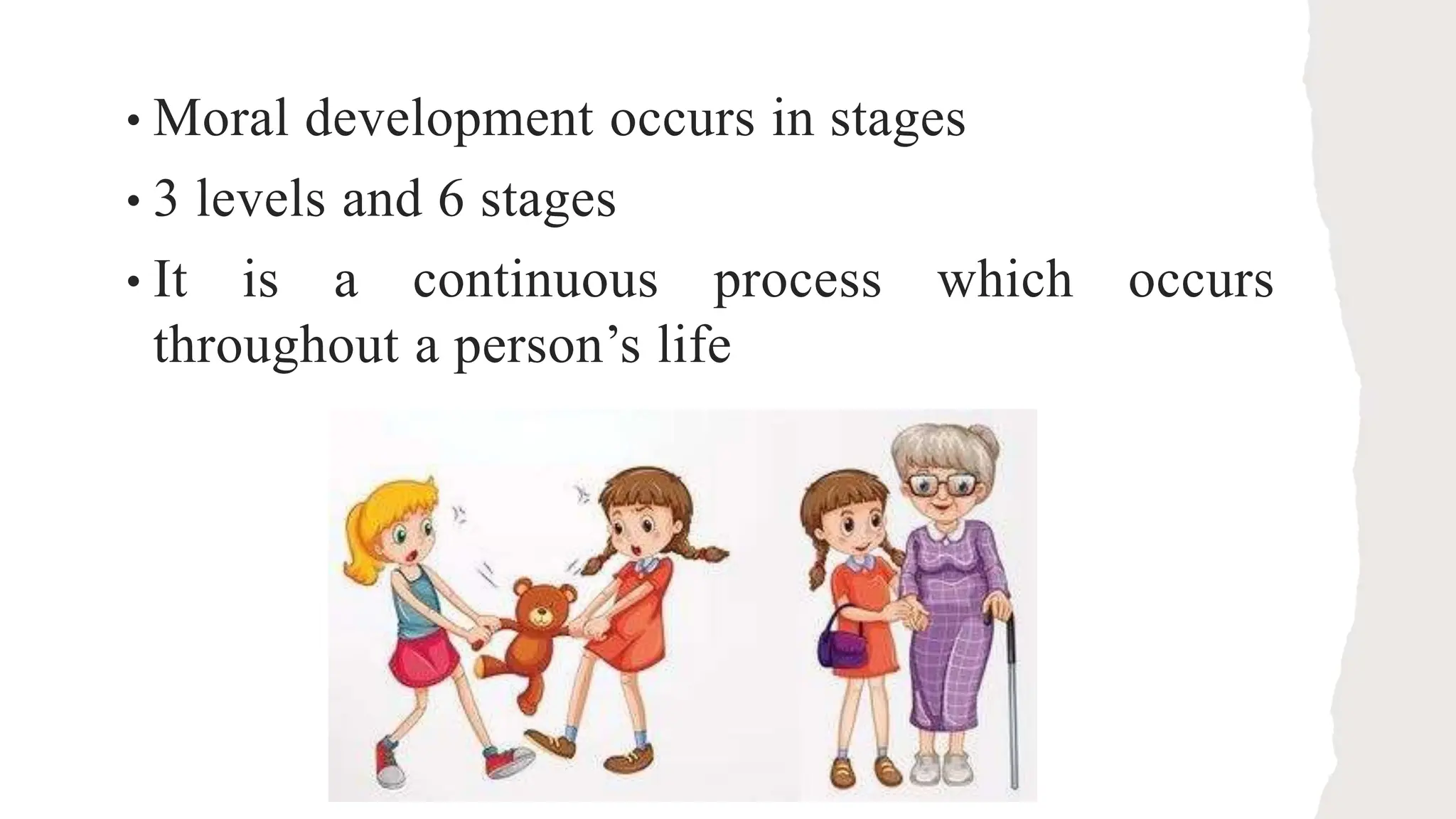
• Moral developmentoccurs in stages
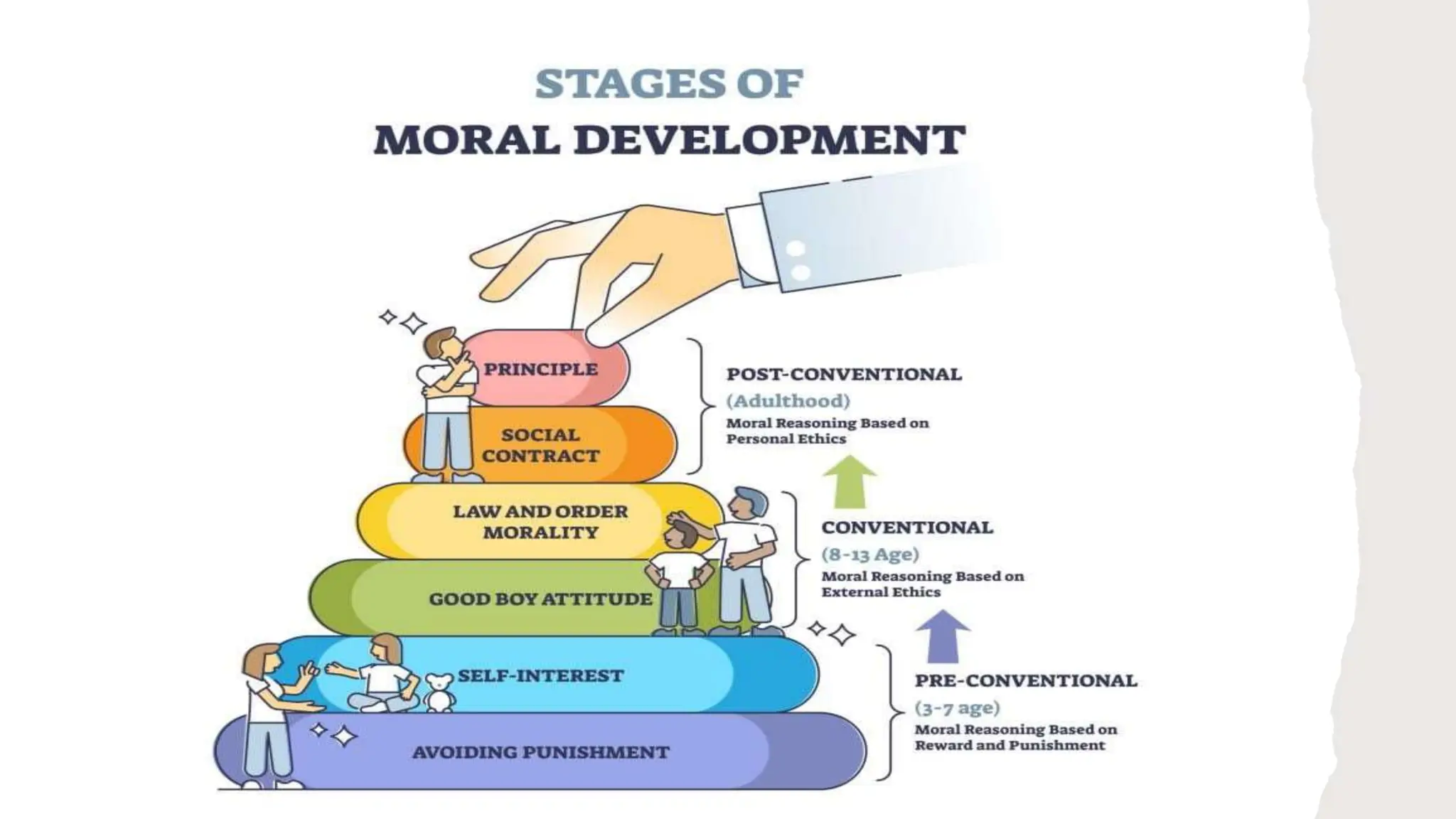
• 3 levels and 6 stages
• It is a continuous process which occurs
throughout a person’s life
5.
H E IN Z D I L E M M A
• Clinical interview
• Stealing the drug to
save a life .
• Participants – adolescence
• Interviewing them at 3 -4 years , intervals over
20 years.
7.
P R E- C O N V E N T I O N A L L E V E L
• Stage -1 ( Obedience and punishment)
• Morality is externally controlled
• Children suppose that rules are
fixed and must be respected
• Avoiding punishment or seeking reward
8.
• Stage -2( self interest)
• Moral reasoning is self centered and shows little
or no consideration of the needs of others
• Children start realising that rules are not absolute
9.
C O NV E N T I O N A L L E V E L
• Morality based on interpersonal
relationships.
• Children continue to conform
to the rules of authority figures
• They wish to ensure good relationship with
others.
10.
• Stage -3( Conformity)
• Children’s actions are motivated by the approval
of others.
• Individuals make moral decision based on the
expectations and approval of others, particularly
those who are important to them.
11.
• Stage -4( law & order)
• Accepting rules because they are important in
maintaining a functional society.
• Morality is determined by what is best for most
people.
• Moral decision based on a sense of duty to
uphold social order and respect for authority.
12.
P O ST C O N V E N T I O N A L L E V E L
• Morality is defined in terms of abstract principles
and values
• laws that are seen as unjust should be removed
or changed.
13.
• Stage -5( social contract)
• Society is full of contrasting opinions and values
that should be respected.
• Laws are regarded as flexible social contracts
• Moral decision based on the principles of justice,
democracy and individual rights
14.
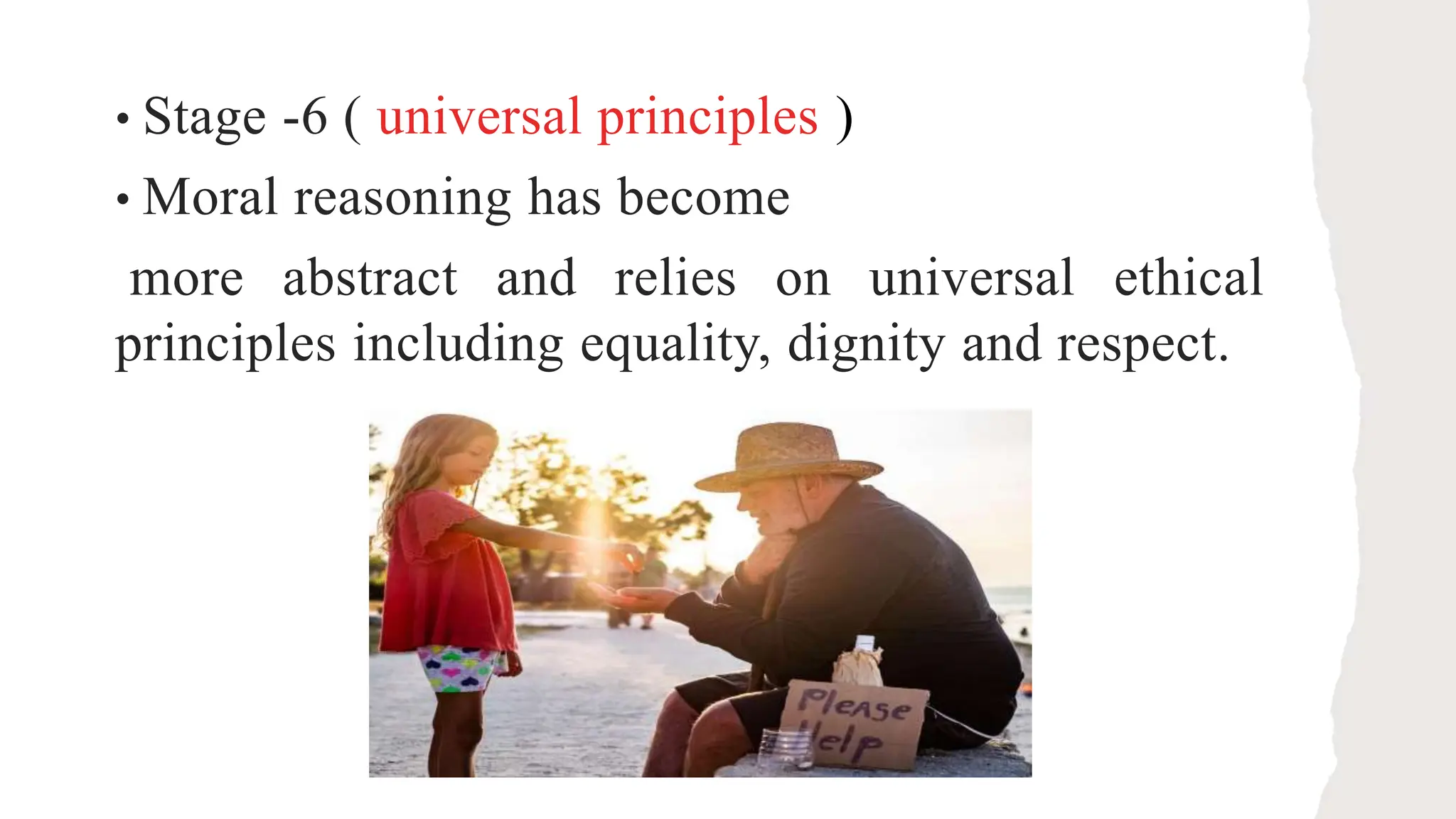
• Stage -6( universal principles )
• Moral reasoning has become
more abstract and relies on universal ethical
principles including equality, dignity and respect.