Margaret Granger/Asheley Jones ACSEducation | September 2012
Integrating SFIA with
Moodle and Mahara in
Continuing Professional
Development for IT
Professionals
Australian Computer Society - ACS
www.acs.org.au
Professional Organisation of ICT Professionals
Provides a certification program
CT – Certified Technician
CP – Certified Practitioner
Certification provides official recognition of your
competencies to potential employers
ACSEducation
The Education arm of ACS
Computer Professional Education Program - CPeP
Professional Year Program- PY
Diploma in IT Program – DIT
Delivered online using Moodle as the delivery platform
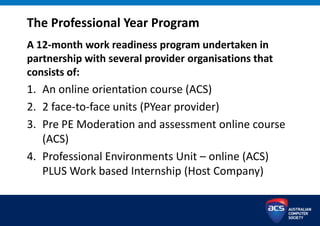
The Professional Year Program
A 12-month work readiness program undertaken in
partnership with several provider organisations that
consists of:
1. An online orientation course (ACS)
2. 2 face-to-face units (PYear provider)
3. Pre PE Moderation and assessment online course
(ACS)
4. Professional Environments Unit – online (ACS)
PLUS Work based Internship (Host Company)
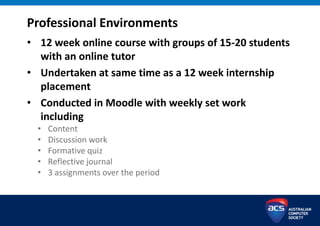
Professional Environments
• 12 week online course with groups of 15-20 students
with an online tutor
• Undertaken at same time as a 12 week internship
placement
• Conducted in Moodle with weekly set work
including
• Content
• Discussion work
• Formative quiz
• Reflective journal
• 3 assignments over the period
Preparing for the Workforce as IT Professionals
• Assessing and demonstrating your current skills
• What is your IT Skills area?
• Finding the shortfalls
• Planning for your professional development
Skills Framework for the Information Age
www.sfia-online.org
The Skills Framework for the Information Age (SFIA) provides a
common reference model for the identification of the skills
needed to develop effective Information Systems (IS) making
use of Information Communications Technologies (ICT).
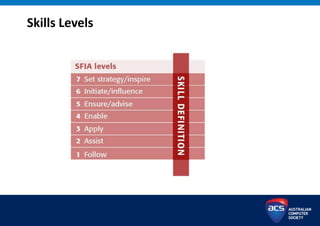
Skills Levels
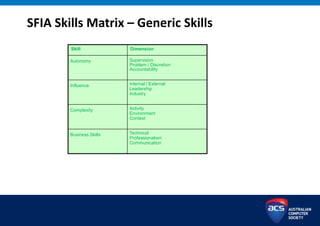
SFIA Skills Matrix – Generic Skills
Skill Dimension
Autonomy Supervision
Problem / Discretion
Accountability
Influence Internal / External
Leadership
Industry
Complexity Activity
Environment
Context
Business Skills Technical
Professionalism
Communication
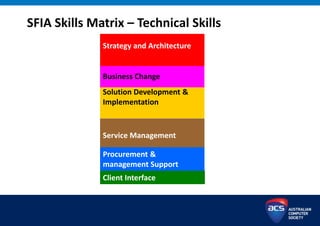
SFIA Skills Matrix – Technical Skills
Solution Development &
Implementation
Strategy and Architecture
Business Change
Client Interface
Service Management
Procurement &
management Support
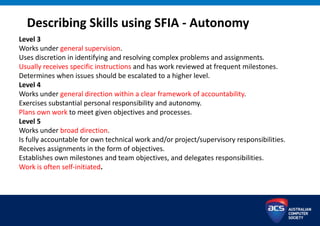
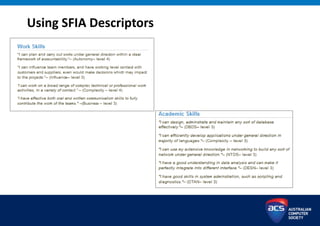
Describing Skills using SFIA - Autonomy
Level 3
Works under general supervision.
Uses discretion in identifying and resolving complex problems and assignments.
Usually receives specific instructions and has work reviewed at frequent milestones.
Determines when issues should be escalated to a higher level.
Level 4
Works under general direction within a clear framework of accountability.
Exercises substantial personal responsibility and autonomy.
Plans own work to meet given objectives and processes.
Level 5
Works under broad direction.
Is fully accountable for own technical work and/or project/supervisory responsibilities.
Receives assignments in the form of objectives.
Establishes own milestones and team objectives, and delegates responsibilities.
Work is often self-initiated.
SFIA and PY Program
Course outcomes mapped to SFIA
Skills Assessment section of the PE course
Students provided with an overview of SFIA
Students map skills to SFIA – generic skills and technical skills
Students develop e-portfolio using Mahara
Students in PY develop resume and job application within
Mahara as part of course work
E-portfolios
As component of PY Program
Skills are recorded in the Skills Artefacts of Mahara
Generic skills within Work Skills artefact
Technical skills within Academic Skills artefact
Career Planning and ongoing Professional Development
within the Career Planning artefact
Can also be presented by using a text box
NOTE: it would be nice to be able to at change labels within Mahara
here to better reflect these.
The Professional Year PY Program
This program is for former international students who
have graduated from a university within Australia and
are seeking permanent residency.
Includes a 12 week online program conducted by ACS
Education to include
Mapping of current skills to SFIA
Development of an e-portfolio in Mahara
Writing and peer review of Job Application
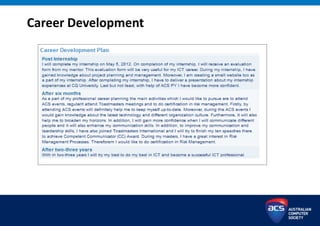
Development of Career Plan
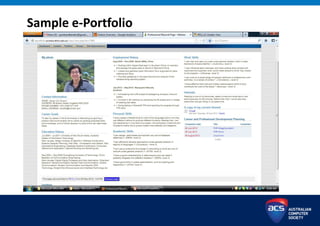
Sample e-Portfolio
Using SFIA Descriptors
Career Development
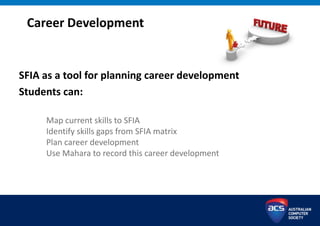
SFIA as a tool for planning career development
Students can:
Map current skills to SFIA
Identify skills gaps from SFIA matrix
Plan career development
Use Mahara to record this career development
Career Development
Student Feedback – PY Students
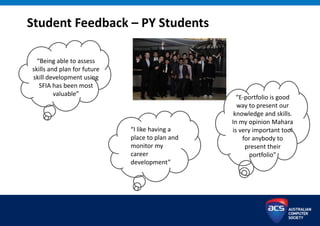
“E-portfolio is good
way to present our
knowledge and skills.
In my opinion Mahara
is very important tool
for anybody to
present their
portfolio”
“Being able to assess
skills and plan for future
skill development using
SFIA has been most
valuable”
“I like having a
place to plan and
monitor my
career
development”
Advantages of the e-Portfolio
Availability
ACS members have ongoing access to Mahara – although the
MySFIA tool available through the ACS website may mean that
any will choose to use this
Career Development Planning
Can use this artefact to provide a career plan and follow progress
Can use tool to develop customised Job Application for
sharing or presenting to prospective employers
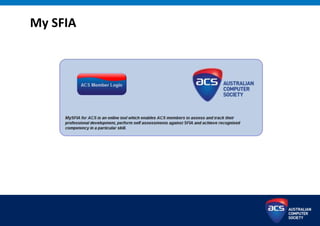
My SFIA
Customisation of ACS Portfolio (Mahara)
Relabelling of Skills Artefacts to reflect SFIA skills types
Addition of customised drop-down boxes with SFIA skills
Addition of webinars to supplement the online
environment for wider ACS Community
Future Developments - ACS Portfolio
Contacts and Further Information
Margaret Granger
MACS (Senior) CP
margaret.granger@acseducation.edu.au
Asheley Jones
MACS CP
asheley.jones@acseducation.edu.au

Intergrating SFIA with Moodle and Mahara in continuing Professional Development for IT Professionals

  • 1.
    Margaret Granger/Asheley JonesACSEducation | September 2012 Integrating SFIA with Moodle and Mahara in Continuing Professional Development for IT Professionals
  • 2.
    Australian Computer Society- ACS www.acs.org.au Professional Organisation of ICT Professionals Provides a certification program CT – Certified Technician CP – Certified Practitioner Certification provides official recognition of your competencies to potential employers
  • 3.
    ACSEducation The Education armof ACS Computer Professional Education Program - CPeP Professional Year Program- PY Diploma in IT Program – DIT Delivered online using Moodle as the delivery platform
  • 4.
    The Professional YearProgram A 12-month work readiness program undertaken in partnership with several provider organisations that consists of: 1. An online orientation course (ACS) 2. 2 face-to-face units (PYear provider) 3. Pre PE Moderation and assessment online course (ACS) 4. Professional Environments Unit – online (ACS) PLUS Work based Internship (Host Company)
  • 5.
    Professional Environments • 12week online course with groups of 15-20 students with an online tutor • Undertaken at same time as a 12 week internship placement • Conducted in Moodle with weekly set work including • Content • Discussion work • Formative quiz • Reflective journal • 3 assignments over the period
  • 6.
    Preparing for theWorkforce as IT Professionals • Assessing and demonstrating your current skills • What is your IT Skills area? • Finding the shortfalls • Planning for your professional development
  • 7.
    Skills Framework forthe Information Age www.sfia-online.org The Skills Framework for the Information Age (SFIA) provides a common reference model for the identification of the skills needed to develop effective Information Systems (IS) making use of Information Communications Technologies (ICT).
  • 8.
  • 9.
    SFIA Skills Matrix– Generic Skills Skill Dimension Autonomy Supervision Problem / Discretion Accountability Influence Internal / External Leadership Industry Complexity Activity Environment Context Business Skills Technical Professionalism Communication
  • 10.
    SFIA Skills Matrix– Technical Skills Solution Development & Implementation Strategy and Architecture Business Change Client Interface Service Management Procurement & management Support
  • 11.
    Describing Skills usingSFIA - Autonomy Level 3 Works under general supervision. Uses discretion in identifying and resolving complex problems and assignments. Usually receives specific instructions and has work reviewed at frequent milestones. Determines when issues should be escalated to a higher level. Level 4 Works under general direction within a clear framework of accountability. Exercises substantial personal responsibility and autonomy. Plans own work to meet given objectives and processes. Level 5 Works under broad direction. Is fully accountable for own technical work and/or project/supervisory responsibilities. Receives assignments in the form of objectives. Establishes own milestones and team objectives, and delegates responsibilities. Work is often self-initiated.
  • 12.
    SFIA and PYProgram Course outcomes mapped to SFIA Skills Assessment section of the PE course Students provided with an overview of SFIA Students map skills to SFIA – generic skills and technical skills Students develop e-portfolio using Mahara Students in PY develop resume and job application within Mahara as part of course work
  • 13.
    E-portfolios As component ofPY Program Skills are recorded in the Skills Artefacts of Mahara Generic skills within Work Skills artefact Technical skills within Academic Skills artefact Career Planning and ongoing Professional Development within the Career Planning artefact Can also be presented by using a text box NOTE: it would be nice to be able to at change labels within Mahara here to better reflect these.
  • 14.
    The Professional YearPY Program This program is for former international students who have graduated from a university within Australia and are seeking permanent residency. Includes a 12 week online program conducted by ACS Education to include Mapping of current skills to SFIA Development of an e-portfolio in Mahara Writing and peer review of Job Application Development of Career Plan
  • 15.
  • 16.
  • 17.
    Career Development SFIA asa tool for planning career development Students can: Map current skills to SFIA Identify skills gaps from SFIA matrix Plan career development Use Mahara to record this career development
  • 18.
  • 19.
    Student Feedback –PY Students “E-portfolio is good way to present our knowledge and skills. In my opinion Mahara is very important tool for anybody to present their portfolio” “Being able to assess skills and plan for future skill development using SFIA has been most valuable” “I like having a place to plan and monitor my career development”
  • 20.
    Advantages of thee-Portfolio Availability ACS members have ongoing access to Mahara – although the MySFIA tool available through the ACS website may mean that any will choose to use this Career Development Planning Can use this artefact to provide a career plan and follow progress Can use tool to develop customised Job Application for sharing or presenting to prospective employers
  • 21.
  • 22.
    Customisation of ACSPortfolio (Mahara) Relabelling of Skills Artefacts to reflect SFIA skills types Addition of customised drop-down boxes with SFIA skills Addition of webinars to supplement the online environment for wider ACS Community Future Developments - ACS Portfolio
  • 23.
    Contacts and FurtherInformation Margaret Granger MACS (Senior) CP margaret.granger@acseducation.edu.au Asheley Jones MACS CP asheley.jones@acseducation.edu.au