Flexible career pathways
Roland Trice, deputy network operations director, Jisc
• Jisc was formed by bringing together sub-contractors of the old JISC
- People from 18 different organisations TUPEd into Jisc
- Multiple salary grades, pay spines, job roles etc
• We needed to establish standard grade and salary structures
- For fairness
- To comply with the law
• We sought third party professional advice
- Job families created along with a grade and salary structure
People challenges for Jisc
2 Flexible career pathways using SFIA
• Seven grades defined, A-G
- Grade A, divisional director roles, G junior team member roles
- Plus an executive director grade beyond grade A
• Structure followed a “traditional” people management hierarchy
- People management often the only route to promotion
- Career limitations for people in purely technical roles
- Often result in inefficient “lollipop” management structures
• No senior technical infrastructure role at Grade A
- Directors of technical divisions are in the service and project delivery family
Establishing a structure
3 Flexible career pathways using SFIA
• Most people managers retain a technical role
• People management and often takes a poor second place because:
- The day-job (the techie bit) “is more important”
- “I have services to run, deadlines to meet, members to support, etc etc etc”
- “My team are really good, so they don’t need much management”
• This is bad for our business
- Technical and people management work often compromised
The “Curse of the player-manager”
4 Flexible career pathways using SFIA
• We want to establish clear technical career pathways across Jisc
- That allow staff to map and develop their careers within and beyond Jisc
• Enable staff to develop as far as possible on technical merit alone
- Without having to become people manages simply to get a promotion
• To establish flexible grading schemes
- Which allow movement along the career path without huge amounts of paperwork
• Enable people to change pathways if they wish
• Establish people management as a technical skill
- Requiring its own career pathway
• We are using SFIA to help us define career pathways in many technical areas,
this is work in progress
Establishing technical career pathways for all
5 Flexible career pathways using SFIA
• You need a licence before you can get the material
• For most uses of SFIA, the licence is free
This slide set contains information from the Skills Framework for the Information Age,
with the permission of the SFIA Foundation
sfia-online.org
The Skills Framework for the Information Age (SFIA)
6 Flexible career pathways using SFIA
• SFIA is a reference architecture designed to describe the skills needed
by professionals working in the information industry
• SFIA provides a framework of professional skills which are mapped to
seven levels of responsibility
• Those responsibilities are defined in terms of the core business attributes
at each layer of the SFIA model:
-Autonomy, business skills, complexity, influence, knowledge
sfia-online.org
The Skills Framework for the Information Age (SFIA)
7 Flexible career pathways using SFIA
• SFIA is designed to be flexible, and to fit into an organisation’s
established ways of working
• It does not define structures, roles or jobs but provides clear descriptions
of skills and levels of responsibility
• It makes no attempt to define organisational values
• Role descriptions can be built from a number of key skills, each with its
own levels of responsibility
sfia-online.org
SFIA
8 Flexible career pathways using SFIA
• Practical experience lies at the heart of SFIA
-To be recognised as having a skill an individual must practise
that skill in a real-world situation by applying knowledge and
achieving outcomes
-Demonstrating you can use skills in your day job, is critical to
moving along the pathway
• It is not sufficient simply to go on a course, tick a box and
expect to progress
sfia-online.org
Experience is key
9 Flexible career pathways using SFIA
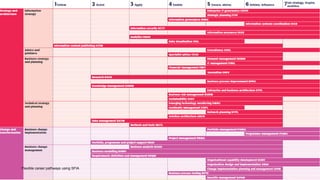
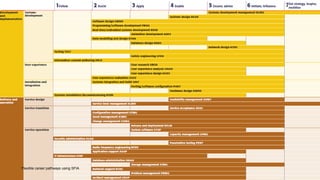
• SFIA 7 consists of 102 professional skills
-Not all skills are defined over all seven responsibility levels
• A skill at a particular SFIA level is consistent with the generic level of
responsibility that applies to that level
• The good news for Jisc, is that the SFIA levels map nicely into our
existing job family and grading structure, so no need to throw these away
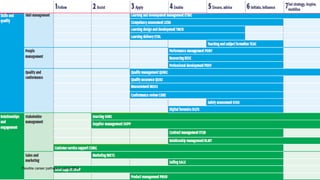
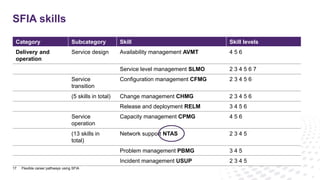
SFIA skills
10 Flexible career pathways using SFIA
SFIA skills
11 Flexible career pathways using SFIA
SFIA skills
12 Flexible career pathways using SFIA
SFIA skills
13 Flexible career pathways using SFIA
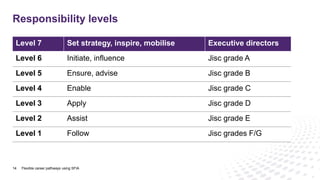
Responsibility levels
14
Level 7 Set strategy, inspire, mobilise Executive directors
Level 6 Initiate, influence Jisc grade A
Level 5 Ensure, advise Jisc grade B
Level 4 Enable Jisc grade C
Level 3 Apply Jisc grade D
Level 2 Assist Jisc grade E
Level 1 Follow Jisc grades F/G
Flexible career pathways using SFIA
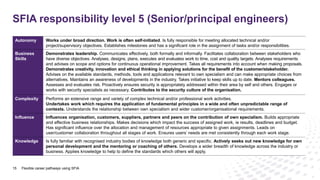
SFIA responsibility level 5 (Senior/principal engineers)
Flexible career pathways using SFIA15
Autonomy Works under broad direction. Work is often self-initiated. Is fully responsible for meeting allocated technical and/or
project/supervisory objectives. Establishes milestones and has a significant role in the assignment of tasks and/or responsibilities.
Business
Skills
Demonstrates leadership. Communicates effectively, both formally and informally. Facilitates collaboration between stakeholders who
have diverse objectives. Analyses, designs, plans, executes and evaluates work to time, cost and quality targets. Analyses requirements
and advises on scope and options for continuous operational improvement. Takes all requirements into account when making proposals.
Demonstrates creativity, innovation and ethical thinking in applying solutions for the benefit of the customer/stakeholder.
Advises on the available standards, methods, tools and applications relevant to own specialism and can make appropriate choices from
alternatives. Maintains an awareness of developments in the industry. Takes initiative to keep skills up to date. Mentors colleagues.
Assesses and evaluates risk. Proactively ensures security is appropriately addressed within their area by self and others. Engages or
works with security specialists as necessary. Contributes to the security culture of the organisation.
Complexity Performs an extensive range and variety of complex technical and/or professional work activities.
Undertakes work which requires the application of fundamental principles in a wide and often unpredictable range of
contexts. Understands the relationship between own specialism and wider customer/organisational requirements.
Influence Influences organisation, customers, suppliers, partners and peers on the contribution of own specialism. Builds appropriate
and effective business relationships. Makes decisions which impact the success of assigned work, ie results, deadlines and budget.
Has significant influence over the allocation and management of resources appropriate to given assignments. Leads on
user/customer collaboration throughout all stages of work. Ensures users’ needs are met consistently through each work stage.
Knowledge Is fully familiar with recognised industry bodies of knowledge both generic and specific. Actively seeks out new knowledge for own
personal development and the mentoring or coaching of others. Develops a wider breadth of knowledge across the industry or
business. Applies knowledge to help to define the standards which others will apply.
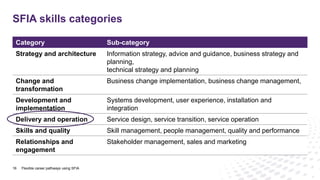
SFIA skills categories
16
Category Sub-category
Strategy and architecture Information strategy, advice and guidance, business strategy and
planning,
technical strategy and planning
Change and
transformation
Business change implementation, business change management,
Development and
implementation
Systems development, user experience, installation and
integration
Delivery and operation Service design, service transition, service operation
Skills and quality Skill management, people management, quality and performance
Relationships and
engagement
Stakeholder management, sales and marketing
Flexible career pathways using SFIA
SFIA skills
17
Category Subcategory Skill Skill levels
Delivery and
operation
Service design Availability management AVMT 4 5 6
Service level management SLMO 2 3 4 5 6 7
Service
transition
Configuration management CFMG 2 3 4 5 6
(5 skills in total) Change management CHMG 2 3 4 5 6
Release and deployment RELM 3 4 5 6
Service
operation
Capacity management CPMG 4 5 6
(13 skills in
total)
Network support NTAS 2 3 4 5
Problem management PBMG 3 4 5
Incident management USUP 2 3 4 5
Flexible career pathways using SFIA
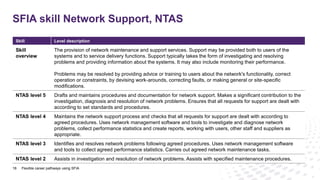
SFIA skill Network Support, NTAS
18
Skill Level description
Skill
overview
The provision of network maintenance and support services. Support may be provided both to users of the
systems and to service delivery functions. Support typically takes the form of investigating and resolving
problems and providing information about the systems. It may also include monitoring their performance.
Problems may be resolved by providing advice or training to users about the network's functionality, correct
operation or constraints, by devising work-arounds, correcting faults, or making general or site-specific
modifications.
NTAS level 5 Drafts and maintains procedures and documentation for network support. Makes a significant contribution to the
investigation, diagnosis and resolution of network problems. Ensures that all requests for support are dealt with
according to set standards and procedures.
NTAS level 4 Maintains the network support process and checks that all requests for support are dealt with according to
agreed procedures. Uses network management software and tools to investigate and diagnose network
problems, collect performance statistics and create reports, working with users, other staff and suppliers as
appropriate.
NTAS level 3 Identifies and resolves network problems following agreed procedures. Uses network management software
and tools to collect agreed performance statistics. Carries out agreed network maintenance tasks.
NTAS level 2 Assists in investigation and resolution of network problems. Assists with specified maintenance procedures.
Flexible career pathways using SFIA
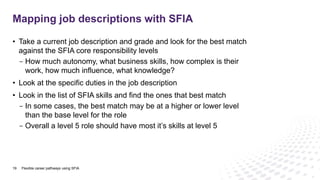
• Take a current job description and grade and look for the best match
against the SFIA core responsibility levels
- How much autonomy, what business skills, how complex is their
work, how much influence, what knowledge?
• Look at the specific duties in the job description
• Look in the list of SFIA skills and find the ones that best match
- In some cases, the best match may be at a higher or lower level
than the base level for the role
- Overall a level 5 role should have most it’s skills at level 5
Mapping job descriptions with SFIA
19 Flexible career pathways using SFIA
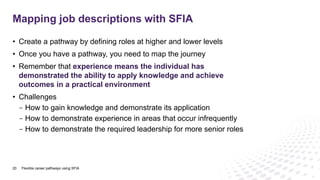
• Create a pathway by defining roles at higher and lower levels
• Once you have a pathway, you need to map the journey
• Remember that experience means the individual has
demonstrated the ability to apply knowledge and achieve
outcomes in a practical environment
• Challenges
- How to gain knowledge and demonstrate its application
- How to demonstrate experience in areas that occur infrequently
- How to demonstrate the required leadership for more senior roles
Mapping job descriptions with SFIA
20 Flexible career pathways using SFIA
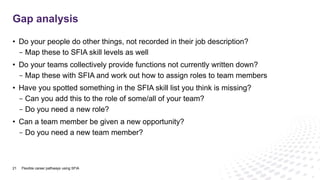
• Do your people do other things, not recorded in their job description?
- Map these to SFIA skill levels as well
• Do your teams collectively provide functions not currently written down?
- Map these with SFIA and work out how to assign roles to team members
• Have you spotted something in the SFIA skill list you think is missing?
- Can you add this to the role of some/all of your team?
- Do you need a new role?
• Can a team member be given a new opportunity?
- Do you need a new team member?
Gap analysis
21 Flexible career pathways using SFIA
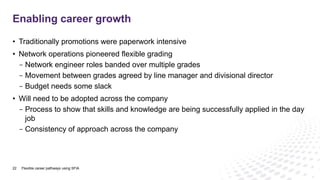
• Traditionally promotions were paperwork intensive
• Network operations pioneered flexible grading
- Network engineer roles banded over multiple grades
- Movement between grades agreed by line manager and divisional director
- Budget needs some slack
• Will need to be adopted across the company
- Process to show that skills and knowledge are being successfully applied in the day
job
- Consistency of approach across the company
Enabling career growth
22 Flexible career pathways using SFIA
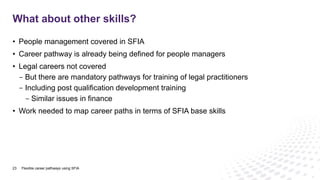
• People management covered in SFIA
• Career pathway is already being defined for people managers
• Legal careers not covered
- But there are mandatory pathways for training of legal practitioners
- Including post qualification development training
- Similar issues in finance
• Work needed to map career paths in terms of SFIA base skills
What about other skills?
23 Flexible career pathways using SFIA
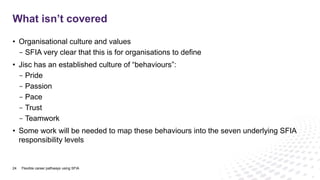
• Organisational culture and values
- SFIA very clear that this is for organisations to define
• Jisc has an established culture of “behaviours”:
- Pride
- Passion
- Pace
- Trust
- Teamwork
• Some work will be needed to map these behaviours into the seven underlying SFIA
responsibility levels
What isn’t covered
24 Flexible career pathways using SFIA
• SFIA has been developed and successfully applied for a long time
• Other people have worked hard on the definitions
- So you don’t have to write your own
- Once SFIA was discovered all our TCP leads adopted it where they could
• Even for the skills not defined in SFIA (Legal for example)
- The base responsibility levels provide an anchor for stuff you do have to write
- To ensure compatibility with the SFIA skills you do adopt elsewhere
Advantages
25 Flexible career pathways using SFIA
• You decide how your business is organised not SFIA
• Just because SFIA has 102 skills
- It does not mean your team needs all of them
- It does not mean your organisation needs SFIA everywhere
• Just because a skill has several levels
- You may not need to employ people at each and every one of them
- Your career pathways may end before the end of the SFIA skill levels
• You decide how the application of knowledge is demonstrated
You drive SFIA, it does not drive you
26 Flexible career pathways using SFIA
customerservices@jisc.ac.uk
jisc.ac.uk
Thank you
Rolly Trice
Deputy network operations director
roland.trice@jisc.ac.uk
Lumen House, Harwell Oxford, OX11 0QS
01235 822206
operations@ja.net

Flexible career pathways

  • 1.
    Flexible career pathways RolandTrice, deputy network operations director, Jisc
  • 2.
    • Jisc wasformed by bringing together sub-contractors of the old JISC - People from 18 different organisations TUPEd into Jisc - Multiple salary grades, pay spines, job roles etc • We needed to establish standard grade and salary structures - For fairness - To comply with the law • We sought third party professional advice - Job families created along with a grade and salary structure People challenges for Jisc 2 Flexible career pathways using SFIA
  • 3.
    • Seven gradesdefined, A-G - Grade A, divisional director roles, G junior team member roles - Plus an executive director grade beyond grade A • Structure followed a “traditional” people management hierarchy - People management often the only route to promotion - Career limitations for people in purely technical roles - Often result in inefficient “lollipop” management structures • No senior technical infrastructure role at Grade A - Directors of technical divisions are in the service and project delivery family Establishing a structure 3 Flexible career pathways using SFIA
  • 4.
    • Most peoplemanagers retain a technical role • People management and often takes a poor second place because: - The day-job (the techie bit) “is more important” - “I have services to run, deadlines to meet, members to support, etc etc etc” - “My team are really good, so they don’t need much management” • This is bad for our business - Technical and people management work often compromised The “Curse of the player-manager” 4 Flexible career pathways using SFIA
  • 5.
    • We wantto establish clear technical career pathways across Jisc - That allow staff to map and develop their careers within and beyond Jisc • Enable staff to develop as far as possible on technical merit alone - Without having to become people manages simply to get a promotion • To establish flexible grading schemes - Which allow movement along the career path without huge amounts of paperwork • Enable people to change pathways if they wish • Establish people management as a technical skill - Requiring its own career pathway • We are using SFIA to help us define career pathways in many technical areas, this is work in progress Establishing technical career pathways for all 5 Flexible career pathways using SFIA
  • 6.
    • You needa licence before you can get the material • For most uses of SFIA, the licence is free This slide set contains information from the Skills Framework for the Information Age, with the permission of the SFIA Foundation sfia-online.org The Skills Framework for the Information Age (SFIA) 6 Flexible career pathways using SFIA
  • 7.
    • SFIA isa reference architecture designed to describe the skills needed by professionals working in the information industry • SFIA provides a framework of professional skills which are mapped to seven levels of responsibility • Those responsibilities are defined in terms of the core business attributes at each layer of the SFIA model: -Autonomy, business skills, complexity, influence, knowledge sfia-online.org The Skills Framework for the Information Age (SFIA) 7 Flexible career pathways using SFIA
  • 8.
    • SFIA isdesigned to be flexible, and to fit into an organisation’s established ways of working • It does not define structures, roles or jobs but provides clear descriptions of skills and levels of responsibility • It makes no attempt to define organisational values • Role descriptions can be built from a number of key skills, each with its own levels of responsibility sfia-online.org SFIA 8 Flexible career pathways using SFIA
  • 9.
    • Practical experiencelies at the heart of SFIA -To be recognised as having a skill an individual must practise that skill in a real-world situation by applying knowledge and achieving outcomes -Demonstrating you can use skills in your day job, is critical to moving along the pathway • It is not sufficient simply to go on a course, tick a box and expect to progress sfia-online.org Experience is key 9 Flexible career pathways using SFIA
  • 10.
    • SFIA 7consists of 102 professional skills -Not all skills are defined over all seven responsibility levels • A skill at a particular SFIA level is consistent with the generic level of responsibility that applies to that level • The good news for Jisc, is that the SFIA levels map nicely into our existing job family and grading structure, so no need to throw these away SFIA skills 10 Flexible career pathways using SFIA
  • 11.
    SFIA skills 11 Flexiblecareer pathways using SFIA
  • 12.
    SFIA skills 12 Flexiblecareer pathways using SFIA
  • 13.
    SFIA skills 13 Flexiblecareer pathways using SFIA
  • 14.
    Responsibility levels 14 Level 7Set strategy, inspire, mobilise Executive directors Level 6 Initiate, influence Jisc grade A Level 5 Ensure, advise Jisc grade B Level 4 Enable Jisc grade C Level 3 Apply Jisc grade D Level 2 Assist Jisc grade E Level 1 Follow Jisc grades F/G Flexible career pathways using SFIA
  • 15.
    SFIA responsibility level5 (Senior/principal engineers) Flexible career pathways using SFIA15 Autonomy Works under broad direction. Work is often self-initiated. Is fully responsible for meeting allocated technical and/or project/supervisory objectives. Establishes milestones and has a significant role in the assignment of tasks and/or responsibilities. Business Skills Demonstrates leadership. Communicates effectively, both formally and informally. Facilitates collaboration between stakeholders who have diverse objectives. Analyses, designs, plans, executes and evaluates work to time, cost and quality targets. Analyses requirements and advises on scope and options for continuous operational improvement. Takes all requirements into account when making proposals. Demonstrates creativity, innovation and ethical thinking in applying solutions for the benefit of the customer/stakeholder. Advises on the available standards, methods, tools and applications relevant to own specialism and can make appropriate choices from alternatives. Maintains an awareness of developments in the industry. Takes initiative to keep skills up to date. Mentors colleagues. Assesses and evaluates risk. Proactively ensures security is appropriately addressed within their area by self and others. Engages or works with security specialists as necessary. Contributes to the security culture of the organisation. Complexity Performs an extensive range and variety of complex technical and/or professional work activities. Undertakes work which requires the application of fundamental principles in a wide and often unpredictable range of contexts. Understands the relationship between own specialism and wider customer/organisational requirements. Influence Influences organisation, customers, suppliers, partners and peers on the contribution of own specialism. Builds appropriate and effective business relationships. Makes decisions which impact the success of assigned work, ie results, deadlines and budget. Has significant influence over the allocation and management of resources appropriate to given assignments. Leads on user/customer collaboration throughout all stages of work. Ensures users’ needs are met consistently through each work stage. Knowledge Is fully familiar with recognised industry bodies of knowledge both generic and specific. Actively seeks out new knowledge for own personal development and the mentoring or coaching of others. Develops a wider breadth of knowledge across the industry or business. Applies knowledge to help to define the standards which others will apply.
  • 16.
    SFIA skills categories 16 CategorySub-category Strategy and architecture Information strategy, advice and guidance, business strategy and planning, technical strategy and planning Change and transformation Business change implementation, business change management, Development and implementation Systems development, user experience, installation and integration Delivery and operation Service design, service transition, service operation Skills and quality Skill management, people management, quality and performance Relationships and engagement Stakeholder management, sales and marketing Flexible career pathways using SFIA
  • 17.
    SFIA skills 17 Category SubcategorySkill Skill levels Delivery and operation Service design Availability management AVMT 4 5 6 Service level management SLMO 2 3 4 5 6 7 Service transition Configuration management CFMG 2 3 4 5 6 (5 skills in total) Change management CHMG 2 3 4 5 6 Release and deployment RELM 3 4 5 6 Service operation Capacity management CPMG 4 5 6 (13 skills in total) Network support NTAS 2 3 4 5 Problem management PBMG 3 4 5 Incident management USUP 2 3 4 5 Flexible career pathways using SFIA
  • 18.
    SFIA skill NetworkSupport, NTAS 18 Skill Level description Skill overview The provision of network maintenance and support services. Support may be provided both to users of the systems and to service delivery functions. Support typically takes the form of investigating and resolving problems and providing information about the systems. It may also include monitoring their performance. Problems may be resolved by providing advice or training to users about the network's functionality, correct operation or constraints, by devising work-arounds, correcting faults, or making general or site-specific modifications. NTAS level 5 Drafts and maintains procedures and documentation for network support. Makes a significant contribution to the investigation, diagnosis and resolution of network problems. Ensures that all requests for support are dealt with according to set standards and procedures. NTAS level 4 Maintains the network support process and checks that all requests for support are dealt with according to agreed procedures. Uses network management software and tools to investigate and diagnose network problems, collect performance statistics and create reports, working with users, other staff and suppliers as appropriate. NTAS level 3 Identifies and resolves network problems following agreed procedures. Uses network management software and tools to collect agreed performance statistics. Carries out agreed network maintenance tasks. NTAS level 2 Assists in investigation and resolution of network problems. Assists with specified maintenance procedures. Flexible career pathways using SFIA
  • 19.
    • Take acurrent job description and grade and look for the best match against the SFIA core responsibility levels - How much autonomy, what business skills, how complex is their work, how much influence, what knowledge? • Look at the specific duties in the job description • Look in the list of SFIA skills and find the ones that best match - In some cases, the best match may be at a higher or lower level than the base level for the role - Overall a level 5 role should have most it’s skills at level 5 Mapping job descriptions with SFIA 19 Flexible career pathways using SFIA
  • 20.
    • Create apathway by defining roles at higher and lower levels • Once you have a pathway, you need to map the journey • Remember that experience means the individual has demonstrated the ability to apply knowledge and achieve outcomes in a practical environment • Challenges - How to gain knowledge and demonstrate its application - How to demonstrate experience in areas that occur infrequently - How to demonstrate the required leadership for more senior roles Mapping job descriptions with SFIA 20 Flexible career pathways using SFIA
  • 21.
    • Do yourpeople do other things, not recorded in their job description? - Map these to SFIA skill levels as well • Do your teams collectively provide functions not currently written down? - Map these with SFIA and work out how to assign roles to team members • Have you spotted something in the SFIA skill list you think is missing? - Can you add this to the role of some/all of your team? - Do you need a new role? • Can a team member be given a new opportunity? - Do you need a new team member? Gap analysis 21 Flexible career pathways using SFIA
  • 22.
    • Traditionally promotionswere paperwork intensive • Network operations pioneered flexible grading - Network engineer roles banded over multiple grades - Movement between grades agreed by line manager and divisional director - Budget needs some slack • Will need to be adopted across the company - Process to show that skills and knowledge are being successfully applied in the day job - Consistency of approach across the company Enabling career growth 22 Flexible career pathways using SFIA
  • 23.
    • People managementcovered in SFIA • Career pathway is already being defined for people managers • Legal careers not covered - But there are mandatory pathways for training of legal practitioners - Including post qualification development training - Similar issues in finance • Work needed to map career paths in terms of SFIA base skills What about other skills? 23 Flexible career pathways using SFIA
  • 24.
    • Organisational cultureand values - SFIA very clear that this is for organisations to define • Jisc has an established culture of “behaviours”: - Pride - Passion - Pace - Trust - Teamwork • Some work will be needed to map these behaviours into the seven underlying SFIA responsibility levels What isn’t covered 24 Flexible career pathways using SFIA
  • 25.
    • SFIA hasbeen developed and successfully applied for a long time • Other people have worked hard on the definitions - So you don’t have to write your own - Once SFIA was discovered all our TCP leads adopted it where they could • Even for the skills not defined in SFIA (Legal for example) - The base responsibility levels provide an anchor for stuff you do have to write - To ensure compatibility with the SFIA skills you do adopt elsewhere Advantages 25 Flexible career pathways using SFIA
  • 26.
    • You decidehow your business is organised not SFIA • Just because SFIA has 102 skills - It does not mean your team needs all of them - It does not mean your organisation needs SFIA everywhere • Just because a skill has several levels - You may not need to employ people at each and every one of them - Your career pathways may end before the end of the SFIA skill levels • You decide how the application of knowledge is demonstrated You drive SFIA, it does not drive you 26 Flexible career pathways using SFIA
  • 27.
    customerservices@jisc.ac.uk jisc.ac.uk Thank you Rolly Trice Deputynetwork operations director roland.trice@jisc.ac.uk Lumen House, Harwell Oxford, OX11 0QS 01235 822206 operations@ja.net