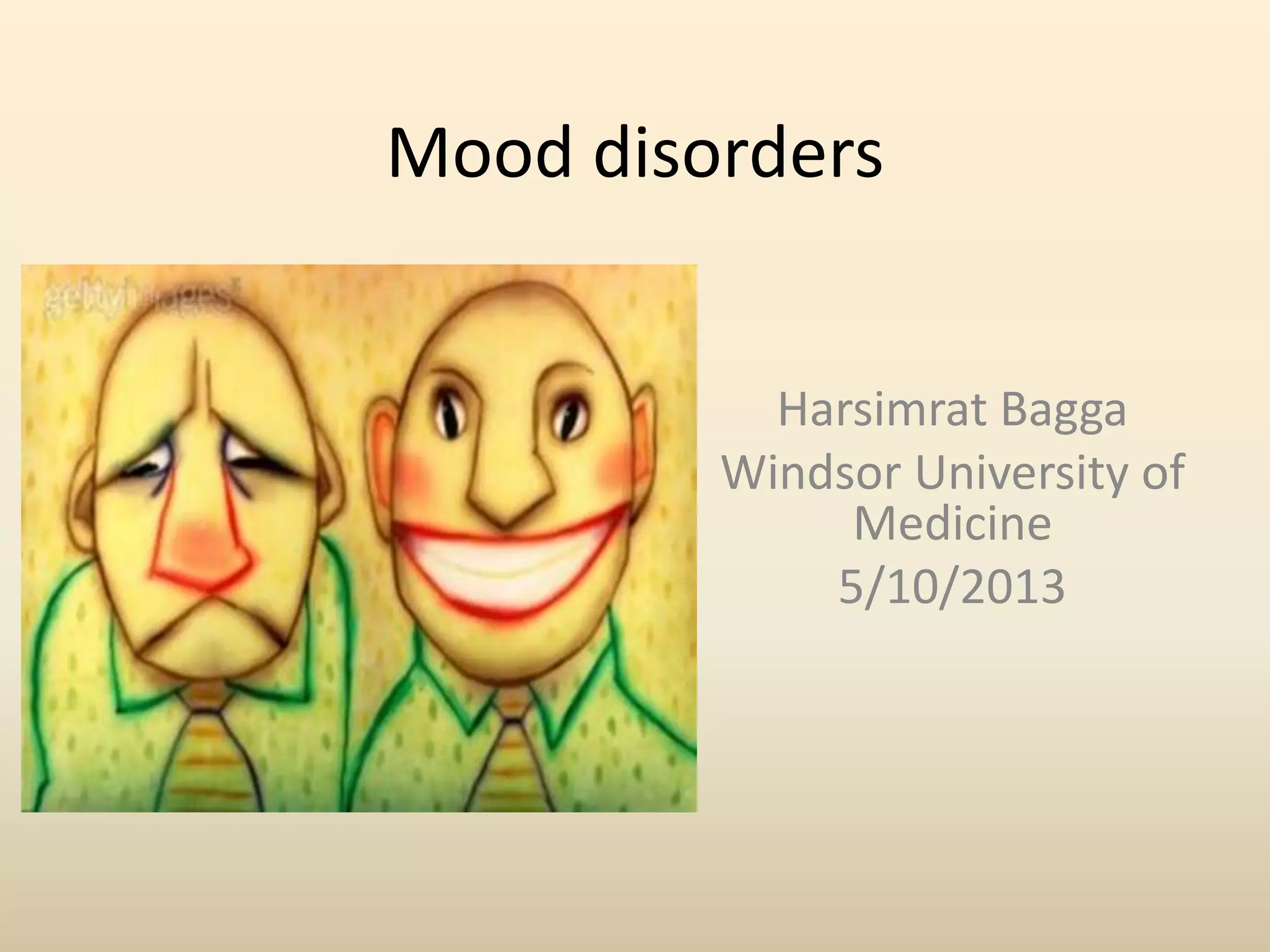
Mood disorders
Harsimrat Bagga
Windsor University of
Medicine
5/10/2013
‘’32 year old man was apprehended by the police 2 weeks ago
for running across the freeway without regard for his personal
safety. The patient stated that he did this “ for the heck of it.”
The patient appeared distracted during the initial
interview, spoke rapidly, and gave long drawn out answers.
When asked about his mood, the patient said that he is feeling
“okay, I’m under the weather, if you get my drift.” He was
admitted to the inpatient unit for observation.
Since his admission, he has been saying that he will soon replace
the president, that he is the next Alexander the Great, and that
he was told by the voices in his head. The patient’s admission
laboratory values, including the drug screen for illicit
substances, came back normal. Which of the following is the
most likely diagnosis?”
• A) Bipolar disorder with psychotic features
• B) Bipolar disorder without psychotic features
• C) Depression with psychotic features
• D) Schizophrenia , disorganized type
• E) Schizophrenia, paranoid type
• Do you know many people are suffering from the
mood disorders that highly impair their daily
functioning and do not even get diagnosed
• Do you know many well-known people have been
diagnosed with mood disorders but are well-
treated to the point that they attain their normal
level of functioning
• Example:
• Catherine Zeta Jones- Bipolar II
Mel Gibson- Bipolar
Jim Carrey- Depression
• So lets study mood
disorders and see
how adequate
diagnosis and
treatment can make a
difference in people’s
lives!
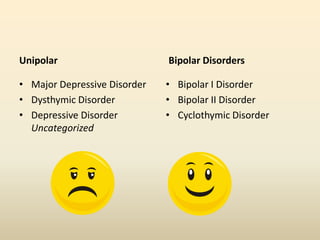
Unipolar
• Major Depressive Disorder
• Dysthymic Disorder
• Depressive Disorder
Uncategorized
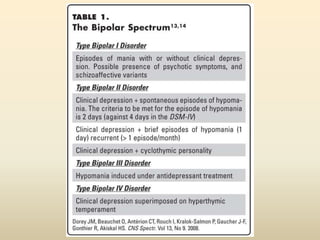
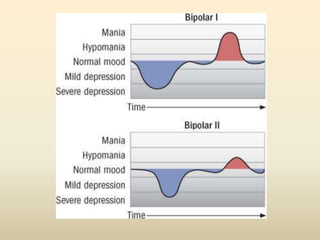
Bipolar Disorders
• Bipolar I Disorder
• Bipolar II Disorder
• Cyclothymic Disorder
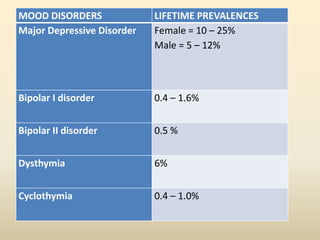
MOOD DISORDERS LIFETIME PREVALENCES
Major Depressive Disorder Female = 10 – 25%
Male = 5 – 12%
Bipolar I disorder 0.4 – 1.6%
Bipolar II disorder 0.5 %
Dysthymia 6%
Cyclothymia 0.4 – 1.0%
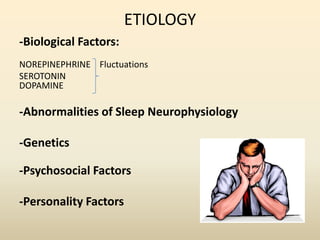
ETIOLOGY
-Biological Factors:
NOREPINEPHRINE Fluctuations
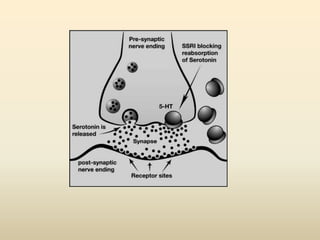
SEROTONIN
DOPAMINE
-Abnormalities of Sleep Neurophysiology
-Genetics
-Psychosocial Factors
-Personality Factors
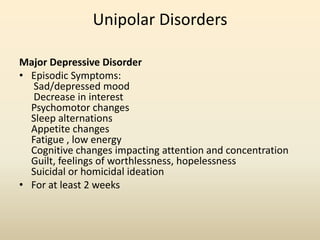
Unipolar Disorders
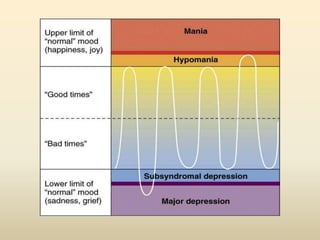
Major Depressive Disorder
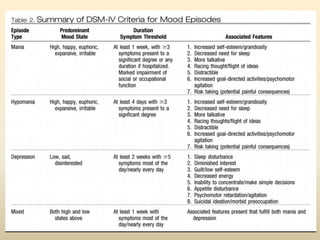
• Episodic Symptoms:
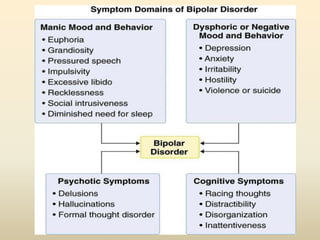
Sad/depressed mood
Decrease in interest
Psychomotor changes
Sleep alternations
Appetite changes
Fatigue , low energy
Cognitive changes impacting attention and concentration
Guilt, feelings of worthlessness, hopelessness
Suicidal or homicidal ideation
• For at least 2 weeks
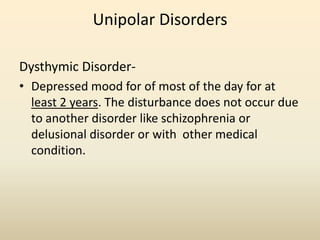
Unipolar Disorders
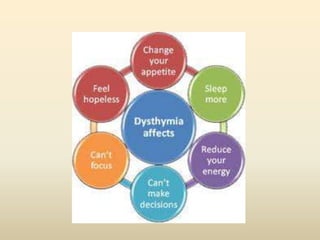
Dysthymic Disorder-
• Depressed mood for of most of the day for at
least 2 years. The disturbance does not occur due
to another disorder like schizophrenia or
delusional disorder or with other medical
condition.
Unipolar Disorders
Atypical depression
• characterized by marked “anhedonia”, weight
gain, increase in
appetite, hypersomnia, ‘leaden paralysis’, and
significant social impairment, hypersensitivity
to perceived interpersonal rejection by others
Unipolar Disorders
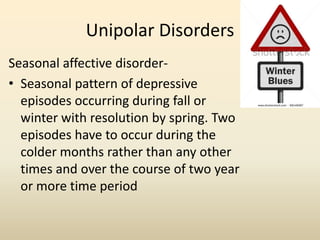
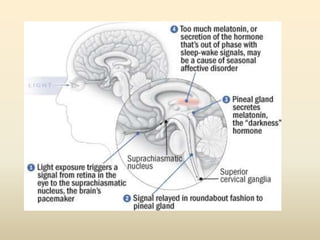
Seasonal affective disorder-
• Seasonal pattern of depressive
episodes occurring during fall or
winter with resolution by spring. Two
episodes have to occur during the
colder months rather than any other
times and over the course of two year
or more time period
Unipolar Disorders
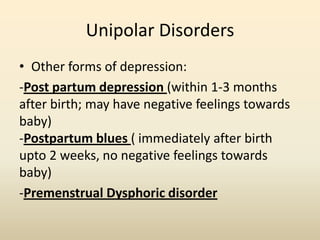
• Other forms of depression:
-Post partum depression (within 1-3 months
after birth; may have negative feelings towards
baby)
-Postpartum blues ( immediately after birth
upto 2 weeks, no negative feelings towards
baby)
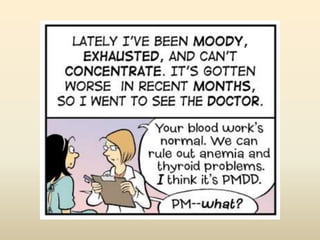
-Premenstrual Dysphoric disorder
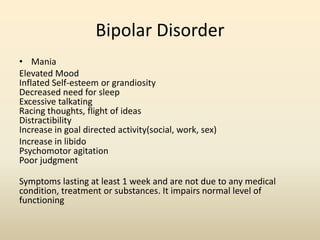
Bipolar Disorder
• Mania
Elevated Mood
Inflated Self-esteem or grandiosity
Decreased need for sleep
Excessive talkating
Racing thoughts, flight of ideas
Distractibility
Increase in goal directed activity(social, work, sex)
Increase in libido
Psychomotor agitation
Poor judgment
Symptoms lasting at least 1 week and are not due to any medical
condition, treatment or substances. It impairs normal level of
functioning
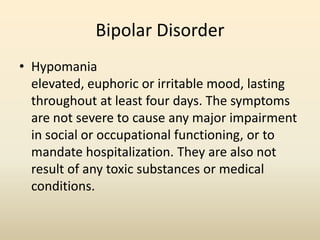
Bipolar Disorder
• Hypomania
elevated, euphoric or irritable mood, lasting
throughout at least four days. The symptoms
are not severe to cause any major impairment
in social or occupational functioning, or to
mandate hospitalization. They are also not
result of any toxic substances or medical
conditions.
Rapidly cycling Bipolar:
• 4 episodes of Mania in 1 year. It is due to use
of anti-depressants
Bipolar Disorder
• Cyclothymic Disorder –
The occurrence of several periods of alternating
hypomanic symptoms with depressive
symptoms for at least 2 years. These symptoms
not due to the effects of substances, mediations
or medical conditions and they do cause
significant distress or impairment in functioning.
TREATMENT
Goals
• Patient’s safety primary concern
• Complete and thorough diagnostic
assessment
• Treatment plan addressing not just immediate
symptoms but overall patient’s prospective
well-being.
• The need for hospitalization should be
evaluated
Treatment
• Hospitalization:
• Psychosocial Therapy
• Cognitive Therapy
• Interpersonal Therapy
• Behavior Therapy
• Psychoanatically-oriented Therapy
• Family Therapy
• Pharmacotherapy:
Treatment
• Pharmacotherapy:
Major Depressive Disorder - MAOI’s, TCAC’s,
SSRI’s, SNRI’s, mirtazipine, Bupropian
Bipolar Disorders - Lithium, anticonvulsants,
antipsychotics
Alternatives to drug therapy: Electroconvulsive
therapy (ECT)
References
• Merino, L. (2009). Mood Disorders; Retrieved from:
http://www.slideshare.net/Lucia_Merino/mood-disorders-
presentation-3893405
• Dr. Manood, H. (2010). Mood Disorders; Retrieved from:
http://www.slideshare.net/specialclass/mood-disorders-
psych-ii
• Faraj, S. (2009). Mood Disorders; Retrieved from:
http://www.slideshare.net/HusseinAliRamadhan/mood-
disorder-drsaman
• Khalife S, Singh V & Muzina D. (2009). Bipolar Disorders;
Retrieved from:
http://www.clevelandclinicmeded.com/medicalpubs/diseas
emanagement/psychiatry-psychology/bipolar-disorder/
References
• Henry, P. (2010). Top 10 Antidepressant Medications Side Effects and Classification SARI SNRI; Retrieved from:
http://paulahenry1.hubpages.com/hub/Antidepressant-medications
• Narconon. (2009). Side Effects of Antidepressants; Retrieved from: http://www.narconon.org/drug-
education/videos/effects-of-antidepressants-video.html
• Harvard Medical School Publication. (2010). Seasonal affective disorder; Retrieved from:
http://174.120.190.8/~abhccom/index.php?option=com_content&view=article&id=81%3Aseasonal-affective-
disorder&catid=1%3Alatest-news&Itemid=1
• Sandhar, N. (2009). Dysthymia Disorders; Retrieved from: http://www.glogster.com/navneet1109/dysthymia-by-nav-
sandhar/g-6l3hr6d7c61glicoh4v3ha0
• Terri D. (2007). PM-what? Retrieved from: http://pajamadiaries.com/pm-what/
• My Healthy Feeling. (2013). Selective Serotonin Reuptake Inhibitors (SSRIs) Side Effects, Brand Names, Action; Retrieved
from: http://www.myhealthyfeeling.com/selective-serotonin-reuptake-inhibitors-ssris-side-effects-brand-names-action/
• Richeimer, S. (2000). The Assessment of the Patient with Pain; Retrieved from: http://www.helpforpain.com/articles/pain-
assess/assessment.htm
• UCCS. (2000). What is Bipolar Disorder? Retrieved from: http://www.uccs.edu/biology/mood-disorders/bipolar-
disorder.html
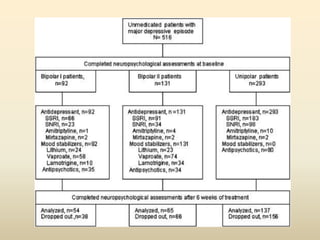
• Chen, J et al. (2011). Neuropsychological performance in bipolar I, bipolar II and unipolar depression patients: A
longitudinal, naturalistic study; Retrieved from: http://www.sciencedirect.com/science/article/pii/S0165032711007464
References
• Dr. Fischer, C. (2013). Master The Boards (Second Edition); Kaplan Publishing Inc.: New York
• Tao L & Vierregger K. (2010). First Aid Q &A for the Usmle Step 2 CK (Second Edition); McGraw Hill
publishing: New York
• Stupid celebrities Gossip. (2012). Celebrities With Mental Disorders; Retrieved from:
http://stupidcelebrities.net/2012/08/celebrities-with-mental-disorders/

Mood disorders

  • 1.
    Mood disorders Harsimrat Bagga WindsorUniversity of Medicine 5/10/2013
  • 2.
    ‘’32 year oldman was apprehended by the police 2 weeks ago for running across the freeway without regard for his personal safety. The patient stated that he did this “ for the heck of it.” The patient appeared distracted during the initial interview, spoke rapidly, and gave long drawn out answers. When asked about his mood, the patient said that he is feeling “okay, I’m under the weather, if you get my drift.” He was admitted to the inpatient unit for observation. Since his admission, he has been saying that he will soon replace the president, that he is the next Alexander the Great, and that he was told by the voices in his head. The patient’s admission laboratory values, including the drug screen for illicit substances, came back normal. Which of the following is the most likely diagnosis?”
  • 3.
    • A) Bipolardisorder with psychotic features • B) Bipolar disorder without psychotic features • C) Depression with psychotic features • D) Schizophrenia , disorganized type • E) Schizophrenia, paranoid type
  • 4.
    • Do youknow many people are suffering from the mood disorders that highly impair their daily functioning and do not even get diagnosed • Do you know many well-known people have been diagnosed with mood disorders but are well- treated to the point that they attain their normal level of functioning • Example: • Catherine Zeta Jones- Bipolar II Mel Gibson- Bipolar Jim Carrey- Depression
  • 5.
    • So letsstudy mood disorders and see how adequate diagnosis and treatment can make a difference in people’s lives!
  • 8.
    Unipolar • Major DepressiveDisorder • Dysthymic Disorder • Depressive Disorder Uncategorized Bipolar Disorders • Bipolar I Disorder • Bipolar II Disorder • Cyclothymic Disorder
  • 9.
    MOOD DISORDERS LIFETIMEPREVALENCES Major Depressive Disorder Female = 10 – 25% Male = 5 – 12% Bipolar I disorder 0.4 – 1.6% Bipolar II disorder 0.5 % Dysthymia 6% Cyclothymia 0.4 – 1.0%
  • 10.
    ETIOLOGY -Biological Factors: NOREPINEPHRINE Fluctuations SEROTONIN DOPAMINE -Abnormalitiesof Sleep Neurophysiology -Genetics -Psychosocial Factors -Personality Factors
  • 11.
    Unipolar Disorders Major DepressiveDisorder • Episodic Symptoms: Sad/depressed mood Decrease in interest Psychomotor changes Sleep alternations Appetite changes Fatigue , low energy Cognitive changes impacting attention and concentration Guilt, feelings of worthlessness, hopelessness Suicidal or homicidal ideation • For at least 2 weeks
  • 12.
    Unipolar Disorders Dysthymic Disorder- •Depressed mood for of most of the day for at least 2 years. The disturbance does not occur due to another disorder like schizophrenia or delusional disorder or with other medical condition.
  • 14.
    Unipolar Disorders Atypical depression •characterized by marked “anhedonia”, weight gain, increase in appetite, hypersomnia, ‘leaden paralysis’, and significant social impairment, hypersensitivity to perceived interpersonal rejection by others
  • 15.
    Unipolar Disorders Seasonal affectivedisorder- • Seasonal pattern of depressive episodes occurring during fall or winter with resolution by spring. Two episodes have to occur during the colder months rather than any other times and over the course of two year or more time period
  • 17.
    Unipolar Disorders • Otherforms of depression: -Post partum depression (within 1-3 months after birth; may have negative feelings towards baby) -Postpartum blues ( immediately after birth upto 2 weeks, no negative feelings towards baby) -Premenstrual Dysphoric disorder
  • 19.
    Bipolar Disorder • Mania ElevatedMood Inflated Self-esteem or grandiosity Decreased need for sleep Excessive talkating Racing thoughts, flight of ideas Distractibility Increase in goal directed activity(social, work, sex) Increase in libido Psychomotor agitation Poor judgment Symptoms lasting at least 1 week and are not due to any medical condition, treatment or substances. It impairs normal level of functioning
  • 20.
    Bipolar Disorder • Hypomania elevated,euphoric or irritable mood, lasting throughout at least four days. The symptoms are not severe to cause any major impairment in social or occupational functioning, or to mandate hospitalization. They are also not result of any toxic substances or medical conditions.
  • 25.
    Rapidly cycling Bipolar: •4 episodes of Mania in 1 year. It is due to use of anti-depressants
  • 26.
    Bipolar Disorder • CyclothymicDisorder – The occurrence of several periods of alternating hypomanic symptoms with depressive symptoms for at least 2 years. These symptoms not due to the effects of substances, mediations or medical conditions and they do cause significant distress or impairment in functioning.
  • 27.
  • 28.
    Goals • Patient’s safetyprimary concern • Complete and thorough diagnostic assessment • Treatment plan addressing not just immediate symptoms but overall patient’s prospective well-being. • The need for hospitalization should be evaluated
  • 29.
    Treatment • Hospitalization: • PsychosocialTherapy • Cognitive Therapy • Interpersonal Therapy • Behavior Therapy • Psychoanatically-oriented Therapy • Family Therapy • Pharmacotherapy:
  • 30.
    Treatment • Pharmacotherapy: Major DepressiveDisorder - MAOI’s, TCAC’s, SSRI’s, SNRI’s, mirtazipine, Bupropian Bipolar Disorders - Lithium, anticonvulsants, antipsychotics Alternatives to drug therapy: Electroconvulsive therapy (ECT)
  • 36.
    References • Merino, L.(2009). Mood Disorders; Retrieved from: http://www.slideshare.net/Lucia_Merino/mood-disorders- presentation-3893405 • Dr. Manood, H. (2010). Mood Disorders; Retrieved from: http://www.slideshare.net/specialclass/mood-disorders- psych-ii • Faraj, S. (2009). Mood Disorders; Retrieved from: http://www.slideshare.net/HusseinAliRamadhan/mood- disorder-drsaman • Khalife S, Singh V & Muzina D. (2009). Bipolar Disorders; Retrieved from: http://www.clevelandclinicmeded.com/medicalpubs/diseas emanagement/psychiatry-psychology/bipolar-disorder/
  • 37.
    References • Henry, P.(2010). Top 10 Antidepressant Medications Side Effects and Classification SARI SNRI; Retrieved from: http://paulahenry1.hubpages.com/hub/Antidepressant-medications • Narconon. (2009). Side Effects of Antidepressants; Retrieved from: http://www.narconon.org/drug- education/videos/effects-of-antidepressants-video.html • Harvard Medical School Publication. (2010). Seasonal affective disorder; Retrieved from: http://174.120.190.8/~abhccom/index.php?option=com_content&view=article&id=81%3Aseasonal-affective- disorder&catid=1%3Alatest-news&Itemid=1 • Sandhar, N. (2009). Dysthymia Disorders; Retrieved from: http://www.glogster.com/navneet1109/dysthymia-by-nav- sandhar/g-6l3hr6d7c61glicoh4v3ha0 • Terri D. (2007). PM-what? Retrieved from: http://pajamadiaries.com/pm-what/ • My Healthy Feeling. (2013). Selective Serotonin Reuptake Inhibitors (SSRIs) Side Effects, Brand Names, Action; Retrieved from: http://www.myhealthyfeeling.com/selective-serotonin-reuptake-inhibitors-ssris-side-effects-brand-names-action/ • Richeimer, S. (2000). The Assessment of the Patient with Pain; Retrieved from: http://www.helpforpain.com/articles/pain- assess/assessment.htm • UCCS. (2000). What is Bipolar Disorder? Retrieved from: http://www.uccs.edu/biology/mood-disorders/bipolar- disorder.html • Chen, J et al. (2011). Neuropsychological performance in bipolar I, bipolar II and unipolar depression patients: A longitudinal, naturalistic study; Retrieved from: http://www.sciencedirect.com/science/article/pii/S0165032711007464
  • 38.
    References • Dr. Fischer,C. (2013). Master The Boards (Second Edition); Kaplan Publishing Inc.: New York • Tao L & Vierregger K. (2010). First Aid Q &A for the Usmle Step 2 CK (Second Edition); McGraw Hill publishing: New York • Stupid celebrities Gossip. (2012). Celebrities With Mental Disorders; Retrieved from: http://stupidcelebrities.net/2012/08/celebrities-with-mental-disorders/