Terry King Emma Duke-Williams University of Portsmouth, UK Grazing or Digesting? Preparing University Students for the Information Economy
Overview Compare quality of student learning in Knowledge Forum and Elgg. Initial findings of research. Implications of findings for lecturers.
Background to KF start  2001 Online community of practice. Idea-centred curriculum vs. problem-based learning. Knowledge Building Community model – Bereiter Knowledge Forum Software. Group ‘views’ Postings within views Extra tools for research-style discussions
KF Views View icon
Inside KF View
Example KF Note
Knowledge Building in KF  20 small groups post-graduates (2001-07). What is knowledge building? 12  determinants of knowledge building .  Groups demonstrated 9 very well. But did not demonstrate the other 3 Those needing links between groups. BUT deep channelling of focus to get good KB results.
KB Example
Elgg Networking Software  What is Elgg ? Initially used for Blogging with MSc eLearning students.  (2005)  Connectivism  – 6 stages (Siemens 2006)  New undergraduate unit (research methods)  Graduated activities/ assessment artefact Hoped to cover stages 1-3 of Siemen’s model Contents of posts. Focus groups.
Findings from Elgg Research Observed 1 st  3 stages of Siemen’s model Focus groups: Claimed to have learnt through discussion Wanted as much collaboration as possible. .... all their cohort for final year.  ... external experts.
KF Views Unconnected  views No collaboration between views
Collaboration inside a KF View
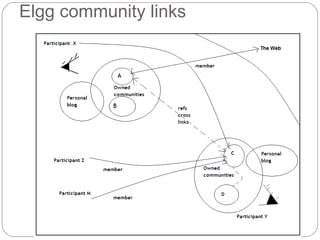
Elgg community links
Knowledge Building in Elgg Same ground as KF AND missing 3 determinants of KB Symmetric Knowledge Advancement Knowledge Building Discourse Pervasive Knowledge Building Elgg work appeared to be more fluid and unfocussed Was actually very successful KB
Conclusions for Lecturers. Can no longer ignore participation culture. Be prepared to delegate control to “learning” networking software. Need an extended e-learning skills set.  Students also need to learn skills.  Importance of personal blogging.
“ If you had an opinion about something, you could read someone else’s posting and it was interesting to see another point of view, and see how they had come to that position... the premise of their argument - if they are putting forward an argument - compared to your own, and it made me think more deeply about the issue in hand.”
Websites. Knowledge Forum http://www.knowledgeforum.com/ http://www.learn.motion.com/  (software developers)  Elgg http: //elgg.org   http://eduspaces.net  (installation that we used)
Knowledge Building Determinants Scardamalia Real Ideas, Authentic Problems. Improvable Ideas Idea Diversity Rise-Above Epistemic Agency Community Knowledge, Collective Responsibility Democratising Knowledge Symmetric Knowledge Advancement Pervasive Knowledge Building Constructive Uses of Authoritative Sources Knowledge Building Discourse Embedded and Transformative Assessment
Connectivism (Siemens 2006) 1. Awareness and Receptivity  Individuals acquire basic skills. 2. Connection Forming Individuals begin to use tools and understanding developed in level 1 3. Contribution and Involvement The learner begins to actively contribute to the network/ecology. 4. Pattern Recognition Learners are network aware and competent and …they are now capable of recognising emerging patterns and trends. 5. Meaning-Making Individuals capable of understanding meaning. What do the emerging patterns mean?  6. Praxis Individuals are actively involved in tweaking, building, and recreating their own learning network. Praxis allows the learner to critically evaluate the tools, processes, and elements of an ecology or network.
 

Montreal Extras

  • 1.
    Terry King EmmaDuke-Williams University of Portsmouth, UK Grazing or Digesting? Preparing University Students for the Information Economy
  • 2.
    Overview Compare qualityof student learning in Knowledge Forum and Elgg. Initial findings of research. Implications of findings for lecturers.
  • 3.
    Background to KFstart 2001 Online community of practice. Idea-centred curriculum vs. problem-based learning. Knowledge Building Community model – Bereiter Knowledge Forum Software. Group ‘views’ Postings within views Extra tools for research-style discussions
  • 4.
  • 5.
  • 6.
  • 7.
    Knowledge Building inKF 20 small groups post-graduates (2001-07). What is knowledge building? 12 determinants of knowledge building . Groups demonstrated 9 very well. But did not demonstrate the other 3 Those needing links between groups. BUT deep channelling of focus to get good KB results.
  • 8.
  • 9.
    Elgg Networking Software What is Elgg ? Initially used for Blogging with MSc eLearning students. (2005) Connectivism – 6 stages (Siemens 2006) New undergraduate unit (research methods) Graduated activities/ assessment artefact Hoped to cover stages 1-3 of Siemen’s model Contents of posts. Focus groups.
  • 10.
    Findings from ElggResearch Observed 1 st 3 stages of Siemen’s model Focus groups: Claimed to have learnt through discussion Wanted as much collaboration as possible. .... all their cohort for final year. ... external experts.
  • 11.
    KF Views Unconnected views No collaboration between views
  • 12.
  • 13.
  • 14.
    Knowledge Building inElgg Same ground as KF AND missing 3 determinants of KB Symmetric Knowledge Advancement Knowledge Building Discourse Pervasive Knowledge Building Elgg work appeared to be more fluid and unfocussed Was actually very successful KB
  • 15.
    Conclusions for Lecturers.Can no longer ignore participation culture. Be prepared to delegate control to “learning” networking software. Need an extended e-learning skills set. Students also need to learn skills. Importance of personal blogging.
  • 16.
    “ If youhad an opinion about something, you could read someone else’s posting and it was interesting to see another point of view, and see how they had come to that position... the premise of their argument - if they are putting forward an argument - compared to your own, and it made me think more deeply about the issue in hand.”
  • 17.
    Websites. Knowledge Forumhttp://www.knowledgeforum.com/ http://www.learn.motion.com/ (software developers) Elgg http: //elgg.org http://eduspaces.net (installation that we used)
  • 18.
    Knowledge Building DeterminantsScardamalia Real Ideas, Authentic Problems. Improvable Ideas Idea Diversity Rise-Above Epistemic Agency Community Knowledge, Collective Responsibility Democratising Knowledge Symmetric Knowledge Advancement Pervasive Knowledge Building Constructive Uses of Authoritative Sources Knowledge Building Discourse Embedded and Transformative Assessment
  • 19.
    Connectivism (Siemens 2006)1. Awareness and Receptivity Individuals acquire basic skills. 2. Connection Forming Individuals begin to use tools and understanding developed in level 1 3. Contribution and Involvement The learner begins to actively contribute to the network/ecology. 4. Pattern Recognition Learners are network aware and competent and …they are now capable of recognising emerging patterns and trends. 5. Meaning-Making Individuals capable of understanding meaning. What do the emerging patterns mean? 6. Praxis Individuals are actively involved in tweaking, building, and recreating their own learning network. Praxis allows the learner to critically evaluate the tools, processes, and elements of an ecology or network.
  • 20.