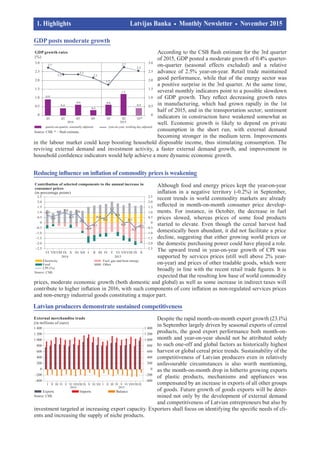
Despite the rapid month-on-month export growth (23.1%)
in September largely driven by seasonal exports of cereal
products, the good export performance both month-on-
month and year-on-year should not be attributed solely
to such one-off and global factors as historically highest
harvest or global cereal price trends. Sustainability of the
competitiveness of Latvian producers even in relatively
unfavourable circumstances is also worth mentioning,
as the month-on-month drop in hitherto growing exports
of plastic products, mechanisms and appliances was
compensat­ed by an increase in exports of all other groups
of goods. Future growth of goods exports will be deter-
mined not only by the development of external demand
and competitiveness of Latvian entrepreneurs but also by
investment targeted at increasing export capacity. Exporters shall focus on identifying the specific needs of cli-
ents and increasing the supply of niche products.
Although food and energy prices kept the year-on-year
inflation in a negative territory (-0.2%) in September,
recent trends in world commodity markets are already
reflected in month-on-month consumer price develop­
ments. For instance, in October, the decrease in fuel
prices slowed, whereas prices of some food products
started to elevate. Even though the cereal harvest had
domesti­cally been abundant, it did not facilitate a price
decline, suggesting that either growing world prices or
the domestic purchasing power could have played a role.
The upward trend in year-on-year growth of CPI was
supported by services prices (still well above 2% year-
on-year) and prices of other tradable goods, which were
broadly in line with the recent retail trade figures. It is
expected that the resulting low base of world commodity
prices, moderate economic growth (both domestic and global) as well as some increase in indirect taxes will
contribute to higher inflation in 2016, with such components of core inflation as non-regulated services prices
and non-energy industrial goods constituting a major part.
According to the CSB flash estimate for the 3rd quarter
of 2015, GDP posted a moderate growth of 0.4% quarter-
on-quarter (seasonal effects excluded) and a relative
advance of 2.5% year-on-year. Retail trade maintained
good performance, while that of the energy sector was
a positive surprise in the 3rd quarter. At the same time,
several monthly indicators point to a possible slowdown
of GDP growth. They reflect decreasing growth rates
in manufacturing, which had grown rapidly in the 1st
half of 2015, and in the transportation sector; sentiment
indicators in construction have weakened somewhat as
well. Economic growth is likely to depend on private
consumption in the short run, with external demand
becoming stronger in the medium term. Improvements
in the labour market could keep boosting household disposable income, thus stimulating consumption. The
reviving external demand and investment activity, a faster external demand growth, and improvement in
household confidence indicators would help achieve a more dynamic economic growth.
1. Highlights			 Latvijas Banka Monthly Newsletter November 2015	
		 		
Latvian producers demonstrate sustained competitiveness
GDP posts moderate growth
Reducing influence on inflation of commodity prices is weakening
Reporting
period
Data (%)
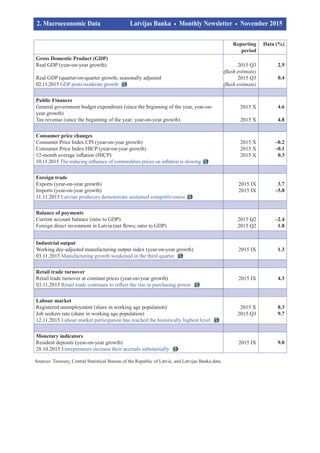
Gross Domestic Product (GDP)
Real GDP (year-on-year growth)
Real GDP (quarter-on-quarter growth; seasonally adjusted
02.11.2015 GDP posts moderate growth
2015 Q3
(flash estimate)
2015 Q3
(flash estimate)
2.5
0.4
Public Finances
General government budget expenditure (since the beginning of the year, year-on-
year growth)
Tax revenue (since the beginning of the year; year-on-year growth)
2015 X
2015 X
4.6
4.8
Consumer price changes
Consumer Price Index CPI (year-on-year growth)
Consumer Price Index HICP (year-on-year growth)
12-month average inflation (HICP)
10.11.2015 The reducing influence of commodities prices on inflation is slowing
2015 X
2015 X
2015 X
–0.2
–0.1
0.3
Foreign trade
Exports (year-on-year growth)
Imports (year-on-year growth)
11.11.2015 Latvian producers demonstrate sustained competitiveness
2015 IX
2015 IX
3.7
–5.8
Balance of payments
Current account balance (ratio to GDP)
Foreign direct investment in Latvia (net flows; ratio to GDP)
2015 Q2
2015 Q2
–2.4
1.8
Industrial output
Working day-adjusted manufacturing output index (year-on-year growth)
03.11.2015 Manufacturing growth weakened in the third quarter
2015 IX 1.3
Retail trade turnover
Retail trade turnover at constant prices (year-on-year growth)
03.11.2015 Retail trade continues to reflect the rise in purchasing power
2015 IX 4.3
Labour market
Registered unemployment (share in working age population)
Job seekers rate (share in working age population)
12.11.2015 Labour market participation has reached the historically highest level
2015 X
2015 Q3
8.3
9.7
Monetary indicators
Resident deposits (year-on-year growth)
28.10.2015 Entrepreneurs increase their accruals substantially
2015 IX 9.0
Sources: Treasury, Central Statistical Bureau of the Republic of Latvia, and Latvijas Banka data.
2. Macroeconomic Data	 Latvijas Banka Monthly Newsletter November 2015
I have attended a number of "international" conferences
where the only claim to "internationalism" was the English
language and the addresses by "wedding generals" of some
nearby countries. I would call the Latvijas Banka's conference
of 28 October international without any quotation marks:
the discussion there was held by people who manage global
developments.
One of the main conclusions was that neither public debt, nor the QE (euro area government bonds purchase
in the amount of 60 billion euro each month) is a magic wand. At best, these are short-term painkillers
that provide a breather before launching the serious treatment process (structural reforms) without
touching the root cause of the problem. Moreover, using them for too long and in too large quantities leads
to undesirable side-effects.
QE lowers the interest rate of government bonds (and interest payments), creating a misperception that even
a high public debt is sustainable and motivating governments to borrow increasingly more. Yet the period
of low interest rates is not endless. To prevent a rapid rise in interest payments, the central banks could try
to postpone the rise in interest rates as long as possible (Niels H. Bünemann, the conference moderator
and Finance Commentator and Correspondent of TV2 Denmark) and with a predictable result – too high
inflation.
Once the pain stops, most people abandon treatment. That makes the harsh words by the former finance
minister of Slovakia Ivan Mikloš addressing QE all the more understandable. Do governments perhaps
launch structural reforms only when they have run out of money and there is not a single moment left (until
the next election) to delay implementing the reforms? If so, then it means that budget deficits and QE would
delay structural reforms. But you can't avoid reforms: postponement only raises the reforms' costs.
It is, however, also easy to see the point made by Peter Praet, member of the Executive Board of the
European Central Bank (ECB), that there may be no alternative to implementing QE. The ECB takes care
of price stability in the euro area and its duty is to use all instruments at its disposal to fight deflation. If
the inflation goal is not reached and nothing is done to reach it, confidence in the ECB will be jeopardized,
endangering the inflation stability in the long term.
Ilmārs Rimšēvičs, Governor of Latvijas Banka and member of the ECB's Governing Council, pointed out
that when the interest rates on government bonds approach zero, investors may seek profit in purchasing
risky assets which they would avoid under other circumstances. Moreover, if the central banks exhaust
all instruments for fighting deflation in short order (by buying "everything that moves") but with modest
results, wouldn't that mean an even greater loss of confidence in the central banks?
Does today's euro area not resemble Japan twenty years ago? The slowing of economic growth in Japan of
the 1990s was first considered cyclical recession and it was treated in the best traditions of Keynes - with a
budget deficit, i.e. by accumulating public debt, but this did not help to fuel the economy (Kenichi Ueda,
Tokyo University). Since 2011, the euro area government debt has increased by a trillion euro or 10% of
GDP. It would probably not make much sense to stubbornly increase the debt burden to Japan's 250% of
GDP only to realise that the mechanism for stimulating total demand is broken.
As we know from the theories of Milton Friedman, pouring money from a helicopter for a long time only
creates inflation, stimulating economic activity only for a short while and only in a crisis situation. The
tricky question for today – why is it that the money helicopter (QE) fails to leave any substantial impact not
only on economic activity but also on consumer prices? It is possible that quietly and imperceptibly money
is being accumulated into a new bubble, which cannot be seen in the consumption basket, for instance, in
real estate prices. It is also possible that we are finding ourselves in a period when economic theory is being
rewritten.
Speeches and presentations from the conference are now available at https://www.macroeconomics.lv/
conference-quo-vadis-europe-how-achieve-growth-high-debt-environment
Quo Vadis, Europe? Latvijas Banka International Conference on Public Debt and QE
3. In Focus			 Latvijas Banka Monthly Newsletter November 2015	
	 		
Dr. oec. Oļegs Krasnopjorovs
Chief Economist,
Monetary Policy Department,
Latvijas Banka

Monthly Newsletter 11/2015

  • 2.
    Despite the rapidmonth-on-month export growth (23.1%) in September largely driven by seasonal exports of cereal products, the good export performance both month-on- month and year-on-year should not be attributed solely to such one-off and global factors as historically highest harvest or global cereal price trends. Sustainability of the competitiveness of Latvian producers even in relatively unfavourable circumstances is also worth mentioning, as the month-on-month drop in hitherto growing exports of plastic products, mechanisms and appliances was compensat­ed by an increase in exports of all other groups of goods. Future growth of goods exports will be deter- mined not only by the development of external demand and competitiveness of Latvian entrepreneurs but also by investment targeted at increasing export capacity. Exporters shall focus on identifying the specific needs of cli- ents and increasing the supply of niche products. Although food and energy prices kept the year-on-year inflation in a negative territory (-0.2%) in September, recent trends in world commodity markets are already reflected in month-on-month consumer price develop­ ments. For instance, in October, the decrease in fuel prices slowed, whereas prices of some food products started to elevate. Even though the cereal harvest had domesti­cally been abundant, it did not facilitate a price decline, suggesting that either growing world prices or the domestic purchasing power could have played a role. The upward trend in year-on-year growth of CPI was supported by services prices (still well above 2% year- on-year) and prices of other tradable goods, which were broadly in line with the recent retail trade figures. It is expected that the resulting low base of world commodity prices, moderate economic growth (both domestic and global) as well as some increase in indirect taxes will contribute to higher inflation in 2016, with such components of core inflation as non-regulated services prices and non-energy industrial goods constituting a major part. According to the CSB flash estimate for the 3rd quarter of 2015, GDP posted a moderate growth of 0.4% quarter- on-quarter (seasonal effects excluded) and a relative advance of 2.5% year-on-year. Retail trade maintained good performance, while that of the energy sector was a positive surprise in the 3rd quarter. At the same time, several monthly indicators point to a possible slowdown of GDP growth. They reflect decreasing growth rates in manufacturing, which had grown rapidly in the 1st half of 2015, and in the transportation sector; sentiment indicators in construction have weakened somewhat as well. Economic growth is likely to depend on private consumption in the short run, with external demand becoming stronger in the medium term. Improvements in the labour market could keep boosting household disposable income, thus stimulating consumption. The reviving external demand and investment activity, a faster external demand growth, and improvement in household confidence indicators would help achieve a more dynamic economic growth. 1. Highlights Latvijas Banka Monthly Newsletter November 2015 Latvian producers demonstrate sustained competitiveness GDP posts moderate growth Reducing influence on inflation of commodity prices is weakening
  • 3.
    Reporting period Data (%) Gross DomesticProduct (GDP) Real GDP (year-on-year growth) Real GDP (quarter-on-quarter growth; seasonally adjusted 02.11.2015 GDP posts moderate growth 2015 Q3 (flash estimate) 2015 Q3 (flash estimate) 2.5 0.4 Public Finances General government budget expenditure (since the beginning of the year, year-on- year growth) Tax revenue (since the beginning of the year; year-on-year growth) 2015 X 2015 X 4.6 4.8 Consumer price changes Consumer Price Index CPI (year-on-year growth) Consumer Price Index HICP (year-on-year growth) 12-month average inflation (HICP) 10.11.2015 The reducing influence of commodities prices on inflation is slowing 2015 X 2015 X 2015 X –0.2 –0.1 0.3 Foreign trade Exports (year-on-year growth) Imports (year-on-year growth) 11.11.2015 Latvian producers demonstrate sustained competitiveness 2015 IX 2015 IX 3.7 –5.8 Balance of payments Current account balance (ratio to GDP) Foreign direct investment in Latvia (net flows; ratio to GDP) 2015 Q2 2015 Q2 –2.4 1.8 Industrial output Working day-adjusted manufacturing output index (year-on-year growth) 03.11.2015 Manufacturing growth weakened in the third quarter 2015 IX 1.3 Retail trade turnover Retail trade turnover at constant prices (year-on-year growth) 03.11.2015 Retail trade continues to reflect the rise in purchasing power 2015 IX 4.3 Labour market Registered unemployment (share in working age population) Job seekers rate (share in working age population) 12.11.2015 Labour market participation has reached the historically highest level 2015 X 2015 Q3 8.3 9.7 Monetary indicators Resident deposits (year-on-year growth) 28.10.2015 Entrepreneurs increase their accruals substantially 2015 IX 9.0 Sources: Treasury, Central Statistical Bureau of the Republic of Latvia, and Latvijas Banka data. 2. Macroeconomic Data Latvijas Banka Monthly Newsletter November 2015
  • 4.
    I have attendeda number of "international" conferences where the only claim to "internationalism" was the English language and the addresses by "wedding generals" of some nearby countries. I would call the Latvijas Banka's conference of 28 October international without any quotation marks: the discussion there was held by people who manage global developments. One of the main conclusions was that neither public debt, nor the QE (euro area government bonds purchase in the amount of 60 billion euro each month) is a magic wand. At best, these are short-term painkillers that provide a breather before launching the serious treatment process (structural reforms) without touching the root cause of the problem. Moreover, using them for too long and in too large quantities leads to undesirable side-effects. QE lowers the interest rate of government bonds (and interest payments), creating a misperception that even a high public debt is sustainable and motivating governments to borrow increasingly more. Yet the period of low interest rates is not endless. To prevent a rapid rise in interest payments, the central banks could try to postpone the rise in interest rates as long as possible (Niels H. Bünemann, the conference moderator and Finance Commentator and Correspondent of TV2 Denmark) and with a predictable result – too high inflation. Once the pain stops, most people abandon treatment. That makes the harsh words by the former finance minister of Slovakia Ivan Mikloš addressing QE all the more understandable. Do governments perhaps launch structural reforms only when they have run out of money and there is not a single moment left (until the next election) to delay implementing the reforms? If so, then it means that budget deficits and QE would delay structural reforms. But you can't avoid reforms: postponement only raises the reforms' costs. It is, however, also easy to see the point made by Peter Praet, member of the Executive Board of the European Central Bank (ECB), that there may be no alternative to implementing QE. The ECB takes care of price stability in the euro area and its duty is to use all instruments at its disposal to fight deflation. If the inflation goal is not reached and nothing is done to reach it, confidence in the ECB will be jeopardized, endangering the inflation stability in the long term. Ilmārs Rimšēvičs, Governor of Latvijas Banka and member of the ECB's Governing Council, pointed out that when the interest rates on government bonds approach zero, investors may seek profit in purchasing risky assets which they would avoid under other circumstances. Moreover, if the central banks exhaust all instruments for fighting deflation in short order (by buying "everything that moves") but with modest results, wouldn't that mean an even greater loss of confidence in the central banks? Does today's euro area not resemble Japan twenty years ago? The slowing of economic growth in Japan of the 1990s was first considered cyclical recession and it was treated in the best traditions of Keynes - with a budget deficit, i.e. by accumulating public debt, but this did not help to fuel the economy (Kenichi Ueda, Tokyo University). Since 2011, the euro area government debt has increased by a trillion euro or 10% of GDP. It would probably not make much sense to stubbornly increase the debt burden to Japan's 250% of GDP only to realise that the mechanism for stimulating total demand is broken. As we know from the theories of Milton Friedman, pouring money from a helicopter for a long time only creates inflation, stimulating economic activity only for a short while and only in a crisis situation. The tricky question for today – why is it that the money helicopter (QE) fails to leave any substantial impact not only on economic activity but also on consumer prices? It is possible that quietly and imperceptibly money is being accumulated into a new bubble, which cannot be seen in the consumption basket, for instance, in real estate prices. It is also possible that we are finding ourselves in a period when economic theory is being rewritten. Speeches and presentations from the conference are now available at https://www.macroeconomics.lv/ conference-quo-vadis-europe-how-achieve-growth-high-debt-environment Quo Vadis, Europe? Latvijas Banka International Conference on Public Debt and QE 3. In Focus Latvijas Banka Monthly Newsletter November 2015 Dr. oec. Oļegs Krasnopjorovs Chief Economist, Monetary Policy Department, Latvijas Banka