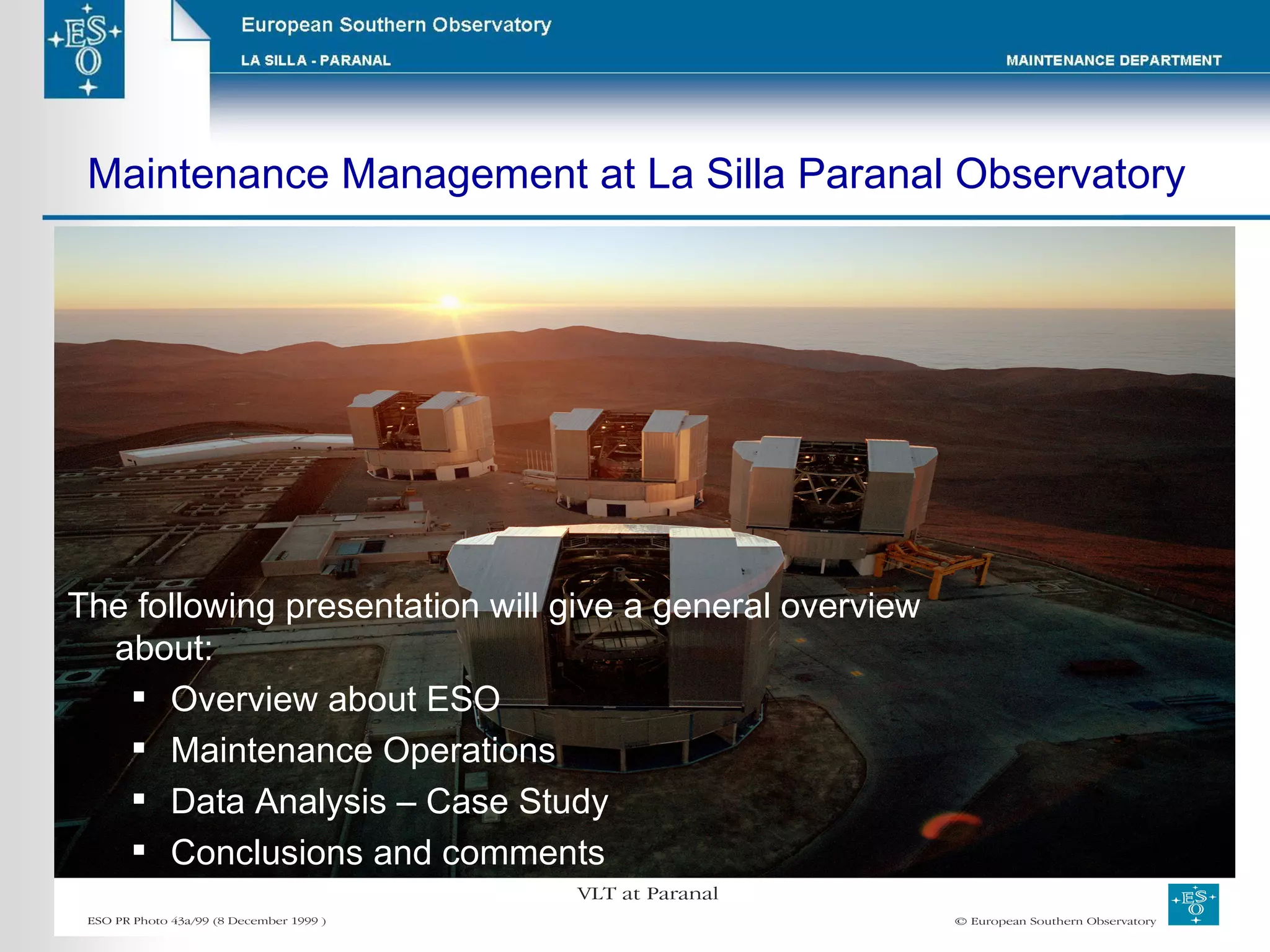


The following presentation will give a general overview about: Overview about ESO  Maintenance Operations Data Analysis – Case Study Conclusions and comments  Maintenance Management at La Silla Paranal Observatory
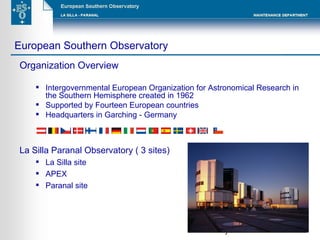
Organization Overview Intergovernmental European Organization for Astronomical Research in the Southern Hemisphere created in 1962 Supported by Fourteen European countries  Headquarters in Garching - Germany La Silla Paranal Observatory ( 3 sites) La Silla site APEX Paranal site European Southern Observatory Garching Germany La Silla
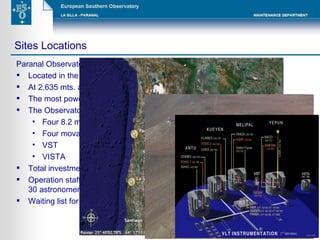
Paranal Observatory Located in the Atacama desert, north of Chile At 2.635 mts. above the sea level The most powerful astronomic installation built in our planet The Observatory consists of: Four 8.2 meters mirror telescopes  Four movable 1.8 meters telescopes VST VISTA Total investment: More than 600 millions Euros Operation staff (excluding contractors) 140 employees, including more than 30 astronomers. Waiting list for observations: Approximately 2 years Sites Locations
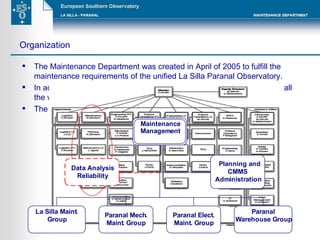
The Maintenance Department was created in April of 2005 to fulfill the maintenance requirements of the unified La Silla Paranal Observatory. In addition to the maintenance activities, the department administrates all the warehouses of the Paranal site. The department is organized according to the following scheme: Organization
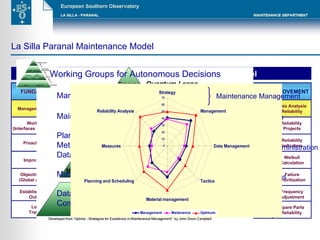
Management and Strategy Maintenance Operations (Tactics) Planning and Scheduling  Metrics – Key Performance Indicators Data management - CMMS Material Management Data Analysis Committees for Improvements Planning &CMMS Administration Maintenance Groups Warehouse Operations Reliability Group Maintenance Management La Silla Paranal Maintenance Model Working Groups for Autonomous Decisions Committees for Improvements Data Analysis Reliability Autonomous  Groups Reliability  Projects Failure Modes Reliability Indicators Failure Record Weibull Calculation PMO, RCA Failure Prioritization Standard Reports Frequency Adjustment Training Requirements Spare Parts Reliability  CONTINOUS IMPROVEMENT Maintenance Operations Planning CMMS and KPI Material  Management Maintenance Tactics Equipment Register Equipment History Storage Practice Multiskilling Standard Practices WO Workflow  Stock Control 5 S Shift Report Maintenance  Reports Tracking of Spare Parts Failure Finding Tactic Development  Plan Long Term KPI Definition (added value) Analysis Regular Meetings Priorities by  Predefined Criteria KPI Systematic Control Operational Procedures Backlog Control Visible KPI  KIT for  Maintenance CONTROL Management & Strategy Work Structure (Interfaces Between Groups) Proactive Culture  Improvement Plan Objectives and Goals (Global and Individual) Established Policy for Outsourcing  Long Term Training Plan FUNDAMENTALS La Silla Paranal Observatory – Maintenance Model
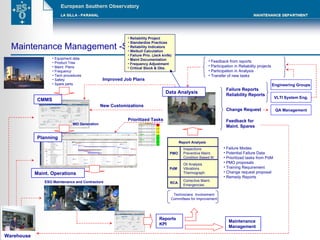
Planning Reports KPI Maintenance Management -Strategy Equipment data Product Tree Maint. Plans Frequency Tech procedures Safety  Spare parts Prioritized Tasks Improved Job Plans  Failure Reports Reliability Reports  Reliability Project Standardize Practices Reliability Indicators Weibull Calculation Failure Prio. (Jack knife) Maint Documentation Frequency Adjustment Critical Stock & Obs. Feedback for  Maint. Spares  Data Analysis Failure Modes Potential Failure Data Prioritized tasks from PdM PMO proposals Training Requirement Change request proposal Remedy Reports  New Customizations Maint. Operations WO Generation Technicians  Involvement Committees for Improvement Change Request Maintenance Management Engineering Groups VLTI System Eng. QA Management CMMS Warehouse ESO Maintenance and Contractors Feedback from reports Participation in Reliability projects  Participation in Analysis Transfer of new tasks Inspections Preventive Maint. Condition Based M. Report Analysis   PMO RCA PdM   Oil Analysis Vibrations Thermograph Corrective Maint. Emergencies
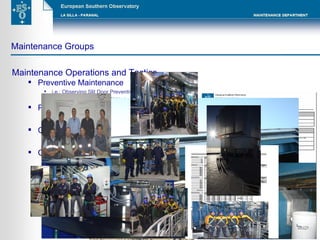
Maintenance Groups Maintenance Operations and Tactics Preventive Maintenance i.e.: Observing Slit Door Preventive Maintenance in Paranal High Voltage Lines PM in La Silla Predictive Maintenance i.e.: Vibration monitoring Thermography Condition Based Maintenance and Inspections i.e.: Operational parameters monitoring Hydraulic Bearing System Corrective Maintenance and recovers i.e.: Corrective Maintenance in Dome Rotation Systems
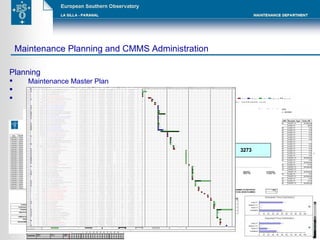
Maintenance Planning and CMMS Administration Planning Maintenance Master Plan Maintenance Tasks Distribution Planning Report
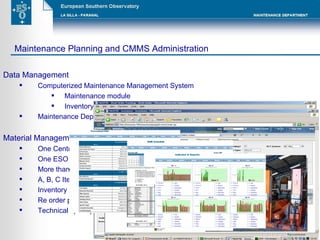
Data Management  Computerized Maintenance Management System  Maintenance module Inventory module Maintenance Department web page Material Management  (Paranal Warehouses) One Central Warehouse and six satellites  One ESO Supervisor with an external contract for operations More than 11.000 items registered in the inventory module A, B, C Item categorization  Inventory cycle counts Re order points adjustments Technical spare parts dispatch by Work Order control Maintenance Planning and CMMS Administration
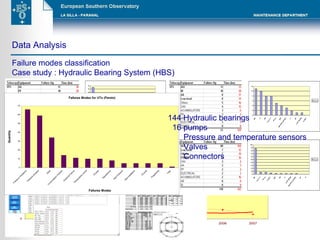
Data Analysis  Failure Modes classification for HBS   Pressure unbalance between pads Pressure drop in chamber  Communication problems  Temperature Control Electrical failure Oil leak Adjustment High pressure Programming  Wrong installation Low oil level in the tank Filter clogged Failure modes classification Case study : Hydraulic Bearing System (HBS) 144 Hydraulic bearings 16 pumps Pressure and temperature sensors Valves Connectors Detection of failures in evolution 1 Week Condition Based Operational test Detection of failures in evolution 1 Day Condition Based  Op. Parameter report Detection of failures in evolution 6 Months  Predictive  Thermography Detection of failures in evolution 6 Months Predictive  Oil analysis Physical reconditioning 1 Year Preventive Elec. Maintenance  Physical reconditioning 1 Year Preventive Mech. Maintenance OBJECTIVE  FREQ. MAINT.TYPE TASK
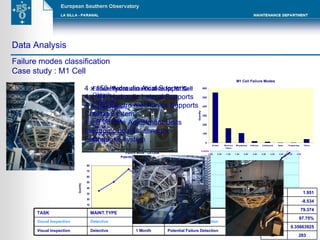
Data Analysis  Failure modes classification Case study : M1 Cell 4 x 150 Hydraulic Axial Supports 4 x  64  Hydraulic Lateral Supports 4 x 150 Electro mechanics Supports  Cooling System 4 x 5 Volume Adjustment Units Electronic boards, sensors,  Earthquake system Failure Modes classification for M1 Cell Oil leak Electrical  Maladjustment Software Cooling leak Noise Programming  Others 283 N = 0.35663925 t0 = 97.75% R 2 79.374 Eta -8.534 b 1.951 Beta Potential Failure Detection 1 Month Detective Visual Inspection Potential Failure Detection 1 Week Detective Visual Inspection OBJECTIVE  FREQ. MAINT.TYPE TASK
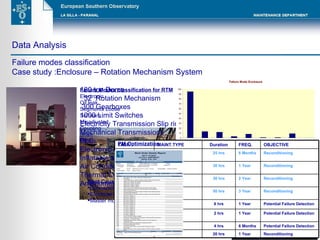
Data Analysis  Failure modes classification Case study :Enclosure – Rotation Mechanism System 180 ton Dome 32  Rotation Mechanism 300 Gearboxes 1000 Limit Switches Electricity Transmission Slip ring Mechanical Transmissions PLC Electronic devices Inflatable seals Air Conditioning System Thermal Control System Anemometers Failure Modes classification for RTM   Electronic Oil leak Segments Loose Software Misadjusted Coupling  Shaft Others Root Cause Analysis Connectors (signal) Electrical Relay  Master motors configuration  PM Optimization   1 2 2 4 3 10 11 12 14 15 16 17 18 20 21 Potential Failure Detection 1 Year 2 hrs Predictive Termography Potential Failure Detection 6 Months 4 hrs CBM Mechanical 20 hrs 6 hrs 50 hrs 30 hrs 30 hrs 25 hrs Duration Reconditioning 3 Year Preventive Mech / Elect Reconditioning 1 Year Preventive Mech / Elect Reconditioning 2 Year Preventive Mech / Elect Potential Failure Detection 1 Year Predictive Oil Analysis Reconditioning 1 Year Preventive Mech / Elect Reconditioning 6 Months Preventive Mech / Elect OBJECTIVE  FREQ. MAINT.TYPE TASK
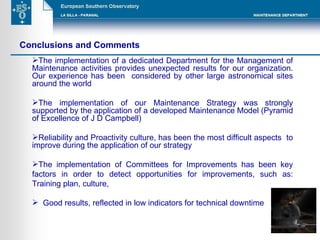
Conclusions and Comments The implementation of a dedicated Department for the Management of Maintenance activities provides unexpected results for our organization. Our experience has been  considered by other large astronomical sites around the world  The implementation of our Maintenance Strategy was strongly supported by the application of a developed Maintenance Model (Pyramid of Excellence of J D Campbell) Reliability and Proactivity culture, has been the most difficult aspects  to improve during the application of our strategy The implementation of Committees for Improvements has been key factors in order to detect opportunities for improvements, such as: Training plan, culture, Good results, reflected in low indicators for technical downtime
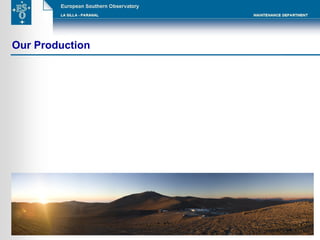
Our Production
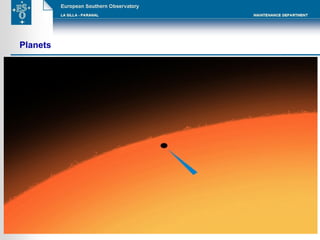
Planets
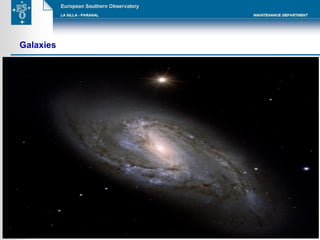
Galaxies
Stars forming
And more Stars GRACIAS

montano-egaf5

  • 1.
    The following presentationwill give a general overview about: Overview about ESO Maintenance Operations Data Analysis – Case Study Conclusions and comments Maintenance Management at La Silla Paranal Observatory
  • 2.
    Organization Overview IntergovernmentalEuropean Organization for Astronomical Research in the Southern Hemisphere created in 1962 Supported by Fourteen European countries Headquarters in Garching - Germany La Silla Paranal Observatory ( 3 sites) La Silla site APEX Paranal site European Southern Observatory Garching Germany La Silla
  • 3.
    Paranal Observatory Locatedin the Atacama desert, north of Chile At 2.635 mts. above the sea level The most powerful astronomic installation built in our planet The Observatory consists of: Four 8.2 meters mirror telescopes Four movable 1.8 meters telescopes VST VISTA Total investment: More than 600 millions Euros Operation staff (excluding contractors) 140 employees, including more than 30 astronomers. Waiting list for observations: Approximately 2 years Sites Locations
  • 4.
    The Maintenance Departmentwas created in April of 2005 to fulfill the maintenance requirements of the unified La Silla Paranal Observatory. In addition to the maintenance activities, the department administrates all the warehouses of the Paranal site. The department is organized according to the following scheme: Organization
  • 5.
    Management and StrategyMaintenance Operations (Tactics) Planning and Scheduling Metrics – Key Performance Indicators Data management - CMMS Material Management Data Analysis Committees for Improvements Planning &CMMS Administration Maintenance Groups Warehouse Operations Reliability Group Maintenance Management La Silla Paranal Maintenance Model Working Groups for Autonomous Decisions Committees for Improvements Data Analysis Reliability Autonomous Groups Reliability Projects Failure Modes Reliability Indicators Failure Record Weibull Calculation PMO, RCA Failure Prioritization Standard Reports Frequency Adjustment Training Requirements Spare Parts Reliability CONTINOUS IMPROVEMENT Maintenance Operations Planning CMMS and KPI Material Management Maintenance Tactics Equipment Register Equipment History Storage Practice Multiskilling Standard Practices WO Workflow Stock Control 5 S Shift Report Maintenance Reports Tracking of Spare Parts Failure Finding Tactic Development Plan Long Term KPI Definition (added value) Analysis Regular Meetings Priorities by Predefined Criteria KPI Systematic Control Operational Procedures Backlog Control Visible KPI KIT for Maintenance CONTROL Management & Strategy Work Structure (Interfaces Between Groups) Proactive Culture Improvement Plan Objectives and Goals (Global and Individual) Established Policy for Outsourcing Long Term Training Plan FUNDAMENTALS La Silla Paranal Observatory – Maintenance Model
  • 6.
    Planning Reports KPIMaintenance Management -Strategy Equipment data Product Tree Maint. Plans Frequency Tech procedures Safety Spare parts Prioritized Tasks Improved Job Plans Failure Reports Reliability Reports Reliability Project Standardize Practices Reliability Indicators Weibull Calculation Failure Prio. (Jack knife) Maint Documentation Frequency Adjustment Critical Stock & Obs. Feedback for Maint. Spares Data Analysis Failure Modes Potential Failure Data Prioritized tasks from PdM PMO proposals Training Requirement Change request proposal Remedy Reports New Customizations Maint. Operations WO Generation Technicians Involvement Committees for Improvement Change Request Maintenance Management Engineering Groups VLTI System Eng. QA Management CMMS Warehouse ESO Maintenance and Contractors Feedback from reports Participation in Reliability projects Participation in Analysis Transfer of new tasks Inspections Preventive Maint. Condition Based M. Report Analysis PMO RCA PdM Oil Analysis Vibrations Thermograph Corrective Maint. Emergencies
  • 7.
    Maintenance Groups MaintenanceOperations and Tactics Preventive Maintenance i.e.: Observing Slit Door Preventive Maintenance in Paranal High Voltage Lines PM in La Silla Predictive Maintenance i.e.: Vibration monitoring Thermography Condition Based Maintenance and Inspections i.e.: Operational parameters monitoring Hydraulic Bearing System Corrective Maintenance and recovers i.e.: Corrective Maintenance in Dome Rotation Systems
  • 8.
    Maintenance Planning andCMMS Administration Planning Maintenance Master Plan Maintenance Tasks Distribution Planning Report
  • 9.
    Data Management Computerized Maintenance Management System Maintenance module Inventory module Maintenance Department web page Material Management (Paranal Warehouses) One Central Warehouse and six satellites One ESO Supervisor with an external contract for operations More than 11.000 items registered in the inventory module A, B, C Item categorization Inventory cycle counts Re order points adjustments Technical spare parts dispatch by Work Order control Maintenance Planning and CMMS Administration
  • 10.
    Data Analysis Failure Modes classification for HBS Pressure unbalance between pads Pressure drop in chamber Communication problems Temperature Control Electrical failure Oil leak Adjustment High pressure Programming Wrong installation Low oil level in the tank Filter clogged Failure modes classification Case study : Hydraulic Bearing System (HBS) 144 Hydraulic bearings 16 pumps Pressure and temperature sensors Valves Connectors Detection of failures in evolution 1 Week Condition Based Operational test Detection of failures in evolution 1 Day Condition Based Op. Parameter report Detection of failures in evolution 6 Months Predictive Thermography Detection of failures in evolution 6 Months Predictive Oil analysis Physical reconditioning 1 Year Preventive Elec. Maintenance Physical reconditioning 1 Year Preventive Mech. Maintenance OBJECTIVE FREQ. MAINT.TYPE TASK
  • 11.
    Data Analysis Failure modes classification Case study : M1 Cell 4 x 150 Hydraulic Axial Supports 4 x 64 Hydraulic Lateral Supports 4 x 150 Electro mechanics Supports Cooling System 4 x 5 Volume Adjustment Units Electronic boards, sensors, Earthquake system Failure Modes classification for M1 Cell Oil leak Electrical Maladjustment Software Cooling leak Noise Programming Others 283 N = 0.35663925 t0 = 97.75% R 2 79.374 Eta -8.534 b 1.951 Beta Potential Failure Detection 1 Month Detective Visual Inspection Potential Failure Detection 1 Week Detective Visual Inspection OBJECTIVE FREQ. MAINT.TYPE TASK
  • 12.
    Data Analysis Failure modes classification Case study :Enclosure – Rotation Mechanism System 180 ton Dome 32 Rotation Mechanism 300 Gearboxes 1000 Limit Switches Electricity Transmission Slip ring Mechanical Transmissions PLC Electronic devices Inflatable seals Air Conditioning System Thermal Control System Anemometers Failure Modes classification for RTM Electronic Oil leak Segments Loose Software Misadjusted Coupling Shaft Others Root Cause Analysis Connectors (signal) Electrical Relay Master motors configuration PM Optimization 1 2 2 4 3 10 11 12 14 15 16 17 18 20 21 Potential Failure Detection 1 Year 2 hrs Predictive Termography Potential Failure Detection 6 Months 4 hrs CBM Mechanical 20 hrs 6 hrs 50 hrs 30 hrs 30 hrs 25 hrs Duration Reconditioning 3 Year Preventive Mech / Elect Reconditioning 1 Year Preventive Mech / Elect Reconditioning 2 Year Preventive Mech / Elect Potential Failure Detection 1 Year Predictive Oil Analysis Reconditioning 1 Year Preventive Mech / Elect Reconditioning 6 Months Preventive Mech / Elect OBJECTIVE FREQ. MAINT.TYPE TASK
  • 13.
    Conclusions and CommentsThe implementation of a dedicated Department for the Management of Maintenance activities provides unexpected results for our organization. Our experience has been considered by other large astronomical sites around the world The implementation of our Maintenance Strategy was strongly supported by the application of a developed Maintenance Model (Pyramid of Excellence of J D Campbell) Reliability and Proactivity culture, has been the most difficult aspects to improve during the application of our strategy The implementation of Committees for Improvements has been key factors in order to detect opportunities for improvements, such as: Training plan, culture, Good results, reflected in low indicators for technical downtime
  • 14.
  • 15.
  • 16.
  • 17.
  • 18.