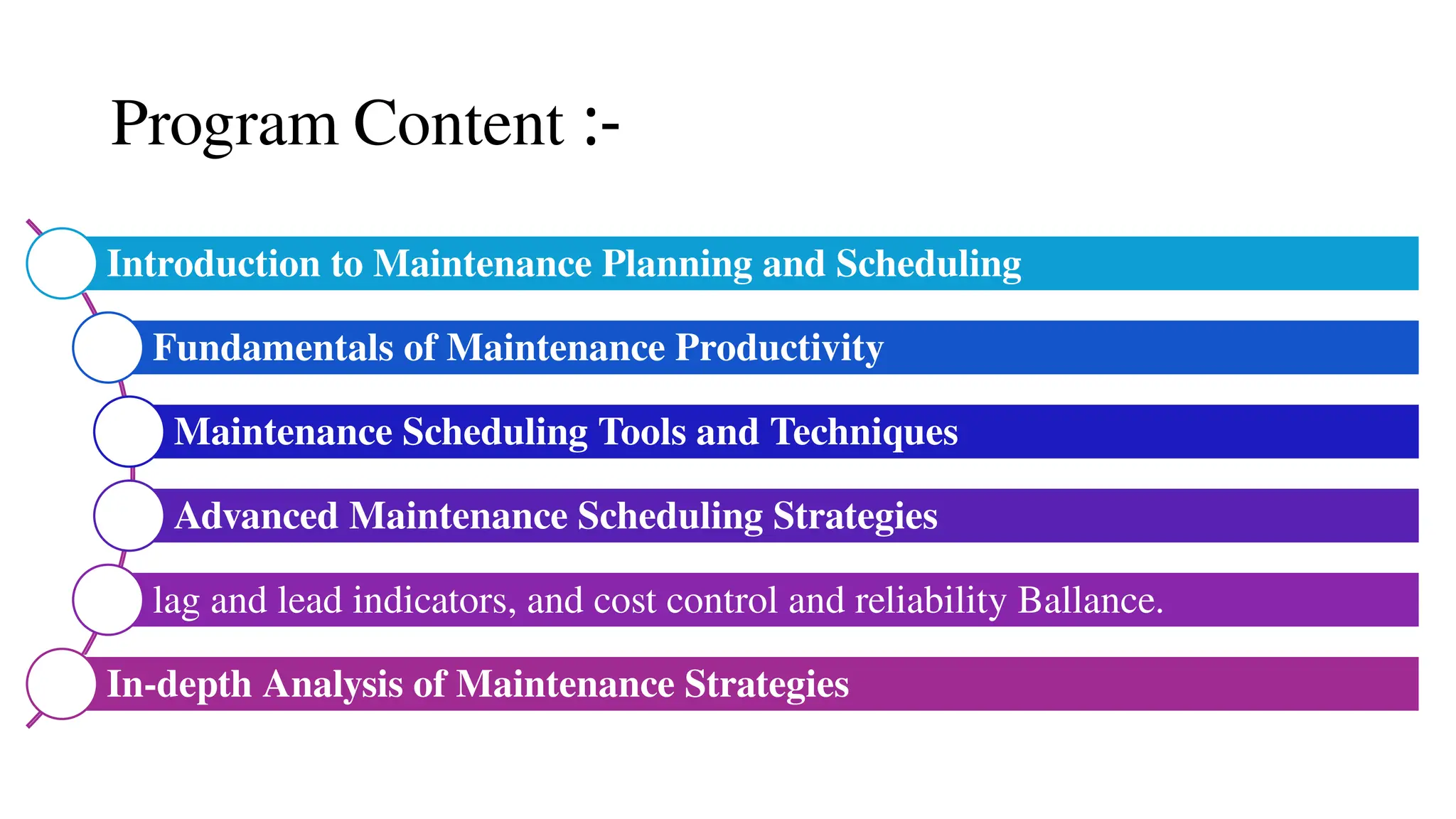
Introduction to Maintenance Planning and Scheduling
Fundamentals of Maintenance Productivity
Maintenance Scheduling Tools and Techniques
Advanced Maintenance Scheduling Strategies
lag and lead indicators, and cost control and reliability Ballance.
In-depth Analysis of Maintenance Strategies
Program Content :-
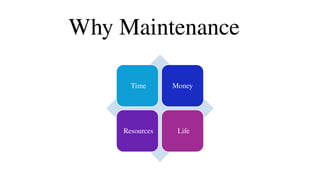
Time Money
Resources Life
Why Maintenance
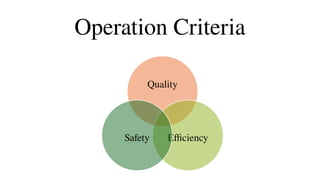
Quality
Efficiency
Safety
Operation Criteria
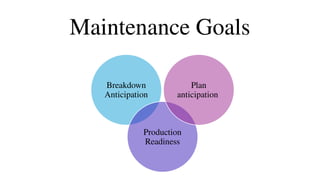
Breakdown
Anticipation
Production
Readiness
Plan
anticipation
Maintenance Goals
Cost
Scop
Reliability
Quality
Planner Mission
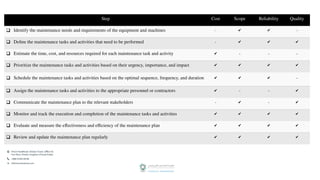
Step Cost Scope Reliability Quality
 Identify the maintenance needs and requirements of the equipment and machines - ✔️ ✔️ -
 Define the maintenance tasks and activities that need to be performed - ✔️ ✔️ ✔️
 Estimate the time, cost, and resources required for each maintenance task and activity ✔️ - - -
 Prioritize the maintenance tasks and activities based on their urgency, importance, and impact ✔️ ✔️ ✔️ ✔️
 Schedule the maintenance tasks and activities based on the optimal sequence, frequency, and duration ✔️ ✔️ ✔️ -
 Assign the maintenance tasks and activities to the appropriate personnel or contractors ✔️ - - ✔️
 Communicate the maintenance plan to the relevant stakeholders - ✔️ - ✔️
 Monitor and track the execution and completion of the maintenance tasks and activities ✔️ ✔️ ✔️ ✔️
 Evaluate and measure the effectiveness and efficiency of the maintenance plan ✔️ ✔️ ✔️ ✔️
 Review and update the maintenance plan regularly ✔️ ✔️ ✔️ ✔️
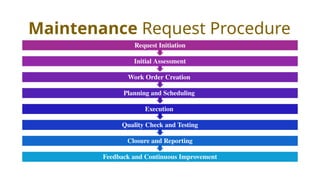
Maintenance Request Procedure
Feedback and Continuous Improvement
Closure and Reporting
Quality Check and Testing
Execution
Planning and Scheduling
Work Order Creation
Initial Assessment
Request Initiation
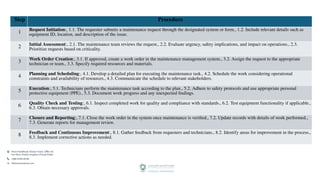
Step Procedure
1 Request Initiation:, 1.1. The requester submits a maintenance request through the designated system or form., 1.2. Include relevant details such as
equipment ID, location, and description of the issue.
2 Initial Assessment:, 2.1. The maintenance team reviews the request., 2.2. Evaluate urgency, safety implications, and impact on operations., 2.3.
Prioritize requests based on criticality.
3 Work Order Creation:, 3.1. If approved, create a work order in the maintenance management system., 3.2. Assign the request to the appropriate
technician or team., 3.3. Specify required resources and materials.
4 Planning and Scheduling:, 4.1. Develop a detailed plan for executing the maintenance task., 4.2. Schedule the work considering operational
constraints and availability of resources., 4.3. Communicate the schedule to relevant stakeholders.
5 Execution:, 5.1. Technicians perform the maintenance task according to the plan., 5.2. Adhere to safety protocols and use appropriate personal
protective equipment (PPE)., 5.3. Document work progress and any unexpected findings.
6 Quality Check and Testing:, 6.1. Inspect completed work for quality and compliance with standards., 6.2. Test equipment functionality if applicable.,
6.3. Obtain necessary approvals.
7 Closure and Reporting:, 7.1. Close the work order in the system once maintenance is verified., 7.2. Update records with details of work performed.,
7.3. Generate reports for management review.
8 Feedback and Continuous Improvement:, 8.1. Gather feedback from requesters and technicians., 8.2. Identify areas for improvement in the process.,
8.3. Implement corrective actions as needed.
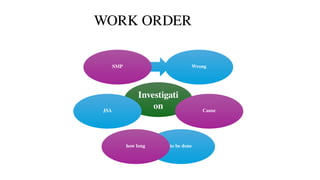
WORK ORDER
Investigati
on
Wrong
Cause
to be done
how long
JSA
SMP
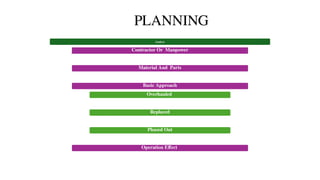
PLANNING
Analyze
Contractor Or Manpower
Material And Parts
Basic Approach
Overhauled
Replaced
Phased Out
Operation Effect
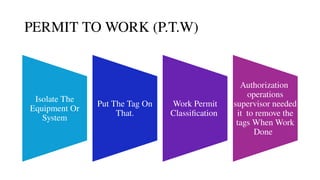
Isolate The
Equipment Or
System
Put The Tag On
That.
Work Permit
Classification
Authorization
operations
supervisor needed
it to remove the
tags When Work
Done
PERMIT TO WORK (P.T.W)
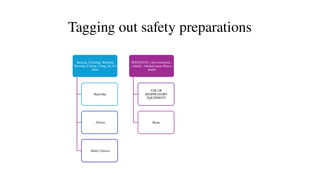
Beating, Grinding, Welding,
Burning, Cutting, Using An Air
Hose
Hard Hat
, Gloves
Safety Glasses
SOLVENTS ( skin irritations ,
volatile , inhaled cause illness,
death)
USE OF
RESPIRATORY
EQUIPMENT
Boots
Tagging out safety preparations
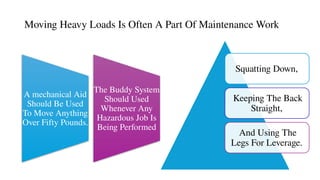
A mechanical Aid
Should Be Used
To Move Anything
Over Fifty Pounds.
The Buddy System
Should Used
Whenever Any
Hazardous Job Is
Being Performed
Moving Heavy Loads Is Often A Part Of Maintenance Work
Squatting Down,
Keeping The Back
Straight,
And Using The
Legs For Leverage.
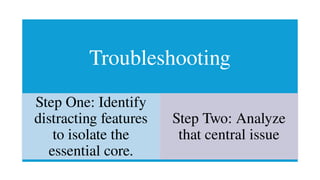
Troubleshooting
Step One: Identify
distracting features
to isolate the
essential core.
Step Two: Analyze
that central issue
Troubleshooting Manual
machinery history record logged
Troubleshooting Reference
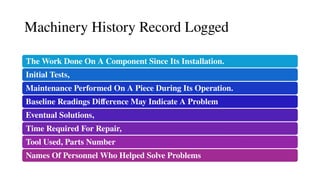
Machinery History Record Logged
The Work Done On A Component Since Its Installation.
Initial Tests,
Maintenance Performed On A Piece During Its Operation.
Baseline Readings Difference May Indicate A Problem
Eventual Solutions,
Time Required For Repair,
Tool Used, Parts Number
Names Of Personnel Who Helped Solve Problems
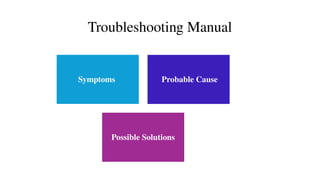
Troubleshooting Manual
Symptoms Probable Cause
Possible Solutions
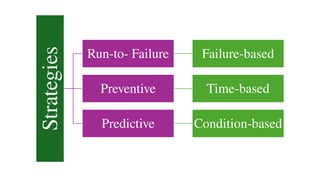
Strategies Run-to- Failure Failure-based
Preventive Time-based
Predictive Condition-based
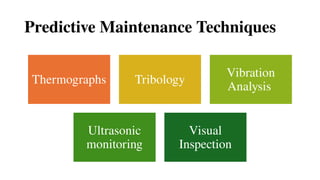
Thermographs Tribology
Vibration
Analysis
Ultrasonic
monitoring
Visual
Inspection
Predictive Maintenance Techniques
Ultrasonic Inspections
These inspections involve using specialized equipment that can scan electrical components at different voltage
levels (low, medium, and high). The key advantage is that inspectors can listen to the equipment while scanning.
Identifying Anomalies:
During ultrasonic inspections, inspectors can quickly detect the following electrical anomalies:
Arcing: This occurs when electricity jumps through the air, potentially causing damage or fire hazards.
Tracking: Leakage of electricity along insulating surfaces, which can lead to wear and eventual failure.
Corona: Ionization of air around high-voltage conductors, signaling potential insulation breakdown.
Why It Matters:
Detecting these anomalies early allows for timely maintenance and prevents unexpected failures.
By addressing issues before they become visible, maintenance teams can minimize downtime and costs.
In summary, ultrasonic monitoring helps keep electrical systems reliable and safe! 🛠️
🔍
Early Fault Detection:
• Unlike some other technologies, ultrasound detects faults at an early stage.
• By identifying issues before they become visible to the human eye, it allows for timely intervention.
• Microscopic changes in friction forces, detectable early with ultrasound, provide a larger window of opportunity for scheduled
maintenance.
• Addressing problems at this stage empowers maintenance teams to limit downtime and overall maintenance costs
Versatility and Ease of Use:
• Ultrasound instruments are user-friendly and adaptable.
• Inspectors can customize their instruments to suit program needs and goals.
• Most detectors convert high-frequency ultrasound into audible sounds, which can be listened to with headphones.
• Some instruments provide visual indicators on bar graph displays or decibel measurements.
• Sophistication and simplicity coexist, making ultrasound a mainstream choice for predictive maintenance practitioners2
.
In summary, ultrasonic monitoring enhances reliability, prevents unexpected failures, and contributes to efficient maintenance practices i
n industrial settings
4
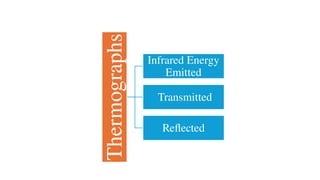
Thermographs
Infrared Energy
Emitted
Transmitted
Reflected
Tribology
Wear
Friction
Lubrication
Ferrography
wear particles a microscopic
examination and analysis
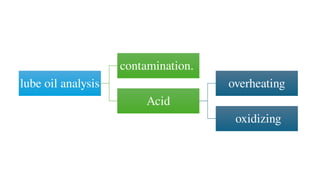
lube oil analysis
contamination.
Acid
overheating
oxidizing
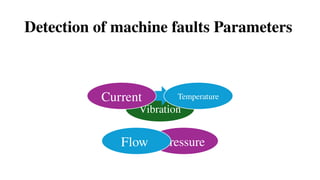
Vibration
Temperature
Pressure
Flow
Current
Detection of machine faults Parameters
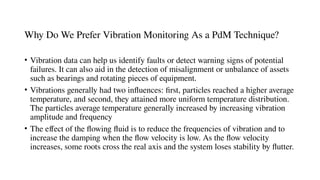
Why Do We Prefer Vibration Monitoring As a PdM Technique?
• Vibration data can help us identify faults or detect warning signs of potential
failures. It can also aid in the detection of misalignment or unbalance of assets
such as bearings and rotating pieces of equipment.
• Vibrations generally had two influences: first, particles reached a higher average
temperature, and second, they attained more uniform temperature distribution.
The particles average temperature generally increased by increasing vibration
amplitude and frequency
• The effect of the flowing fluid is to reduce the frequencies of vibration and to
increase the damping when the flow velocity is low. As the flow velocity
increases, some roots cross the real axis and the system loses stability by flutter.
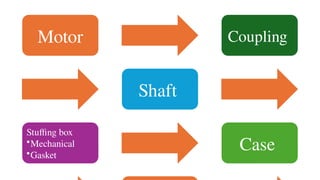
Motor Coupling
Shaft
Stuffing box
•Mechanical
•Gasket
Case
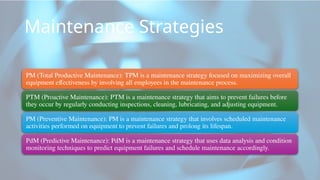
Maintenance Strategies
PM (Total Productive Maintenance): TPM is a maintenance strategy focused on maximizing overall
equipment effectiveness by involving all employees in the maintenance process.
PTM (Proactive Maintenance): PTM is a maintenance strategy that aims to prevent failures before
they occur by regularly conducting inspections, cleaning, lubricating, and adjusting equipment.
PM (Preventive Maintenance): PM is a maintenance strategy that involves scheduled maintenance
activities performed on equipment to prevent failures and prolong its lifespan.
PdM (Predictive Maintenance): PdM is a maintenance strategy that uses data analysis and condition
monitoring techniques to predict equipment failures and schedule maintenance accordingly.
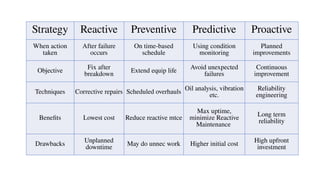
Strategy Reactive Preventive Predictive Proactive
When action
taken
After failure
occurs
On time-based
schedule
Using condition
monitoring
Planned
improvements
Objective Fix after
breakdown Extend equip life Avoid unexpected
failures
Continuous
improvement
Techniques Corrective repairs Scheduled overhauls Oil analysis, vibration
etc.
Reliability
engineering
Benefits Lowest cost Reduce reactive mtce
Max uptime,
minimize Reactive
Maintenance
Long term
reliability
Drawbacks Unplanned
downtime
May do unnec work Higher initial cost High upfront
investment

Optimizing Maintenance Planning, Scheduling, and Control.pptx

  • 1.
    Introduction to MaintenancePlanning and Scheduling Fundamentals of Maintenance Productivity Maintenance Scheduling Tools and Techniques Advanced Maintenance Scheduling Strategies lag and lead indicators, and cost control and reliability Ballance. In-depth Analysis of Maintenance Strategies Program Content :-
  • 2.
  • 3.
  • 4.
  • 5.
  • 6.
    Step Cost ScopeReliability Quality  Identify the maintenance needs and requirements of the equipment and machines - ✔️ ✔️ -  Define the maintenance tasks and activities that need to be performed - ✔️ ✔️ ✔️  Estimate the time, cost, and resources required for each maintenance task and activity ✔️ - - -  Prioritize the maintenance tasks and activities based on their urgency, importance, and impact ✔️ ✔️ ✔️ ✔️  Schedule the maintenance tasks and activities based on the optimal sequence, frequency, and duration ✔️ ✔️ ✔️ -  Assign the maintenance tasks and activities to the appropriate personnel or contractors ✔️ - - ✔️  Communicate the maintenance plan to the relevant stakeholders - ✔️ - ✔️  Monitor and track the execution and completion of the maintenance tasks and activities ✔️ ✔️ ✔️ ✔️  Evaluate and measure the effectiveness and efficiency of the maintenance plan ✔️ ✔️ ✔️ ✔️  Review and update the maintenance plan regularly ✔️ ✔️ ✔️ ✔️
  • 7.
    Maintenance Request Procedure Feedbackand Continuous Improvement Closure and Reporting Quality Check and Testing Execution Planning and Scheduling Work Order Creation Initial Assessment Request Initiation
  • 8.
    Step Procedure 1 RequestInitiation:, 1.1. The requester submits a maintenance request through the designated system or form., 1.2. Include relevant details such as equipment ID, location, and description of the issue. 2 Initial Assessment:, 2.1. The maintenance team reviews the request., 2.2. Evaluate urgency, safety implications, and impact on operations., 2.3. Prioritize requests based on criticality. 3 Work Order Creation:, 3.1. If approved, create a work order in the maintenance management system., 3.2. Assign the request to the appropriate technician or team., 3.3. Specify required resources and materials. 4 Planning and Scheduling:, 4.1. Develop a detailed plan for executing the maintenance task., 4.2. Schedule the work considering operational constraints and availability of resources., 4.3. Communicate the schedule to relevant stakeholders. 5 Execution:, 5.1. Technicians perform the maintenance task according to the plan., 5.2. Adhere to safety protocols and use appropriate personal protective equipment (PPE)., 5.3. Document work progress and any unexpected findings. 6 Quality Check and Testing:, 6.1. Inspect completed work for quality and compliance with standards., 6.2. Test equipment functionality if applicable., 6.3. Obtain necessary approvals. 7 Closure and Reporting:, 7.1. Close the work order in the system once maintenance is verified., 7.2. Update records with details of work performed., 7.3. Generate reports for management review. 8 Feedback and Continuous Improvement:, 8.1. Gather feedback from requesters and technicians., 8.2. Identify areas for improvement in the process., 8.3. Implement corrective actions as needed.
  • 9.
  • 10.
    PLANNING Analyze Contractor Or Manpower MaterialAnd Parts Basic Approach Overhauled Replaced Phased Out Operation Effect
  • 11.
    Isolate The Equipment Or System PutThe Tag On That. Work Permit Classification Authorization operations supervisor needed it to remove the tags When Work Done PERMIT TO WORK (P.T.W)
  • 12.
    Beating, Grinding, Welding, Burning,Cutting, Using An Air Hose Hard Hat , Gloves Safety Glasses SOLVENTS ( skin irritations , volatile , inhaled cause illness, death) USE OF RESPIRATORY EQUIPMENT Boots Tagging out safety preparations
  • 13.
    A mechanical Aid ShouldBe Used To Move Anything Over Fifty Pounds. The Buddy System Should Used Whenever Any Hazardous Job Is Being Performed Moving Heavy Loads Is Often A Part Of Maintenance Work Squatting Down, Keeping The Back Straight, And Using The Legs For Leverage.
  • 14.
    Troubleshooting Step One: Identify distractingfeatures to isolate the essential core. Step Two: Analyze that central issue
  • 15.
    Troubleshooting Manual machinery historyrecord logged Troubleshooting Reference
  • 16.
    Machinery History RecordLogged The Work Done On A Component Since Its Installation. Initial Tests, Maintenance Performed On A Piece During Its Operation. Baseline Readings Difference May Indicate A Problem Eventual Solutions, Time Required For Repair, Tool Used, Parts Number Names Of Personnel Who Helped Solve Problems
  • 17.
  • 18.
    Strategies Run-to- FailureFailure-based Preventive Time-based Predictive Condition-based
  • 20.
  • 21.
    Ultrasonic Inspections These inspectionsinvolve using specialized equipment that can scan electrical components at different voltage levels (low, medium, and high). The key advantage is that inspectors can listen to the equipment while scanning. Identifying Anomalies: During ultrasonic inspections, inspectors can quickly detect the following electrical anomalies: Arcing: This occurs when electricity jumps through the air, potentially causing damage or fire hazards. Tracking: Leakage of electricity along insulating surfaces, which can lead to wear and eventual failure. Corona: Ionization of air around high-voltage conductors, signaling potential insulation breakdown. Why It Matters: Detecting these anomalies early allows for timely maintenance and prevents unexpected failures. By addressing issues before they become visible, maintenance teams can minimize downtime and costs. In summary, ultrasonic monitoring helps keep electrical systems reliable and safe! 🛠️ 🔍
  • 22.
    Early Fault Detection: •Unlike some other technologies, ultrasound detects faults at an early stage. • By identifying issues before they become visible to the human eye, it allows for timely intervention. • Microscopic changes in friction forces, detectable early with ultrasound, provide a larger window of opportunity for scheduled maintenance. • Addressing problems at this stage empowers maintenance teams to limit downtime and overall maintenance costs Versatility and Ease of Use: • Ultrasound instruments are user-friendly and adaptable. • Inspectors can customize their instruments to suit program needs and goals. • Most detectors convert high-frequency ultrasound into audible sounds, which can be listened to with headphones. • Some instruments provide visual indicators on bar graph displays or decibel measurements. • Sophistication and simplicity coexist, making ultrasound a mainstream choice for predictive maintenance practitioners2 . In summary, ultrasonic monitoring enhances reliability, prevents unexpected failures, and contributes to efficient maintenance practices i n industrial settings 4
  • 23.
  • 24.
  • 25.
    Ferrography wear particles amicroscopic examination and analysis
  • 26.
  • 27.
  • 28.
    Why Do WePrefer Vibration Monitoring As a PdM Technique? • Vibration data can help us identify faults or detect warning signs of potential failures. It can also aid in the detection of misalignment or unbalance of assets such as bearings and rotating pieces of equipment. • Vibrations generally had two influences: first, particles reached a higher average temperature, and second, they attained more uniform temperature distribution. The particles average temperature generally increased by increasing vibration amplitude and frequency • The effect of the flowing fluid is to reduce the frequencies of vibration and to increase the damping when the flow velocity is low. As the flow velocity increases, some roots cross the real axis and the system loses stability by flutter.
  • 29.
  • 30.
    Maintenance Strategies PM (TotalProductive Maintenance): TPM is a maintenance strategy focused on maximizing overall equipment effectiveness by involving all employees in the maintenance process. PTM (Proactive Maintenance): PTM is a maintenance strategy that aims to prevent failures before they occur by regularly conducting inspections, cleaning, lubricating, and adjusting equipment. PM (Preventive Maintenance): PM is a maintenance strategy that involves scheduled maintenance activities performed on equipment to prevent failures and prolong its lifespan. PdM (Predictive Maintenance): PdM is a maintenance strategy that uses data analysis and condition monitoring techniques to predict equipment failures and schedule maintenance accordingly.
  • 31.
    Strategy Reactive PreventivePredictive Proactive When action taken After failure occurs On time-based schedule Using condition monitoring Planned improvements Objective Fix after breakdown Extend equip life Avoid unexpected failures Continuous improvement Techniques Corrective repairs Scheduled overhauls Oil analysis, vibration etc. Reliability engineering Benefits Lowest cost Reduce reactive mtce Max uptime, minimize Reactive Maintenance Long term reliability Drawbacks Unplanned downtime May do unnec work Higher initial cost High upfront investment