GD 20503
Financial Markets and Institutions


                                     1
Outlines:
 Types of Money Market Securities
 Institutional Use of Money Markets
 Valuation of Money Market Securities
 Globalization of Money Markets


                                         2
Types of Money Market Securities
 Treasury Bills
 Commercial Paper
 Negotiable Certificates of Deposit (NCDs)
 Repurchase Agreements
 Federal Funds
 Banker’s Acceptance


                                              3
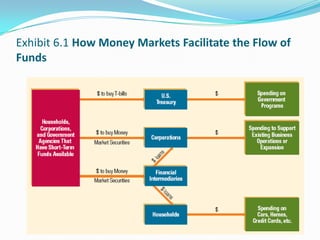
Exhibit 6.1 How Money Markets Facilitate the Flow of
Funds
Treasury Bills
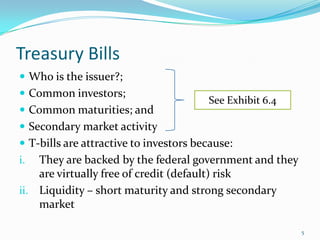
 Who is the issuer?;
 Common investors;
                                        See Exhibit 6.4
 Common maturities; and
 Secondary market activity
 T-bills are attractive to investors because:
i.  They are backed by the federal government and they
    are virtually free of credit (default) risk
ii. Liquidity – short maturity and strong secondary
    market

                                                          5
Treasury Bills
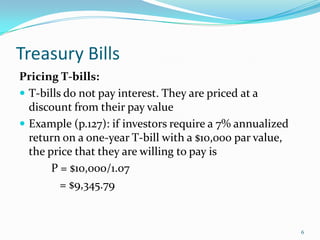
Pricing T-bills:
 T-bills do not pay interest. They are priced at a
  discount from their pay value
 Example (p.127): if investors require a 7% annualized
  return on a one-year T-bill with a $10,000 par value,
  the price that they are willing to pay is
       P = $10,000/1.07
         = $9,345.79


                                                          6
Treasury Bills



                 7
Treasury Bills



                 8
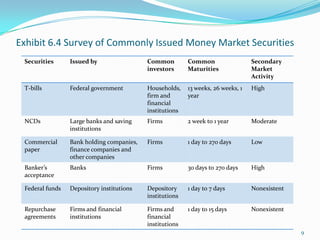
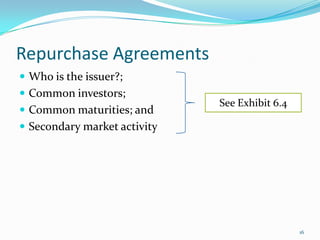
Exhibit 6.4 Survey of Commonly Issued Money Market Securities
 Securities      Issued by                 Common         Common                  Secondary
                                           investors      Maturities              Market
                                                                                  Activity
 T-bills         Federal government        Households,    13 weeks, 26 weeks, 1   High
                                           firm and       year
                                           financial
                                           institutions
 NCDs            Large banks and saving    Firms          2 week to 1 year        Moderate
                 institutions

 Commercial      Bank holding companies,   Firms          1 day to 270 days       Low
 paper           finance companies and
                 other companies
 Banker’s        Banks                     Firms          30 days to 270 days     High
 acceptance

 Federal funds   Depository institutions   Depository     1 day to 7 days         Nonexistent
                                           institutions

 Repurchase      Firms and financial       Firms and      1 day to 15 days        Nonexistent
 agreements      institutions              financial
                                           institutions
                                                                                                9
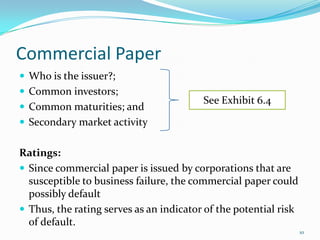
Commercial Paper
 Who is the issuer?;
 Common investors;
                                         See Exhibit 6.4
 Common maturities; and
 Secondary market activity


Ratings:
 Since commercial paper is issued by corporations that are
  susceptible to business failure, the commercial paper could
  possibly default
 Thus, the rating serves as an indicator of the potential risk
  of default.
                                                                  10
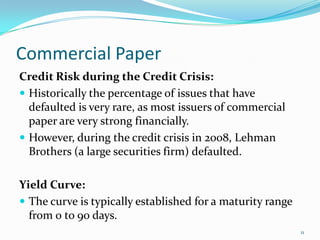
Commercial Paper
Credit Risk during the Credit Crisis:
 Historically the percentage of issues that have
  defaulted is very rare, as most issuers of commercial
  paper are very strong financially.
 However, during the credit crisis in 2008, Lehman
  Brothers (a large securities firm) defaulted.

Yield Curve:
 The curve is typically established for a maturity range
  from 0 to 90 days.
                                                            11
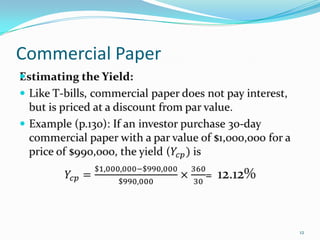
Commercial Paper



                   12
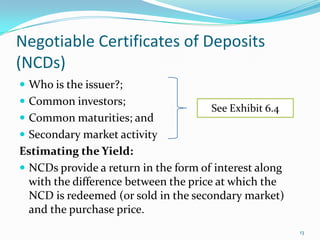
Negotiable Certificates of Deposits
(NCDs)
 Who is the issuer?;
 Common investors;
                                      See Exhibit 6.4
 Common maturities; and
 Secondary market activity
Estimating the Yield:
 NCDs provide a return in the form of interest along
  with the difference between the price at which the
  NCD is redeemed (or sold in the secondary market)
  and the purchase price.
                                                        13
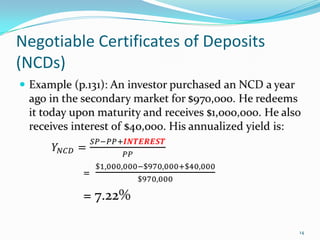
Negotiable Certificates of Deposits
(NCDs)



                                      14
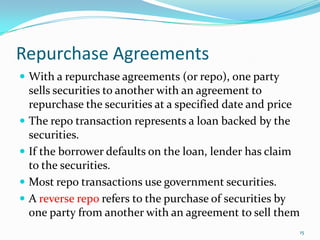
Repurchase Agreements
 With a repurchase agreements (or repo), one party
  sells securities to another with an agreement to
  repurchase the securities at a specified date and price
 The repo transaction represents a loan backed by the
  securities.
 If the borrower defaults on the loan, lender has claim
  to the securities.
 Most repo transactions use government securities.
 A reverse repo refers to the purchase of securities by
  one party from another with an agreement to sell them
                                                            15
Repurchase Agreements
 Who is the issuer?;
 Common investors;
                              See Exhibit 6.4
 Common maturities; and
 Secondary market activity


                                                16
Federal Funds
 Who is the issuer?;
 Common investors;
                                      See Exhibit 6.4
 Common maturities; and
 Secondary market activity
 The federal funds market allows depository
  institutions to effectively lend or borrow short-
  term from each other at the so-called federal funds
  rate.
 The federal funds rate is normally slightly higher
  than the T-bill rate.                                 17
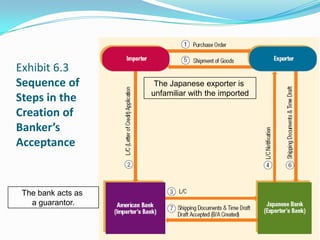
Banker’s Acceptance
 A banker’s acceptance indicates that a bank accept
  responsibility for a future payment (the bank acts as a
  guarantor).
 It is commonly used for international trade
  transactions
 Who is the issuer?;
 Common investors;
                                       See Exhibit 6.4
 Common maturities; and
 Secondary market activity

                                                            18
Exhibit 6.3
Sequence of          The Japanese exporter is
                    unfamiliar with the imported
Steps in the
Creation of
Banker’s
Acceptance


 The bank acts as
   a guarantor.
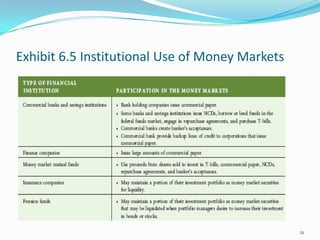
Institutional Use of Money Markets
 Types of Financial Institutions:
i.   Commercial Banks
ii. Finance companies
iii. Money market mutual funds
iv. Insurance companies
v. Pension funds
 Financial institutions purchase money market securities in
  order to simultaneously earn a return and maintain
  adequate liquidity.
 They issue money market securities when experiencing a
  temporary shortage of cash

                                                               20
Exhibit 6.5 Institutional Use of Money Markets


                                                 21
Valuation of Money Market Securities
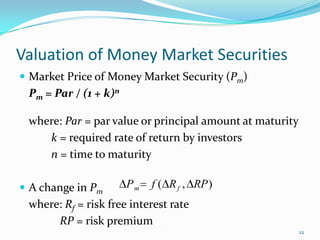
 Market Price of Money Market Security (Pm)
 Pm = Par / (1 + k)n

 where: Par = par value or principal amount at maturity
    k = required rate of return by investors
    n = time to maturity

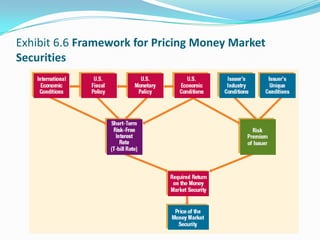
 A change in Pm       Pm   f ( R f , RP )
 where: Rf = risk free interest rate
      RP = risk premium
                                                          22
Exhibit 6.6 Framework for Pricing Money Market
Securities
Valuation of Money Market Securities
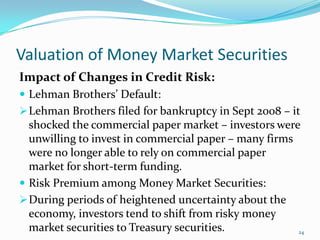
Impact of Changes in Credit Risk:
 Lehman Brothers’ Default:
 Lehman Brothers filed for bankruptcy in Sept 2008 – it
  shocked the commercial paper market – investors were
  unwilling to invest in commercial paper – many firms
  were no longer able to rely on commercial paper
  market for short-term funding.
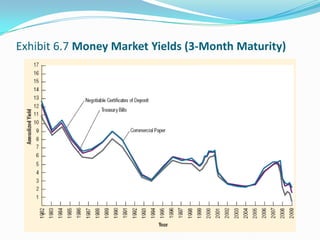
 Risk Premium among Money Market Securities:
 During periods of heightened uncertainty about the
  economy, investors tend to shift from risky money
  market securities to Treasury securities.            24
Exhibit 6.7 Money Market Yields (3-Month Maturity)
Valuation of Money Market Securities
 Interest Rate Risk:
 If short-term interest rates increase, the required rate
  of return on money market securities will increase and
  the price of the money market securities will decrease
  (see the valuation formula).
 Although money market securities values are sensitive
  to interest rate movements in the same direction as
  bonds, they are not as sensitive as bond values to
  interest rate movements.


                                                             26
Globalization of Money Markets
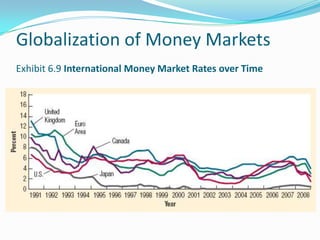
Exhibit 6.9 International Money Market Rates over Time

Money markets

  • 1.
    GD 20503 Financial Marketsand Institutions 1
  • 2.
    Outlines:  Types ofMoney Market Securities  Institutional Use of Money Markets  Valuation of Money Market Securities  Globalization of Money Markets 2
  • 3.
    Types of MoneyMarket Securities  Treasury Bills  Commercial Paper  Negotiable Certificates of Deposit (NCDs)  Repurchase Agreements  Federal Funds  Banker’s Acceptance 3
  • 4.
    Exhibit 6.1 HowMoney Markets Facilitate the Flow of Funds
  • 5.
    Treasury Bills  Whois the issuer?;  Common investors; See Exhibit 6.4  Common maturities; and  Secondary market activity  T-bills are attractive to investors because: i. They are backed by the federal government and they are virtually free of credit (default) risk ii. Liquidity – short maturity and strong secondary market 5
  • 6.
    Treasury Bills Pricing T-bills: T-bills do not pay interest. They are priced at a discount from their pay value  Example (p.127): if investors require a 7% annualized return on a one-year T-bill with a $10,000 par value, the price that they are willing to pay is P = $10,000/1.07 = $9,345.79 6
  • 7.
  • 8.
  • 9.
    Exhibit 6.4 Surveyof Commonly Issued Money Market Securities Securities Issued by Common Common Secondary investors Maturities Market Activity T-bills Federal government Households, 13 weeks, 26 weeks, 1 High firm and year financial institutions NCDs Large banks and saving Firms 2 week to 1 year Moderate institutions Commercial Bank holding companies, Firms 1 day to 270 days Low paper finance companies and other companies Banker’s Banks Firms 30 days to 270 days High acceptance Federal funds Depository institutions Depository 1 day to 7 days Nonexistent institutions Repurchase Firms and financial Firms and 1 day to 15 days Nonexistent agreements institutions financial institutions 9
  • 10.
    Commercial Paper  Whois the issuer?;  Common investors; See Exhibit 6.4  Common maturities; and  Secondary market activity Ratings:  Since commercial paper is issued by corporations that are susceptible to business failure, the commercial paper could possibly default  Thus, the rating serves as an indicator of the potential risk of default. 10
  • 11.
    Commercial Paper Credit Riskduring the Credit Crisis:  Historically the percentage of issues that have defaulted is very rare, as most issuers of commercial paper are very strong financially.  However, during the credit crisis in 2008, Lehman Brothers (a large securities firm) defaulted. Yield Curve:  The curve is typically established for a maturity range from 0 to 90 days. 11
  • 12.
  • 13.
    Negotiable Certificates ofDeposits (NCDs)  Who is the issuer?;  Common investors; See Exhibit 6.4  Common maturities; and  Secondary market activity Estimating the Yield:  NCDs provide a return in the form of interest along with the difference between the price at which the NCD is redeemed (or sold in the secondary market) and the purchase price. 13
  • 14.
    Negotiable Certificates ofDeposits (NCDs)  14
  • 15.
    Repurchase Agreements  Witha repurchase agreements (or repo), one party sells securities to another with an agreement to repurchase the securities at a specified date and price  The repo transaction represents a loan backed by the securities.  If the borrower defaults on the loan, lender has claim to the securities.  Most repo transactions use government securities.  A reverse repo refers to the purchase of securities by one party from another with an agreement to sell them 15
  • 16.
    Repurchase Agreements  Whois the issuer?;  Common investors; See Exhibit 6.4  Common maturities; and  Secondary market activity 16
  • 17.
    Federal Funds  Whois the issuer?;  Common investors; See Exhibit 6.4  Common maturities; and  Secondary market activity  The federal funds market allows depository institutions to effectively lend or borrow short- term from each other at the so-called federal funds rate.  The federal funds rate is normally slightly higher than the T-bill rate. 17
  • 18.
    Banker’s Acceptance  Abanker’s acceptance indicates that a bank accept responsibility for a future payment (the bank acts as a guarantor).  It is commonly used for international trade transactions  Who is the issuer?;  Common investors; See Exhibit 6.4  Common maturities; and  Secondary market activity 18
  • 19.
    Exhibit 6.3 Sequence of The Japanese exporter is unfamiliar with the imported Steps in the Creation of Banker’s Acceptance The bank acts as a guarantor.
  • 20.
    Institutional Use ofMoney Markets  Types of Financial Institutions: i. Commercial Banks ii. Finance companies iii. Money market mutual funds iv. Insurance companies v. Pension funds  Financial institutions purchase money market securities in order to simultaneously earn a return and maintain adequate liquidity.  They issue money market securities when experiencing a temporary shortage of cash 20
  • 21.
    Exhibit 6.5 InstitutionalUse of Money Markets 21
  • 22.
    Valuation of MoneyMarket Securities  Market Price of Money Market Security (Pm) Pm = Par / (1 + k)n where: Par = par value or principal amount at maturity k = required rate of return by investors n = time to maturity  A change in Pm Pm f ( R f , RP ) where: Rf = risk free interest rate RP = risk premium 22
  • 23.
    Exhibit 6.6 Frameworkfor Pricing Money Market Securities
  • 24.
    Valuation of MoneyMarket Securities Impact of Changes in Credit Risk:  Lehman Brothers’ Default:  Lehman Brothers filed for bankruptcy in Sept 2008 – it shocked the commercial paper market – investors were unwilling to invest in commercial paper – many firms were no longer able to rely on commercial paper market for short-term funding.  Risk Premium among Money Market Securities:  During periods of heightened uncertainty about the economy, investors tend to shift from risky money market securities to Treasury securities. 24
  • 25.
    Exhibit 6.7 MoneyMarket Yields (3-Month Maturity)
  • 26.
    Valuation of MoneyMarket Securities  Interest Rate Risk:  If short-term interest rates increase, the required rate of return on money market securities will increase and the price of the money market securities will decrease (see the valuation formula).  Although money market securities values are sensitive to interest rate movements in the same direction as bonds, they are not as sensitive as bond values to interest rate movements. 26
  • 27.
    Globalization of MoneyMarkets Exhibit 6.9 International Money Market Rates over Time