© 2010. National Endowment for Financial Education. All rights reserved.

The content in this material are believed to be current as of this electronic version, but over time,
    legislative and regulatory changes, as well as new developments, may date this material.
Introduction ............................................................ 3   Part Three: Your Future
Part One: Your Spending                                                       Determining Your Financial Future .....................                40
                                                                              	 What Are Financial Goals? ..............................             40
Your Money ............................................................. 4
                                                                              	 Some Goals to Consider . .................................           43
	 Where Does the Money Go? . ............................. 4
                                                                              	 Thinking About Tomorrow . ............................               44
	 Plugging Spending Leaks ................................... 5
                                                                              	 A Spending Plan to Make It Happen . .............                    44
	 Spending Time and Spending Money:
                                                                              	 You’re at the Start of an Adventure .................                49
		 Are They Really so Different? ........................ 6
	 What Motivates Your Spending? ....................... 6                     Resources .............................................................. 50
	 Buying Smart ..................................................... 9
	 Spending Stumbling Blocks . ............................ 10                 Acknowledgments ................................................. 52

The Money You Borrow .......................................           11
	 How Much Consumer Debt
		 Can I Manage? .............................................         12
	 Warning Signs of Too Much Debt ..................                    13
	 How to Get Out of Debt .................................             14
	 Bankruptcy: A Last Resort ...............................            15
	 Bankruptcy FAQs .............................................        15
	 Getting Help With Your Debt ..........................               16
	 Using a Debt Recovery Worksheet . .................                  17
	 How to Use a Credit Card Wisely . ..................                 18
	 Credit Card Tips ..............................................      19
	 Using a Secured Credit Card ...........................              20
	 Understanding Interest, Fees
		 and Finance Charges ....................................            20
	 Your Credit Report ..........................................        21

Part Two: Your Savings
Staring a Savings Habit ........................................       23
	 Start Saving Early. It Pays! ...............................         23
	 Making the Commitment to Save ....................                   24
	 Where Do I Put My Pay and My Savings? ......                         25
	 Your Checking Account ...................................            25
	 Compare Checking Accounts ..........................                 26
	 Making Your Checking
		 Account Work for You ..................................             27
	 Tips for Using a Checking Account .................                  28
	 How to Balance a Checking Account ..............                     29
	 Your Savings Account ......................................          30
	 Saving for Emergencies ....................................          31
	 The Two-for-One Savings Plan .......................                 32
	 Saving vs. Investing: What is the Difference? ...                    33
	 Double Your Money: The Rule of 72 ..............                     34
	 Some Investments to Learn About . .................                  35
	 Dollar-Cost Averaging . ....................................         36
	 Tax-Advantaged Retirement Accounts ............                      37
	 Tax-Advantaged Ways to Pay for Education ...                         39
Introduction
                                                           Positive change can
                                                         happen at any moment.
                                                       It all begins with believing in yourself, refusing to
                                                         accept limitations, and nurturing your talents.


What
                                          buy. Now it’s time to improve upon       pen or pencil on hand and write
                                          those basic skills and add some          on these pages. That way, you will
                                          new ones. The purpose of this            make Your Spending, Your Savings,
place does money have in your             skill development is to ensure that      Your Future your personal planning
life? Of course, you might think          you actually can reach the dreams        notebook and a path for getting
of money as what you need to pay          you have for yourself and your           where you want to go financially.
your bills, buy groceries and take        family. Before you begin to use this
                                                                                        The National Endowment for
care of other practical concerns          publication, take a few minutes to
                                                                                   Financial Education® (NEFE®)
of life. All of this is true. We do       think about your dreams and goals.
                                                                                   also developed The Wealth Care
need money to carry on with our
                                              If money seems to have been          Kit, an electronic publication that
day-to-day lives. Yet, money can
                                          a source of problems in your past,       covers areas of your finances
be more than that—it can be
                                          it may be difficult to dream or          such as insurance, savings and
the key that opens the door to a
                                          set goals right now. So, just start      investments, taxes, retirement and
brighter future.
                                          by thinking about a small goal.          estate planning. Your Spending, Your
    How is that possible? It              It could be something as simple          Savings, Your Future was designed to
happens by using money wisely—            as setting aside $500 to start an        work with The Wealth Care Kit. You
by making it work for you and             emergency fund. Then, as you             can download The Wealth Care
your dreams. That’s the purpose           work your way through these              Kit online:
of Your Spending, Your Savings, Your      pages and gain new knowledge
Future: A Beginner’s Guide to Financial                                            www.smartaboutmoney.org/wealthcarekit
                                          and confidence, change your
Readiness. This publication is meant      goals; make them bigger and more
to help you realize that you are in                                                  The more skilled you
                                          ambitious. Think about furthering
control of your financial future.         your education, buying a home or           become with money,
Positive change can happen at             starting your own business.               the more possible your
any moment. It all begins with
believing in yourself, refusing to             To help you get started, we’re           dreams can be.
accept limitations and nurturing          going to talk about the topics of
your talents.                             your spending and your savings.               NEFE is proud to make this
                                          These are the building blocks for        publication available so you can reach
   One talent just about everyone                                                    your fullest potential. Best wishes!
                                          the last—and most important—
needs to nurture is money skills.         part of this publication: your future.
The good news is that you already         In all three parts of this guide, you
have some money skills. No doubt,         will be asked to read about how to
you’ve already had to make money          plan your finances—and then you
choices—what to buy and when to           will start doing just that. Keep a
                                                      introduction // 3
Part One     Your Spending
Your Mon ey


The
                         first building block for reaching your dreams is to take a look at what you currently
                         earn and spend. This is a good step for all of us, regardless of income. Did you know
                         that many people with salaries above $100,000 feel broke much of the time? A person
can earn a lot and still feel financially insecure. On the other hand, many people who earn $30,000 or less feel
that they’re doing well financially. Financial security doesn’t depend on how much you earn. Instead, financial
security is determined by how much you keep—and how you manage what you keep.
     This first section will give you a clear picture of where your money goes and how you can take control
of the money flow. Let’s clarify a point here. By controlling the flow of your money, we’re not talking about
putting yourself on some sort of strict “financial diet.” Of course, you need to spend money, and it’s perfectly
all right to buy some of the little extras that make life more pleasant. The key to money management—and
to so many other parts of our lives—is finding balance. You need to find balance between what you earn and
what you spend.

    The point of getting a handle on your spending is that far too many people have no idea where their
money goes. As a result, they can’t afford to set goals for the future. By knowing your spending habits and your
motivations to spend, you can make better choices. These better spending choices will help you free up money
to save and use toward your goals.
W here Does The                                         Tr a c k i n g Yo u r M o n ey F l ow
M o ney Go?                                     First, create a list of how you think you spend your money—an
                                            Anticipated Spending list. In this list, jot down all the things you think you
     Have you ever looked in                spend money on each month and their approximate costs. Some things you
your wallet and asked, “Where               may buy each day; other things, perhaps only once a week.
is the cash I had just yesterday?”              Next, keep a list of what you actually spend in one month—an Actual
Sometimes, it’s hard for us to              Spending list. (If you have an infrequent or unusual expense that month,
remember how we’ve spent our                such as a car insurance bill you pay every six months, list the amount for one
money. However, we need to know             month.) If you haven’t done this before, the easiest way is to keep a small
                                            spiral notebook with you at all times.
where our money goes before we
can figure out how to save more.            •	 Mark notebook pages for each day in the month.
To find out how, try the activities         •	Each day, list everything you buy and how much you pay for it. Include
to the right. . . . . . . . . . . . . . .      all your purchases, whether you paid for them with cash, money orders,
                                               checks, debit cards, or credit cards. Don’t forget to include even small
                                               purchases, such as a soft drink or a candy bar. (Over time, these small
                                               items really add up.)
                                            •	 the end of the month, compare your Anticipated Spending list to your
                                               At
                                               Actual Spending list.
                                            •	You may be surprised to learn how much you’ve spent on things
                                               that seemed insignificant when you bought them. It’s so easy to
                                               underestimate spending.
                                            •	From your Actual Spending list, fill in the chart on Page 5. When you
                                               finish filling in the chart, you will know where your money goes.

                                                       your spending // 4
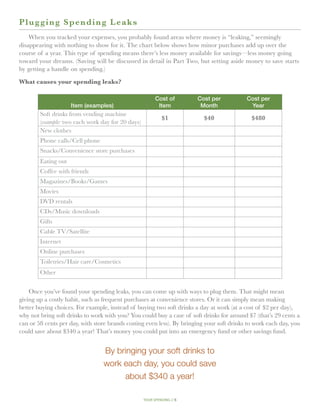
P l ugging Spending Leaks
    When you tracked your expenses, you probably found areas where money is “leaking,” seemingly
disappearing with nothing to show for it. The chart below shows how minor purchases add up over the
course of a year. This type of spending means there’s less money available for savings—less money going
toward your dreams. (Saving will be discussed in detail in Part Two, but setting aside money to save starts
by getting a handle on spending.)

What causes your spending leaks?

                                                         Cost of        Cost per           Cost per
                     Item (examples)                      Item           Month              Year
        Soft drinks from vending machine
                                                            $1            $40                $480
        (example: two each work day for 20 days)
        New clothes
        Phone calls/Cell phone
        Snacks/Convenience store purchases
        Eating out
        Coffee with friends
        Magazines/Books/Games
        Movies
        DVD rentals
        CDs/Music downloads
        Gifts
        Cable TV/Satellite
        Internet
        Online purchases
        Toiletries/Hair care/Cosmetics
        Other

    Once you’ve found your spending leaks, you can come up with ways to plug them. That might mean
giving up a costly habit, such as frequent purchases at convenience stores. Or it can simply mean making
better buying choices. For example, instead of buying two soft drinks a day at work (at a cost of $2 per day),
why not bring soft drinks to work with you? You could buy a case of soft drinks for around $7 (that’s 29 cents a
can or 58 cents per day, with store brands costing even less). By bringing your soft drinks to work each day, you
could save about $340 a year! That’s money you could put into an emergency fund or other savings fund.


                                  By bringing your soft drinks to
                                  work each day, you could save
                                       about $340 a year!

                                                   your spending // 5
S p ending Time and Spend i n g M o n ey :
A r e They Really so Dif fer e n t ?
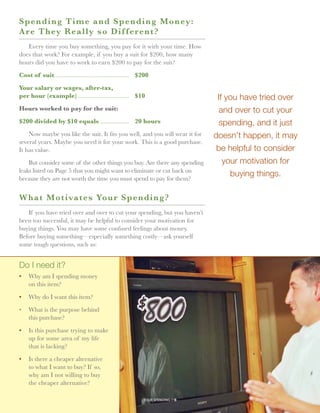
   Every time you buy something, you pay for it with your time. How
does that work? For example, if you buy a suit for $200, how many
hours did you have to work to earn $200 to pay for the suit?

Cost of suit...............................................	 $200
            .

Your salary or wages, after-tax,
per hour (example).................................	 $10                            If you have tried over
Hours worked to pay for the suit:                                                    and over to cut your
$200 divided by $10 equals...................	 20 hours                              spending, and it just
    Now maybe you like the suit. It fits you well, and you will wear it for        doesn’t happen, it may
several years. Maybe you need it for your work. This is a good purchase.
It has value.                                                                       be helpful to consider
    But consider some of the other things you buy. Are there any spending             your motivation for
leaks listed on Page 5 that you might want to eliminate or cut back on
because they are not worth the time you must spend to pay for them?
                                                                                        buying things.

W hat Motivates Your Spe n d i n g ?
   If you have tried over and over to cut your spending, but you haven’t
been too successful, it may be helpful to consider your motivation for
buying things. You may have some confused feelings about money.
Before buying something—especially something costly—ask yourself
some tough questions, such as:


Do I need it?
•	 Why am I spending money
   on this item?

•	 Why do I want this item?

•	 What is the purpose behind
   this purchase?

•	 Is this purchase trying to make
   up for some area of my life
   that is lacking?

•	 Is there a cheaper alternative
   to what I want to buy? If so,
   why am I not willing to buy
   the cheaper alternative?

                                                              your spending // 6
Don’t cheat yourself with quick answers like, “I just want it.” If
you’re really having trouble getting your spending under control, you
                                                                               My new agreements
need to ask yourself, and then honestly answer, the “Do I Need It?”            with money
questions listed on Page 6. Careless spending may be a symptom of a
deeper problem. For example, maybe you buy expensive gifts to try to              I will use my money so
impress someone or gain a friendship. Perhaps you buy “things” to make            my family and I can live
up for the fact that you don’t believe you’ll ever get what you really want,      in decent housing in a
such as a better education or a nice home.                                        safe neighborhood.

    If your spending habits are a result of unhealthy motivations, you            I will use my money to
need to take care of the root problem. This could mean anything from              promote the physical health
reflecting on your motivations to seeking counseling. It’s important to           and emotional well-being of
know that careless spending will not take away personal pain. Instead, it         my family and myself.
can lead to serious financial problems that only add to your pain.                I will use my money to help
     To move away from the problem of careless spending, it may be                further the educational and
helpful to develop some new agreements with money. Consider the                   personal growth of my family
suggestions in the “My New Agreements With Money” sidebar at left.                and myself.
Check the agreements you want to achieve, personalize them, and add to            I will use my money to
them. Then, read your money agreements often, especially when you’re              provide for a secure future.
at risk of falling back into old, negative spending habits.
                                                                                  I will use my money to help
                                                                                  charities of my choice.

                                                                               Other:____________________
                                                                               Other:____________________
                                                                               Other:____________________
                                                                               When you have made your new
                                                                               agreements with money and are
                                                                               working toward putting money
                                                                               in its proper place, you can make
                                                                               better spending decisions.

                                                                                               n

                                                                               Resources
                                                                               To learn more about setting
                                                                               goals and taking charge of
                                                                               your finances, visit the following
                                                                               Web sites:

                                                                               www.americasaves.org
                                                                               www.financialworkshopkits.org
                                                                               www.managingmymoney.com
                                                                               www.smartaboutmoney.org
                                                                               www.spendster.org

                                                   your spending // 7
Yo ur Money, Your Future


                                             “I always wanted to go to college,”
                                                  said Maria, “but my parents
                                                 couldn’t afford to send me.”


M aria Redirects Her Life
    Maria had been working for       just recently earned her bachelor’s    pay off her car loan and her
a number of years doing office       degree, even though we were            department store account. Then,
work for a downtown company.         about the same age. When I told        she moved into a much smaller
Many of the people around her        her that if I started college now,     and less costly apartment. Now,
had college degrees, and she         I would be older than the other        she rarely buys clothes and when
envied them, despite the fact that   students, she just asked, ‘How         she does, they come from a
she earned good wages. “I always     old will you be if you don’t go to     consignment store and not
wanted to go to college,” said       college?’ All of my ‘reasons’ simply   her favorite department store.
Maria, “but my parents couldn’t      became excuses.”                       A little while ago, Maria earned
afford to send me.” Still, Maria                                            an associate’s degree, and
                                         After lots of talks with Denise
took pride in her fine wardrobe                                             now she’s working toward
                                     and lots of soul-searching, Maria
and her newer model car.                                                    her bachelor’s degree.
                                     finally faced the real issue. “I
     Then, her company hired a       was afraid. It’s true that my               “Sometimes I get tired of
new woman, Denise, who would         parents couldn’t afford to send        watching my money so closely. I
play an important role in Maria’s    me to college after high school,       miss buying new clothes, my car is
life. “Denise and I would go to      but it was my fear that stopped        really old now and juggling work
lunch together. One day she asked    me after that. I also had been         and school isn’t easy,” said Maria.
me why I hadn’t gone to college      buying ‘things’ as a way to make       “But when I get an ‘A’ on an exam,
since it seemed like I wanted to     up for not having what I really        I feel better than I do with a new
go. I gave my usual answer: ‘My      wanted—a college degree.”              outfit. More than anything, I’m
parents couldn’t afford it.’ That                                           proud of myself in a way that I
                                          With encouragement from
usually stopped most people, but                                            never thought I would be. I feel
                                     Denise and her family, Maria
not Denise. She just laughed and                                            like I can do anything. That makes
                                     started taking night classes at her
said, ‘Yeah, mine couldn’t either.                                          it all worth it.”
                                     local community college. She
That’s why I did it on my own.’
                                     studied hard and did well. So
   “At first I was a bit angry.      she took more classes. To afford        “When I get an ‘A’ on an
How could she compare our lives?     the tuition, Maria changed her          exam, I feel better than I
Then I learned that Denise had       lifestyle. Her first step was to         do with a new outfit.”
                                                your spending // 8
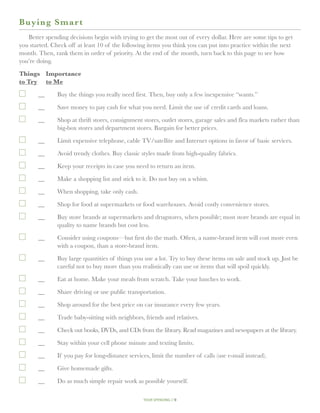
B u ying Smar t
   Better spending decisions begin with trying to get the most out of every dollar. Here are some tips to get
you started. Check off at least 10 of the following items you think you can put into practice within the next
month. Then, rank them in order of priority. At the end of the month, turn back to this page to see how
you’re doing.

Things 	 Importance
to Try	 to Me

   	   __	Buy the things you really need first. Then, buy only a few inexpensive “wants.”

  		   __	Save money to pay cash for what you need. Limit the use of credit cards and loans.

  		   __	Shop at thrift stores, consignment stores, outlet stores, garage sales and flea markets rather than
           big-box stores and department stores. Bargain for better prices.

   	   __	Limit expensive telephone, cable TV/satellite and Internet options in favor of basic services.

  		   __	Avoid trendy clothes. Buy classic styles made from high-quality fabrics.

  		   __	Keep your receipts in case you need to return an item.

  		   __	Make a shopping list and stick to it. Do not buy on a whim.

  		   __	When shopping, take only cash.

  		   __	Shop for food at supermarkets or food warehouses. Avoid costly convenience stores.

  		   __	Buy store brands at supermarkets and drugstores, when possible; most store brands are equal in
           quality to name brands but cost less.

  		   __	Consider using coupons—but first do the math. Often, a name-brand item will cost more even
           with a coupon, than a store-brand item.

  		   __	Buy large quantities of things you use a lot. Try to buy these items on sale and stock up. Just be
           careful not to buy more than you realistically can use or items that will spoil quickly.
  		   __	 at home. Make your meals from scratch. Take your lunches to work.
           Eat

  		   __	Share driving or use public transportation.

  		   __	Shop around for the best price on car insurance every few years.

  		   __	Trade baby-sitting with neighbors, friends and relatives.

  		   __	Check out books, DVDs, and CDs from the library. Read magazines and newspapers at the library.

  		   __	Stay within your cell phone minute and texting limits.
  		   __	 you pay for long-distance services, limit the number of calls (use e-mail instead).
           If

  		   __	Give homemade gifts.

  		   __	 as much simple repair work as possible yourself.
           Do

                                                 your spending // 9
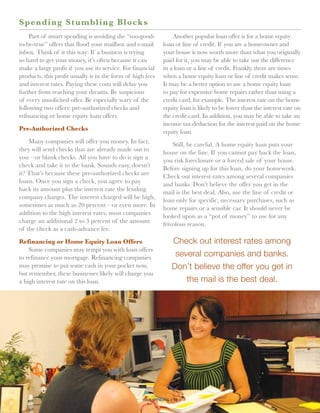
S p ending Stumbling Bloc k s
     Part of smart spending is avoiding the “too-good-            Another popular loan offer is for a home equity
to-be-true” offers that flood your mailbox and e-mail         loan or line of credit. If you are a homeowner and
inbox. Think of it this way: If a business is trying          your house is now worth more than what you originally
so hard to get your money, it’s often because it can          paid for it, you may be able to take out the difference
make a large profit if you use its service. For financial     in a loan or a line of credit. Frankly, there are times
products, this profit usually is in the form of high fees     when a home equity loan or line of credit makes sense.
and interest rates. Paying these costs will delay you         It may be a better option to use a home equity loan
further from reaching your dreams. Be suspicious              to pay for expensive home repairs rather than using a
of every unsolicited offer. Be especially wary of the         credit card, for example. The interest rate on the home
following two offers: pre-authorized checks and               equity loan is likely to be lower than the interest rate on
refinancing or home equity loan offers.                       the credit card. In addition, you may be able to take an
                                                              income tax deduction for the interest paid on the home
Pre-Authorized Checks                                         equity loan.
    Many companies will offer you money. In fact,                 Still, be careful. A home equity loan puts your
they will send checks that are already made out to            house on the line. If you cannot pay back the loan,
you—or blank checks. All you have to do is sign a             you risk foreclosure or a forced sale of your house.
check and take it to the bank. Sounds easy, doesn’t           Before signing up for this loan, do your homework.
it? That’s because these pre-authorized checks are            Check out interest rates among several companies
loans. Once you sign a check, you agree to pay                and banks. Don’t believe the offer you get in the
back its amount plus the interest rate the lending            mail is the best deal. Also, use the line of credit or
company charges. The interest charged will be high,           loan only for specific, necessary purchases, such as
sometimes as much as 20 percent—or even more. In              home repairs or a sensible car. It should never be
addition to the high interest rates, most companies           looked upon as a “pot of money” to use for any
charge an additional 2 to 3 percent of the amount             frivolous reason.
of the check as a cash-advance fee.

Refinancing or Home Equity Loan Offers                            Check out interest rates among
    Some companies may tempt you with loan offers
to refinance your mortgage. Refinancing companies                  several companies and banks.
may promise to put some cash in your pocket now,                  Don’t believe the offer you get in
but remember, these businesses likely will charge you
a high interest rate on this loan.                                    the mail is the best deal.


                                                   your spending // 10
The Money Yo u B o r r ow


The
                        most important point you can remember about borrowing money is that not all debt
                        is created equal. Some types of debt are better than others. For example, a home loan,
                        or mortgage, usually is one of the better forms of debt. That’s because most homes
increase in value over time. Also, the interest paid on the loan may be tax deductible. Another type of “better”
debt can be a student loan. In general, workers with more education earn higher wages. So, a student loan can
have a long-term financial payoff.
    The least-favorable type of debt is called              and need to borrow money to make the purchase.)
consumer debt, which is debt for items that do not          However, falling too deeply into consumer debt
increase in value over time. Consumer debt includes         is one of the biggest mistakes many people make.
such items as balances on credit cards and car loans.       This often happens when they have several forms
The interest paid on consumer debt is likely to be          of consumer debt, such as balances on major credit
high and not tax deductible.                                cards and department store cards in addition to
                                                            sizable car loans. These expensive, multiple debts
    Even though consumer debt is costly, there              drain financial resources and jeopardize your
may be times when it is unavoidable. (For example,          financial future. So how do you avoid falling into the
few people have enough money in savings to buy              consumer-debt sinkhole? It begins by knowing how
a good used car, let alone a new car, with cash             much debt you can manage.
                              The least-favorable type of debt is
                               called consumer debt, which
                                is debt for items that do not
                                 increase in value over time.


                                                 your spending // 11
H ow Much Consumer Deb t C a n I M a n a ge ?
    In general, no more than 15 to 20 percent              Yearly income after taxes and deductions
of your net (after-tax) income should be paid              = $25,000
to consumer debt. When looking at your debt,
remember to consider the amount you borrowed               Monthly income
along with the interest on the debt. Even while            = $2,083 ($25,000 ÷ 12)
you’re paying down debts, you are being charged            Recommended maximum debt levels
interest on the remaining balance. Interest rates vary     (15 to 20 percent):
widely depending on the type of debt. For example,         $312 to $417 ($2,083 x 0.15
a new car loan may cost you 9 percent a year, but          = $312; $2,083 x 0.20 = $417).
a credit card balance could cost you 18 percent or
more a year.                                                   So, for the above example, this person probably
                                                           can manage to pay between $312 and $417 a month,
    Rather than trying to figure out the total amount      including interest charges, for total consumer debt.
of consumer debt you can afford, it’s easier to
calculate how much you can afford each month for
consumer debt. Look at the example below and then
complete the calculation for your own income.


                                     Your Turn

                                     Now it’s your turn to try:

                                     Yearly income after taxes and deductions = $_________

                                     Monthy income: $_________ (Yearly income ÷ 12)

                                     Amount of consumer debt per month that I should not exceed is:

                                     $_________to $_________ (Monthly income x 0.15;
                                     Monthly income x 0.20)

                                     Each month, I can afford to pay between $_________and
                                     $_________, including interest charges, for my consumer debt.

                                         A word of caution: If your current debt level is below what you
                                     can afford to pay each month, don’t feel compelled to go on a spending
                                     spree. Instead, congratulate yourself on living below your means. Your
                                     lower debt level can mean more freedom to change jobs or reach your
                                     long-term goals even sooner. Also, the 15 to 20 percent rule of thumb
                                     is general and may not apply to you. For example, if you live in an area
                                     with high housing costs, you may not be able to afford 15 to 20 percent
                                     in consumer debt because you have to use more of your money to pay
                                     your rent or mortgage.
                                        Of course, after completing the calculation, you may find that you’re
                                     paying more than 15 to 20 percent for consumer debt. Does this mean
                                     you have a debt problem? Read on and find out.
                                                your spending // 12
Ten signs of
                                                                            too much debt:
                                                                            1.	 You spend more than 20
                                                                                percent of your paycheck to pay
                                                                                off car loans, credit cards or
                                                                                other types of consumer debt.

                                                                            2.	 You are borrowing to pay off
                                                                                other debts.

                                                                            3.	 You do not know how much
                                                                                money you owe.

                                                                            4.	 You make only the minimum
                                                                                payment on each bill.

                                                                            5.	 You miss payments, or you pay
                                                                                your bills late monthly.

                                                                            6.	 Creditors are calling.

                                                                            7.	 People or stores refuse to give
                                                                                you credit.

                                                                            8.	 You borrow from retirement
                                                                                accounts or use credit cards to
                                                                                pay normal monthly bills.

                                                                            9.	 You were overdrawn in your
                                                                                checking account more than
                                                                                three times in the last year.

                                                                            10.	 ou must take an extra job
                                                                               Y
                                                                               just to keep up with paying
                                                                               your bills.

Wa r ning Signs Of Too Mu c h D eb t
    While a limited amount of debt isn’t necessarily bad, excessive debt is. At the very least, excessive debt
delays you from reaching your goals. At its worst, excessive debt could rob you of your dreams. The sense of
hopelessness that often comes with excessive debt can affect your behavior and most valued relationships.

    You already may know whether you’re in over your head when it comes to debt. Still, read the 10 warning
signs above and see how many apply to you. The important point to remember is that even if you’re carrying
too much debt, you can reduce it over time. It will take patience, and it won’t always be easy, but you can
regain control. You can achieve balance in the future.

                                                                             It’ll take patience, and it
                                                                              won’t always be easy...

                                                 your spending // 13
H ow To Get Out Of Debt
    Reclaiming your financial future starts by taking       •	 Try to increase your income. Is it possible to
positive steps to get out of debt. Even if you have            get a second job or get paid overtime and use
serious problems with debt, there is hope. Consider            the money to reduce debt? (If you have family
taking at least some of the steps below:                       responsibilities, first consider what effect your
                                                               absence could have on the well-being of your
•	 Don’t wait to act. Just as investments compound
                                                               family. It’s important to balance the need to get
   over time, so do debts.
                                                               out of debt with the need to spend time with
•	 Create a get-out-of-debt plan. Use the Debt                 your family.)
   Recovery Worksheet on Page 17 to organize
                                                            •	 Consolidate loans. Shift higher-interest loans
   your plan.
                                                               to a single lower-rate loan and stop running up
•	 When one debt is paid off, keep making the                  new charges.
   same payment—just put that amount toward
                                                            •	 Keep only one or two major credit cards. Cut
   another debt.
                                                               up your other credit cards and call the credit
•	 Cut expenses. Try to find a few things you can              card companies to cancel the accounts. Keep
   stop buying or buy less often. See Page 9 for               the remaining one or two credit cards at home
   smart buying tips.                                          (as long as the card won’t be used by anyone
                                                               else). Consider having the credit limit lowered.
•	 Sell rarely used items. Sell items yourself—avoid           (Canceling credit card accounts may affect your
   going to a pawnshop or using an Internet broker.            credit score—but you need to find a balance
•	 Honestly assess your ability to pay for something           between reducing your debt and a possible
   and then take the appropriate action. Say that you          reduction in your credit score.)
   bought a car and are having trouble making the           •	 To stop most credit card offers from arriving
   payments. It may be better to sell the car and pay          in your mail, call 1-888-5OPTOUT
   off the loan than to let the creditor repossess your        (1-888-567-8688). You also can visit
   car. Repossession will hurt your credit record.             www.optoutprescreen.com.


                                Check with your credit card
                                and loan companies to see
                                if you can set up automatic
                                payments online. Automatic
                                payments will eliminate late
                                   and missed payments.


                                                 your spending // 14
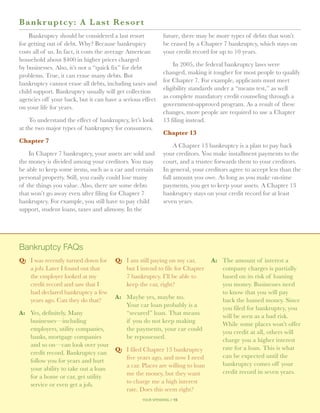
B a nkr uptc y: A Last Reso r t
    Bankruptcy should be considered a last resort            future, there may be more types of debts that won’t
for getting out of debt. Why? Because bankruptcy             be erased by a Chapter 7 bankruptcy, which stays on
costs all of us. In fact, it costs the average American      your credit record for up to 10 years.
household about $400 in higher prices charged
                                                                 In 2005, the federal bankruptcy laws were
by businesses. Also, it’s not a “quick fix” for debt
                                                             changed, making it tougher for most people to qualify
problems. True, it can erase many debts. But
                                                             for Chapter 7. For example, applicants must meet
bankruptcy cannot erase all debts, including taxes and
                                                             eligibility standards under a “means test,” as well
child support. Bankruptcy usually will get collection
                                                             as complete mandatory credit counseling through a
agencies off your back, but it can have a serious effect
                                                             government-approved program. As a result of these
on your life for years.
                                                             changes, more people are required to use a Chapter
    To understand the effect of bankruptcy, let’s look       13 filing instead.
at the two major types of bankruptcy for consumers.
                                                             Chapter 13
Chapter 7
                                                                  A Chapter 13 bankruptcy is a plan to pay back
    In Chapter 7 bankruptcy, your assets are sold and        your creditors. You make installment payments to the
the money is divided among your creditors. You may           court, and a trustee forwards them to your creditors.
be able to keep some items, such as a car and certain        In general, your creditors agree to accept less than the
personal property. Still, you easily could lose many         full amount you owe. As long as you make on-time
of the things you value. Also, there are some debts          payments, you get to keep your assets. A Chapter 13
that won’t go away even after filing for Chapter 7           bankruptcy stays on your credit record for at least
bankruptcy. For example, you still have to pay child         seven years.
support, student loans, taxes and alimony. In the


Bankruptcy FAQs
Q: 	 I was recently turned down for    Q: 	 I am still paying on my car,    A: 	 The amount of interest a
     a job. Later I found out that          but I intend to file for Chapter     company charges is partially
     the employer looked at my              7 bankruptcy. I’ll be able to        based on its risk of loaning
     credit record and saw that I           keep the car, right?                 you money. Businesses need
     had declared bankruptcy a few                                               to know that you will pay
                                     A: 	 Maybe yes, maybe no.
     years ago. Can they do that?                                                back the loaned money. Since
                                          Your car loan probably is a            you filed for bankruptcy, you
A: 	 Yes, definitely. Many                “secured” loan. That means             will be seen as a bad risk.
     businesses—including                 if you do not keep making              While some places won’t offer
     employers, utility companies,        the payments, your car could           you credit at all, others will
     banks, mortgage companies            be repossessed.                        charge you a higher interest
     and so on—can look over your                                                rate for a loan. This is what
     credit record. Bankruptcy can Q: 	 I filed Chapter 13 bankruptcy
                                          five years ago, and now I need         can be expected until the
     follow you for years and hurt
                                          a car. Places are willing to loan      bankruptcy comes off your
     your ability to take out a loan
                                          me the money, but they want            credit record in seven years.
     for a home or car, get utility
                                          to charge me a high interest
     service or even get a job.
                                          rate. Does this seem right?
                                                  your spending // 15
Before you get in over your
                                       head in debt, consider taking
                                             the steps below.

G e tting Help With Your D eb t
1.	 Call your creditors to discuss your options, and call them before
    you miss a payment. This may be a difficult step, but it is less
    embarrassing than receiving telephone calls from creditors
    demanding payment. Often, you can work out terms with your
    creditors. Perhaps your creditors will divide payments into smaller
    amounts or even forgive some of your debt. Negotiate with lenders.
    They may suspend payments, lower payments, waive late fees or
    forgive part of the loan. Get any agreement in writing.                    Only you can repair
2.	 Go to a nonprofit credit-counseling service such as the National            your bad credit by
    Foundation for Credit Counseling (NFCC). These nonprofit services          repaying your debts
    can put you on a budget and help you negotiate with lenders. To
    contact the NFCC, visit www.nfcc.org or call 1-800-388-2227.             and paying your current
3.	 Stay away from so-called “credit-repair” companies which offer to fix         bills on time.
    your credit history for a fee. Only you can repair your bad credit by
    repaying your debts and paying your current bills on time. Promises
    like “We can erase your bad credit—100 percent guaranteed” are
    dangerous. To check out a credit-repair company’s reputation, contact
    the Better Business Bureau (www.bbb.org) or your state’s attorney
    general (www.naag.org, and click The Attorneys General at upper left).


                                                 your spending // 16
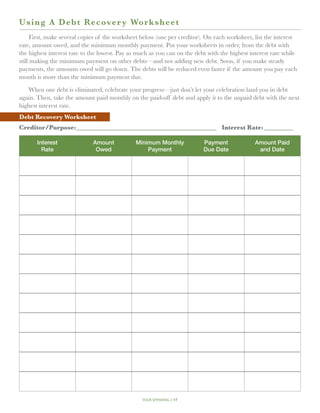
U s i ng A Debt Recover y Wo r k s h e e t
      First, make several copies of the worksheet below (one per creditor). On each worksheet, list the interest
rate, amount owed, and the minimum monthly payment. Put your worksheets in order, from the debt with
the highest interest rate to the lowest. Pay as much as you can on the debt with the highest interest rate while
still making the minimum payment on other debts—and not adding new debt. Soon, if you make steady
payments, the amounts owed will go down. The debts will be reduced even faster if the amount you pay each
month is more than the minimum payment due.

   When one debt is eliminated, celebrate your progress—just don’t let your celebration land you in debt
again. Then, take the amount paid monthly on the paid-off debt and apply it to the unpaid debt with the next
highest interest rate.
Debt Recovery Worksheet
Creditor/Purpose:_____________________________________________ 	 Interest Rate:__________

       Interest              Amount            Minimum Monthly            Payment              Amount Paid
         Rate                 Owed                 Payment                Due Date              and Date


                                                 your spending // 17
How To U s e A C r e d i t C a rd Wi s e ly
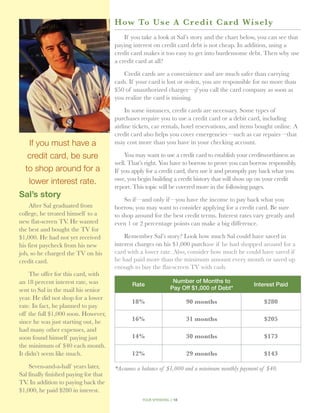
                                           If you take a look at Sal’s story and the chart below, you can see that
                                       paying interest on credit card debt is not cheap. In addition, using a
                                       credit card makes it too easy to get into burdensome debt. Then why use
                                       a credit card at all?

                                           Credit cards are a convenience and are much safer than carrying
                                       cash. If your card is lost or stolen, you are responsible for no more than
                                       $50 of un­ uthorized charges—if you call the card company as soon as
                                                 a
                                       you realize the card is missing.

                                            In some instances, credit cards are necessary. Some types of
                                       purchases require you to use a credit card or a debit card, including
                                       airline tickets, car rentals, hotel reservations, and items bought online. A
                                       credit card also helps you cover emergencies—such as car repairs—that
   If you must have a                  may cost more than you have in your checking account.

   credit card, be sure                    You may want to use a credit card to establish your creditworthiness as
                                       well. That’s right. You have to borrow to prove you can borrow responsibly.
  to shop around for a                 If you apply for a credit card, then use it and promptly pay back what you
   lower interest rate.                owe, you begin building a credit history that will show up on your credit
                                       report. This topic will be covered more in the following pages.
Sal’s story
                                           So if—and only if—you have the income to pay back what you
     After Sal graduated from          borrow, you may want to consider applying for a credit card. Be sure
college, he treated himself to a       to shop around for the best credit terms. Interest rates vary greatly and
new flat-screen TV. He wanted          even 1 or 2 percentage points can make a big difference.
the best and bought the TV for
$1,000. He had not yet received            Remember Sal’s story? Look how much Sal could have saved in
his first paycheck from his new        interest charges on his $1,000 purchase if he had shopped around for a
job, so he charged the TV on his       card with a lower rate. Also, consider how much he could have saved if
credit card.                           he had paid more than the minimum amount every month or saved up
                                       enough to buy the flat-screen TV with cash.
    The offer for this card, with
an 18 percent interest rate, was                                  Number of Months to
                                              Rate                                              Interest Paid
sent to Sal in the mail his senior                               Pay Off $1,000 of Debt*
year. He did not shop for a lower
                                              18%                       90 months                    $280
rate. In fact, he planned to pay
off the full $1,000 soon. However,
since he was just starting out, he            16%                       31 months                    $205
had many other expenses, and
soon found himself paying just                14%                       30 months                    $173
the minimum of $40 each month.
It didn’t seem like much.                     12%                       29 months                    $143

     Seven-and-a-half years later,     *Assumes a balance of $1,000 and a minimum monthly payment of $40.
Sal finally finished paying for that
TV In addition to paying back the
   .
$1,000, he paid $280 in interest.
                                                  your spending // 18
C r edit Card Tips
If you choose to use a credit card, here are some tips to help you use it wisely:

•	 Use only one or two cards.

•	 If you are just starting out, consider using a secured credit card to impose some self-restraint. Using a
   secured credit card requires you to deposit money into your account in advance of using your credit card.
   (See “Using a Secured Credit Card” on Page 20.)

•	 Keep track of what you charge just as you would with a checking account. That way, you won’t be shocked
   when your credit card bill arrives.

•	 Use credit cards only for essential needs.

•	 Save for big-ticket items instead of putting them on a card. If you must borrow for those items, less
   expensive loans from banks and credit unions may be available. Shop around.

•	 Pay credit card bills as soon as they arrive. This lowers the average daily balance on which interest is
   charged and avoids late payment fees.

•	 Always pay more than the minimum balance due. If at all possible, pay off the entire balance each month.

•	 If the balance begins to increase, quit using the card for a while.

•	 If the balance continues to increase, leave the card at home.

•	  f the balance still continues to increase, call the credit card company and request to have your credit limit
   I
   lowered. (Note that lowering your credit limit can affect
   your credit score.)

•	  se a card with a low interest rate and either a low
   U
   annual fee or no annual fee. Shop around on the Internet
   or through offers sent to you in the mail. Rates vary
   widely. (Credit cards issued by department stores tend
   to charge the highest interest rates.) Use the Credit
   Comparison Worksheet on Page 20 to compare interest
   rates and fees from at least three lenders.

•	 Be wary of cards that offer extremely low interest rates
   “for a limited time.” All too soon, that time ends, and
   the new interest rate charged may be well above average
   interest rates.

•	 Pay attention to the minimum payment disclosures on
   your credit card statements. The disclosures tell you how
   long it will take and how much money you will spend
   to pay off your credit card balance if you pay only the
   minimum amount due.


                                                  your spending // 19
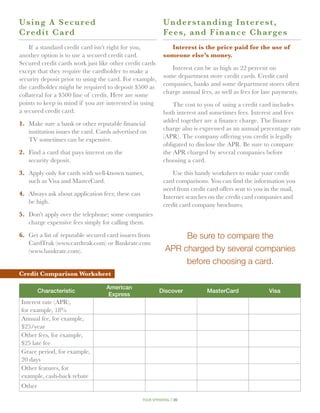
U s i ng A Secured                                            Understanding Interest,
C r edit Card                                                 Fe e s, a n d F i n a n c e C h a r ge s
    If a standard credit card isn’t right for you,              Interest is the price paid for the use of
another option is to use a secured credit card.               someone else’s money.
Secured credit cards work just like other credit cards
                                                                 Interest can be as high as 22 percent on
except that they require the cardholder to make a
                                                              some department store credit cards. Credit card
security deposit prior to using the card. For example,
                                                              companies, banks and some department stores often
the cardholder might be required to deposit $500 as
                                                              charge annual fees, as well as fees for late payments.
collateral for a $500 line of credit. Here are some
points to keep in mind if you are interested in using             The cost to you of using a credit card includes
a secured credit card:                                        both interest and sometimes fees. Interest and fees
                                                              added together are a finance charge. The finance
1.	 Make sure a bank or other reputable financial
                                                              charge also is expressed as an annual percentage rate
    institution issues the card. Cards advertised on
                                                              (APR). The company offering you credit is legally
    TV sometimes can be expensive.
                                                              obligated to disclose the APR. Be sure to compare
2.	 Find a card that pays interest on the                     the APR charged by several companies before
    security deposit.                                         choosing a card.

3.	 Apply only for cards with well-known names,                   Use this handy worksheet to make your credit
    such as Visa and MasterCard.                              card comparisons. You can find the information you
                                                              need from credit card offers sent to you in the mail,
4.	 Always ask about application fees; these can              Internet searches on the credit card companies and
    be high.                                                  credit card company brochures.
5.	 Don’t apply over the telephone; some companies
    charge expensive fees simply for calling them.

6.	 Get a list of reputable secured card issuers from               Be sure to compare the
    CardTrak (www.cardtrak.com) or Bankrate.com
    (www.bankrate.com).                                        APR charged by several companies
                                                                    before choosing a card.
Credit Comparison Worksheet

                                   American
        Characteristic                                      Discover           MasterCard               Visa
                                   Express
Interest rate (APR),
for example, 18%
Annual fee, for example,
$25/year
Other fees, for example,
$25 late fee
Grace period, for example,
20 days
Other features, for
example, cash-back rebate
Other

                                                   your spending // 20
Yo ur Credit Repor t
   Your power to borrow depends on your reputation for repaying your
debts. A credit report is a record of how you have paid your credit card
debt and other loans over time. A credit report shows:
•	 How much debt you have.
•	 If you have made payments on time.
•	 If you have not paid back some loans at all.
•	 How long you’ve used credit.
•	 The dollar amount of credit you have available.
•	 The amount of credit you’re using.                                         Resources
•	 Whether any of your accounts have gone to collection.                      Annual Credit Report
•	 If you’ve declared bankruptcy.                                             1-877-322-8228
                                                                              www.annualcreditreport.com
•	 If you have any liens against you.
                                                                              Consumer Federation
•	 If you have any unpaid bills, such as utility bills.                       of America
   Credit reports do not show information about your race, religion,          www.consumerfed.org
medical history, personal lifestyle, political preferences, specific          (choose Finance, then Credit and Debt,
purchases, criminal record or any other information unrelated to credit.      then Credit Scores and Reporting)

    Creditors rely on your credit information to see how you’ve handled       Federal Reserve System
your loans in the past and decide how likely you are to repay a new           www.federalreserve.gov
loan. When you apply for a credit card or a loan, you give the creditor       (click Consumer Information, then
permission to order your credit report from a credit reporting agency.        Consumer Credit)

How to Order a Credit Report

   The best way to know what is on your credit report is to order one for yourself and review it carefully. It’s a
good idea to order your credit report once a year to make sure there are no errors on it.

    The Fair and Accurate Credit Transactions Act (FACTA) of December 2003 gives all consumers the right
to review their credit reports, free of charge, each year.

To order your free report:                                  It’s a good idea to order your
• 	 Visit www.annualcreditreport.com                         credit report once a year to
• 	 Call 1-877-322-8228                                   make sure there are no errors on it.
   When you order your report, have ready your Social Security number, date of birth, current and previous
addresses for the past five years and maiden name, if applicable.

    If you order another credit report after receiving your free one, you may have to pay a small fee (about $8)
to get it. Credit reports are free after you have been turned down for credit. However, you must ask the agency
that produced the credit report for a copy of it within a specified period of time after being turned down,
usually 60 days.
                                                   your spending // 21
How to Correct Errors

                              It is important to check your credit report, since about 25 percent
                          of all credit reports contain inaccurate information. Errors or outdated
                          information that appear on your credit report may result in a low credit
                          score that can jeopardize your chances of being approved for a loan or
                          credit card.

                              The good news is that you have the right to have the mistakes
                          corrected at no charge to you. The bad news is that the process of
                          correcting an error requires patience and persistence. Here’s how to
                          get started:

                          1.	 The credit report itself may include information on how to correct
                              errors. Follow the instructions that you get with the credit report
                              to tell the credit reporting agency about the mistake. Most credit
                              bureaus offer an online dispute form on their Web sites.

                          2.	 A telephone call to the agency alerting it of the error may take care
                              of the problem, but always follow up with written documentation.

                          3.	 more information is needed to correct the error, the credit
                             If
                             reporting agency will tell you what to send. For example, the agency
                             may ask for copies of canceled checks or other payment information.
                             If you have kept good records of this information, it will be much
   Successful credit         easier to show where a mistake occurred.
  repair requires that    4.	
                             You also may wish to explain the problem in a brief letter. The credit
                             reporting agency must investigate your complaint within 30 days and
 you put everything in       respond with its results. As part of its investigation, the agency will
writing. When disputing      check with the creditor whose information you are questioning. If the
                             agency finds that the information in the credit report is inaccurate,
   items, make sure          the creditor must notify the other major credit reporting agencies of
 your communication          the error so they can correct their information, too.

     exchanges are            If the credit reporting agency does not find an error, but you still
                          believe your credit report is inaccurate, you can contact the creditor
      documented.         directly to try to straighten out the problem. When you resolve the
                          dispute, ask the creditor to send a copy of the correction notice to the
                          credit reporting agency and to you.

                              You also have the right to explain your side of the story on the credit
                          report if an issue remains unresolved. You may write up to 100 words to
                          explain the situation. The statement will appear on your credit report.
                          For example, if you did not pay a car repair bill because the mechanic
                          did not fix the problem, the unpaid bill may show up on your credit
                          report, but so will your explanation.

                                     your spending // 22
Part two   Your Savings
Star ting a S av i n g s H ab i t


The
                       second building block for reaching your dreams is to develop a strong savings habit. When
                       you put money away, it’s the same as saying, “I believe in my future, and I’m willing to take
                       charge of it.” Saving is simply the faith you have in yourself put into action.
    If you haven’t successfully put money aside in the past, that’s all right. Having read Part One and applied
some of the techniques discussed there, you have concluded that saving some amount is possible—no matter the
size of your paycheck. Here in Part two, we’ll show you how to make use of your money so you can:

•	 Save for short-term goals,

•	 Save for an emergency,

•	 Finance your long-term goals and dreams.

S t ar t Saving Early. It Pay s !
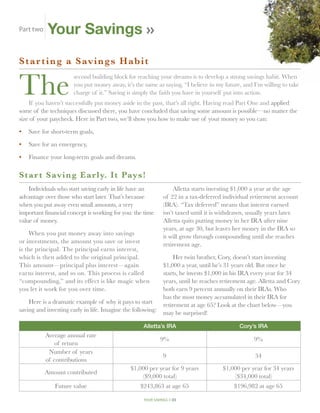
    Individuals who start saving early in life have an             Alletta starts investing $1,000 a year at the age
advantage over those who start later. That’s because          of 22 in a tax-deferred individual retirement account
when you put away even small amounts, a very                  (IRA). “Tax deferred” means that interest earned
important financial concept is working for you: the time      isn’t taxed until it is withdrawn, usually years later.
value of money.                                               Alletta quits putting money in her IRA after nine
                                                              years, at age 30, but leaves her money in the IRA so
     When you put money away into savings                     it will grow through compounding until she reaches
or investments, the amount you save or invest                 retirement age.
is the principal. The principal earns interest,
which is then added to the original principal.                     Her twin brother, Cory, doesn’t start investing
This amount—principal plus interest—again                     $1,000 a year, until he’s 31 years old. But once he
earns interest, and so on. This process is called             starts, he invests $1,000 in his IRA every year for 34
“compounding,” and its effect is like magic when              years, until he reaches retirement age. Alletta and Cory
you let it work for you over time.                            both earn 9 percent annually on their IRAs. Who
                                                              has the most money accumulated in their IRA for
    Here is a dramatic example of why it pays to start        retirement at age 65? Look at the chart below—you
saving and investing early in life. Imagine the following:    may be surprised!

                                                    Alletta’s IRA                            Cory’s IRA
           Average annual rate
                                                             9%                                    9%
               of return
            Number of years
                                                              9                                    34
           of contributions
                                               $1,000 per year for 9 years            $1,000 per year for 34 years
           Amount contributed
                                                   ($9,000 total)                         ($34,000 total)
               Future value                        $243,863 at age 65                      $196,982 at age 65

                                                    your savings // 23
M a king The Commitmen t To S ave
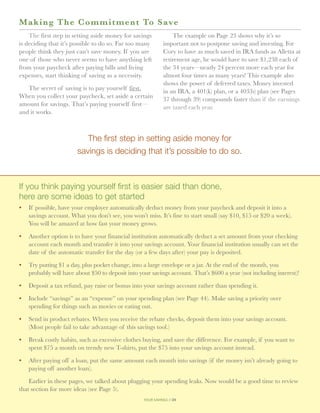
    The first step in setting aside money for savings           The example on Page 23 shows why it’s so
is deciding that it’s possible to do so. Far too many       important not to postpone saving and investing. For
people think they just can’t save money. If you are         Cory to have as much saved in IRA funds as Alletta at
one of those who never seems to have anything left          retirement age, he would have to save $1,238 each of
from your paycheck after paying bills and living            the 34 years—nearly 24 percent more each year for
expenses, start thinking of saving as a necessity.          almost four times as many years! This example also
                                                            shows the power of deferred taxes. Money invested
   The secret of saving is to pay yourself first.           in an IRA, a 401(k) plan, or a 403(b) plan (see Pages
When you collect your paycheck, set aside a certain         37 through 39) compounds faster than if the earnings
amount for savings. That’s paying yourself first—           are taxed each year.
and it works.


                          The first step in setting aside money for
                       savings is deciding that it’s possible to do so.


If you think paying yourself first is easier said than done,
here are some ideas to get started
•	  f possible, have your employer automatically deduct money from your paycheck and deposit it into a
   I
   savings account. What you don’t see, you won’t miss. It’s fine to start small (say $10, $15 or $20 a week).
   You will be amazed at how fast your money grows.

•	 Another option is to have your financial institution automatically deduct a set amount from your checking
   account each month and transfer it into your savings account. Your financial institution usually can set the
   date of the automatic transfer for the day (or a few days after) your pay is deposited.

•	 Try putting $1 a day, plus pocket change, into a large envelope or a jar. At the end of the month, you
   probably will have about $50 to deposit into your savings account. That’s $600 a year (not including interest)!

•	  eposit a tax refund, pay raise or bonus into your savings account rather than spending it.
   D

•	 Include “savings” as an “expense” on your spending plan (see Page 44). Make saving a priority over
   spending for things such as movies or eating out.

•	  end in product rebates. When you receive the rebate checks, deposit them into your savings account.
   S
   (Most people fail to take advantage of this savings tool.)

•	 Break costly habits, such as excessive clothes buying, and save the difference. For example, if you want to
   spent $75 a month on trendy new T-shirts, put the $75 into your savings account instead.

•	 After paying off a loan, put the same amount each month into savings (if the money isn’t already going to
   paying off another loan).

    Earlier in these pages, we talked about plugging your spending leaks. Now would be a good time to review
that section for more ideas (see Page 5).
                                                  your savings // 24
W here Do I
P u t My Pay
a n d My Savings?
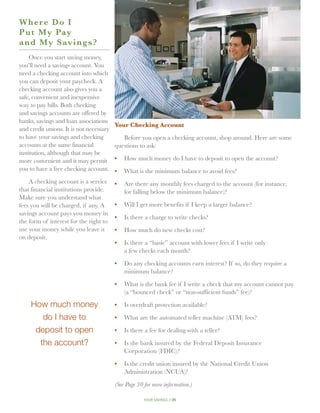
     Once you start saving money,
you’ll need a savings account. You
need a checking account into which
you can deposit your paycheck. A
checking account also gives you a
safe, convenient and inexpensive
way to pay bills. Both checking
and savings accounts are offered by
banks, savings and loan associations
                                         Your Checking Account
and credit unions. It is not necessary
to have your savings and checking           Before you open a checking account, shop around. Here are some
accounts at the same financial           questions to ask:
institution, although that may be
more convenient and it may permit        •	 How much money do I have to deposit to open the account?
you to have a free checking account.     •	 What is the minimum balance to avoid fees?
    A checking account is a service      •	 Are there any monthly fees charged to the account (for instance,
that financial institutions provide.        for falling below the minimum balance)?
Make sure you understand what
fees you will be charged, if any. A      •	 Will I get more benefits if I keep a larger balance?
savings account pays you money in
                                         •	  s there a charge to write checks?
                                            I
the form of interest for the right to
use your money while you leave it        •	 How much do new checks cost?
on deposit.
                                         •	  s there a “basic” account with lower fees if I write only
                                            I
                                            a few checks each month?

                                         •	 Do any checking accounts earn interest? If so, do they require a
                                            minimum balance?

                                         •	 What is the bank fee if I write a check that my account cannot pay
                                            (a “bounced check” or “non-sufficient funds” fee)?

    How much money                       •	  s overdraft protection available?
                                            I

       do I have to                      •	 What are the automated teller machine (ATM) fees?

     deposit to open                     •	 Is there a fee for dealing with a teller?

      the account?                       •	 Is the bank insured by the Federal Deposit Insurance
                                            Corporation (FDIC)?

                                         •	 Is the credit union insured by the National Credit Union
                                            Administration (NCUA)?

                                         (See Page 30 for more information.)

                                                      your savings // 25
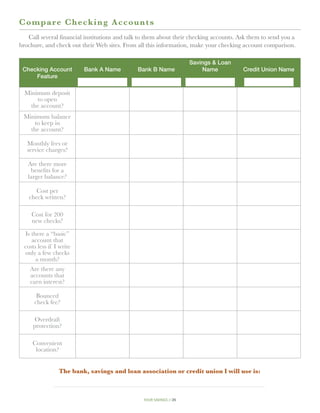
C o mpare Checking Accou n t s
   Call several financial institutions and talk to them about their checking accounts. Ask them to send you a
brochure, and check out their Web sites. From all this information, make your checking account comparison.

                                                                      Savings  Loan
 Checking Account         Bank A Name         Bank B Name                 Name          Credit Union Name
     Feature

  Minimum deposit
      to open
    the account?
 Minimum balance
     to keep in
   the account?

   Monthly fees or
   service charges?

   Are there more
    benefits for a
   larger balance?

       Cost per
    check written?

     Cost for 200
     new checks?

  Is there a “basic”
     account that
  costs less if I write
  only a few checks
       a month?
    Are there any
    accounts that
    earn interest?

       Bounced
      check fee?

      Overdraft
      protection?

     Convenient
      location?


                 The bank, savings and loan association or credit union I will use is:


                                                 your savings // 26
M a king Your Checking Ac c o u n t Wo r k Fo r Yo u
     Today’s checking accounts             to have part of your pay directly        you owe money. This way you don’t
include features that can make             deposited into that account. This        have to write a check, and you save
money management convenient. For           is highly recommended. If you            time and postage. Most importantly,
example, you can ask your employer         start with an affordable amount,         you can be sure your bill is paid on
to pay you through direct deposit, so      you won’t miss it and your savings       time, and that you avoid penalties
your paycheck is deposited directly        will grow without effort on your         for late payments. But be careful!
into your account electronically.          part. An alternate way to “pay           If you lose track of your checking
Your paycheck funds will be there          yourself first” is by having money       account balance, or if for some
on payday, ready for you to use. You       transferred automatically from your      reason you run low on money, you
will not have to go into the bank and      checking account to your savings         could overdraw your checking
wait in line to make your deposit,         or investment account on a certain       account. This could cost you a lot
and there is no chance of losing           day of each month.                       of money in fees. Keep a reminder
your paycheck or having it stolen.                                                  in your checkbook register to
                                               Another convenient feature is
Your money is easy to track. You                                                    deduct automatic payments when
                                           automatic bill payment from your
will receive a statement from your                                                  they occur. Some banks also offer
                                           checking account. If you have
employer showing exactly how much                                                   online payments, where you can
                                           regular bills (for example, mortgage
was deposited to your account.                                                      make payments over the Internet.
                                           or car payments), you may want the
   Also, if you have a savings             bank to transfer the bill amount to
account, you can ask your employer         the company or institution to whom

Automatic payments can work for you—or against you
One couple pays a price for                $30 overdraft fee for each of the        those bills sit in a pile until one of
automatic payments                         checks. Tina and Tyler needlessly        them gets around to buying stamps
    When Tina and Tyler bought             lost a total of $85.                     and writing checks. As a result,
their first home, they chose the                                                    they’ve paid late fees.
                                               After paying these charges,
automatic payment feature so that
                                           Tina and Tyler decided to drop               So when they bought a one-
their house payments went directly
                                           the automatic payment on their           year-old used car, Joe and Jennifer
from their checking account to
                                           mortgage until they got their            requested automatic payments.
the mortgage company. At first it
                                           finances back under control. For         Their car payment money stays
was great—no checks to write, no
                                           them, this convenience feature was       in their checking account, earning
worries about late payments.
                                           no deal.                                 interest, right up until it’s due each
     When their first child, Alicia,                                                month. (Their checking account
                                           Automatic payments save the
was born, Tina quit work for three                                                  pays interest if they keep it above
                                           day—and money
months to care for the baby. With no                                                a certain balance.) Joe and Jennifer
                                               Recent college graduates and
second paycheck and extra expenses,                                                 have signed up for e-mail “spending
                                           newlyweds Joe and Jennifer are
money was a little tight. A little while                                            alerts” and they both frequently
                                           accustomed to doing everything
later, one of them forgot to enter a                                                check their bank account balances
                                           online. They use direct deposit
check written for groceries. Not only                                               using the Web browsers on their
                                           and make as many bill payments
did the automatic payment bounce,                                                   phones. By keeping close tabs on
                                           online as possible. Joe and Jennifer
but so did two other small checks.                                                  their accounts, they can ensure that
                                           generally pay all their bills on time,
The mortgage company charged a                                                      their online payments automatic
                                           except for those pesky bills that
$25 penalty because the payment                                                     payments, and daily spending aren’t
                                           can’t be paid online. Sometimes
was late. Also, the bank charged a                                                  getting them in trouble.

                                                       your savings // 27
T i ps For Using A Checkin g A c c o u n t
The following tips can help you keep your checking account under control:
•	 Keep track of how much money is in your               •	 When the bank mails your checking account
   checking account. Write down in your checkbook           statement each month, promptly balance your
   register the amount of each check you write from         checkbook by comparing the bank’s figures with
   your account. Then, subtract the amount of               your own. Follow the tips listed in How to Balance
   each check from your current balance to keep a           a Checking Account on Page 29. If needed, ask
   running balance of how much money you have               a bank or credit union representative to help you
   left in your checking account.                           balance your checking account. Do not use the
                                                            ATM to determine the balance in your checking
•	  f you use an ATM card or debit card, write
   I                                                        account; some checks may be outstanding. It
   down all of those transactions in your checkbook         is likely, then, that the balance on your ATM
   register, too.                                           statement will show that you have more money
•	  ever write checks for more money than you have
   N                                                        than what is actually in your account.
   in your account. The bank’s non-sufficient funds      •	  romptly report any errors, lost or stolen checks
                                                            P
   (NSF) service charges can be as high as $35 for          or lost or stolen ATM cards to your bank or
   each bounced check. Bounced checks will hurt             credit union.
   your reputation with the bank and with people to
   whom you owe money. The business to whom you          •	 Keep your bank statements, check registers,
   wrote the check may charge a bounced check fee           duplicate checks and canceled checks (if your bank
   as well.                                                 returns them) with your other financial records.
                                                            Canceled checks are a good way to keep track of
•	 Be careful about using your debit card when your         what you spend. In addition, you may need this
   account is running low. Depending on how a               information to prepare and defend your tax returns
   business verifies your card, you can get approval        or dispute an error on your credit report.
   to spend more than you have in your account.
   Then, the bank charges you $35 or more for            •	  hen you are ready to dispose of any paperwork
                                                            W
   overdrawing your account.                                from the bank (statements, canceled checks, etc.),
                                                            shred it to prevent identity theft.


                                               your savings // 28
H ow To Balance A Check i n g A c c o u n t
1.	
   Place all canceled checks in numerical order when you get them back at the end of the month. If your
   bank does not send your canceled checks back, the bank either will send you a statement and/or let you
   view online all the checks that have been paid from your account.

2.	  erify your withdrawals. Make sure you actually made them. Withdrawals include amounts for written
    V
    checks, ATM withdrawals and debit card charges.

3.	 Total up the amounts of checks and debits that have not been posted, or paid.

4.	 Take the statement ending balance and add to it the total of deposits that do not appear on the statement.

5.	
   Subtract the total of outstanding checks (checks you wrote that are not yet paid). Also, subtract ATM
   withdrawals, debit card transactions and/or automatic withdrawals (for savings or monthly bills) that you
   posted in your checkbook register but are not listed on your statement.

6.	
   Subtract any bank fees (for example, to print checks) that you posted in your checkbook register but are not
   listed on your statement.

7.	 The resulting balance should match the balance in your checkbook register.

8.	 the numbers don’t agree, check your math and look for missing transactions (for example, additional
   If
   checks that have not cleared). Remember, you can always ask a bank or credit union representative for help
   (just be aware you might be charged a fee for this help, depending on your financial institution).


                                                                                Balancing your
                                                                            checkbook verifies that
                                                                            your records match the
                                                                               bank’s records.


                                                 your savings // 29
Yo ur Savings Account
    Before opening a savings account, call several               Certificates of Deposit. CDs are deposits
financial institutions and ask the following questions:      you make for a specific period of time. At the end of
                                                             that time period—called the maturity date—you get
•	 How much money do I need to open the account?
                                                             back the dollar amount of the CD (the principal) plus
•	 What is the minimum balance I will need to keep           interest. CDs pay a fixed amount of interest, so the
   in the account?                                           amount you can earn on a CD doesn’t change over its
•	 How much interest does the account pay?                   time period.
•	 How often is interest credited to the account?                You can choose a CD with a maturity period of
•	 How do I withdraw money when the time comes               one month, three months, six months, one year, two
   to spend or invest it?                                    years, three years, and so on. The longer the maturity,
                                                             the higher the interest rate you earn in your account.
•	 Is there a limit to the number of times I can
                                                             CDs are great when you have a specific time frame to
   withdraw money from my account each month
                                                             meet a specific goal. For example, say you plan to buy
   without incurring a charge? (Remember, the
                                                             a new car in three years. You can choose a CD with a
   whole point of having a savings account is to
                                                             three-year maturity. If you need the money before the
   leave the money there, so a few reasonable limits
                                                             CD matures, you may encounter some type of penalty
   on how often you can take money out should not
                                                             (such as losing three to six months’ worth of interest).
   be a problem.)
•	 When I take money out of the account, is there                Money Market Deposit Accounts.
   an effect on the interest earned?                         Compared to regular checking accounts that
                                                             sometimes pay interest, you may earn a higher
•	  s the bank insured by the FDIC? If it’s a credit
   I
                                                             interest rate on money market deposit accounts.
   union, is it NCUSIF insured?
                                                             However, you may need to deposit as much as
    After those questions are answered, you also may         $2,500. (Each financial institution may require a
want to ask about Certificates of Deposit (CDs)              different minimum balance.) Like a regular savings
and Money Market Deposit Accounts. These                     account, a money market deposit account may limit
accounts typically pay more interest than a regular          the number of monthly withdrawals and usually sets
savings account. But, for this higher interest rate,         a minimum amount for each withdrawal. A money
there is a trade-off. With a CD, the trade-off is that       market deposit account may be a very good place to
you have to leave your money in the account for a            keep your emergency fund.
certain period of time. With a money market deposit
account, the trade-off is that you have to keep a high
minimum balance, such as $1,000, to earn the higher
interest. The following paragraphs explain more
about CDs and money market deposit accounts.


Keeping your money safe
    When you select a bank for your checking and savings accounts, be sure the bank is insured by the
FDIC. This insures your bank accounts (checking, savings, trust, CDs and IRAs) up to a total of $250,000
(note that the $250,000 insured limit for non-retirement accounts is currently set to expire at the end of
2013). Other accounts, such as mutual funds, may not be insured. Credit union accounts are insured in a
similar manner by the NCUA.


                                                   your savings // 30
S aving For Emergencies
   Nobody can predict the future—so it makes sense to put aside money for a rainy day. Keep this emergency
fund money in an account that is separate from your general savings. If you mix your emergency fund with
your general savings account, it becomes too easy to dip into the emergency fund.

    Using the money in your emergency fund is better than taking out a loan or cashing in your investments to
pay for an emergency. If you take out a loan, you will have to pay interest. If you cash in an investment, you
will lose interest and possibly some of the original investment.

   Remember these points when building an emergency fund:

•	The rule of thumb is to set aside enough to cover your basic living expenses for at least three months.
   (Saving even $500, however, can help you better cope with unexpected expenses.)

•	Keep the money in an easily accessible savings account or money market deposit account.

•	 not keep the money in a long-term investment asset, such as a stock, mutual fund or a CD with a long
   Do
   maturity date..

•	 se the money only for true emergencies, such as unexpected medical bills. If you lose your job, you may
   U
   
   need your emergency fund for food, utilities, mortgage payments or rent and necessary transportation.
   (Usually, people can put off buying clothing for at least three months.)


For ideas on how to save money for an emergency fund, see Page 5: plugging spending leaks.
Here’s how much I will need to keep in my emergency fund

Grocery bill for 1 month
$______x 3 months = $________

Gas/oil, electric, and water for
1 month
$______x 3 months = $________

Mortgage or rent for 1 month
$______ x 3 months = $________

Car payment and gas or bus fare
for 1 month
$_______x 3 months = $________

Other debt payments for 1 month
$_______x 3 months = $________

Total amount I will need to keep in
my emergency fund: $________


                                                 your savings // 31
T h e Two-For-One Savings P l a n
    You know you need to set aside money to help             IRA accumulates earnings. After you retire, you can
pay for emergencies. You know, too, you need to save         take out the money you put in, plus the earnings,
for retirement. But did you know that you can do             without paying taxes on any of that money. For
both with one account? It’s true. If you put some of         more information on the Roth IRA and other tax-
your earnings into a Roth IRA, you can save for both         advantaged retirement accounts, see Pages 37-38.
your emergency fund and retirement goals.
                                                                 That’s how the retirement part works, but how
    The Roth IRA (or individual retirement account)          does this help you pay for emergencies? You can take
works differently from most retirement plans. First, the     out money you put into your Roth IRA at any time
money you put into the account comes from “after-            without paying a penalty or any more taxes. This
tax” dollars, such as income from your paychecks.            means that your Roth IRA can help you pay for that
That means you already have paid taxes on the                “rainy day.” (The penalty-free withdrawal applies to
money. Over time, the money you put into your Roth           money you contributed, not earnings.)

Learn how Daniel used his Roth IRA
    Daniel saved $500 and opened a Roth IRA. (This was the amount his financial institution required to
open an account.) He opened a Roth IRA because he read that it would likely pay more in interest than a
savings account, especially if he invested the Roth IRA money in mutual funds. Each month, Daniel put in
at least $125. In a year, he had a total of $2,000 in his account. With his investment earning a 10 percent
rate of return, Daniel earned $200, for a total of $2,200 by year-end. Then, Daniel’s car broke down, and it
needed $700 in repairs. He didn’t have that amount of money in his checking account, and he didn’t want
to use his credit card. What could he do?

    Daniel transferred $700 from his Roth IRA into his checking account. He didn’t like taking the money out of
his Roth IRA, but he decided it was a better choice than using his credit card, which charges 18 percent interest.

     Of course, the best way to
save for retirement is to put away
money that you never use. Also,
if you work for a business that has
a retirement plan, it’s a good idea
to take part in that plan, too. This
is especially true if your employer
matches your contributions—that’s
free money!

    Keep in mind a Roth IRA
should be only part of your
retirement savings. Still, a Roth
IRA can be a good way to:

1.	  ossibly earn more interest than
    P
    you would in a savings account.

2.	 Save for an emergency.

3.	
   Help ensure your financial
   well-being during retirement.
                                                   your savings // 32
S aving vs. Investing: Wha t I s T h e D i f f e r e n c e ?
     There can be confusion about
the words “saving” and “investing.”
For example, someone might claim
that a new car is an “investment.”
That’s probably not true since
most cars lose their value over time
and an investment should ideally
increase in value. For the purpose
of basic money, think of “saving”
and “investing” as methods of
setting aside money for the future.
Which method is best? That
depends on your needs and goals.

     Saving means putting aside
money in “low-risk” accounts.
                                            minimum amount needed to make               Investments are meant to
As mentioned earlier, that could
                                            an investment.                          pay for long-term needs, such as
include a regular savings account,
                                                                                    your children’s education or your
a certificate of deposit (CD) or a               Investing means putting            retirement. Investment accounts
money market deposit account. Use           aside money into assets that have       can be very volatile—they can lose
these accounts for money you want           additional risks but typically offer    (or gain) a great deal of value in a
to be able to get to quickly, with little   greater return. The most common         short period of time. As long-term
or no risk that you’ll lose what you        investment choices are stocks,          goals approach, you should move
set aside.                                  bonds, real estate, and mutual funds.   the money for those goals from
                                            Although these assets have more         investments to savings. For a full
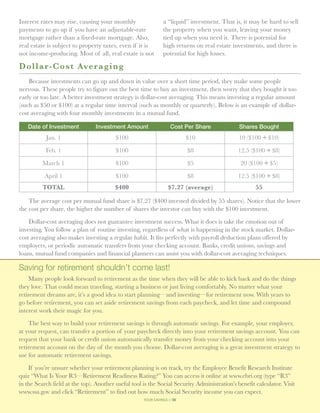
    Savings can be used to meet
                                            risk associated with them, they         explanation of investment risk,
short-term needs (for example, an
                                            are capable of earning more than        see The Wealth Care Kit, which is
emergency, a down payment for
                                            low-risk savings accounts. Generally
a car or a major appliance). You                                                    described on Page 3.
                                            speaking, the longer you invest, the
also can use savings to build up the
                                            more the risks are reduced.


   In time, you will have
   both short-term and
     long-term financial
      needs; therefore,
   you will need money
    in both savings and
        investments.


                                                        your savings // 33
D o uble Your Money: The Ru l e O f 7 2
    As noted earlier, key to investment success is time.        Option 2. To determine the interest rate needed
The longer a sum of money earns compound interest,          to double your money, divide 72 by the number of
the larger it becomes. The other important factor is        years in which you want to double your money. The
rate of interest earned. The higher the interest            example below assumes an investor wants her money
rate, the more quickly a sum of money will grow.            to double in six years.

    To see how fast your money can grow in different              7
                                                                   2 ÷ by 6 (the desired
savings and investment products, use The Rule of                  number of years)
72, which is an approximation of how quickly your                 = 12 (the interest rate)
money will double.
                                                                  S
                                                                   o, to double $500 to $1,000
    Option 1. To see how long it will take to double              in six years, a 12 percent interest
a sum of money (for example, turn $500 into $1,000),              rate is needed.
divide 72 by the interest rate. The example below
                                                                The Rule of 72 shows that, over time, investors
assumes an 8 percent interest rate.
                                                            earn more on their money than savers. Using sample
   7
    2 ÷ by 8 (the interest rate)                           rates of returns in the table below, compare the
   = 9 (years)                                              outcomes of two different average returns from
                                                            individual stocks or stock mutual funds compared to
   S
    o, in nine years, $500 doubles to                      money market deposit accounts. Using an 8 percent
   $1,000 at 8 percent interest.                            average return on individual stocks or stock mutual
                                                            funds and a 4 percent money market deposit account
    The rate of return can make an                          return, compare the number of years it takes to
                                                            achieve the same dollar value of returns. (Note that
  amazing difference. Investors need
                                                            these interest rates and returns are for illustration
   to balance higher rates of return                        purposes; they are not indicative of any specific
                                                            products or returns.)
          with increased risk.

                         Saving $1,000                                       Investing $1,000

                         Money Market                                       Stock/Mutual Fund

           Number of Years            4% Return             Number of Years              8% Return

                    18                   $2,000                        9                    $2,000

                    36                   $4,000                        18                   $4,000

                    54                   $8,000                        27                   $8,000


                                                  your savings // 34
S o me Investments To Lea r n A b o u t
    Following are some basic investment types. To learn more, visit the
                                                                                 Resources
Web sites in the sidebar at right. Remember that the money you initially         It’s important to thoroughly
invest is called the “principal.”                                                educate yourself on the various
                                                                                 types of investments before
     Stocks: Owning stock means you own part of a company. In general,
if a company does well, its stock increases, too. You also might receive         getting started, because everyone’s
some of the profit in the form of a dividend. Of course, if the company          risk tolerance and financial
does not do well, the stock goes down in value. Also, stocks can be affected     situation is different. Online
by outside factors, such as political and market events, that have nothing       resources to check out include:
to do with the company’s performance. Therefore, stocks can be risky.            Alliance for Investor
However, over time—and the “time” part is important—many stocks do               Education
increase in value. To decrease the risk that comes with stocks, it’s a good
                                                                                 www.investoreducation.org
idea to own stock in more than one company. Also, it is a good idea to
own stock in different industries (diversifying your investments) and to hold    American Association of
these stocks for long periods of time.                                           Individual Investors
                                                                                 www.aaii.com
    Mutual Funds: A good way for most people to diversify their
investments is through mutual funds. A mutual fund pools your money              Bloomberg
with money from many other people. Instead of buying just a few assets,          www.bloomberg.com
a professional fund manager purchases many stocks, bonds, and/or other           CNN Money
assets. This diversifies your investment so that you don’t have “all of your     www.money.cnn.com
eggs in one basket.” Professional management and diversification are
two of the main benefits of mutual funds.                                        Investing for Your Future, a
                                                                                 basic at-home study course
    Bonds: Bonds are issued by both companies and government                     www.investing.rutgers.edu
entities (federal, state or local). When you buy a bond, you lend money to
the issuer. The bond represents a legal promise to pay you interest for the      Investment Company
use of your money (for example, for bridges and highways) and to repay           Institute
you the original amount you paid for the bond (the principal). There are         www.ici.org
various types of risk associated with bonds. (See The Wealth Care Kit,           Investorguide.com
which is described on Page 3, for details.) However, the potential for your      www.investorguide.com
money to grow is greater than if your money sits in a savings account.           (click University)
     Treasury securities: Treasury securities include federal government         Kiplinger.com
bills, notes and bonds. The principal is safe as long as you hold the security   www.kiplinger.com
to maturity (the time at which the government agrees to pay back the
principal). However, if you sell the security before maturity, you risk losing   Morningstar
some of the principal if interest rates have risen since your purchase date.     www.morningstar.com
                                                                                 National Association of
    Real Estate: A real estate investment may include residential rental
                                                                                 Investors Corporation
property, raw land, real estate investment trusts (REITs) or commercial
businesses. Real estate is an attractive investment to many people. It           www.betterinvesting.org
can be seen and touched, and it offers pride of ownership. However, an           Quicken
investment in real estate carries some distinct risks.                           www.quicken.com
     It is possible for property values to go down as well as up. If you         Smart Money Magazine
sell the property when it is “down,” or worth less than the price for            www.smartmoney.com
which you bought it, you could lose some of your investment principal.
                                                     your savings // 35
Interest rates may rise, causing your monthly                  a “liquid” investment. That is, it may be hard to sell
payments to go up if you have an adjustable-rate               the property when you want, leaving your money
mortgage rather than a fixed-rate mortgage. Also,              tied up when you need it. There is potential for
real estate is subject to property taxes, even if it is        high returns on real estate investments, and there is
not income-producing. Most of all, real estate is not          potential for high losses.

D o llar-Cost Averaging
    Because investments can go up and down in value over a short time period, they make some people
nervous. These people try to figure out the best time to buy an investment, then worry that they bought it too
early or too late. A better investment strategy is dollar-cost averaging. This means investing a regular amount
(such as $50 or $100) at a regular time interval (such as monthly or quarterly). Below is an example of dollar-
cost averaging with four monthly investments in a mutual fund.

   Date of Investment           Investment Amount                  Cost Per Share             Shares Bought
           Jan. 1                        $100                             $10                 10 ($100 ÷ $10)

           Feb. 1                        $100                             $8                 12.5 ($100 ÷ $8)

          March 1                        $100                             $5                  20 ($100 ÷ $5)

           April 1                       $100                             $8                 12.5 ($100 ÷ $8)
          TOTAL                          $400                     $7.27 (average)                    55

    The average cost per mutual fund share is $7.27 ($400 invested divided by 55 shares). Notice that the lower
the cost per share, the higher the number of shares the investor can buy with the $100 investment.

    Dollar-cost averaging does not guarantee investment success. What it does is take the emotion out of
investing. You follow a plan of routine investing, regardless of what is happening in the stock market. Dollar-
cost averaging also makes investing a regular habit. It fits perfectly with payroll deduction plans offered by
employers, or periodic automatic transfers from your checking account. Banks, credit unions, savings and
loans, mutual fund companies and financial planners can assist you with dollar-cost averaging techniques.

Saving for retirement shouldn’t come last!
    Many people look forward to retirement as the time when they will be able to kick back and do the things
they love. That could mean traveling, starting a business or just living comfortably. No matter what your
retirement dreams are, it’s a good idea to start planning—and investing—for retirement now. With years to
go before retirement, you can set aside retirement savings from each paycheck, and let time and compound
interest work their magic for you.

    The best way to build your retirement savings is through automatic savings. For example, your employer,
at your request, can transfer a portion of your paycheck directly into your retirement savings account. You can
request that your bank or credit union automatically transfer money from your checking account into your
retirement account on the day of the month you choose. Dollar-cost averaging is a great investment strategy to
use for automatic retirement savings.

    If you’re unsure whether your retirement planning is on track, try the Employee Benefit Research Institute
quiz “What Is Your R3—Retirement Readiness Rating?” You can access it online at www.ebri.org (type “R3”
in the Search field at the top). Another useful tool is the Social Security Administration’s benefit calculator. Visit
www.ssa.gov and click “Retirement” to find out how much Social Security income you can expect.
                                                     your savings // 36
Tax-A dva n t a ge d Re t i r e m e n t A c c o u n t s
Resources
For more information or to find a       To make it easier to grow your retirement nest egg, the federal
financial planner, visit:           government enables you to put your retirement investments into certain
                                    accounts that have special tax advantages. These accounts, such as
Certified Financial Planner         IRAs, are available from mutual fund companies and stock brokerage
Board of Standards, inc.            houses. Financial institutions, such as banks, credit unions and savings
www.cfp.net                         and loan associations, also offer and maintain these accounts. Be
Understanding your                  sure to ask about costs, such as annual fees and sales charges, before
retirement paycheck                 opening a retirement account.
www.myretirementpaycheck.org             Often, you can choose the assets you want to put into a retirement
Financial Planning                  account. You can choose among cash, CDs, money market funds,
Association                         annuities, mutual funds, stocks, bonds and other assets. (In general, you
www.fpanet.org                      cannot invest in collectibles such as coins, stamps, antiques and so on in a
                                    retirement account.) Ask your employer, financial planner, insurance agent,
The American Institute of           stock broker, or your financial institution about investment options.
Certified Public Accountants
www.aicpa.org
                                         One smart way to invest for retirement is to
The National Association of
Personal Financial Advisors            use accounts that let your money grow without
www.napfa.org
                                              generating a tax bill each year.
Society of Financial Service
Professionals
www.financialpro.org                Individual Retirement Accounts (IRA)

                                       If you have a job, you can put away as much as $5,000 each
                                    year ($6,000 if you are age 50 or older) in an Individual Retirement
               n                    Account (IRA). If you have a nonworking spouse, you can open a
                                    spousal IRA and contribute from your earnings up to the same limits.
                                    Contribution limits can change, so double check the current amounts
                                    with your financial planner or consult the Internal Revenue Service
                                    (www.irs.gov, search “IRA contribution limit”).

                                        The money you put into an IRA often can be deducted from your
                                    taxable income, so you pay less in taxes each year. Your IRA money is
                                    not taxed until it is withdrawn. This is a big advantage because you end
                                    up having more money earning compound interest year after year.

                                        You can withdraw your IRA money without penalty after you reach
                                    age 59½ . Under certain conditions, such as buying a home, you may be
                                    able to withdraw funds out of certain IRAs without paying a penalty. If
                                    you withdraw your IRA money and do not meet the certain conditions,
                                    you will face a large penalty. You will have to pay $1 for every $10 that
                                    you withdraw (10 percent). In addition, you will have to pay income
                                    taxes on the withdrawn money.


                                               your savings // 37
The Roth IRA
                                                                               Resources
    As with a regular IRA, the money you contribute to a Roth IRA
                                                                               Planning for retirement can be
is made with “after-tax” dollars. The difference is that regular IRA
                                                                               a complex process, but there are
contributions lower your taxable income while Roth IRA contributions
                                                                               numerous online resources to
do not. The amount of money you can put into a Roth IRA is the same
                                                                               help you find your way:
as a traditional IRA, but you can’t fully fund both types of IRAs. Roth
IRA withdrawals work as follows:                                               AARP
                                                                               www.aarp.org
•	After age 59½, you can take out the money you put in—plus the interest
   earned on the account—without paying taxes on any of that money.            American Savings
                                                                               Education Council
•	Interest earned on Roth IRA contributions can be subject to income
                                                                               www.choosetosave.org
   tax upon withdrawal if funds are withdrawn within the first five
   years from the date of your first contribution. Such a withdrawal           Social Security
   is an “unqualified distribution.” Only qualified distributions are          Administration
   completely exempt from taxes.                                               www.ssa.gov
•	  ou can withdraw the original money you put into a Roth IRA
   Y                                                                           U.S. Department of
   before reaching 59½ without paying a penalty or taxes. (Of course,          Agriculture’s Cooperative
   withdrawing funds prior to retirement reduces your potential                Extension Initiative on
   earnings for retirement.)                                                   financial security in late life
                                                                               www.nifa.usda.gov
    For more information about how Roth IRAs work, see Page 32. The
                                                                               (search “Online Tools for Later Life”)
rules for Roth IRAs are different if you convert another investment or
savings account into a Roth IRA. It is best to talk with a tax advisor or      National Endowment for
financial planner and visit www.irs.gov to get the latest information about    Financial Education
a Roth IRA.                                                                    www.nefe.org
                                                                               www.financialworkshopkits.org
                                                                               www.smartaboutmoney.org
401(k) Plans
                                                                               www.myretirementpaycheck.org
    This type of retirement plan is offered by employers. Usually, you         www.spendster.org
sign up for the plan and indicate to your employer a percentage of your
paycheck to transfer into your plan. (The maximum dollar amount you
can contribute each year is set by the federal government.)

    Many employers sweeten the pot by matching a percentage of your
contributions. For example, an employer might contribute 25 to 50
percent for every dollar (25 to 50 cents) you contribute to the plan. This
is equal to getting a bonus, so it pays to put in as much as you can afford.      Many employers
   A 401(k) offers you a number of advantages:                                  sweeten the pot by
•	 You do not pay taxes on the money you contribute; in other words,           matching a percentage
   you make “pre-tax” contributions.
                                                                               of your contributions.
•	 You pay taxes on those contributions only after you withdraw them
   from your plan—usually after you retire.

•	 The money you contribute to a 401(k) plan usually can be invested in
   a selection of investments that range from reasonably safe to risky.
                                                   your savings // 38
After you contribute money to a 401(k) plan, leave it     to visit The Profit Sharing/401k Council of America
there. It’s true that some 401(k) accounts permit you to      (PSCA) at www.psca.org.
borrow from them,but borrowing slows down the rate
at which your account grows. If you borrow from your
                                                              403(b) Plans
401(k), you will have less money with which to retire.
                                                                  Nonprofit organizations offer 403(b) retirement
    Borrowed 401(k) funds must be paid back with
“after-tax” dollars. Because you must pay income tax on       plans, which are similar to 401(k) plans. These plans
401(k) withdrawals after you retire, you end up paying        are sometimes referred to as “tax-sheltered annuities.”
income tax twice on borrowed funds: once when you                 As with a 401(k), you do not pay taxes on your
borrow, then again when you retire. If you leave your         contributions or on the amount of money the plan
job and cannot repay borrowed funds within a short            earns until you withdraw funds after you retire.
time period, you will pay taxes on the balance. If you’re     Also, similar to the 401(k), you choose how your
younger than 59½, you also will pay a penalty of $1 for       contributions are invested. There are limits on how
every $10 you borrowed from this fund.                        much you can contribute each year. Taking money
    To learn more about 401(k) plans and how they             out of a 403(b) plan before you retire has the same 10
help you reach your retirement goals, you may want            percent penalty that applies to the 401(k) plan.


Ta x-Advantaged Ways To Pay Fo r E d u c a t i o n
     The U.S. government not only provides tax-                •	 529 plans: Established in 1996 and named for
 advantaged ways to save for retirement, but it also              Section 529 of the IRS code, 529 plans provide
 provides tax-advantaged ways to pay for education.               tax incentives to set aside money for college. Each
 These include Coverdell Education Savings Accounts,              state offers its own plans—and its own type of
 which apply to a child’s entire education; 529                   tax incentives. The plan’s beneficiary, usually a
 plans, which are helpful for traditional college; and            child or grandchild, can withdraw funds tax free
 HOPE Scholarships, which can be ideal for adult                  for qualified educational expenses at any college
 education. Be sure to consult a financial planner or             in the country. The 529 plans are either savings
 tax professional on all these options.                           plans, which can grow on a tax-deferred basis, or
                                                                  prepaid plans. For more information about 529
 •	 Coverdell Education Savings Account
                                                                  plans, visit the College Savings Plans Network at
    (ESA): A Coverdell ESA provides a tax-deferred
                                                                  www.collegesavings.org.
    method to save for elementary, secondary and
    post-secondary education expenses, including               •	 HOPE Scholarship: The HOPE Scholarship
    tuition, books, supplies, room and board, private             provides a tax credit up to $2,500 per student
    school enrollment fees, and other qualified                   for four years of college or other eligible post-
    expenses. You can set up a Coverdell ESA for                  secondary training. The tax credit applies to
    any child under the age of 18, and contribute                 tuition, fees, and course materials, minus grant
    a maximum of $2,000 per year per child until                  aid, for families below certain income levels. For
    his or her 18th birthday. A Coverdell ESA                     more information about HOPE Scholarships, visit
    can be transferred without penalty to another                 the U.S. Department of Education at www.ed.gov
    family member. The contributions are not tax                  and type “Hope” in the search box.
    deductible, but earnings accumulate tax free. The
    rules regarding the Coverdell ESA—including                   Additional tax-advantaged ways to pay for
    the contribution limit—may change over time.               education include Lifetime Learning Credits,
    For more information, visit www.irs.gov and type           Education IRAs, student loan interest deductions
    “Coverdell” in the search box.                             and more. For more information, visit www.irs.gov.

                                                    your savings// 39
Part Three   Your Future
Deter min i n g Yo u r F i n a n c i a l F u t u r e


In
           this publication, we talk a lot about how to keep money from slipping through your fingers. We’ve
           talked about how to get out of debt and how saving and investing can make your money grow
           over time. But why make all the effort? Money cannot buy everything. It cannot even buy the most
important things, such as a good reputation and loyal friends. However, there are many things that you might
like to accomplish in life that do require money. What are they?
    In this section, we provide information to help you answer that very important question and think through
what you might like to accomplish with money. Once you have the answer, you can use goal-setting techniques
to help make your future what you want it to be. By the end of this section, you will know:

1.	 How to set goals.

2.	 How to develop a spending plan.

3.	 How to reach goals by sticking to your spending plan.

W h at Are Financial Goals ?
   Too many people never ask themselves what they’d like to accomplish in life. They’re far too busy trying to
keep up with everyday life demands, such as paying the bills and taking care of loved ones. How do you take
control of your life and move forward? The answer is planning. The first step in planning is setting goals.

    Financial goals are the things you want to accomplish in life that cost money.

Example #1: Buy a $750 computer within eight months.

Example #2: Save $20 per week during the next year for a vacation.

Note that the goals mentioned have time frames (for example, eight months) and dollar figures (for example,
$20 per week). These are SMART goals because they are:


	                                                S	pecific
	                                              M	easurable
	                                               A	chievable
	                                               R	ealistic
	                                               T	ime-bound
                                                  your future // 40
Different goals will have different time frames.         pay cash for a used car, or make a down payment on
Goals generally can be divided into three durations:       a home.

•	 Short term                                                 Once you’ve set your goals, you can figure out what
                                                           you need to save each week and chart your progress.
•	 Medium term
                                                               Before you get started, however, take some time to
•	 Long term                                               think about what you want and need that costs money.
   Short-term goals: These are goals you want to           1.	 Use the chart on the next page. Simply jot
accomplish within three months. For example, you               down a dozen or more items that could become
could save $250 to buy an MP3 player in two months.            your goals.
    Medium-term goals: These are goals you                 2.	 Prioritize these items, starting with the goal that is
want to accomplish within three months to a year.              the most important to you.
An example would be to buy a laptop that cost $750
within eight months.                                       3.	 Mark each goal with a time frame: short term,
                                                               medium term or long term.
    Long-term goals: These are goals you want to
accomplish within a year or more. An example would
be to save $10,000 or more in two years so you can


                      Goal setting is a major component of personal
                      development. To achieve your goals, you must
                       focus on them. Achieving your goals will give
                          you a great sense of accomplishment.


                                                 your future // 41
My Goals

                                                   Short,             Weekly
                  Priority   Achievement                      Total
           Goal                                  Medium, or           Savings
                  Number        Date                          Cost
                                                 Long Term            Needed


                             your future // 42
S o me Goals To Consider
    Setting goals is a personal thing. What is important to one may be irrelevant to another. Only you can
determine what you actually need and want. Nonetheless, at this point, you may want to discuss your goals
with friends or family members. Sometimes getting feedback helps to clarify your thinking. It also may help to
know some common goals people have such as:

Short Term:
•	 Create a plan to pay off credit card debt

•	 Start an emergency fund

•	 Upgrade computer system

•	 Buy new clothing

•	 Buy more household goods and gadgets


Medium Term:
•	 Get further education or training
•	 Start investing
•	 Give more money to charities
•	 Take a dream vacation
•	 Buy a new or used car
•	 Have an established emergency fund

Long Term:
•	 Buy a home
•	 Educate children
•	 Start a business
•	 Acquire a rental income property
•	 Retire


Stick to your plan
    Once you have set your goals and know how much you need to save each week to meet them, you are on
your way to accomplishment. Save for your goals each time you are paid, and don’t let little things keep you
from paying yourself first. If something unexpected happens, you may have to change your plan slightly. But,
start saving again as soon as you can.

                                                 your future // 43
T h inking About Tomor row
    Terrell and Maya’s most important long-term goal was building up a
$10,000 down payment for a home. Both had good jobs and, to reduce
expenses, they agreed to drive older cars that ran well. With good incomes and
low expenses, they were able to put away $500 a month into a money market
deposit account. With interest, this amount of monthly savings would enable
them to save the down payment and buy their home in 24 months.

     But, one cold morning, one of the cars would not start. It was time
for a new battery, which cost $52. With this unexpected expense, Terrell
and Maya were only able to save $448 that month. Not discouraged,
the following month they resumed their savings plan. There were
other expenses too—a dental bill, some higher utility bills they had not
planned for, and an emergency trip to see Maya’s mother, who had fallen
ill. Each time, they used their money market deposit account to cover the
expense, and the next month they went back to saving $500. They were
able to buy their home just a few months beyond the planned time frame.


A Spending Plan To Make I t H a p p e n
    Now that you know what you want to do with your money in
the future, it’s time to find the money to meet your goals. If you’re
wondering, “Where on earth can I find so much money?” do not be
discouraged. It’s estimated that the average family wastes 30 percent
of its money (yes, 30 cents out of every dollar) through unexamined               Pay your bills on time.
spending habits. To avoid this waste—which is like giving yourself a 30
                                                                                  This is one of the best
percent pay increase—you need to create a spending plan.
                                                                                     ways to keep your
    A spending plan is simply a tool for taking control of your financial
future—a way to meet your goals. There are four steps to making a                credit in good standing.
spending plan:
                                                                                   It Also is a great way
1.	 Identify your income.
                                                                                  to keep more of your
2.	 List your expenses.
                                                                                    hard-earned money
3.	 Compare income and expenses.
                                                                                    and not waste it on
4.	 Set priorities and make changes.
                                                                                     late-payment fees.
    The worksheets that follow will help you get started. Consider making
several copies of them so you will have them ready to use throughout the year.

    Keep in mind that for a spending plan to work, it must be accurate.
Don’t forget about bills that come due every few months or so, such as
car insurance. For those cases, list an average amount you must pay each
month on your monthly expense sheet. For example, if you pay $450 for
car insurance every six months, you must save $75 each month to pay
the bill ($450 ÷ 6 = $75).
                                                     your future // 44
Step 1: Identify your Income

    When completing this worksheet, don’t overestimate your income. Look back at check stubs and savings or
investment statements to get the following information:

          Income Sources                      Annual Amount                     Amount Per Month

Wages – your own, after taxes        $                                   $

Wages – others in household,
                                     $                                   $
after taxes

Job bonuses, overtime pay, or tips   $                                   $

Interest and dividends on savings
                                     $                                   $
and investments

Child support                        $                                   $


Pension benefits                     $                                   $


Social Security benefits             $                                   $


Gifts                                $                                   $


Tax refund(s)                        $                                   $


Rental income                        $                                   $


Business income                      $                                   $

                                     $                                   $
Other_______________________
                                     $
___________________________
                                     $
___________________________
                                     $
___________________________
                                     $


Total Income                         $                                   $


                                               your future // 45
Step 2: List Your Expenses

   To get started, gather together the items listed below.

•	 The list you made earlier on Page 5 of your monthly expenses.

•	 Your checking account statements for three months.

•	 Your credit card statements for three months (if you use a credit card).

Using this information, fill in the worksheet.
                                Expenses                                          Per Month (Average)

Savings and investments                                                       $

Housing (mortgage or rent)                                                    $

Electricity                                                                   $

Gas/heating oil                                                               $

Water                                                                         $

Telephone:

  Monthly charges                                                             $
  Long distance                                                               $
  Cell phone                                                                  $

Satellite or cable TV                                                         $

Internet                                                                      $

Groceries                                                                     $

Snacks and meals eaten out                                                    $

Transportation:

  Car payment                                                                 $
  Gas                                                                         $

  Car repairs                                                                 $
                                                                              $
  Insurance premiums
                                                                              $
  Bus fare, parking, other

                                                  your future // 46
Expenses                                   Per Month (Average)

Child care                                                             $

Alimony or spousal maintenance                                         $

Child support or support to other family members                       $

Insurance premiums:

  Life                                                                 $

  Health                                                               $

  Property/Homeowners                                                  $

  Renters                                                              $

Doctor or dentist bills                                                $

Property tax                                                           $

Pet care                                                               $

Union or professional association dues                                 $

Clothing/uniforms:                                                     $
  Purchase cost                                                        $
  Dry cleaning bills                                                   $

Donations                                                              $

Loan payments (not mortgage)                                           $

Credit card payments (all credit cards)                                $

Personal expenses (allowances, toiletries, etc.)                       $

Home improvements and repairs                                          $

Other (classes, downloads, etc.)_______________________________        $

_______________________________________________________                $
                                                                       $
_______________________________________________________
                                                                       $

Total Monthly Expenses                                                 $


                                                   your future // 47
Step 3: Compare Income and Expenses


                         Income and Expenses                                   Per Month (Average)

Write down your total monthly income (from Step 1).                     $


Write down your total monthly expenses (from Step 2).                   $


Subtract expenses from income and list amount here.                     $


Step 4: Set Priorities and Make Changes

   Did you have money left over at the end of the month? If so, great! Your income and your expenses are
“balanced.” If you put the money left over at the end of the month into your savings toward one of your
goals, you’re well on your way to controlling your money and getting what you want out of life.

   But what if your expenses were more than your income? This can happen to anyone occasionally. But if it
happens often, your budget is “out of balance,” and you’re said to have a negative cash flow. How do you get
back in the driver’s seat and start moving toward your goals again?

    There are three ways: Cut back on your expenses, increase your income or do both. Earlier, we talked
about ways to find out where your money is going and how to plug spending leaks. This would be a good time
to review Pages 4 and 5. Maybe you can think of even more ways to cut spending.

   Now, turn to the idea of increasing your income. Here are options to consider:

•	 Look for a better job.

•	 Ask if you can work overtime.

•	 Take on a second job.

•	 Turn a hobby into extra income.

•	 Sell unwanted items (online or at a yard sale, for example).

What are your ideas for cutting back expenses and increasing your income?

_______________________________________________________________________________________

_______________________________________________________________________________________

_______________________________________________________________________________________

_______________________________________________________________________________________

_______________________________________________________________________________________

_______________________________________________________________________________________

_______________________________________________________________________________________
                                                 your future // 48
Yo u’re At The Star t Of A n A dve n t u r e
    No one said dealing with money would be easy.            good source of information. Also look at some of the
But, it can be exciting and satisfying. Financial            resources listed on Pages 50 and 51. Remember to
planning gives you the tools you need to meet and            visit www.financialworkshopkits.org,
goals and overcome challenges you will meet along            www.myretirementpaycheck.org,
the way.                                                     www.smartaboutmoney.org and
                                                             www.spendster.org for additional tips.
    Your Spending, Your Savings, Your Future
is packed with life skills you will be able to use for           Keep Your Spending, Your Savings, Your
the entire journey—the basics of saving, investing           Future on hand and review it often. If you slip back
budgeting and goal setting. Plus, if you did the             into old habits (such as overusing your credit card),
activities suggested, you have a pretty good idea of         you will be able to use this publication to recover and
where you are financially and what to do next.               get started again.

   You can add to your financial skills and                       Remember, you are not saving and investing just
knowledge as you go along. We already have                   to be saving and investing. A pile of money isn’t a life.
mentioned The Wealth Care Kit, which you can                 It’s what you can do with money to meet your life
download from www.smartaboutmoney.org, as a                  goals that matters.


          Cong ratulations on s t ar t i n g a n e w f i n an c i al l i fe !


                                                   your future // 49
Resources
The following list is a compilation of readily available resources. It is not meant to be
an exclusive or comprehensive list. To find helpful books on managing money, browse a
bookstore or visit the library.
Government Agencies
•	 Federal Reserve System, www.federalreserve.gov
•	 Internal Revenue Service, www.irs.gov
•	 Social Security Administration, www.ssa.gov
•	 U.S. Department of Labor, www.savingsmatters.dol.gov
•	 U.S. Department of the Treasury, www.mymoney.gov
•	 U.S. Financial Literacy and Education Commission, www.mymoney.gov
 Magazines
•	 Consumer Reports
•	 Kiplinger’s Personal Finance Magazine
•	 Money Magazine
•	 SmartMoney Magazine
Newspapers
•	 Barron’s
•	 Investor’s Business Daily
•	 The Wall Street Journal
Nonprofit Organizations
•	 Alliance for Investor Education,
	 www.investoreducation.org
•	 American Institute of Certified Public Accountants, www.aicpa.org
•	 American Savings Education Council,
	 www.choosetosave.org/asec
•	 Certified Financial Planner Board of Standards, Inc., www.cfp.net
•	 Consumer Federation of America, www.consumerfed.org
•	  inancial Planning Association, www.fpanet.org
   F
•	 Investment Company Institute, www.ici.org
•	  ational Association of Personal Financial Advisors, www.napfa.org
   N
•	 National Endowment for Financial Education,
   www.nefe.org
   www.financialworkshopkits.org
   www.smartaboutmoney.org
   www.spendster.org
   www.myretirementpaycheck.org
•	 National Association of Investors Cooperation, www.betterinvesting.org
•	 National Foundation for Credit Counseling, www.nfcc.org
•	 North American Securities Administrators Association, www.nasaa.org
•	  ociety of Financial Service Professionals, www.financialpro.org
   S


                                                  resources // 50
Software                                    •	 www.spendster.org
•	 Kiplinger’s Simply Money                 •	 www.smartmoney.com
•	 Microsoft Money                          •	 www.usatoday.com/money
•	 Quicken Deluxe                           Investing
Web Sites                                   •	 www.aaii.com
                                            •	 www.investoreducation.org
Credit Related                              •	 www.saveandinvest.org
•	 www.annualcreditreport.com               •	 www.401k.org
•	 www.bankrate.com
•	 www.cardtrak.com                         Retirement
•	 www.consumerfed.org                      •	 www.aarp.org
•	 www.equifax.com                          •	 www.choosetosave.org
•	 www.experian.com                         •	 www.myretirementpaycheck.org
•	 www.optoutprescreen.com                  •	 www.psca.org
•	 www.transunion.com                       •	 www.ssa.gov
General Personal Finance
•	 www.americasaves.org
•	 www.kiplinger.com
•	 www.managingmymoney.com
•	 www.money.cnn.com
•	 www.nefe.org
•	 www.financialworkshopkits.org
•	 www.smartaboutmoney.org


                                   resources // 51
Acknowledgments
        Your Spending, Your Savings, Your Future was written and
    prepared as a public service by the Denver-based National Endowment
    for Financial Education® (NEFE®); Ted Beck, President and CEO;
    Brent A. Neiser, CFP®, Director of Strategic Programs and Alliances;
    Mary J. Schultz, MNM, Project Manager of Strategic Programs and Alliances.

         NEFE is an independent, nonprofit foundation committed to educating
    Americans about personal finance and empowering them to make positive
    and sound decisions to reach financial goals. The National Endowment for
    Financial Education, NEFE, and the NEFE logo are federally registered
    service marks of the National Endowment for Financial Education. For
    more information about the National Endowment for Financial Education,
    visit www.nefe.org.


                                      www.nefe.org


                              www.financialworkshopkits.org


                               www.smartaboutmoney.org


                                   www.spendster.org


                             www.myretirementpaycheck.org


                                 acknowledgments // 52

Your Spending, Your Savings, Your Future

  • 2.
    © 2010. NationalEndowment for Financial Education. All rights reserved. The content in this material are believed to be current as of this electronic version, but over time, legislative and regulatory changes, as well as new developments, may date this material.
  • 3.
    Introduction ............................................................ 3 Part Three: Your Future Part One: Your Spending Determining Your Financial Future ..................... 40 What Are Financial Goals? .............................. 40 Your Money ............................................................. 4 Some Goals to Consider . ................................. 43 Where Does the Money Go? . ............................. 4 Thinking About Tomorrow . ............................ 44 Plugging Spending Leaks ................................... 5 A Spending Plan to Make It Happen . ............. 44 Spending Time and Spending Money: You’re at the Start of an Adventure ................. 49 Are They Really so Different? ........................ 6 What Motivates Your Spending? ....................... 6 Resources .............................................................. 50 Buying Smart ..................................................... 9 Spending Stumbling Blocks . ............................ 10 Acknowledgments ................................................. 52 The Money You Borrow ....................................... 11 How Much Consumer Debt Can I Manage? ............................................. 12 Warning Signs of Too Much Debt .................. 13 How to Get Out of Debt ................................. 14 Bankruptcy: A Last Resort ............................... 15 Bankruptcy FAQs ............................................. 15 Getting Help With Your Debt .......................... 16 Using a Debt Recovery Worksheet . ................. 17 How to Use a Credit Card Wisely . .................. 18 Credit Card Tips .............................................. 19 Using a Secured Credit Card ........................... 20 Understanding Interest, Fees and Finance Charges .................................... 20 Your Credit Report .......................................... 21 Part Two: Your Savings Staring a Savings Habit ........................................ 23 Start Saving Early. It Pays! ............................... 23 Making the Commitment to Save .................... 24 Where Do I Put My Pay and My Savings? ...... 25 Your Checking Account ................................... 25 Compare Checking Accounts .......................... 26 Making Your Checking Account Work for You .................................. 27 Tips for Using a Checking Account ................. 28 How to Balance a Checking Account .............. 29 Your Savings Account ...................................... 30 Saving for Emergencies .................................... 31 The Two-for-One Savings Plan ....................... 32 Saving vs. Investing: What is the Difference? ... 33 Double Your Money: The Rule of 72 .............. 34 Some Investments to Learn About . ................. 35 Dollar-Cost Averaging . .................................... 36 Tax-Advantaged Retirement Accounts ............ 37 Tax-Advantaged Ways to Pay for Education ... 39
  • 4.
    Introduction Positive change can happen at any moment. It all begins with believing in yourself, refusing to accept limitations, and nurturing your talents. What buy. Now it’s time to improve upon pen or pencil on hand and write those basic skills and add some on these pages. That way, you will new ones. The purpose of this make Your Spending, Your Savings, place does money have in your skill development is to ensure that Your Future your personal planning life? Of course, you might think you actually can reach the dreams notebook and a path for getting of money as what you need to pay you have for yourself and your where you want to go financially. your bills, buy groceries and take family. Before you begin to use this The National Endowment for care of other practical concerns publication, take a few minutes to Financial Education® (NEFE®) of life. All of this is true. We do think about your dreams and goals. also developed The Wealth Care need money to carry on with our If money seems to have been Kit, an electronic publication that day-to-day lives. Yet, money can a source of problems in your past, covers areas of your finances be more than that—it can be it may be difficult to dream or such as insurance, savings and the key that opens the door to a set goals right now. So, just start investments, taxes, retirement and brighter future. by thinking about a small goal. estate planning. Your Spending, Your How is that possible? It It could be something as simple Savings, Your Future was designed to happens by using money wisely— as setting aside $500 to start an work with The Wealth Care Kit. You by making it work for you and emergency fund. Then, as you can download The Wealth Care your dreams. That’s the purpose work your way through these Kit online: of Your Spending, Your Savings, Your pages and gain new knowledge Future: A Beginner’s Guide to Financial www.smartaboutmoney.org/wealthcarekit and confidence, change your Readiness. This publication is meant goals; make them bigger and more to help you realize that you are in The more skilled you ambitious. Think about furthering control of your financial future. your education, buying a home or become with money, Positive change can happen at starting your own business. the more possible your any moment. It all begins with believing in yourself, refusing to To help you get started, we’re dreams can be. accept limitations and nurturing going to talk about the topics of your talents. your spending and your savings. NEFE is proud to make this These are the building blocks for publication available so you can reach One talent just about everyone your fullest potential. Best wishes! the last—and most important— needs to nurture is money skills. part of this publication: your future. The good news is that you already In all three parts of this guide, you have some money skills. No doubt, will be asked to read about how to you’ve already had to make money plan your finances—and then you choices—what to buy and when to will start doing just that. Keep a introduction // 3
  • 5.
    Part One Your Spending Your Mon ey The first building block for reaching your dreams is to take a look at what you currently earn and spend. This is a good step for all of us, regardless of income. Did you know that many people with salaries above $100,000 feel broke much of the time? A person can earn a lot and still feel financially insecure. On the other hand, many people who earn $30,000 or less feel that they’re doing well financially. Financial security doesn’t depend on how much you earn. Instead, financial security is determined by how much you keep—and how you manage what you keep. This first section will give you a clear picture of where your money goes and how you can take control of the money flow. Let’s clarify a point here. By controlling the flow of your money, we’re not talking about putting yourself on some sort of strict “financial diet.” Of course, you need to spend money, and it’s perfectly all right to buy some of the little extras that make life more pleasant. The key to money management—and to so many other parts of our lives—is finding balance. You need to find balance between what you earn and what you spend. The point of getting a handle on your spending is that far too many people have no idea where their money goes. As a result, they can’t afford to set goals for the future. By knowing your spending habits and your motivations to spend, you can make better choices. These better spending choices will help you free up money to save and use toward your goals. W here Does The Tr a c k i n g Yo u r M o n ey F l ow M o ney Go? First, create a list of how you think you spend your money—an Anticipated Spending list. In this list, jot down all the things you think you Have you ever looked in spend money on each month and their approximate costs. Some things you your wallet and asked, “Where may buy each day; other things, perhaps only once a week. is the cash I had just yesterday?” Next, keep a list of what you actually spend in one month—an Actual Sometimes, it’s hard for us to Spending list. (If you have an infrequent or unusual expense that month, remember how we’ve spent our such as a car insurance bill you pay every six months, list the amount for one money. However, we need to know month.) If you haven’t done this before, the easiest way is to keep a small spiral notebook with you at all times. where our money goes before we can figure out how to save more. • Mark notebook pages for each day in the month. To find out how, try the activities • Each day, list everything you buy and how much you pay for it. Include to the right. . . . . . . . . . . . . . . all your purchases, whether you paid for them with cash, money orders, checks, debit cards, or credit cards. Don’t forget to include even small purchases, such as a soft drink or a candy bar. (Over time, these small items really add up.) • the end of the month, compare your Anticipated Spending list to your At Actual Spending list. • You may be surprised to learn how much you’ve spent on things that seemed insignificant when you bought them. It’s so easy to underestimate spending. • From your Actual Spending list, fill in the chart on Page 5. When you finish filling in the chart, you will know where your money goes. your spending // 4
  • 6.
    P l uggingSpending Leaks When you tracked your expenses, you probably found areas where money is “leaking,” seemingly disappearing with nothing to show for it. The chart below shows how minor purchases add up over the course of a year. This type of spending means there’s less money available for savings—less money going toward your dreams. (Saving will be discussed in detail in Part Two, but setting aside money to save starts by getting a handle on spending.) What causes your spending leaks? Cost of Cost per Cost per Item (examples) Item Month Year Soft drinks from vending machine $1 $40 $480 (example: two each work day for 20 days) New clothes Phone calls/Cell phone Snacks/Convenience store purchases Eating out Coffee with friends Magazines/Books/Games Movies DVD rentals CDs/Music downloads Gifts Cable TV/Satellite Internet Online purchases Toiletries/Hair care/Cosmetics Other Once you’ve found your spending leaks, you can come up with ways to plug them. That might mean giving up a costly habit, such as frequent purchases at convenience stores. Or it can simply mean making better buying choices. For example, instead of buying two soft drinks a day at work (at a cost of $2 per day), why not bring soft drinks to work with you? You could buy a case of soft drinks for around $7 (that’s 29 cents a can or 58 cents per day, with store brands costing even less). By bringing your soft drinks to work each day, you could save about $340 a year! That’s money you could put into an emergency fund or other savings fund. By bringing your soft drinks to work each day, you could save about $340 a year! your spending // 5
  • 7.
    S p endingTime and Spend i n g M o n ey : A r e They Really so Dif fer e n t ? Every time you buy something, you pay for it with your time. How does that work? For example, if you buy a suit for $200, how many hours did you have to work to earn $200 to pay for the suit? Cost of suit............................................... $200 . Your salary or wages, after-tax, per hour (example)................................. $10 If you have tried over Hours worked to pay for the suit: and over to cut your $200 divided by $10 equals................... 20 hours spending, and it just Now maybe you like the suit. It fits you well, and you will wear it for doesn’t happen, it may several years. Maybe you need it for your work. This is a good purchase. It has value. be helpful to consider But consider some of the other things you buy. Are there any spending your motivation for leaks listed on Page 5 that you might want to eliminate or cut back on because they are not worth the time you must spend to pay for them? buying things. W hat Motivates Your Spe n d i n g ? If you have tried over and over to cut your spending, but you haven’t been too successful, it may be helpful to consider your motivation for buying things. You may have some confused feelings about money. Before buying something—especially something costly—ask yourself some tough questions, such as: Do I need it? • Why am I spending money on this item? • Why do I want this item? • What is the purpose behind this purchase? • Is this purchase trying to make up for some area of my life that is lacking? • Is there a cheaper alternative to what I want to buy? If so, why am I not willing to buy the cheaper alternative? your spending // 6
  • 8.
    Don’t cheat yourselfwith quick answers like, “I just want it.” If you’re really having trouble getting your spending under control, you My new agreements need to ask yourself, and then honestly answer, the “Do I Need It?” with money questions listed on Page 6. Careless spending may be a symptom of a deeper problem. For example, maybe you buy expensive gifts to try to I will use my money so impress someone or gain a friendship. Perhaps you buy “things” to make my family and I can live up for the fact that you don’t believe you’ll ever get what you really want, in decent housing in a such as a better education or a nice home. safe neighborhood. If your spending habits are a result of unhealthy motivations, you I will use my money to need to take care of the root problem. This could mean anything from promote the physical health reflecting on your motivations to seeking counseling. It’s important to and emotional well-being of know that careless spending will not take away personal pain. Instead, it my family and myself. can lead to serious financial problems that only add to your pain. I will use my money to help To move away from the problem of careless spending, it may be further the educational and helpful to develop some new agreements with money. Consider the personal growth of my family suggestions in the “My New Agreements With Money” sidebar at left. and myself. Check the agreements you want to achieve, personalize them, and add to I will use my money to them. Then, read your money agreements often, especially when you’re provide for a secure future. at risk of falling back into old, negative spending habits. I will use my money to help charities of my choice. Other:____________________ Other:____________________ Other:____________________ When you have made your new agreements with money and are working toward putting money in its proper place, you can make better spending decisions. n Resources To learn more about setting goals and taking charge of your finances, visit the following Web sites: www.americasaves.org www.financialworkshopkits.org www.managingmymoney.com www.smartaboutmoney.org www.spendster.org your spending // 7
  • 9.
    Yo ur Money,Your Future “I always wanted to go to college,” said Maria, “but my parents couldn’t afford to send me.” M aria Redirects Her Life Maria had been working for just recently earned her bachelor’s pay off her car loan and her a number of years doing office degree, even though we were department store account. Then, work for a downtown company. about the same age. When I told she moved into a much smaller Many of the people around her her that if I started college now, and less costly apartment. Now, had college degrees, and she I would be older than the other she rarely buys clothes and when envied them, despite the fact that students, she just asked, ‘How she does, they come from a she earned good wages. “I always old will you be if you don’t go to consignment store and not wanted to go to college,” said college?’ All of my ‘reasons’ simply her favorite department store. Maria, “but my parents couldn’t became excuses.” A little while ago, Maria earned afford to send me.” Still, Maria an associate’s degree, and After lots of talks with Denise took pride in her fine wardrobe now she’s working toward and lots of soul-searching, Maria and her newer model car. her bachelor’s degree. finally faced the real issue. “I Then, her company hired a was afraid. It’s true that my “Sometimes I get tired of new woman, Denise, who would parents couldn’t afford to send watching my money so closely. I play an important role in Maria’s me to college after high school, miss buying new clothes, my car is life. “Denise and I would go to but it was my fear that stopped really old now and juggling work lunch together. One day she asked me after that. I also had been and school isn’t easy,” said Maria. me why I hadn’t gone to college buying ‘things’ as a way to make “But when I get an ‘A’ on an exam, since it seemed like I wanted to up for not having what I really I feel better than I do with a new go. I gave my usual answer: ‘My wanted—a college degree.” outfit. More than anything, I’m parents couldn’t afford it.’ That proud of myself in a way that I With encouragement from usually stopped most people, but never thought I would be. I feel Denise and her family, Maria not Denise. She just laughed and like I can do anything. That makes started taking night classes at her said, ‘Yeah, mine couldn’t either. it all worth it.” local community college. She That’s why I did it on my own.’ studied hard and did well. So “At first I was a bit angry. she took more classes. To afford “When I get an ‘A’ on an How could she compare our lives? the tuition, Maria changed her exam, I feel better than I Then I learned that Denise had lifestyle. Her first step was to do with a new outfit.” your spending // 8
  • 10.
    B u yingSmar t Better spending decisions begin with trying to get the most out of every dollar. Here are some tips to get you started. Check off at least 10 of the following items you think you can put into practice within the next month. Then, rank them in order of priority. At the end of the month, turn back to this page to see how you’re doing. Things Importance to Try to Me __ Buy the things you really need first. Then, buy only a few inexpensive “wants.” __ Save money to pay cash for what you need. Limit the use of credit cards and loans. __ Shop at thrift stores, consignment stores, outlet stores, garage sales and flea markets rather than big-box stores and department stores. Bargain for better prices. __ Limit expensive telephone, cable TV/satellite and Internet options in favor of basic services. __ Avoid trendy clothes. Buy classic styles made from high-quality fabrics. __ Keep your receipts in case you need to return an item. __ Make a shopping list and stick to it. Do not buy on a whim. __ When shopping, take only cash. __ Shop for food at supermarkets or food warehouses. Avoid costly convenience stores. __ Buy store brands at supermarkets and drugstores, when possible; most store brands are equal in quality to name brands but cost less. __ Consider using coupons—but first do the math. Often, a name-brand item will cost more even with a coupon, than a store-brand item. __ Buy large quantities of things you use a lot. Try to buy these items on sale and stock up. Just be careful not to buy more than you realistically can use or items that will spoil quickly. __ at home. Make your meals from scratch. Take your lunches to work. Eat __ Share driving or use public transportation. __ Shop around for the best price on car insurance every few years. __ Trade baby-sitting with neighbors, friends and relatives. __ Check out books, DVDs, and CDs from the library. Read magazines and newspapers at the library. __ Stay within your cell phone minute and texting limits. __ you pay for long-distance services, limit the number of calls (use e-mail instead). If __ Give homemade gifts. __ as much simple repair work as possible yourself. Do your spending // 9
  • 11.
    S p endingStumbling Bloc k s Part of smart spending is avoiding the “too-good- Another popular loan offer is for a home equity to-be-true” offers that flood your mailbox and e-mail loan or line of credit. If you are a homeowner and inbox. Think of it this way: If a business is trying your house is now worth more than what you originally so hard to get your money, it’s often because it can paid for it, you may be able to take out the difference make a large profit if you use its service. For financial in a loan or a line of credit. Frankly, there are times products, this profit usually is in the form of high fees when a home equity loan or line of credit makes sense. and interest rates. Paying these costs will delay you It may be a better option to use a home equity loan further from reaching your dreams. Be suspicious to pay for expensive home repairs rather than using a of every unsolicited offer. Be especially wary of the credit card, for example. The interest rate on the home following two offers: pre-authorized checks and equity loan is likely to be lower than the interest rate on refinancing or home equity loan offers. the credit card. In addition, you may be able to take an income tax deduction for the interest paid on the home Pre-Authorized Checks equity loan. Many companies will offer you money. In fact, Still, be careful. A home equity loan puts your they will send checks that are already made out to house on the line. If you cannot pay back the loan, you—or blank checks. All you have to do is sign a you risk foreclosure or a forced sale of your house. check and take it to the bank. Sounds easy, doesn’t Before signing up for this loan, do your homework. it? That’s because these pre-authorized checks are Check out interest rates among several companies loans. Once you sign a check, you agree to pay and banks. Don’t believe the offer you get in the back its amount plus the interest rate the lending mail is the best deal. Also, use the line of credit or company charges. The interest charged will be high, loan only for specific, necessary purchases, such as sometimes as much as 20 percent—or even more. In home repairs or a sensible car. It should never be addition to the high interest rates, most companies looked upon as a “pot of money” to use for any charge an additional 2 to 3 percent of the amount frivolous reason. of the check as a cash-advance fee. Refinancing or Home Equity Loan Offers Check out interest rates among Some companies may tempt you with loan offers to refinance your mortgage. Refinancing companies several companies and banks. may promise to put some cash in your pocket now, Don’t believe the offer you get in but remember, these businesses likely will charge you a high interest rate on this loan. the mail is the best deal. your spending // 10
  • 12.
    The Money You B o r r ow The most important point you can remember about borrowing money is that not all debt is created equal. Some types of debt are better than others. For example, a home loan, or mortgage, usually is one of the better forms of debt. That’s because most homes increase in value over time. Also, the interest paid on the loan may be tax deductible. Another type of “better” debt can be a student loan. In general, workers with more education earn higher wages. So, a student loan can have a long-term financial payoff. The least-favorable type of debt is called and need to borrow money to make the purchase.) consumer debt, which is debt for items that do not However, falling too deeply into consumer debt increase in value over time. Consumer debt includes is one of the biggest mistakes many people make. such items as balances on credit cards and car loans. This often happens when they have several forms The interest paid on consumer debt is likely to be of consumer debt, such as balances on major credit high and not tax deductible. cards and department store cards in addition to sizable car loans. These expensive, multiple debts Even though consumer debt is costly, there drain financial resources and jeopardize your may be times when it is unavoidable. (For example, financial future. So how do you avoid falling into the few people have enough money in savings to buy consumer-debt sinkhole? It begins by knowing how a good used car, let alone a new car, with cash much debt you can manage. The least-favorable type of debt is called consumer debt, which is debt for items that do not increase in value over time. your spending // 11
  • 13.
    H ow MuchConsumer Deb t C a n I M a n a ge ? In general, no more than 15 to 20 percent Yearly income after taxes and deductions of your net (after-tax) income should be paid = $25,000 to consumer debt. When looking at your debt, remember to consider the amount you borrowed Monthly income along with the interest on the debt. Even while = $2,083 ($25,000 ÷ 12) you’re paying down debts, you are being charged Recommended maximum debt levels interest on the remaining balance. Interest rates vary (15 to 20 percent): widely depending on the type of debt. For example, $312 to $417 ($2,083 x 0.15 a new car loan may cost you 9 percent a year, but = $312; $2,083 x 0.20 = $417). a credit card balance could cost you 18 percent or more a year. So, for the above example, this person probably can manage to pay between $312 and $417 a month, Rather than trying to figure out the total amount including interest charges, for total consumer debt. of consumer debt you can afford, it’s easier to calculate how much you can afford each month for consumer debt. Look at the example below and then complete the calculation for your own income. Your Turn Now it’s your turn to try: Yearly income after taxes and deductions = $_________ Monthy income: $_________ (Yearly income ÷ 12) Amount of consumer debt per month that I should not exceed is: $_________to $_________ (Monthly income x 0.15; Monthly income x 0.20) Each month, I can afford to pay between $_________and $_________, including interest charges, for my consumer debt. A word of caution: If your current debt level is below what you can afford to pay each month, don’t feel compelled to go on a spending spree. Instead, congratulate yourself on living below your means. Your lower debt level can mean more freedom to change jobs or reach your long-term goals even sooner. Also, the 15 to 20 percent rule of thumb is general and may not apply to you. For example, if you live in an area with high housing costs, you may not be able to afford 15 to 20 percent in consumer debt because you have to use more of your money to pay your rent or mortgage. Of course, after completing the calculation, you may find that you’re paying more than 15 to 20 percent for consumer debt. Does this mean you have a debt problem? Read on and find out. your spending // 12
  • 14.
    Ten signs of too much debt: 1. You spend more than 20 percent of your paycheck to pay off car loans, credit cards or other types of consumer debt. 2. You are borrowing to pay off other debts. 3. You do not know how much money you owe. 4. You make only the minimum payment on each bill. 5. You miss payments, or you pay your bills late monthly. 6. Creditors are calling. 7. People or stores refuse to give you credit. 8. You borrow from retirement accounts or use credit cards to pay normal monthly bills. 9. You were overdrawn in your checking account more than three times in the last year. 10. ou must take an extra job Y just to keep up with paying your bills. Wa r ning Signs Of Too Mu c h D eb t While a limited amount of debt isn’t necessarily bad, excessive debt is. At the very least, excessive debt delays you from reaching your goals. At its worst, excessive debt could rob you of your dreams. The sense of hopelessness that often comes with excessive debt can affect your behavior and most valued relationships. You already may know whether you’re in over your head when it comes to debt. Still, read the 10 warning signs above and see how many apply to you. The important point to remember is that even if you’re carrying too much debt, you can reduce it over time. It will take patience, and it won’t always be easy, but you can regain control. You can achieve balance in the future. It’ll take patience, and it won’t always be easy... your spending // 13
  • 15.
    H ow ToGet Out Of Debt Reclaiming your financial future starts by taking • Try to increase your income. Is it possible to positive steps to get out of debt. Even if you have get a second job or get paid overtime and use serious problems with debt, there is hope. Consider the money to reduce debt? (If you have family taking at least some of the steps below: responsibilities, first consider what effect your absence could have on the well-being of your • Don’t wait to act. Just as investments compound family. It’s important to balance the need to get over time, so do debts. out of debt with the need to spend time with • Create a get-out-of-debt plan. Use the Debt your family.) Recovery Worksheet on Page 17 to organize • Consolidate loans. Shift higher-interest loans your plan. to a single lower-rate loan and stop running up • When one debt is paid off, keep making the new charges. same payment—just put that amount toward • Keep only one or two major credit cards. Cut another debt. up your other credit cards and call the credit • Cut expenses. Try to find a few things you can card companies to cancel the accounts. Keep stop buying or buy less often. See Page 9 for the remaining one or two credit cards at home smart buying tips. (as long as the card won’t be used by anyone else). Consider having the credit limit lowered. • Sell rarely used items. Sell items yourself—avoid (Canceling credit card accounts may affect your going to a pawnshop or using an Internet broker. credit score—but you need to find a balance • Honestly assess your ability to pay for something between reducing your debt and a possible and then take the appropriate action. Say that you reduction in your credit score.) bought a car and are having trouble making the • To stop most credit card offers from arriving payments. It may be better to sell the car and pay in your mail, call 1-888-5OPTOUT off the loan than to let the creditor repossess your (1-888-567-8688). You also can visit car. Repossession will hurt your credit record. www.optoutprescreen.com. Check with your credit card and loan companies to see if you can set up automatic payments online. Automatic payments will eliminate late and missed payments. your spending // 14
  • 16.
    B a nkruptc y: A Last Reso r t Bankruptcy should be considered a last resort future, there may be more types of debts that won’t for getting out of debt. Why? Because bankruptcy be erased by a Chapter 7 bankruptcy, which stays on costs all of us. In fact, it costs the average American your credit record for up to 10 years. household about $400 in higher prices charged In 2005, the federal bankruptcy laws were by businesses. Also, it’s not a “quick fix” for debt changed, making it tougher for most people to qualify problems. True, it can erase many debts. But for Chapter 7. For example, applicants must meet bankruptcy cannot erase all debts, including taxes and eligibility standards under a “means test,” as well child support. Bankruptcy usually will get collection as complete mandatory credit counseling through a agencies off your back, but it can have a serious effect government-approved program. As a result of these on your life for years. changes, more people are required to use a Chapter To understand the effect of bankruptcy, let’s look 13 filing instead. at the two major types of bankruptcy for consumers. Chapter 13 Chapter 7 A Chapter 13 bankruptcy is a plan to pay back In Chapter 7 bankruptcy, your assets are sold and your creditors. You make installment payments to the the money is divided among your creditors. You may court, and a trustee forwards them to your creditors. be able to keep some items, such as a car and certain In general, your creditors agree to accept less than the personal property. Still, you easily could lose many full amount you owe. As long as you make on-time of the things you value. Also, there are some debts payments, you get to keep your assets. A Chapter 13 that won’t go away even after filing for Chapter 7 bankruptcy stays on your credit record for at least bankruptcy. For example, you still have to pay child seven years. support, student loans, taxes and alimony. In the Bankruptcy FAQs Q: I was recently turned down for Q: I am still paying on my car, A: The amount of interest a a job. Later I found out that but I intend to file for Chapter company charges is partially the employer looked at my 7 bankruptcy. I’ll be able to based on its risk of loaning credit record and saw that I keep the car, right? you money. Businesses need had declared bankruptcy a few to know that you will pay A: Maybe yes, maybe no. years ago. Can they do that? back the loaned money. Since Your car loan probably is a you filed for bankruptcy, you A: Yes, definitely. Many “secured” loan. That means will be seen as a bad risk. businesses—including if you do not keep making While some places won’t offer employers, utility companies, the payments, your car could you credit at all, others will banks, mortgage companies be repossessed. charge you a higher interest and so on—can look over your rate for a loan. This is what credit record. Bankruptcy can Q: I filed Chapter 13 bankruptcy five years ago, and now I need can be expected until the follow you for years and hurt a car. Places are willing to loan bankruptcy comes off your your ability to take out a loan me the money, but they want credit record in seven years. for a home or car, get utility to charge me a high interest service or even get a job. rate. Does this seem right? your spending // 15
  • 17.
    Before you getin over your head in debt, consider taking the steps below. G e tting Help With Your D eb t 1. Call your creditors to discuss your options, and call them before you miss a payment. This may be a difficult step, but it is less embarrassing than receiving telephone calls from creditors demanding payment. Often, you can work out terms with your creditors. Perhaps your creditors will divide payments into smaller amounts or even forgive some of your debt. Negotiate with lenders. They may suspend payments, lower payments, waive late fees or forgive part of the loan. Get any agreement in writing. Only you can repair 2. Go to a nonprofit credit-counseling service such as the National your bad credit by Foundation for Credit Counseling (NFCC). These nonprofit services repaying your debts can put you on a budget and help you negotiate with lenders. To contact the NFCC, visit www.nfcc.org or call 1-800-388-2227. and paying your current 3. Stay away from so-called “credit-repair” companies which offer to fix bills on time. your credit history for a fee. Only you can repair your bad credit by repaying your debts and paying your current bills on time. Promises like “We can erase your bad credit—100 percent guaranteed” are dangerous. To check out a credit-repair company’s reputation, contact the Better Business Bureau (www.bbb.org) or your state’s attorney general (www.naag.org, and click The Attorneys General at upper left). your spending // 16
  • 18.
    U s ing A Debt Recover y Wo r k s h e e t First, make several copies of the worksheet below (one per creditor). On each worksheet, list the interest rate, amount owed, and the minimum monthly payment. Put your worksheets in order, from the debt with the highest interest rate to the lowest. Pay as much as you can on the debt with the highest interest rate while still making the minimum payment on other debts—and not adding new debt. Soon, if you make steady payments, the amounts owed will go down. The debts will be reduced even faster if the amount you pay each month is more than the minimum payment due. When one debt is eliminated, celebrate your progress—just don’t let your celebration land you in debt again. Then, take the amount paid monthly on the paid-off debt and apply it to the unpaid debt with the next highest interest rate. Debt Recovery Worksheet Creditor/Purpose:_____________________________________________ Interest Rate:__________ Interest Amount Minimum Monthly Payment Amount Paid Rate Owed Payment Due Date and Date your spending // 17
  • 19.
    How To Us e A C r e d i t C a rd Wi s e ly If you take a look at Sal’s story and the chart below, you can see that paying interest on credit card debt is not cheap. In addition, using a credit card makes it too easy to get into burdensome debt. Then why use a credit card at all? Credit cards are a convenience and are much safer than carrying cash. If your card is lost or stolen, you are responsible for no more than $50 of un­ uthorized charges—if you call the card company as soon as a you realize the card is missing. In some instances, credit cards are necessary. Some types of purchases require you to use a credit card or a debit card, including airline tickets, car rentals, hotel reservations, and items bought online. A credit card also helps you cover emergencies—such as car repairs—that If you must have a may cost more than you have in your checking account. credit card, be sure You may want to use a credit card to establish your creditworthiness as well. That’s right. You have to borrow to prove you can borrow responsibly. to shop around for a If you apply for a credit card, then use it and promptly pay back what you lower interest rate. owe, you begin building a credit history that will show up on your credit report. This topic will be covered more in the following pages. Sal’s story So if—and only if—you have the income to pay back what you After Sal graduated from borrow, you may want to consider applying for a credit card. Be sure college, he treated himself to a to shop around for the best credit terms. Interest rates vary greatly and new flat-screen TV. He wanted even 1 or 2 percentage points can make a big difference. the best and bought the TV for $1,000. He had not yet received Remember Sal’s story? Look how much Sal could have saved in his first paycheck from his new interest charges on his $1,000 purchase if he had shopped around for a job, so he charged the TV on his card with a lower rate. Also, consider how much he could have saved if credit card. he had paid more than the minimum amount every month or saved up enough to buy the flat-screen TV with cash. The offer for this card, with an 18 percent interest rate, was Number of Months to Rate Interest Paid sent to Sal in the mail his senior Pay Off $1,000 of Debt* year. He did not shop for a lower 18% 90 months $280 rate. In fact, he planned to pay off the full $1,000 soon. However, since he was just starting out, he 16% 31 months $205 had many other expenses, and soon found himself paying just 14% 30 months $173 the minimum of $40 each month. It didn’t seem like much. 12% 29 months $143 Seven-and-a-half years later, *Assumes a balance of $1,000 and a minimum monthly payment of $40. Sal finally finished paying for that TV In addition to paying back the . $1,000, he paid $280 in interest. your spending // 18
  • 20.
    C r editCard Tips If you choose to use a credit card, here are some tips to help you use it wisely: • Use only one or two cards. • If you are just starting out, consider using a secured credit card to impose some self-restraint. Using a secured credit card requires you to deposit money into your account in advance of using your credit card. (See “Using a Secured Credit Card” on Page 20.) • Keep track of what you charge just as you would with a checking account. That way, you won’t be shocked when your credit card bill arrives. • Use credit cards only for essential needs. • Save for big-ticket items instead of putting them on a card. If you must borrow for those items, less expensive loans from banks and credit unions may be available. Shop around. • Pay credit card bills as soon as they arrive. This lowers the average daily balance on which interest is charged and avoids late payment fees. • Always pay more than the minimum balance due. If at all possible, pay off the entire balance each month. • If the balance begins to increase, quit using the card for a while. • If the balance continues to increase, leave the card at home. • f the balance still continues to increase, call the credit card company and request to have your credit limit I lowered. (Note that lowering your credit limit can affect your credit score.) • se a card with a low interest rate and either a low U annual fee or no annual fee. Shop around on the Internet or through offers sent to you in the mail. Rates vary widely. (Credit cards issued by department stores tend to charge the highest interest rates.) Use the Credit Comparison Worksheet on Page 20 to compare interest rates and fees from at least three lenders. • Be wary of cards that offer extremely low interest rates “for a limited time.” All too soon, that time ends, and the new interest rate charged may be well above average interest rates. • Pay attention to the minimum payment disclosures on your credit card statements. The disclosures tell you how long it will take and how much money you will spend to pay off your credit card balance if you pay only the minimum amount due. your spending // 19
  • 21.
    U s ing A Secured Understanding Interest, C r edit Card Fe e s, a n d F i n a n c e C h a r ge s If a standard credit card isn’t right for you, Interest is the price paid for the use of another option is to use a secured credit card. someone else’s money. Secured credit cards work just like other credit cards Interest can be as high as 22 percent on except that they require the cardholder to make a some department store credit cards. Credit card security deposit prior to using the card. For example, companies, banks and some department stores often the cardholder might be required to deposit $500 as charge annual fees, as well as fees for late payments. collateral for a $500 line of credit. Here are some points to keep in mind if you are interested in using The cost to you of using a credit card includes a secured credit card: both interest and sometimes fees. Interest and fees added together are a finance charge. The finance 1. Make sure a bank or other reputable financial charge also is expressed as an annual percentage rate institution issues the card. Cards advertised on (APR). The company offering you credit is legally TV sometimes can be expensive. obligated to disclose the APR. Be sure to compare 2. Find a card that pays interest on the the APR charged by several companies before security deposit. choosing a card. 3. Apply only for cards with well-known names, Use this handy worksheet to make your credit such as Visa and MasterCard. card comparisons. You can find the information you need from credit card offers sent to you in the mail, 4. Always ask about application fees; these can Internet searches on the credit card companies and be high. credit card company brochures. 5. Don’t apply over the telephone; some companies charge expensive fees simply for calling them. 6. Get a list of reputable secured card issuers from Be sure to compare the CardTrak (www.cardtrak.com) or Bankrate.com (www.bankrate.com). APR charged by several companies before choosing a card. Credit Comparison Worksheet American Characteristic Discover MasterCard Visa Express Interest rate (APR), for example, 18% Annual fee, for example, $25/year Other fees, for example, $25 late fee Grace period, for example, 20 days Other features, for example, cash-back rebate Other your spending // 20
  • 22.
    Yo ur CreditRepor t Your power to borrow depends on your reputation for repaying your debts. A credit report is a record of how you have paid your credit card debt and other loans over time. A credit report shows: • How much debt you have. • If you have made payments on time. • If you have not paid back some loans at all. • How long you’ve used credit. • The dollar amount of credit you have available. • The amount of credit you’re using. Resources • Whether any of your accounts have gone to collection. Annual Credit Report • If you’ve declared bankruptcy. 1-877-322-8228 www.annualcreditreport.com • If you have any liens against you. Consumer Federation • If you have any unpaid bills, such as utility bills. of America Credit reports do not show information about your race, religion, www.consumerfed.org medical history, personal lifestyle, political preferences, specific (choose Finance, then Credit and Debt, purchases, criminal record or any other information unrelated to credit. then Credit Scores and Reporting) Creditors rely on your credit information to see how you’ve handled Federal Reserve System your loans in the past and decide how likely you are to repay a new www.federalreserve.gov loan. When you apply for a credit card or a loan, you give the creditor (click Consumer Information, then permission to order your credit report from a credit reporting agency. Consumer Credit) How to Order a Credit Report The best way to know what is on your credit report is to order one for yourself and review it carefully. It’s a good idea to order your credit report once a year to make sure there are no errors on it. The Fair and Accurate Credit Transactions Act (FACTA) of December 2003 gives all consumers the right to review their credit reports, free of charge, each year. To order your free report: It’s a good idea to order your • Visit www.annualcreditreport.com credit report once a year to • Call 1-877-322-8228 make sure there are no errors on it. When you order your report, have ready your Social Security number, date of birth, current and previous addresses for the past five years and maiden name, if applicable. If you order another credit report after receiving your free one, you may have to pay a small fee (about $8) to get it. Credit reports are free after you have been turned down for credit. However, you must ask the agency that produced the credit report for a copy of it within a specified period of time after being turned down, usually 60 days. your spending // 21
  • 23.
    How to CorrectErrors It is important to check your credit report, since about 25 percent of all credit reports contain inaccurate information. Errors or outdated information that appear on your credit report may result in a low credit score that can jeopardize your chances of being approved for a loan or credit card. The good news is that you have the right to have the mistakes corrected at no charge to you. The bad news is that the process of correcting an error requires patience and persistence. Here’s how to get started: 1. The credit report itself may include information on how to correct errors. Follow the instructions that you get with the credit report to tell the credit reporting agency about the mistake. Most credit bureaus offer an online dispute form on their Web sites. 2. A telephone call to the agency alerting it of the error may take care of the problem, but always follow up with written documentation. 3. more information is needed to correct the error, the credit If reporting agency will tell you what to send. For example, the agency may ask for copies of canceled checks or other payment information. If you have kept good records of this information, it will be much Successful credit easier to show where a mistake occurred. repair requires that 4. You also may wish to explain the problem in a brief letter. The credit reporting agency must investigate your complaint within 30 days and you put everything in respond with its results. As part of its investigation, the agency will writing. When disputing check with the creditor whose information you are questioning. If the agency finds that the information in the credit report is inaccurate, items, make sure the creditor must notify the other major credit reporting agencies of your communication the error so they can correct their information, too. exchanges are If the credit reporting agency does not find an error, but you still believe your credit report is inaccurate, you can contact the creditor documented. directly to try to straighten out the problem. When you resolve the dispute, ask the creditor to send a copy of the correction notice to the credit reporting agency and to you. You also have the right to explain your side of the story on the credit report if an issue remains unresolved. You may write up to 100 words to explain the situation. The statement will appear on your credit report. For example, if you did not pay a car repair bill because the mechanic did not fix the problem, the unpaid bill may show up on your credit report, but so will your explanation. your spending // 22
  • 24.
    Part two Your Savings Star ting a S av i n g s H ab i t The second building block for reaching your dreams is to develop a strong savings habit. When you put money away, it’s the same as saying, “I believe in my future, and I’m willing to take charge of it.” Saving is simply the faith you have in yourself put into action. If you haven’t successfully put money aside in the past, that’s all right. Having read Part One and applied some of the techniques discussed there, you have concluded that saving some amount is possible—no matter the size of your paycheck. Here in Part two, we’ll show you how to make use of your money so you can: • Save for short-term goals, • Save for an emergency, • Finance your long-term goals and dreams. S t ar t Saving Early. It Pay s ! Individuals who start saving early in life have an Alletta starts investing $1,000 a year at the age advantage over those who start later. That’s because of 22 in a tax-deferred individual retirement account when you put away even small amounts, a very (IRA). “Tax deferred” means that interest earned important financial concept is working for you: the time isn’t taxed until it is withdrawn, usually years later. value of money. Alletta quits putting money in her IRA after nine years, at age 30, but leaves her money in the IRA so When you put money away into savings it will grow through compounding until she reaches or investments, the amount you save or invest retirement age. is the principal. The principal earns interest, which is then added to the original principal. Her twin brother, Cory, doesn’t start investing This amount—principal plus interest—again $1,000 a year, until he’s 31 years old. But once he earns interest, and so on. This process is called starts, he invests $1,000 in his IRA every year for 34 “compounding,” and its effect is like magic when years, until he reaches retirement age. Alletta and Cory you let it work for you over time. both earn 9 percent annually on their IRAs. Who has the most money accumulated in their IRA for Here is a dramatic example of why it pays to start retirement at age 65? Look at the chart below—you saving and investing early in life. Imagine the following: may be surprised! Alletta’s IRA Cory’s IRA Average annual rate 9% 9% of return Number of years 9 34 of contributions $1,000 per year for 9 years $1,000 per year for 34 years Amount contributed ($9,000 total) ($34,000 total) Future value $243,863 at age 65 $196,982 at age 65 your savings // 23
  • 25.
    M a kingThe Commitmen t To S ave The first step in setting aside money for savings The example on Page 23 shows why it’s so is deciding that it’s possible to do so. Far too many important not to postpone saving and investing. For people think they just can’t save money. If you are Cory to have as much saved in IRA funds as Alletta at one of those who never seems to have anything left retirement age, he would have to save $1,238 each of from your paycheck after paying bills and living the 34 years—nearly 24 percent more each year for expenses, start thinking of saving as a necessity. almost four times as many years! This example also shows the power of deferred taxes. Money invested The secret of saving is to pay yourself first. in an IRA, a 401(k) plan, or a 403(b) plan (see Pages When you collect your paycheck, set aside a certain 37 through 39) compounds faster than if the earnings amount for savings. That’s paying yourself first— are taxed each year. and it works. The first step in setting aside money for savings is deciding that it’s possible to do so. If you think paying yourself first is easier said than done, here are some ideas to get started • f possible, have your employer automatically deduct money from your paycheck and deposit it into a I savings account. What you don’t see, you won’t miss. It’s fine to start small (say $10, $15 or $20 a week). You will be amazed at how fast your money grows. • Another option is to have your financial institution automatically deduct a set amount from your checking account each month and transfer it into your savings account. Your financial institution usually can set the date of the automatic transfer for the day (or a few days after) your pay is deposited. • Try putting $1 a day, plus pocket change, into a large envelope or a jar. At the end of the month, you probably will have about $50 to deposit into your savings account. That’s $600 a year (not including interest)! • eposit a tax refund, pay raise or bonus into your savings account rather than spending it. D • Include “savings” as an “expense” on your spending plan (see Page 44). Make saving a priority over spending for things such as movies or eating out. • end in product rebates. When you receive the rebate checks, deposit them into your savings account. S (Most people fail to take advantage of this savings tool.) • Break costly habits, such as excessive clothes buying, and save the difference. For example, if you want to spent $75 a month on trendy new T-shirts, put the $75 into your savings account instead. • After paying off a loan, put the same amount each month into savings (if the money isn’t already going to paying off another loan). Earlier in these pages, we talked about plugging your spending leaks. Now would be a good time to review that section for more ideas (see Page 5). your savings // 24
  • 26.
    W here DoI P u t My Pay a n d My Savings? Once you start saving money, you’ll need a savings account. You need a checking account into which you can deposit your paycheck. A checking account also gives you a safe, convenient and inexpensive way to pay bills. Both checking and savings accounts are offered by banks, savings and loan associations Your Checking Account and credit unions. It is not necessary to have your savings and checking Before you open a checking account, shop around. Here are some accounts at the same financial questions to ask: institution, although that may be more convenient and it may permit • How much money do I have to deposit to open the account? you to have a free checking account. • What is the minimum balance to avoid fees? A checking account is a service • Are there any monthly fees charged to the account (for instance, that financial institutions provide. for falling below the minimum balance)? Make sure you understand what fees you will be charged, if any. A • Will I get more benefits if I keep a larger balance? savings account pays you money in • s there a charge to write checks? I the form of interest for the right to use your money while you leave it • How much do new checks cost? on deposit. • s there a “basic” account with lower fees if I write only I a few checks each month? • Do any checking accounts earn interest? If so, do they require a minimum balance? • What is the bank fee if I write a check that my account cannot pay (a “bounced check” or “non-sufficient funds” fee)? How much money • s overdraft protection available? I do I have to • What are the automated teller machine (ATM) fees? deposit to open • Is there a fee for dealing with a teller? the account? • Is the bank insured by the Federal Deposit Insurance Corporation (FDIC)? • Is the credit union insured by the National Credit Union Administration (NCUA)? (See Page 30 for more information.) your savings // 25
  • 27.
    C o mpareChecking Accou n t s Call several financial institutions and talk to them about their checking accounts. Ask them to send you a brochure, and check out their Web sites. From all this information, make your checking account comparison. Savings Loan Checking Account Bank A Name Bank B Name Name Credit Union Name Feature Minimum deposit to open the account? Minimum balance to keep in the account? Monthly fees or service charges? Are there more benefits for a larger balance? Cost per check written? Cost for 200 new checks? Is there a “basic” account that costs less if I write only a few checks a month? Are there any accounts that earn interest? Bounced check fee? Overdraft protection? Convenient location? The bank, savings and loan association or credit union I will use is: your savings // 26
  • 28.
    M a kingYour Checking Ac c o u n t Wo r k Fo r Yo u Today’s checking accounts to have part of your pay directly you owe money. This way you don’t include features that can make deposited into that account. This have to write a check, and you save money management convenient. For is highly recommended. If you time and postage. Most importantly, example, you can ask your employer start with an affordable amount, you can be sure your bill is paid on to pay you through direct deposit, so you won’t miss it and your savings time, and that you avoid penalties your paycheck is deposited directly will grow without effort on your for late payments. But be careful! into your account electronically. part. An alternate way to “pay If you lose track of your checking Your paycheck funds will be there yourself first” is by having money account balance, or if for some on payday, ready for you to use. You transferred automatically from your reason you run low on money, you will not have to go into the bank and checking account to your savings could overdraw your checking wait in line to make your deposit, or investment account on a certain account. This could cost you a lot and there is no chance of losing day of each month. of money in fees. Keep a reminder your paycheck or having it stolen. in your checkbook register to Another convenient feature is Your money is easy to track. You deduct automatic payments when automatic bill payment from your will receive a statement from your they occur. Some banks also offer checking account. If you have employer showing exactly how much online payments, where you can regular bills (for example, mortgage was deposited to your account. make payments over the Internet. or car payments), you may want the Also, if you have a savings bank to transfer the bill amount to account, you can ask your employer the company or institution to whom Automatic payments can work for you—or against you One couple pays a price for $30 overdraft fee for each of the those bills sit in a pile until one of automatic payments checks. Tina and Tyler needlessly them gets around to buying stamps When Tina and Tyler bought lost a total of $85. and writing checks. As a result, their first home, they chose the they’ve paid late fees. After paying these charges, automatic payment feature so that Tina and Tyler decided to drop So when they bought a one- their house payments went directly the automatic payment on their year-old used car, Joe and Jennifer from their checking account to mortgage until they got their requested automatic payments. the mortgage company. At first it finances back under control. For Their car payment money stays was great—no checks to write, no them, this convenience feature was in their checking account, earning worries about late payments. no deal. interest, right up until it’s due each When their first child, Alicia, month. (Their checking account Automatic payments save the was born, Tina quit work for three pays interest if they keep it above day—and money months to care for the baby. With no a certain balance.) Joe and Jennifer Recent college graduates and second paycheck and extra expenses, have signed up for e-mail “spending newlyweds Joe and Jennifer are money was a little tight. A little while alerts” and they both frequently accustomed to doing everything later, one of them forgot to enter a check their bank account balances online. They use direct deposit check written for groceries. Not only using the Web browsers on their and make as many bill payments did the automatic payment bounce, phones. By keeping close tabs on online as possible. Joe and Jennifer but so did two other small checks. their accounts, they can ensure that generally pay all their bills on time, The mortgage company charged a their online payments automatic except for those pesky bills that $25 penalty because the payment payments, and daily spending aren’t can’t be paid online. Sometimes was late. Also, the bank charged a getting them in trouble. your savings // 27
  • 29.
    T i psFor Using A Checkin g A c c o u n t The following tips can help you keep your checking account under control: • Keep track of how much money is in your • When the bank mails your checking account checking account. Write down in your checkbook statement each month, promptly balance your register the amount of each check you write from checkbook by comparing the bank’s figures with your account. Then, subtract the amount of your own. Follow the tips listed in How to Balance each check from your current balance to keep a a Checking Account on Page 29. If needed, ask running balance of how much money you have a bank or credit union representative to help you left in your checking account. balance your checking account. Do not use the ATM to determine the balance in your checking • f you use an ATM card or debit card, write I account; some checks may be outstanding. It down all of those transactions in your checkbook is likely, then, that the balance on your ATM register, too. statement will show that you have more money • ever write checks for more money than you have N than what is actually in your account. in your account. The bank’s non-sufficient funds • romptly report any errors, lost or stolen checks P (NSF) service charges can be as high as $35 for or lost or stolen ATM cards to your bank or each bounced check. Bounced checks will hurt credit union. your reputation with the bank and with people to whom you owe money. The business to whom you • Keep your bank statements, check registers, wrote the check may charge a bounced check fee duplicate checks and canceled checks (if your bank as well. returns them) with your other financial records. Canceled checks are a good way to keep track of • Be careful about using your debit card when your what you spend. In addition, you may need this account is running low. Depending on how a information to prepare and defend your tax returns business verifies your card, you can get approval or dispute an error on your credit report. to spend more than you have in your account. Then, the bank charges you $35 or more for • hen you are ready to dispose of any paperwork W overdrawing your account. from the bank (statements, canceled checks, etc.), shred it to prevent identity theft. your savings // 28
  • 30.
    H ow ToBalance A Check i n g A c c o u n t 1. Place all canceled checks in numerical order when you get them back at the end of the month. If your bank does not send your canceled checks back, the bank either will send you a statement and/or let you view online all the checks that have been paid from your account. 2. erify your withdrawals. Make sure you actually made them. Withdrawals include amounts for written V checks, ATM withdrawals and debit card charges. 3. Total up the amounts of checks and debits that have not been posted, or paid. 4. Take the statement ending balance and add to it the total of deposits that do not appear on the statement. 5. Subtract the total of outstanding checks (checks you wrote that are not yet paid). Also, subtract ATM withdrawals, debit card transactions and/or automatic withdrawals (for savings or monthly bills) that you posted in your checkbook register but are not listed on your statement. 6. Subtract any bank fees (for example, to print checks) that you posted in your checkbook register but are not listed on your statement. 7. The resulting balance should match the balance in your checkbook register. 8. the numbers don’t agree, check your math and look for missing transactions (for example, additional If checks that have not cleared). Remember, you can always ask a bank or credit union representative for help (just be aware you might be charged a fee for this help, depending on your financial institution). Balancing your checkbook verifies that your records match the bank’s records. your savings // 29
  • 31.
    Yo ur SavingsAccount Before opening a savings account, call several Certificates of Deposit. CDs are deposits financial institutions and ask the following questions: you make for a specific period of time. At the end of that time period—called the maturity date—you get • How much money do I need to open the account? back the dollar amount of the CD (the principal) plus • What is the minimum balance I will need to keep interest. CDs pay a fixed amount of interest, so the in the account? amount you can earn on a CD doesn’t change over its • How much interest does the account pay? time period. • How often is interest credited to the account? You can choose a CD with a maturity period of • How do I withdraw money when the time comes one month, three months, six months, one year, two to spend or invest it? years, three years, and so on. The longer the maturity, the higher the interest rate you earn in your account. • Is there a limit to the number of times I can CDs are great when you have a specific time frame to withdraw money from my account each month meet a specific goal. For example, say you plan to buy without incurring a charge? (Remember, the a new car in three years. You can choose a CD with a whole point of having a savings account is to three-year maturity. If you need the money before the leave the money there, so a few reasonable limits CD matures, you may encounter some type of penalty on how often you can take money out should not (such as losing three to six months’ worth of interest). be a problem.) • When I take money out of the account, is there Money Market Deposit Accounts. an effect on the interest earned? Compared to regular checking accounts that sometimes pay interest, you may earn a higher • s the bank insured by the FDIC? If it’s a credit I interest rate on money market deposit accounts. union, is it NCUSIF insured? However, you may need to deposit as much as After those questions are answered, you also may $2,500. (Each financial institution may require a want to ask about Certificates of Deposit (CDs) different minimum balance.) Like a regular savings and Money Market Deposit Accounts. These account, a money market deposit account may limit accounts typically pay more interest than a regular the number of monthly withdrawals and usually sets savings account. But, for this higher interest rate, a minimum amount for each withdrawal. A money there is a trade-off. With a CD, the trade-off is that market deposit account may be a very good place to you have to leave your money in the account for a keep your emergency fund. certain period of time. With a money market deposit account, the trade-off is that you have to keep a high minimum balance, such as $1,000, to earn the higher interest. The following paragraphs explain more about CDs and money market deposit accounts. Keeping your money safe When you select a bank for your checking and savings accounts, be sure the bank is insured by the FDIC. This insures your bank accounts (checking, savings, trust, CDs and IRAs) up to a total of $250,000 (note that the $250,000 insured limit for non-retirement accounts is currently set to expire at the end of 2013). Other accounts, such as mutual funds, may not be insured. Credit union accounts are insured in a similar manner by the NCUA. your savings // 30
  • 32.
    S aving ForEmergencies Nobody can predict the future—so it makes sense to put aside money for a rainy day. Keep this emergency fund money in an account that is separate from your general savings. If you mix your emergency fund with your general savings account, it becomes too easy to dip into the emergency fund. Using the money in your emergency fund is better than taking out a loan or cashing in your investments to pay for an emergency. If you take out a loan, you will have to pay interest. If you cash in an investment, you will lose interest and possibly some of the original investment. Remember these points when building an emergency fund: • The rule of thumb is to set aside enough to cover your basic living expenses for at least three months. (Saving even $500, however, can help you better cope with unexpected expenses.) • Keep the money in an easily accessible savings account or money market deposit account. • not keep the money in a long-term investment asset, such as a stock, mutual fund or a CD with a long Do maturity date.. • se the money only for true emergencies, such as unexpected medical bills. If you lose your job, you may U need your emergency fund for food, utilities, mortgage payments or rent and necessary transportation. (Usually, people can put off buying clothing for at least three months.) For ideas on how to save money for an emergency fund, see Page 5: plugging spending leaks. Here’s how much I will need to keep in my emergency fund Grocery bill for 1 month $______x 3 months = $________ Gas/oil, electric, and water for 1 month $______x 3 months = $________ Mortgage or rent for 1 month $______ x 3 months = $________ Car payment and gas or bus fare for 1 month $_______x 3 months = $________ Other debt payments for 1 month $_______x 3 months = $________ Total amount I will need to keep in my emergency fund: $________ your savings // 31
  • 33.
    T h eTwo-For-One Savings P l a n You know you need to set aside money to help IRA accumulates earnings. After you retire, you can pay for emergencies. You know, too, you need to save take out the money you put in, plus the earnings, for retirement. But did you know that you can do without paying taxes on any of that money. For both with one account? It’s true. If you put some of more information on the Roth IRA and other tax- your earnings into a Roth IRA, you can save for both advantaged retirement accounts, see Pages 37-38. your emergency fund and retirement goals. That’s how the retirement part works, but how The Roth IRA (or individual retirement account) does this help you pay for emergencies? You can take works differently from most retirement plans. First, the out money you put into your Roth IRA at any time money you put into the account comes from “after- without paying a penalty or any more taxes. This tax” dollars, such as income from your paychecks. means that your Roth IRA can help you pay for that That means you already have paid taxes on the “rainy day.” (The penalty-free withdrawal applies to money. Over time, the money you put into your Roth money you contributed, not earnings.) Learn how Daniel used his Roth IRA Daniel saved $500 and opened a Roth IRA. (This was the amount his financial institution required to open an account.) He opened a Roth IRA because he read that it would likely pay more in interest than a savings account, especially if he invested the Roth IRA money in mutual funds. Each month, Daniel put in at least $125. In a year, he had a total of $2,000 in his account. With his investment earning a 10 percent rate of return, Daniel earned $200, for a total of $2,200 by year-end. Then, Daniel’s car broke down, and it needed $700 in repairs. He didn’t have that amount of money in his checking account, and he didn’t want to use his credit card. What could he do? Daniel transferred $700 from his Roth IRA into his checking account. He didn’t like taking the money out of his Roth IRA, but he decided it was a better choice than using his credit card, which charges 18 percent interest. Of course, the best way to save for retirement is to put away money that you never use. Also, if you work for a business that has a retirement plan, it’s a good idea to take part in that plan, too. This is especially true if your employer matches your contributions—that’s free money! Keep in mind a Roth IRA should be only part of your retirement savings. Still, a Roth IRA can be a good way to: 1. ossibly earn more interest than P you would in a savings account. 2. Save for an emergency. 3. Help ensure your financial well-being during retirement. your savings // 32
  • 34.
    S aving vs.Investing: Wha t I s T h e D i f f e r e n c e ? There can be confusion about the words “saving” and “investing.” For example, someone might claim that a new car is an “investment.” That’s probably not true since most cars lose their value over time and an investment should ideally increase in value. For the purpose of basic money, think of “saving” and “investing” as methods of setting aside money for the future. Which method is best? That depends on your needs and goals. Saving means putting aside money in “low-risk” accounts. minimum amount needed to make Investments are meant to As mentioned earlier, that could an investment. pay for long-term needs, such as include a regular savings account, your children’s education or your a certificate of deposit (CD) or a Investing means putting retirement. Investment accounts money market deposit account. Use aside money into assets that have can be very volatile—they can lose these accounts for money you want additional risks but typically offer (or gain) a great deal of value in a to be able to get to quickly, with little greater return. The most common short period of time. As long-term or no risk that you’ll lose what you investment choices are stocks, goals approach, you should move set aside. bonds, real estate, and mutual funds. the money for those goals from Although these assets have more investments to savings. For a full Savings can be used to meet risk associated with them, they explanation of investment risk, short-term needs (for example, an are capable of earning more than see The Wealth Care Kit, which is emergency, a down payment for low-risk savings accounts. Generally a car or a major appliance). You described on Page 3. speaking, the longer you invest, the also can use savings to build up the more the risks are reduced. In time, you will have both short-term and long-term financial needs; therefore, you will need money in both savings and investments. your savings // 33
  • 35.
    D o ubleYour Money: The Ru l e O f 7 2 As noted earlier, key to investment success is time. Option 2. To determine the interest rate needed The longer a sum of money earns compound interest, to double your money, divide 72 by the number of the larger it becomes. The other important factor is years in which you want to double your money. The rate of interest earned. The higher the interest example below assumes an investor wants her money rate, the more quickly a sum of money will grow. to double in six years. To see how fast your money can grow in different 7 2 ÷ by 6 (the desired savings and investment products, use The Rule of number of years) 72, which is an approximation of how quickly your = 12 (the interest rate) money will double. S o, to double $500 to $1,000 Option 1. To see how long it will take to double in six years, a 12 percent interest a sum of money (for example, turn $500 into $1,000), rate is needed. divide 72 by the interest rate. The example below The Rule of 72 shows that, over time, investors assumes an 8 percent interest rate. earn more on their money than savers. Using sample 7 2 ÷ by 8 (the interest rate) rates of returns in the table below, compare the = 9 (years) outcomes of two different average returns from individual stocks or stock mutual funds compared to S o, in nine years, $500 doubles to money market deposit accounts. Using an 8 percent $1,000 at 8 percent interest. average return on individual stocks or stock mutual funds and a 4 percent money market deposit account The rate of return can make an return, compare the number of years it takes to achieve the same dollar value of returns. (Note that amazing difference. Investors need these interest rates and returns are for illustration to balance higher rates of return purposes; they are not indicative of any specific products or returns.) with increased risk. Saving $1,000 Investing $1,000 Money Market Stock/Mutual Fund Number of Years 4% Return Number of Years 8% Return 18 $2,000 9 $2,000 36 $4,000 18 $4,000 54 $8,000 27 $8,000 your savings // 34
  • 36.
    S o meInvestments To Lea r n A b o u t Following are some basic investment types. To learn more, visit the Resources Web sites in the sidebar at right. Remember that the money you initially It’s important to thoroughly invest is called the “principal.” educate yourself on the various types of investments before Stocks: Owning stock means you own part of a company. In general, if a company does well, its stock increases, too. You also might receive getting started, because everyone’s some of the profit in the form of a dividend. Of course, if the company risk tolerance and financial does not do well, the stock goes down in value. Also, stocks can be affected situation is different. Online by outside factors, such as political and market events, that have nothing resources to check out include: to do with the company’s performance. Therefore, stocks can be risky. Alliance for Investor However, over time—and the “time” part is important—many stocks do Education increase in value. To decrease the risk that comes with stocks, it’s a good www.investoreducation.org idea to own stock in more than one company. Also, it is a good idea to own stock in different industries (diversifying your investments) and to hold American Association of these stocks for long periods of time. Individual Investors www.aaii.com Mutual Funds: A good way for most people to diversify their investments is through mutual funds. A mutual fund pools your money Bloomberg with money from many other people. Instead of buying just a few assets, www.bloomberg.com a professional fund manager purchases many stocks, bonds, and/or other CNN Money assets. This diversifies your investment so that you don’t have “all of your www.money.cnn.com eggs in one basket.” Professional management and diversification are two of the main benefits of mutual funds. Investing for Your Future, a basic at-home study course Bonds: Bonds are issued by both companies and government www.investing.rutgers.edu entities (federal, state or local). When you buy a bond, you lend money to the issuer. The bond represents a legal promise to pay you interest for the Investment Company use of your money (for example, for bridges and highways) and to repay Institute you the original amount you paid for the bond (the principal). There are www.ici.org various types of risk associated with bonds. (See The Wealth Care Kit, Investorguide.com which is described on Page 3, for details.) However, the potential for your www.investorguide.com money to grow is greater than if your money sits in a savings account. (click University) Treasury securities: Treasury securities include federal government Kiplinger.com bills, notes and bonds. The principal is safe as long as you hold the security www.kiplinger.com to maturity (the time at which the government agrees to pay back the principal). However, if you sell the security before maturity, you risk losing Morningstar some of the principal if interest rates have risen since your purchase date. www.morningstar.com National Association of Real Estate: A real estate investment may include residential rental Investors Corporation property, raw land, real estate investment trusts (REITs) or commercial businesses. Real estate is an attractive investment to many people. It www.betterinvesting.org can be seen and touched, and it offers pride of ownership. However, an Quicken investment in real estate carries some distinct risks. www.quicken.com It is possible for property values to go down as well as up. If you Smart Money Magazine sell the property when it is “down,” or worth less than the price for www.smartmoney.com which you bought it, you could lose some of your investment principal. your savings // 35
  • 37.
    Interest rates mayrise, causing your monthly a “liquid” investment. That is, it may be hard to sell payments to go up if you have an adjustable-rate the property when you want, leaving your money mortgage rather than a fixed-rate mortgage. Also, tied up when you need it. There is potential for real estate is subject to property taxes, even if it is high returns on real estate investments, and there is not income-producing. Most of all, real estate is not potential for high losses. D o llar-Cost Averaging Because investments can go up and down in value over a short time period, they make some people nervous. These people try to figure out the best time to buy an investment, then worry that they bought it too early or too late. A better investment strategy is dollar-cost averaging. This means investing a regular amount (such as $50 or $100) at a regular time interval (such as monthly or quarterly). Below is an example of dollar- cost averaging with four monthly investments in a mutual fund. Date of Investment Investment Amount Cost Per Share Shares Bought Jan. 1 $100 $10 10 ($100 ÷ $10) Feb. 1 $100 $8 12.5 ($100 ÷ $8) March 1 $100 $5 20 ($100 ÷ $5) April 1 $100 $8 12.5 ($100 ÷ $8) TOTAL $400 $7.27 (average) 55 The average cost per mutual fund share is $7.27 ($400 invested divided by 55 shares). Notice that the lower the cost per share, the higher the number of shares the investor can buy with the $100 investment. Dollar-cost averaging does not guarantee investment success. What it does is take the emotion out of investing. You follow a plan of routine investing, regardless of what is happening in the stock market. Dollar- cost averaging also makes investing a regular habit. It fits perfectly with payroll deduction plans offered by employers, or periodic automatic transfers from your checking account. Banks, credit unions, savings and loans, mutual fund companies and financial planners can assist you with dollar-cost averaging techniques. Saving for retirement shouldn’t come last! Many people look forward to retirement as the time when they will be able to kick back and do the things they love. That could mean traveling, starting a business or just living comfortably. No matter what your retirement dreams are, it’s a good idea to start planning—and investing—for retirement now. With years to go before retirement, you can set aside retirement savings from each paycheck, and let time and compound interest work their magic for you. The best way to build your retirement savings is through automatic savings. For example, your employer, at your request, can transfer a portion of your paycheck directly into your retirement savings account. You can request that your bank or credit union automatically transfer money from your checking account into your retirement account on the day of the month you choose. Dollar-cost averaging is a great investment strategy to use for automatic retirement savings. If you’re unsure whether your retirement planning is on track, try the Employee Benefit Research Institute quiz “What Is Your R3—Retirement Readiness Rating?” You can access it online at www.ebri.org (type “R3” in the Search field at the top). Another useful tool is the Social Security Administration’s benefit calculator. Visit www.ssa.gov and click “Retirement” to find out how much Social Security income you can expect. your savings // 36
  • 38.
    Tax-A dva nt a ge d Re t i r e m e n t A c c o u n t s Resources For more information or to find a To make it easier to grow your retirement nest egg, the federal financial planner, visit: government enables you to put your retirement investments into certain accounts that have special tax advantages. These accounts, such as Certified Financial Planner IRAs, are available from mutual fund companies and stock brokerage Board of Standards, inc. houses. Financial institutions, such as banks, credit unions and savings www.cfp.net and loan associations, also offer and maintain these accounts. Be Understanding your sure to ask about costs, such as annual fees and sales charges, before retirement paycheck opening a retirement account. www.myretirementpaycheck.org Often, you can choose the assets you want to put into a retirement Financial Planning account. You can choose among cash, CDs, money market funds, Association annuities, mutual funds, stocks, bonds and other assets. (In general, you www.fpanet.org cannot invest in collectibles such as coins, stamps, antiques and so on in a retirement account.) Ask your employer, financial planner, insurance agent, The American Institute of stock broker, or your financial institution about investment options. Certified Public Accountants www.aicpa.org One smart way to invest for retirement is to The National Association of Personal Financial Advisors use accounts that let your money grow without www.napfa.org generating a tax bill each year. Society of Financial Service Professionals www.financialpro.org Individual Retirement Accounts (IRA) If you have a job, you can put away as much as $5,000 each year ($6,000 if you are age 50 or older) in an Individual Retirement n Account (IRA). If you have a nonworking spouse, you can open a spousal IRA and contribute from your earnings up to the same limits. Contribution limits can change, so double check the current amounts with your financial planner or consult the Internal Revenue Service (www.irs.gov, search “IRA contribution limit”). The money you put into an IRA often can be deducted from your taxable income, so you pay less in taxes each year. Your IRA money is not taxed until it is withdrawn. This is a big advantage because you end up having more money earning compound interest year after year. You can withdraw your IRA money without penalty after you reach age 59½ . Under certain conditions, such as buying a home, you may be able to withdraw funds out of certain IRAs without paying a penalty. If you withdraw your IRA money and do not meet the certain conditions, you will face a large penalty. You will have to pay $1 for every $10 that you withdraw (10 percent). In addition, you will have to pay income taxes on the withdrawn money. your savings // 37
  • 39.
    The Roth IRA Resources As with a regular IRA, the money you contribute to a Roth IRA Planning for retirement can be is made with “after-tax” dollars. The difference is that regular IRA a complex process, but there are contributions lower your taxable income while Roth IRA contributions numerous online resources to do not. The amount of money you can put into a Roth IRA is the same help you find your way: as a traditional IRA, but you can’t fully fund both types of IRAs. Roth IRA withdrawals work as follows: AARP www.aarp.org • After age 59½, you can take out the money you put in—plus the interest earned on the account—without paying taxes on any of that money. American Savings Education Council • Interest earned on Roth IRA contributions can be subject to income www.choosetosave.org tax upon withdrawal if funds are withdrawn within the first five years from the date of your first contribution. Such a withdrawal Social Security is an “unqualified distribution.” Only qualified distributions are Administration completely exempt from taxes. www.ssa.gov • ou can withdraw the original money you put into a Roth IRA Y U.S. Department of before reaching 59½ without paying a penalty or taxes. (Of course, Agriculture’s Cooperative withdrawing funds prior to retirement reduces your potential Extension Initiative on earnings for retirement.) financial security in late life www.nifa.usda.gov For more information about how Roth IRAs work, see Page 32. The (search “Online Tools for Later Life”) rules for Roth IRAs are different if you convert another investment or savings account into a Roth IRA. It is best to talk with a tax advisor or National Endowment for financial planner and visit www.irs.gov to get the latest information about Financial Education a Roth IRA. www.nefe.org www.financialworkshopkits.org www.smartaboutmoney.org 401(k) Plans www.myretirementpaycheck.org This type of retirement plan is offered by employers. Usually, you www.spendster.org sign up for the plan and indicate to your employer a percentage of your paycheck to transfer into your plan. (The maximum dollar amount you can contribute each year is set by the federal government.) Many employers sweeten the pot by matching a percentage of your contributions. For example, an employer might contribute 25 to 50 percent for every dollar (25 to 50 cents) you contribute to the plan. This is equal to getting a bonus, so it pays to put in as much as you can afford. Many employers A 401(k) offers you a number of advantages: sweeten the pot by • You do not pay taxes on the money you contribute; in other words, matching a percentage you make “pre-tax” contributions. of your contributions. • You pay taxes on those contributions only after you withdraw them from your plan—usually after you retire. • The money you contribute to a 401(k) plan usually can be invested in a selection of investments that range from reasonably safe to risky. your savings // 38
  • 40.
    After you contributemoney to a 401(k) plan, leave it to visit The Profit Sharing/401k Council of America there. It’s true that some 401(k) accounts permit you to (PSCA) at www.psca.org. borrow from them,but borrowing slows down the rate at which your account grows. If you borrow from your 403(b) Plans 401(k), you will have less money with which to retire. Nonprofit organizations offer 403(b) retirement Borrowed 401(k) funds must be paid back with “after-tax” dollars. Because you must pay income tax on plans, which are similar to 401(k) plans. These plans 401(k) withdrawals after you retire, you end up paying are sometimes referred to as “tax-sheltered annuities.” income tax twice on borrowed funds: once when you As with a 401(k), you do not pay taxes on your borrow, then again when you retire. If you leave your contributions or on the amount of money the plan job and cannot repay borrowed funds within a short earns until you withdraw funds after you retire. time period, you will pay taxes on the balance. If you’re Also, similar to the 401(k), you choose how your younger than 59½, you also will pay a penalty of $1 for contributions are invested. There are limits on how every $10 you borrowed from this fund. much you can contribute each year. Taking money To learn more about 401(k) plans and how they out of a 403(b) plan before you retire has the same 10 help you reach your retirement goals, you may want percent penalty that applies to the 401(k) plan. Ta x-Advantaged Ways To Pay Fo r E d u c a t i o n The U.S. government not only provides tax- • 529 plans: Established in 1996 and named for advantaged ways to save for retirement, but it also Section 529 of the IRS code, 529 plans provide provides tax-advantaged ways to pay for education. tax incentives to set aside money for college. Each These include Coverdell Education Savings Accounts, state offers its own plans—and its own type of which apply to a child’s entire education; 529 tax incentives. The plan’s beneficiary, usually a plans, which are helpful for traditional college; and child or grandchild, can withdraw funds tax free HOPE Scholarships, which can be ideal for adult for qualified educational expenses at any college education. Be sure to consult a financial planner or in the country. The 529 plans are either savings tax professional on all these options. plans, which can grow on a tax-deferred basis, or prepaid plans. For more information about 529 • Coverdell Education Savings Account plans, visit the College Savings Plans Network at (ESA): A Coverdell ESA provides a tax-deferred www.collegesavings.org. method to save for elementary, secondary and post-secondary education expenses, including • HOPE Scholarship: The HOPE Scholarship tuition, books, supplies, room and board, private provides a tax credit up to $2,500 per student school enrollment fees, and other qualified for four years of college or other eligible post- expenses. You can set up a Coverdell ESA for secondary training. The tax credit applies to any child under the age of 18, and contribute tuition, fees, and course materials, minus grant a maximum of $2,000 per year per child until aid, for families below certain income levels. For his or her 18th birthday. A Coverdell ESA more information about HOPE Scholarships, visit can be transferred without penalty to another the U.S. Department of Education at www.ed.gov family member. The contributions are not tax and type “Hope” in the search box. deductible, but earnings accumulate tax free. The rules regarding the Coverdell ESA—including Additional tax-advantaged ways to pay for the contribution limit—may change over time. education include Lifetime Learning Credits, For more information, visit www.irs.gov and type Education IRAs, student loan interest deductions “Coverdell” in the search box. and more. For more information, visit www.irs.gov. your savings// 39
  • 41.
    Part Three Your Future Deter min i n g Yo u r F i n a n c i a l F u t u r e In this publication, we talk a lot about how to keep money from slipping through your fingers. We’ve talked about how to get out of debt and how saving and investing can make your money grow over time. But why make all the effort? Money cannot buy everything. It cannot even buy the most important things, such as a good reputation and loyal friends. However, there are many things that you might like to accomplish in life that do require money. What are they? In this section, we provide information to help you answer that very important question and think through what you might like to accomplish with money. Once you have the answer, you can use goal-setting techniques to help make your future what you want it to be. By the end of this section, you will know: 1. How to set goals. 2. How to develop a spending plan. 3. How to reach goals by sticking to your spending plan. W h at Are Financial Goals ? Too many people never ask themselves what they’d like to accomplish in life. They’re far too busy trying to keep up with everyday life demands, such as paying the bills and taking care of loved ones. How do you take control of your life and move forward? The answer is planning. The first step in planning is setting goals. Financial goals are the things you want to accomplish in life that cost money. Example #1: Buy a $750 computer within eight months. Example #2: Save $20 per week during the next year for a vacation. Note that the goals mentioned have time frames (for example, eight months) and dollar figures (for example, $20 per week). These are SMART goals because they are: S pecific M easurable A chievable R ealistic T ime-bound your future // 40
  • 42.
    Different goals willhave different time frames. pay cash for a used car, or make a down payment on Goals generally can be divided into three durations: a home. • Short term Once you’ve set your goals, you can figure out what you need to save each week and chart your progress. • Medium term Before you get started, however, take some time to • Long term think about what you want and need that costs money. Short-term goals: These are goals you want to 1. Use the chart on the next page. Simply jot accomplish within three months. For example, you down a dozen or more items that could become could save $250 to buy an MP3 player in two months. your goals. Medium-term goals: These are goals you 2. Prioritize these items, starting with the goal that is want to accomplish within three months to a year. the most important to you. An example would be to buy a laptop that cost $750 within eight months. 3. Mark each goal with a time frame: short term, medium term or long term. Long-term goals: These are goals you want to accomplish within a year or more. An example would be to save $10,000 or more in two years so you can Goal setting is a major component of personal development. To achieve your goals, you must focus on them. Achieving your goals will give you a great sense of accomplishment. your future // 41
  • 43.
    My Goals Short, Weekly Priority Achievement Total Goal Medium, or Savings Number Date Cost Long Term Needed your future // 42
  • 44.
    S o meGoals To Consider Setting goals is a personal thing. What is important to one may be irrelevant to another. Only you can determine what you actually need and want. Nonetheless, at this point, you may want to discuss your goals with friends or family members. Sometimes getting feedback helps to clarify your thinking. It also may help to know some common goals people have such as: Short Term: • Create a plan to pay off credit card debt • Start an emergency fund • Upgrade computer system • Buy new clothing • Buy more household goods and gadgets Medium Term: • Get further education or training • Start investing • Give more money to charities • Take a dream vacation • Buy a new or used car • Have an established emergency fund Long Term: • Buy a home • Educate children • Start a business • Acquire a rental income property • Retire Stick to your plan Once you have set your goals and know how much you need to save each week to meet them, you are on your way to accomplishment. Save for your goals each time you are paid, and don’t let little things keep you from paying yourself first. If something unexpected happens, you may have to change your plan slightly. But, start saving again as soon as you can. your future // 43
  • 45.
    T h inkingAbout Tomor row Terrell and Maya’s most important long-term goal was building up a $10,000 down payment for a home. Both had good jobs and, to reduce expenses, they agreed to drive older cars that ran well. With good incomes and low expenses, they were able to put away $500 a month into a money market deposit account. With interest, this amount of monthly savings would enable them to save the down payment and buy their home in 24 months. But, one cold morning, one of the cars would not start. It was time for a new battery, which cost $52. With this unexpected expense, Terrell and Maya were only able to save $448 that month. Not discouraged, the following month they resumed their savings plan. There were other expenses too—a dental bill, some higher utility bills they had not planned for, and an emergency trip to see Maya’s mother, who had fallen ill. Each time, they used their money market deposit account to cover the expense, and the next month they went back to saving $500. They were able to buy their home just a few months beyond the planned time frame. A Spending Plan To Make I t H a p p e n Now that you know what you want to do with your money in the future, it’s time to find the money to meet your goals. If you’re wondering, “Where on earth can I find so much money?” do not be discouraged. It’s estimated that the average family wastes 30 percent of its money (yes, 30 cents out of every dollar) through unexamined Pay your bills on time. spending habits. To avoid this waste—which is like giving yourself a 30 This is one of the best percent pay increase—you need to create a spending plan. ways to keep your A spending plan is simply a tool for taking control of your financial future—a way to meet your goals. There are four steps to making a credit in good standing. spending plan: It Also is a great way 1. Identify your income. to keep more of your 2. List your expenses. hard-earned money 3. Compare income and expenses. and not waste it on 4. Set priorities and make changes. late-payment fees. The worksheets that follow will help you get started. Consider making several copies of them so you will have them ready to use throughout the year. Keep in mind that for a spending plan to work, it must be accurate. Don’t forget about bills that come due every few months or so, such as car insurance. For those cases, list an average amount you must pay each month on your monthly expense sheet. For example, if you pay $450 for car insurance every six months, you must save $75 each month to pay the bill ($450 ÷ 6 = $75). your future // 44
  • 46.
    Step 1: Identifyyour Income When completing this worksheet, don’t overestimate your income. Look back at check stubs and savings or investment statements to get the following information: Income Sources Annual Amount Amount Per Month Wages – your own, after taxes $ $ Wages – others in household, $ $ after taxes Job bonuses, overtime pay, or tips $ $ Interest and dividends on savings $ $ and investments Child support $ $ Pension benefits $ $ Social Security benefits $ $ Gifts $ $ Tax refund(s) $ $ Rental income $ $ Business income $ $ $ $ Other_______________________ $ ___________________________ $ ___________________________ $ ___________________________ $ Total Income $ $ your future // 45
  • 47.
    Step 2: ListYour Expenses To get started, gather together the items listed below. • The list you made earlier on Page 5 of your monthly expenses. • Your checking account statements for three months. • Your credit card statements for three months (if you use a credit card). Using this information, fill in the worksheet. Expenses Per Month (Average) Savings and investments $ Housing (mortgage or rent) $ Electricity $ Gas/heating oil $ Water $ Telephone: Monthly charges $ Long distance $ Cell phone $ Satellite or cable TV $ Internet $ Groceries $ Snacks and meals eaten out $ Transportation: Car payment $ Gas $ Car repairs $ $ Insurance premiums $ Bus fare, parking, other your future // 46
  • 48.
    Expenses Per Month (Average) Child care $ Alimony or spousal maintenance $ Child support or support to other family members $ Insurance premiums: Life $ Health $ Property/Homeowners $ Renters $ Doctor or dentist bills $ Property tax $ Pet care $ Union or professional association dues $ Clothing/uniforms: $ Purchase cost $ Dry cleaning bills $ Donations $ Loan payments (not mortgage) $ Credit card payments (all credit cards) $ Personal expenses (allowances, toiletries, etc.) $ Home improvements and repairs $ Other (classes, downloads, etc.)_______________________________ $ _______________________________________________________ $ $ _______________________________________________________ $ Total Monthly Expenses $ your future // 47
  • 49.
    Step 3: CompareIncome and Expenses Income and Expenses Per Month (Average) Write down your total monthly income (from Step 1). $ Write down your total monthly expenses (from Step 2). $ Subtract expenses from income and list amount here. $ Step 4: Set Priorities and Make Changes Did you have money left over at the end of the month? If so, great! Your income and your expenses are “balanced.” If you put the money left over at the end of the month into your savings toward one of your goals, you’re well on your way to controlling your money and getting what you want out of life. But what if your expenses were more than your income? This can happen to anyone occasionally. But if it happens often, your budget is “out of balance,” and you’re said to have a negative cash flow. How do you get back in the driver’s seat and start moving toward your goals again? There are three ways: Cut back on your expenses, increase your income or do both. Earlier, we talked about ways to find out where your money is going and how to plug spending leaks. This would be a good time to review Pages 4 and 5. Maybe you can think of even more ways to cut spending. Now, turn to the idea of increasing your income. Here are options to consider: • Look for a better job. • Ask if you can work overtime. • Take on a second job. • Turn a hobby into extra income. • Sell unwanted items (online or at a yard sale, for example). What are your ideas for cutting back expenses and increasing your income? _______________________________________________________________________________________ _______________________________________________________________________________________ _______________________________________________________________________________________ _______________________________________________________________________________________ _______________________________________________________________________________________ _______________________________________________________________________________________ _______________________________________________________________________________________ your future // 48
  • 50.
    Yo u’re AtThe Star t Of A n A dve n t u r e No one said dealing with money would be easy. good source of information. Also look at some of the But, it can be exciting and satisfying. Financial resources listed on Pages 50 and 51. Remember to planning gives you the tools you need to meet and visit www.financialworkshopkits.org, goals and overcome challenges you will meet along www.myretirementpaycheck.org, the way. www.smartaboutmoney.org and www.spendster.org for additional tips. Your Spending, Your Savings, Your Future is packed with life skills you will be able to use for Keep Your Spending, Your Savings, Your the entire journey—the basics of saving, investing Future on hand and review it often. If you slip back budgeting and goal setting. Plus, if you did the into old habits (such as overusing your credit card), activities suggested, you have a pretty good idea of you will be able to use this publication to recover and where you are financially and what to do next. get started again. You can add to your financial skills and Remember, you are not saving and investing just knowledge as you go along. We already have to be saving and investing. A pile of money isn’t a life. mentioned The Wealth Care Kit, which you can It’s what you can do with money to meet your life download from www.smartaboutmoney.org, as a goals that matters. Cong ratulations on s t ar t i n g a n e w f i n an c i al l i fe ! your future // 49
  • 51.
    Resources The following listis a compilation of readily available resources. It is not meant to be an exclusive or comprehensive list. To find helpful books on managing money, browse a bookstore or visit the library. Government Agencies • Federal Reserve System, www.federalreserve.gov • Internal Revenue Service, www.irs.gov • Social Security Administration, www.ssa.gov • U.S. Department of Labor, www.savingsmatters.dol.gov • U.S. Department of the Treasury, www.mymoney.gov • U.S. Financial Literacy and Education Commission, www.mymoney.gov Magazines • Consumer Reports • Kiplinger’s Personal Finance Magazine • Money Magazine • SmartMoney Magazine Newspapers • Barron’s • Investor’s Business Daily • The Wall Street Journal Nonprofit Organizations • Alliance for Investor Education, www.investoreducation.org • American Institute of Certified Public Accountants, www.aicpa.org • American Savings Education Council, www.choosetosave.org/asec • Certified Financial Planner Board of Standards, Inc., www.cfp.net • Consumer Federation of America, www.consumerfed.org • inancial Planning Association, www.fpanet.org F • Investment Company Institute, www.ici.org • ational Association of Personal Financial Advisors, www.napfa.org N • National Endowment for Financial Education, www.nefe.org www.financialworkshopkits.org www.smartaboutmoney.org www.spendster.org www.myretirementpaycheck.org • National Association of Investors Cooperation, www.betterinvesting.org • National Foundation for Credit Counseling, www.nfcc.org • North American Securities Administrators Association, www.nasaa.org • ociety of Financial Service Professionals, www.financialpro.org S resources // 50
  • 52.
    Software • www.spendster.org • Kiplinger’s Simply Money • www.smartmoney.com • Microsoft Money • www.usatoday.com/money • Quicken Deluxe Investing Web Sites • www.aaii.com • www.investoreducation.org Credit Related • www.saveandinvest.org • www.annualcreditreport.com • www.401k.org • www.bankrate.com • www.cardtrak.com Retirement • www.consumerfed.org • www.aarp.org • www.equifax.com • www.choosetosave.org • www.experian.com • www.myretirementpaycheck.org • www.optoutprescreen.com • www.psca.org • www.transunion.com • www.ssa.gov General Personal Finance • www.americasaves.org • www.kiplinger.com • www.managingmymoney.com • www.money.cnn.com • www.nefe.org • www.financialworkshopkits.org • www.smartaboutmoney.org resources // 51
  • 53.
    Acknowledgments Your Spending, Your Savings, Your Future was written and prepared as a public service by the Denver-based National Endowment for Financial Education® (NEFE®); Ted Beck, President and CEO; Brent A. Neiser, CFP®, Director of Strategic Programs and Alliances; Mary J. Schultz, MNM, Project Manager of Strategic Programs and Alliances. NEFE is an independent, nonprofit foundation committed to educating Americans about personal finance and empowering them to make positive and sound decisions to reach financial goals. The National Endowment for Financial Education, NEFE, and the NEFE logo are federally registered service marks of the National Endowment for Financial Education. For more information about the National Endowment for Financial Education, visit www.nefe.org. www.nefe.org www.financialworkshopkits.org www.smartaboutmoney.org www.spendster.org www.myretirementpaycheck.org acknowledgments // 52