Economics
Theory of money
Meaning of money
• Money is any item or verifiable record that is
generally accepted as payment for goods and
services and repayment of debts in a particular
country or socio-economic context.
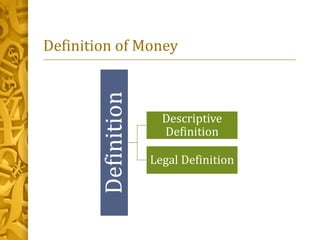
Definition of Money
Definition Descriptive
Definition
Legal Definition
Descriptive definition
• “Anything that is generally acceptable as a means of
exchange and that at the same time acts as a measure
and store of value.” – Crowther in his book: An outline
of money
• “Money may be defined as a means of valuation and
of payment” – Coulborn
• “Money is anything that is widely used as a mean of
payment and is generally acceptable in settlement of
debts.” – Cole
Legal Definition
• “Anything which is defined by the state as money is
money” – Professor Knap
• Professor Hartley believes that money should be legal
tender.
Types of money
1. Commodity money
2. Metallic money
3. Paper money
4. Credit money
5. Electronic money
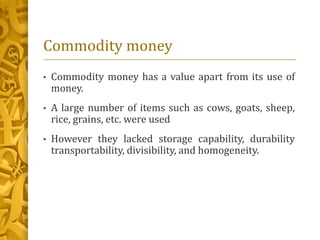
Commodity money
• Commodity money has a value apart from its use of
money.
• A large number of items such as cows, goats, sheep,
rice, grains, etc. were used
• However they lacked storage capability, durability
transportability, divisibility, and homogeneity.
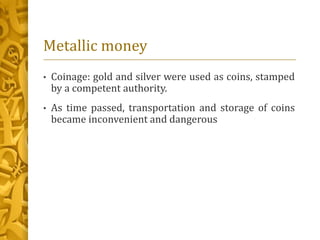
Metallic money
• Coinage: gold and silver were used as coins, stamped
by a competent authority.
• As time passed, transportation and storage of coins
became inconvenient and dangerous
Paper Currency
• Paper currency is made of paper and functions as a
medium of exchange
• Initially paper currency carried a promise that it was
convertible into a fixed quantity of precious metallic gold
and silver
• This promise was eliminated in 1914 in England and in
1933 in America.
• Fiat money: this newspaper money which is considered
legal tender because the government says it is money. It
has no backing of gold, silver or government securities
Credit money or bank money
• Bank money is the use of cheques as the medium of
exchange.
• Cheques have made it possible an easier to make
transactions for large amounts. They are easier to
transport.
• They are safe and provide receipts
• Checks are not legal tender. They cannot be enforced
in payments of debts
Other tools for bank money
• Demand draft
• Bankers check
• Promissory note
• Bills of exchange
• Hundi etc.
Electronic banking stage
• This is a modern system of transferring funds using
Electronic Communications.
• Payments are now made through magnetic strip
cards such as bank debit cards, credit cards,
telephone cards etc.
• This form of banking has reduced processing costs,
lead times for payments and increasing flexibility.
• These are also not considered legal tender
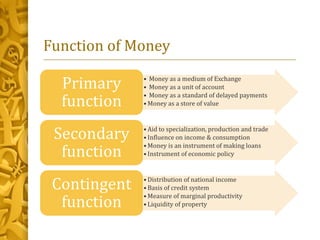
Function of Money
• Money as a medium of Exchange
• Money as a unit of account
• Money as a standard of delayed payments
• Money as a store of value
Primary
function
• Aid to specialization, production and trade
• Influence on income & consumption
• Money is an instrument of making loans
• Instrument of economic policy
Secondary
function
• Distribution of national income
• Basis of credit system
• Measure of marginal productivity
• Liquidity of property
Contingent
function
Disadvantages of Money
1. It creates economic instability
2. It leads to over capitalization and over production
3. Money strengthens capitalism
4. Money causes trade cycle
5. Money creates inequality of income and wealth
6. Money is the main cause of corruption
7. Money just mobilizes the resources but does not
creates it.
Money

Money

  • 1.
  • 2.
    Meaning of money •Money is any item or verifiable record that is generally accepted as payment for goods and services and repayment of debts in a particular country or socio-economic context.
  • 3.
    Definition of Money DefinitionDescriptive Definition Legal Definition
  • 4.
    Descriptive definition • “Anythingthat is generally acceptable as a means of exchange and that at the same time acts as a measure and store of value.” – Crowther in his book: An outline of money • “Money may be defined as a means of valuation and of payment” – Coulborn • “Money is anything that is widely used as a mean of payment and is generally acceptable in settlement of debts.” – Cole
  • 5.
    Legal Definition • “Anythingwhich is defined by the state as money is money” – Professor Knap • Professor Hartley believes that money should be legal tender.
  • 6.
    Types of money 1.Commodity money 2. Metallic money 3. Paper money 4. Credit money 5. Electronic money
  • 7.
    Commodity money • Commoditymoney has a value apart from its use of money. • A large number of items such as cows, goats, sheep, rice, grains, etc. were used • However they lacked storage capability, durability transportability, divisibility, and homogeneity.
  • 8.
    Metallic money • Coinage:gold and silver were used as coins, stamped by a competent authority. • As time passed, transportation and storage of coins became inconvenient and dangerous
  • 9.
    Paper Currency • Papercurrency is made of paper and functions as a medium of exchange • Initially paper currency carried a promise that it was convertible into a fixed quantity of precious metallic gold and silver • This promise was eliminated in 1914 in England and in 1933 in America. • Fiat money: this newspaper money which is considered legal tender because the government says it is money. It has no backing of gold, silver or government securities
  • 10.
    Credit money orbank money • Bank money is the use of cheques as the medium of exchange. • Cheques have made it possible an easier to make transactions for large amounts. They are easier to transport. • They are safe and provide receipts • Checks are not legal tender. They cannot be enforced in payments of debts
  • 11.
    Other tools forbank money • Demand draft • Bankers check • Promissory note • Bills of exchange • Hundi etc.
  • 12.
    Electronic banking stage •This is a modern system of transferring funds using Electronic Communications. • Payments are now made through magnetic strip cards such as bank debit cards, credit cards, telephone cards etc. • This form of banking has reduced processing costs, lead times for payments and increasing flexibility. • These are also not considered legal tender
  • 13.
    Function of Money •Money as a medium of Exchange • Money as a unit of account • Money as a standard of delayed payments • Money as a store of value Primary function • Aid to specialization, production and trade • Influence on income & consumption • Money is an instrument of making loans • Instrument of economic policy Secondary function • Distribution of national income • Basis of credit system • Measure of marginal productivity • Liquidity of property Contingent function
  • 14.
    Disadvantages of Money 1.It creates economic instability 2. It leads to over capitalization and over production 3. Money strengthens capitalism 4. Money causes trade cycle 5. Money creates inequality of income and wealth 6. Money is the main cause of corruption 7. Money just mobilizes the resources but does not creates it.