RESERVE BANK OF INDIA
INTRODUCTION
• Central bank of the country
• Head office: Mumbai
• Executive head: Governor
• Founded on the recommendation of HILTON
YOUNG COMMISSION
• The British insisted that they would make the
transfer of responsibility from Central
Government to India hands provided that there
is a central bank
Interesting Facts About Reserve Bank of
India (RBI)
• The first Governor of RBI was Osborne Smith,
• The first Indian governor of RBI was C D Deshmukh.
• Originally, the Reserve Bank of India was privately owned;
and was established as a private bank with two extra
functions: the regulation and control of all banks in India, and
to be the banker to the then government.
• Since its nationalization in 1949, RBI has been wholly
owned by the Government of India and thus, some new roles
were added to the list of functions of RBI!
MANAGEMENT / ORGANISATIONAL
STRUCTUREOF RBI
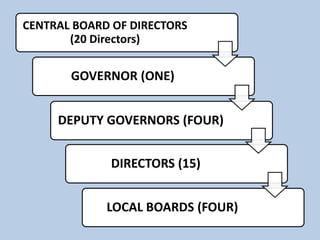
CENTRAL BOARD OF DIRECTORS
(20 Directors)
GOVERNOR (ONE)
DEPUTY GOVERNORS (FOUR)
DIRECTORS (15)
LOCAL BOARDS (FOUR)
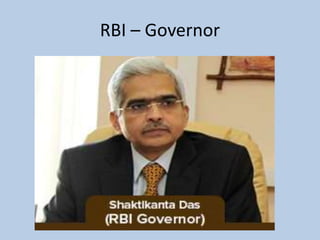
RBI – Governor
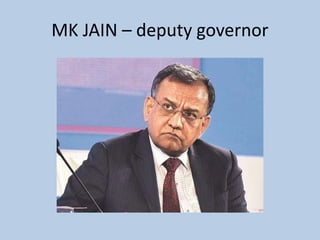
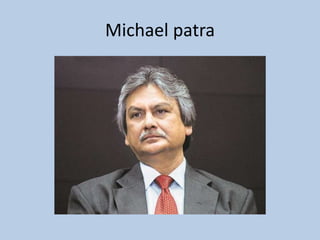
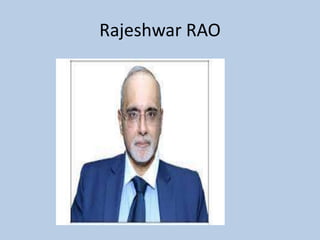
Deputy governor of RBI
MK JAIN – deputy governor
Michael patra
Rajeshwar RAO
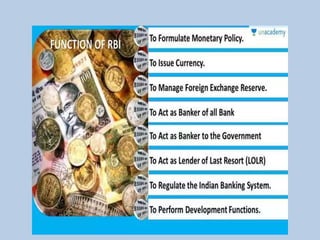
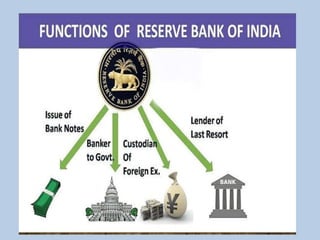
FUNCTIONS OF R.B.I.
A) CENTRAL BANKING FUNCTIONS
• Note issuing authority -The Reserve
Bank of India has the sole right to issue
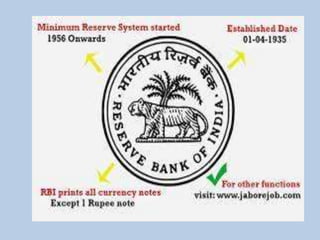
currency notes except one rupee notes which
are issued by the Ministry of Finance.
Currency notes issued by the Reserve Bank are
declared unlimited legal tender throughout
the country.
• Banker to government- As banker to
the government the Reserve Bank
manages the banking needs of the
government. It has to-maintain and
operate the government’s deposit
accounts. It collects receipts of funds and
makes payments on behalf of the
government. It represents the Government
of India as the member of the IMF and the
World Bank.
• Banker’s bank- The commercial banks
hold deposits in the Reserve Bank and the
latter has the custody of the cash reserves of
the commercial banks.
• Lender of last resort- The commercial
banks approach the Reserve Bank in times of
emergency to tide over financial difficulties,
and the Reserve bank comes to their rescue
though it might charge a higher rate of
interest.
• Credit control -Since credit money
forms the most important part of supply of
money, and since the supply of money has
important implications for economic
stability, the importance of control of
credit becomes obvious. Credit is
controlled by the Reserve Bank in
accordance with the economic priorities of
the government.
• Regulation of foreign exchange/
Custodian of Foreign currency
reserves - The Reserve Bank has the
custody of the country’s reserves of
international currency, and this enables
the Reserve Bank to deal with crisis
connected with adverse balance of
payments position.
B) PROMOTIONAL AND
DEVELOPMENTAL FUNCTIONS
• Promotion of commercial banks
• Promotion of rural and agriculrtural
credit
• Promotion of industrial finance
C) SUPERVISORY FUNCTIONS
• Licensing of banks
• Branch licensing policy
• Approval of capital, reserves and liquid
assets of banks
• Inspection of banks
• Control over management of banks
• Audit of banks
• Training and banking education
MONETARY POLICYAND
METHODS OF CREDIT
CONTROL
Monetary Policy
Monetary Policy –
Meaning….
Reserve Bank of India states that,
• Monetary policy refers to the use of instruments under the
control of the central bank to regulate the availability, cost and
use of money and credit.
It is the policy by which the quantity, use and cost of
money and credit are suitably controlled to achieve
pre- determined objectives.
• “ monetary policy means the policy of keeping
control on money supply , by the central
banks , so that objectives of general economic
policy may be achieved”
Methods
• The RBI aims toachieve its objectivesof economic growth
and control of inflation through variousmethods.
These methods can be groupedas:
– General/ quantitative methods
– Selective/ qualitative methods
General/ Quantitative methods
• These methods maintain and control the total quantityor
volumeof creditor moneysupply in theeconomy:
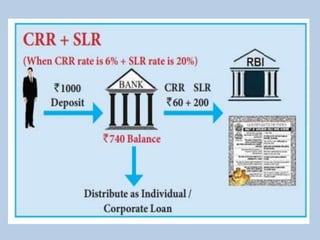
Cash reserve ratio(CRR)
 The money supply in the economy is influenced by CRR.
 It is the ratio of a bank’s timeand demand liabilities to be kept in reserve with the RBI.
 The RBI isauthorized tovary the CRR between 3% and 15%.
 Presently 4%
Statutory liquidity ratio(SLR):
 Under SLR, banks have to keep a certain percentage of their deposits as liquid assets.
 The reduction in SLR enhances the liquidity ofcommercial banks.
 Presently 18.75%
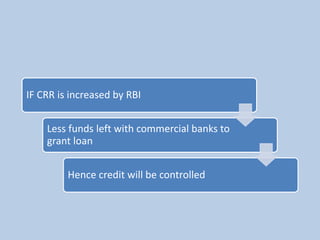
IF CRR is increased by RBI
Less funds left with commercial banks to
grant loan
Hence credit will be controlled
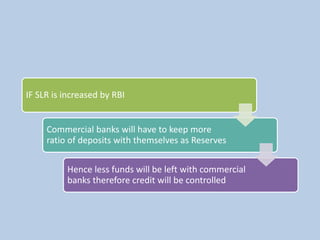
IF SLR is increased by RBI
Commercial banks will have to keep more
ratio of deposits with themselves as Reserves
Hence less funds will be left with commercial
banks therefore credit will be controlled
BANK RATE
• This is the rate at which the central bank of the
country gives loans to the banks or discounts their
securities.
• High bank rate is called as the dear money policy.
• When bank rate is reduced, it is called cheap money
policy.
• In India, the success of bank rate remains doubtful,
because of imbalanced development of banking system,
role of indegeneous lenders, inflexible economic
structure, dominance of agriculture sector.
• Presently 5.65%
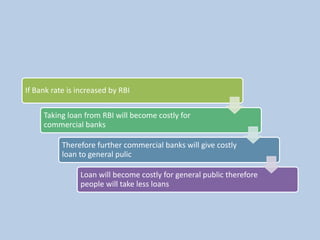
If Bank rate is increased by RBI
Taking loan from RBI will become costly for
commercial banks
Therefore further commercial banks will give costly
loan to general pulic
Loan will become costly for general public therefore
people will take less loans
OPEN MARKET OPERATIONS
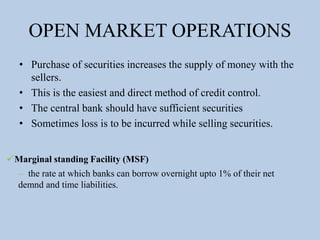
• Purchase of securities increases the supply of money with the
sellers.
• This is the easiest and direct method of credit control.
• The central bank should have sufficient securities
• Sometimes loss is to be incurred while selling securities.
Marginal standing Facility (MSF)
– the rate at which banks can borrow overnight upto 1% of their net
demnd and time liabilities.
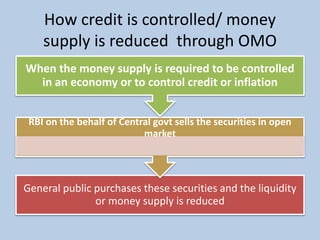
How credit is controlled/ money
supply is reduced through OMO
General public purchases these securities and the liquidity
or money supply is reduced
RBI on the behalf of Central govt sells the securities in open
market
When the money supply is required to be controlled
in an economy or to control credit or inflation
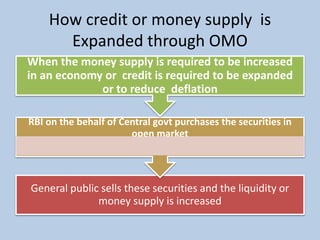
How credit or money supply is
Expanded through OMO
General public sells these securities and the liquidity or
money supply is increased
RBI on the behalf of Central govt purchases the securities in
open market
When the money supply is required to be increased
in an economy or credit is required to be expanded
or to reduce deflation
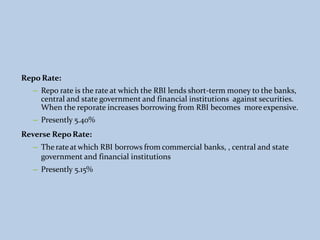
Repo Rate:
– Repo rate is the rate at which the RBI lends short-term money to the banks,
central and state government and financial institutions against securities.
When the reporate increases borrowing from RBI becomes moreexpensive.
– Presently 5.40%
Reverse RepoRate:
– The rateatwhich RBI borrows from commercial banks, , central and state
government and financial institutions
– Presently 5.15%
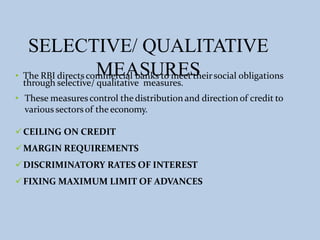
SELECTIVE/ QUALITATIVE
MEASURES
• The RBI directs commercial banks to meet theirsocial obligations
through selective/ qualitative measures.
• These measures control the distribution and direction of credit to
various sectorsof the economy.
CEILING ON CREDIT
MARGIN REQUIREMENTS
DISCRIMINATORY RATES OF INTEREST
FIXING MAXIMUM LIMIT OF ADVANCES
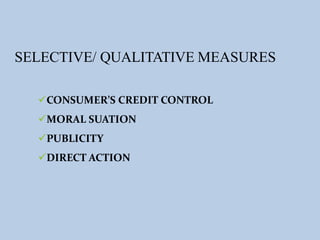
CONSUMER’S CREDIT CONTROL
MORAL SUATION
PUBLICITY
DIRECT ACTION
SELECTIVE/ QUALITATIVE MEASURES
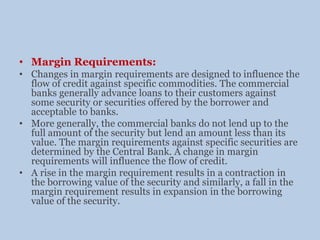
• Margin Requirements:
• Changes in margin requirements are designed to influence the
flow of credit against specific commodities. The commercial
banks generally advance loans to their customers against
some security or securities offered by the borrower and
acceptable to banks.
• More generally, the commercial banks do not lend up to the
full amount of the security but lend an amount less than its
value. The margin requirements against specific securities are
determined by the Central Bank. A change in margin
requirements will influence the flow of credit.
• A rise in the margin requirement results in a contraction in
the borrowing value of the security and similarly, a fall in the
margin requirement results in expansion in the borrowing
value of the security.
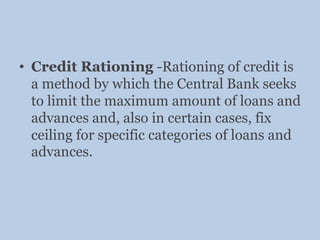
• Credit Rationing -Rationing of credit is
a method by which the Central Bank seeks
to limit the maximum amount of loans and
advances and, also in certain cases, fix
ceiling for specific categories of loans and
advances.
• Regulation of Consumer Credit:
• Regulation of consumer credit is designed to
check the flow of credit for consumer durable
goods. This can be done by regulating the
total volume of credit that may be extended
for purchasing specific durable goods and
regulating the number of installments
through which such loan can be spread.
Central Bank uses this method to restrict or
liberalise loan conditions accordingly to
stabilise the economy.
• Moral Suasion:
• Moral suasion and credit monitoring arrangement are
other methods of credit control. The policy of moral
suasion will succeed only if the Central Bank is strong
enough to influence the commercial banks.
• In India, from 1949 onwards, the Reserve Bank has
been successful in using the method of moral suasion
to bring the commercial banks to fall in line with its
policies regarding credit.
• Publicity is another method, whereby the Reserve
Bank marks direct appeal to the public and publishes
data which will have sobering effect on other banks
and the commercial circles.
• Role of RBI in Indian Banking System
• 1. The main aim of RBI is to ensure stability of price which is done
through monetary policies. Monetary policies are those actions
taken by RBI to control the supply of money in order to ensure
economic growth. RBI makes regular changes in the credit control
measures as it seems fit to ensure economic stability which may
include changing the Bank Rate, Repo Rate etc. It ensures low and
stable inflationary and deflationary trends.
• 2. The financial sector of India comprising of commercial banks,
financial institutions and non-banking firms are supervised by RBI.
As per the Foreign Exchange Management Act, RBI owns the right
to manage all foreign exchange so as to facilitate external trade and
also to ensure proper development of foreign exchange market in
India. The Forex and gold exchange of our country is also
maintained by RBI.
• 3. RBI is the only bank who has the authority to issues currency and coins in our country which
means that RBI can create or destroy as it seems fit. For example, the currency notes of rupees
thousand was destroyed in the year 2018 and changed the notes of other denominations and also
introduced two thousand-rupee notes. RBI works as the agent of Government of India who mint
coins and RBI distributes the coins. It acts as the banker to the Government of India. By the issue of
bonds and securities to the public, RBI ensures that the Government of India earns money from
them. It acts as a guide to the Government by retaining credits without charging interests, by
carrying exchange payments and so on.
• 4. All the banks maintain an account with the Reserve Bank of India. Hence, RBI acts as a bank for
other commercial banks. Maintaining an account in RBI ensures that the banks maintain the reserve
requirements. Also, RBI acts as a lender for all the other banks.
• 5. RBI regulates the financial system of our country. It regulates and supervises the activity of other
banks by various methods like supervising the bank license, inspections, off site surveillance etc
thereby, building the confidence of the public in the banking system. It issues banking license
without which no bank or new branch of any of the existing bank is authorized to function.
• 6. RBI has formulated the standard boarding of India and Banking codes (BCSBI) in accordance with
the global practices to calculate the standards of other banks and their banking practices. It also
formed the Fair Practice Code for investors in order to ensure that the interest of the investors is
protected as well.
Control of RBI Over NBFC
• The Department of Non-Banking Supervision (DNBS) is entrusted with
the responsibility of regulation and supervision of Non-Banking Financial
Companies (NBFCs) under the regulatory - provisions contained under
Chapter III B and C and Chapter V of the Reserve Bank of India Act, 1934.
• The Regulatory and Supervisory Framework of the Reserve Bank provides for, among other things,
registration of NBFCs, prudential regulation of various categories of NBFC, issue of directions on
acceptance of deposits by NBFCs and surveillance of the sector through off-site and on-site
supervision. Deposit taking NBFCs and Systemically Important Non-Deposit Accepting Companies
are subjected to a greater degree of regulation and supervision. The focus of regulation and
supervision is three fold, viz., a) depositor protection, b) consumer protection and c) financial
stability.
• The Reserve Bank has also been empowered under the RBI
Act 1934 to take punitive action which includes cancellation
of Certificate of Registration, issue of prohibitory orders
from accepting deposits, filing criminal cases or winding up
petitions under provisions of Companies Act in extreme
cases.
• Developmental activities of the Department
• Co-ordination with State Governments to pass State Legislations to curb unauthorized and fraudulent activities
• Conducting public awareness programmes, depositors' education, conducting workshops / seminars for trade and
industry organizations
• Promoting Self-Regulatory Organization (SRO) for NBFC-MFI
• Conducting training programmes for personnel of NBFCs, State Governments, State Police and auditors of NBFCs
• Interacting with co-regulators viz., SEBI, IRDA, and Government of India and State Governments for greater
coordination on related issues.
• The current focus of the Department is to
• Identify and review regulatory framework to bridge gaps and align regulations with other financial intermediaries,
wherever appropriate;
• Identify and monitor areas of systemic risks and unregulated shadow banking activities from the financial stability
perspective;
• Supervise the regulated entities through Off-Site Reporting, On-Site Inspections and Market Intelligence;
• Coordinate with other financial sector regulators and enforcement agencies to check unauthorized financial
activities;
• Conduct public awareness campaigns on Non-Banking Financial Companies and unauthorized acceptance of
deposits through press advertisements, participation in fairs / workshops/seminars;
• Streamline the sector to ensure that only serious players occupy the NBFC space
• Enhance disclosure and transparency in the sector
Provisions of Reserve Bank of India Act ,
1934
•
short title extent and commencement- section 1
•
the Reserve Bank of India Act 1934 extends
to whole of India
• this section shall come into force at once and the
remaining provisions of this act shall come into force
on such date or date as the central government by
notification in the gazette of India appoint
Provisions of Reserve Bank of India Act
, 1934
• Establishment and incorporation of Reserve Bank, section 3
•
the bank is constituted for the purpose taking over the
management of currency from the central govt and carrying on the
business of banking in accordance of the provisions of the act .
•
the bank shall be a body corporate by the name of Reserve Bank of
India having perpetual succession and common seal and shall by
the said name sue and be sued
•
capital of the bank Section 4- the capital of Reserve Bank of India
shall not be less than 5 crores
Provisions of Reserve Bank of India Act
, 1934
• Section 6 in The Reserve Bank of India Act,
1934
• . Offices, branches and agencies.—The Bank
shall, as soon as may be, establish offices in
MUMBAI, KOLKATA, Delhi and chennai and
may establish branches or agencies in any
other place in India or, with the previous
sanction of the [Central Government]
elsewhere,
Provisions of Reserve Bank of India Act , 1934
• management section 7 the central government
made from time to time give directions to
Reserve Bank of India after consultation with the
governor of the bank considered necessary in the
public interest
•
Regulations made by Central Board the
Governor in and in his absence the Deputy
Governor nominated by him on his Behalf shall
also have the powers of general superintendence
direction of affairs and the business of banks
Provisions of Reserve Bank of India Act
, 1934
•
•
Composition of the Central Board and term of director
section 8
• a governor and not more than four Deputy Governors to the
appointed by central government
•
four directors to be nominated by central government one
from each of the four local boards
•
10 directors to be nominated by central government
• one government official to be nominated by central
government
•
the Governor and the deputy with deputy governor devote
their whole time to the affairs of the bank and shall receive
such salaries and allowances as may be determined by the
• the Governor and Deputy Governor shall hold
office for a term not exceeding five years
• The governor and the deputy governor shall
devote their whole time to the affairs of the bank
and shall receive the salary and allowances as
may be determined by the central board ,with
the approval of central govt
Provisions of Reserve Bank of India Act
, 1934
• Local boards their constitution and function section 9
• a local board shall be constituted for each of the four areas specified in the first
schedule and shall consist of 5 members to be appointed by central government to
represent
•
the members of the local board shall elect from amongst themselves to one person to
be the chairman of the board
• every member of a local board shall hold office for 4 years and thereafter until his
successor shall have been appointed and shall be eligible for reappointment
•
board shall advise The Central Board on such matters as may be generally or specifically
referred to it and shall perform such duties as the Central Board Mein delicate to it
•
Provisions of Reserve Bank of India Act
, 1934
• disqualification of directors and
members of local board section 10
•
no person may be a director or member of local board
who :
• is a salaried government official for
• or is or at any time has been advocated as insolvent
• is found lunatic or becomes of an unsound mind
• is an officer or employee of the bank
• Is a director of banking company within the
meaning of clause of section 5 of Banking
regulation Act , 1949
• No two persons who are partners of the same
mercantile firm , or are directors of the same
private company
Provisions of Reserve Bank of India Act
, 1934
• Removal and vacation from of office section
11
• the central government may remove from office the Governor Deputy Governor
or any other director or any member of a local board
• the central government shall remove from office any director and the Central
Board shall removed from office any member of the local board if such director or
member become subject to any disqualification specified in section 10
• a director or a member of a local board removed to hold shall not be eligible for
reappointment either as a director or as a member of a local boars until the expiry
of the term for which his appointment was made
• the nomination as director or as member of a local Board of any person who is a
member of Parliament or Legislature of any state shall be void unless within 2
months of the date of his nomination he ceases to be such member
•
the director may resign his office to the central government and a member of
local board may resign his office to the central board on the acceptance of the
resignation in the office shall become vacant
•
Provisions of Reserve Bank of India Act
, 1934
• Casual vacancies and absences section 12
• if the Governor or Deputy Governor by infirmity or otherwise is rendered
incapable of executing his duties or is absent on leave or otherwise in
circumstances not involving the vacation of his appointment , the central
government may ,after the consideration of the recommendations made
by the central board in this behalf
•
where any casual vacancy in the office of any member of a local board
occurs ,the central Govt board may nominate that to any person
recommended by other members of the local board
•
where any Casual Vacancy occurs in the office of the director the vacancy
shall be filled by the central government
•
Provisions of Reserve Bank of India Act
, 1934
• Meetings of the Central Board section
13
• meetings of the Central Board shall be convened by the Governor at least
6 times in each year and at least once in each quarter
•
any four directors may require the Governor to convene a meeting of the
Central Board at any time
•
the Governor or if for any reason he is unable to attend the Deputy
Governor authorised by the Governor under the provision to sub section 3
of Section 8 to vote for him shall preside at the meetings of the Central
Board
•
Section 18 - Power of direct
discount : RBI Act 1934
• When, in the opinion of the Bank a
special occasion has arisen making it
necessary or expedient that action
should be taken under this section
for the purposes of regulating credit
in the interests of Indian trade,
commerce, industry and agricultural,
the Bank may, notwithstanding any
limitation contained in section 17,-
• (1) purchase, sell or discount any bill
of exchange or promissory note
though such bill or promissory note
is not eligible for purchase or
discount by the Bank under that
section ; or
• 3) make loans or advances to-
• (a) a State co-operative bank, or
• (b) on the recommendation of a
State co-operative bank, to a co-
operative society registered within
the area in which the State co-
operative bank operates, or
•
Provisions of Reserve Bank of India Act
, 1934
• Business which a bank may not transact
section 19
• the bank may not engage in trade or otherwise have a direct interest in any
commercial industrial or other undertaking except such interest as it may in
anyway acquire in the course of satisfaction of any of its claim
•
purchase the shares of any banking company or any other company or grant loans
up to the security of any such shares
•
Make loans or advances
•
Draw or accept bills otherwise than on demand
•
allowed interest on deposits on current accounts
•
Provisions of Reserve Bank of India Act
, 1934
• obligation of the bank to transact
government business section 20
•
the bank shall undertake to accept money for account
of Central Government and to make payments upto the
amount standing to the credit of its account and to
carry out its exchange remittance and other banking
operations including the management of public debt
•
Provisions of Reserve Bank of India Act
, 1934
• BANK TO HAVE RIGHT TO TRANSACT GOVT BUSINESS IN
INDIA section 21 :
• The central government shall entrust the bank on such
conditions as may be agreed upon with all its money,
remittance exchange and banking transactions in India ,and
in particular shall deposit free of interest all its cash
balances with the bank
• the central government shall and trust the bank with the
management of the public debt and with issue of any new
loans
Provisions of Reserve Bank of India Act
, 1934
• Right to issue banknotes section 22 to the bank shall
have the sole right to issue the bank notes in India for a
period which shall be fixed by the central government
on the Recommendation of Central Board , issue
currency notes of the Government of India supplied to
it by the central government, and the provisions of this
act applicable to Bank notes unless a contrary intention
appears , applied to all currency notes of the
Government of India issued either by Central
Government or by bank
•
Provisions of Reserve Bank of India Act
, 1934
• Issue department Section 23 - the issue of
bank note shall be conducted by the bank in
an issue department which shall be separated
and kept wholly distinct from the banking
department and the assets of the issue
department shall not be subject to any liability
other than the liabilities of the issue
department
Provisions of Reserve Bank of India Act
, 1934
• DENOMINATION OF NOTES SECTION 24: Bank notes we
shall be of denominational value of 2 rupees 5 rupees 10
rupees 20 rupees 50 rupees 100 rupees 500 rupees 1000
rupees 5000 rupees and 10000 rupees not exceeding
10000 Rupees as the central government may on the
Recommendation of Central Board specify in this behalf
•
the central government may on the Recommendation of of
Central Board direct the non issue or discontinuance of the
issue of banknotes of such denominational values
•
Provisions of Reserve Bank of India Act
, 1934
• FORM OF BANK NOTES SECTION 25 : The
design, form and material of banknotes shall
be such as may be approved by the central
government after consideration of the
recommendations made by the Central Board
•
Provisions of Reserve Bank of India Act
, 1934
• Legal tender character of notes section 26
• every bank note shall be legal tender at any place in India
in payment or on account for the amount expressed
therein, and shall be guaranteed by central government
•
on Recommendation of the Central Board the central
government may , by notification in the gazette of India
declared that with effect from such date as may be
specified in the notification any series of banknotes of any
denomination shall cease to be the legal tender
•
Provisions of Reserve Bank of India Act
, 1934
• Reissue of notes section 27 the bank shall not Re issue banknotes
which are torn defaced or excessively soiled
•
recovery of notes lost stolen multi lated or Imperfect
section 28
•
no person shall of right be entitled to recover from central government or the
bank the value of any lost stolen multi lated or imperfect currency note of the
Government of India or banknote
•
bank exempt from stamp duty on Bank
notes section 29 the bank shall not be liable to the payment of any
stamp duty under the Indian stamp act, 1899 in the respect of banknotes issued
by it
•
Provisions of Reserve Bank of India Act , 1934
• Powers of Central government to supersede
Central Board Section 30
•
if in the opinion of the central government the bank fails to carry
out any of the obligations imposed on it by or under this act the
central government may by notification in the gazette of India
declared the Central Board to be superseded and thereafter the
general superintendence and the direction of the affairs of the bank
shall be interested to such agency as the central government may
determine
•

1 RBI related.pptx

  • 1.
  • 3.
    INTRODUCTION • Central bankof the country • Head office: Mumbai • Executive head: Governor • Founded on the recommendation of HILTON YOUNG COMMISSION • The British insisted that they would make the transfer of responsibility from Central Government to India hands provided that there is a central bank
  • 4.
    Interesting Facts AboutReserve Bank of India (RBI) • The first Governor of RBI was Osborne Smith, • The first Indian governor of RBI was C D Deshmukh. • Originally, the Reserve Bank of India was privately owned; and was established as a private bank with two extra functions: the regulation and control of all banks in India, and to be the banker to the then government. • Since its nationalization in 1949, RBI has been wholly owned by the Government of India and thus, some new roles were added to the list of functions of RBI!
  • 5.
  • 6.
    CENTRAL BOARD OFDIRECTORS (20 Directors) GOVERNOR (ONE) DEPUTY GOVERNORS (FOUR) DIRECTORS (15) LOCAL BOARDS (FOUR)
  • 7.
  • 8.
  • 9.
    MK JAIN –deputy governor
  • 10.
  • 11.
  • 14.
    FUNCTIONS OF R.B.I. A)CENTRAL BANKING FUNCTIONS • Note issuing authority -The Reserve Bank of India has the sole right to issue currency notes except one rupee notes which are issued by the Ministry of Finance. Currency notes issued by the Reserve Bank are declared unlimited legal tender throughout the country.
  • 15.
    • Banker togovernment- As banker to the government the Reserve Bank manages the banking needs of the government. It has to-maintain and operate the government’s deposit accounts. It collects receipts of funds and makes payments on behalf of the government. It represents the Government of India as the member of the IMF and the World Bank.
  • 16.
    • Banker’s bank-The commercial banks hold deposits in the Reserve Bank and the latter has the custody of the cash reserves of the commercial banks. • Lender of last resort- The commercial banks approach the Reserve Bank in times of emergency to tide over financial difficulties, and the Reserve bank comes to their rescue though it might charge a higher rate of interest.
  • 17.
    • Credit control-Since credit money forms the most important part of supply of money, and since the supply of money has important implications for economic stability, the importance of control of credit becomes obvious. Credit is controlled by the Reserve Bank in accordance with the economic priorities of the government.
  • 18.
    • Regulation offoreign exchange/ Custodian of Foreign currency reserves - The Reserve Bank has the custody of the country’s reserves of international currency, and this enables the Reserve Bank to deal with crisis connected with adverse balance of payments position.
  • 19.
    B) PROMOTIONAL AND DEVELOPMENTALFUNCTIONS • Promotion of commercial banks • Promotion of rural and agriculrtural credit • Promotion of industrial finance
  • 20.
    C) SUPERVISORY FUNCTIONS •Licensing of banks • Branch licensing policy • Approval of capital, reserves and liquid assets of banks • Inspection of banks • Control over management of banks • Audit of banks • Training and banking education
  • 21.
  • 22.
  • 23.
    Monetary Policy – Meaning…. ReserveBank of India states that, • Monetary policy refers to the use of instruments under the control of the central bank to regulate the availability, cost and use of money and credit. It is the policy by which the quantity, use and cost of money and credit are suitably controlled to achieve pre- determined objectives.
  • 24.
    • “ monetarypolicy means the policy of keeping control on money supply , by the central banks , so that objectives of general economic policy may be achieved”
  • 26.
    Methods • The RBIaims toachieve its objectivesof economic growth and control of inflation through variousmethods. These methods can be groupedas: – General/ quantitative methods – Selective/ qualitative methods
  • 27.
    General/ Quantitative methods •These methods maintain and control the total quantityor volumeof creditor moneysupply in theeconomy: Cash reserve ratio(CRR)  The money supply in the economy is influenced by CRR.  It is the ratio of a bank’s timeand demand liabilities to be kept in reserve with the RBI.  The RBI isauthorized tovary the CRR between 3% and 15%.  Presently 4% Statutory liquidity ratio(SLR):  Under SLR, banks have to keep a certain percentage of their deposits as liquid assets.  The reduction in SLR enhances the liquidity ofcommercial banks.  Presently 18.75%
  • 28.
    IF CRR isincreased by RBI Less funds left with commercial banks to grant loan Hence credit will be controlled
  • 29.
    IF SLR isincreased by RBI Commercial banks will have to keep more ratio of deposits with themselves as Reserves Hence less funds will be left with commercial banks therefore credit will be controlled
  • 31.
    BANK RATE • Thisis the rate at which the central bank of the country gives loans to the banks or discounts their securities. • High bank rate is called as the dear money policy. • When bank rate is reduced, it is called cheap money policy. • In India, the success of bank rate remains doubtful, because of imbalanced development of banking system, role of indegeneous lenders, inflexible economic structure, dominance of agriculture sector. • Presently 5.65%
  • 32.
    If Bank rateis increased by RBI Taking loan from RBI will become costly for commercial banks Therefore further commercial banks will give costly loan to general pulic Loan will become costly for general public therefore people will take less loans
  • 33.
    OPEN MARKET OPERATIONS •Purchase of securities increases the supply of money with the sellers. • This is the easiest and direct method of credit control. • The central bank should have sufficient securities • Sometimes loss is to be incurred while selling securities. Marginal standing Facility (MSF) – the rate at which banks can borrow overnight upto 1% of their net demnd and time liabilities.
  • 34.
    How credit iscontrolled/ money supply is reduced through OMO General public purchases these securities and the liquidity or money supply is reduced RBI on the behalf of Central govt sells the securities in open market When the money supply is required to be controlled in an economy or to control credit or inflation
  • 35.
    How credit ormoney supply is Expanded through OMO General public sells these securities and the liquidity or money supply is increased RBI on the behalf of Central govt purchases the securities in open market When the money supply is required to be increased in an economy or credit is required to be expanded or to reduce deflation
  • 36.
    Repo Rate: – Reporate is the rate at which the RBI lends short-term money to the banks, central and state government and financial institutions against securities. When the reporate increases borrowing from RBI becomes moreexpensive. – Presently 5.40% Reverse RepoRate: – The rateatwhich RBI borrows from commercial banks, , central and state government and financial institutions – Presently 5.15%
  • 37.
    SELECTIVE/ QUALITATIVE MEASURES • TheRBI directs commercial banks to meet theirsocial obligations through selective/ qualitative measures. • These measures control the distribution and direction of credit to various sectorsof the economy. CEILING ON CREDIT MARGIN REQUIREMENTS DISCRIMINATORY RATES OF INTEREST FIXING MAXIMUM LIMIT OF ADVANCES
  • 38.
    CONSUMER’S CREDIT CONTROL MORALSUATION PUBLICITY DIRECT ACTION SELECTIVE/ QUALITATIVE MEASURES
  • 39.
    • Margin Requirements: •Changes in margin requirements are designed to influence the flow of credit against specific commodities. The commercial banks generally advance loans to their customers against some security or securities offered by the borrower and acceptable to banks. • More generally, the commercial banks do not lend up to the full amount of the security but lend an amount less than its value. The margin requirements against specific securities are determined by the Central Bank. A change in margin requirements will influence the flow of credit. • A rise in the margin requirement results in a contraction in the borrowing value of the security and similarly, a fall in the margin requirement results in expansion in the borrowing value of the security.
  • 40.
    • Credit Rationing-Rationing of credit is a method by which the Central Bank seeks to limit the maximum amount of loans and advances and, also in certain cases, fix ceiling for specific categories of loans and advances.
  • 41.
    • Regulation ofConsumer Credit: • Regulation of consumer credit is designed to check the flow of credit for consumer durable goods. This can be done by regulating the total volume of credit that may be extended for purchasing specific durable goods and regulating the number of installments through which such loan can be spread. Central Bank uses this method to restrict or liberalise loan conditions accordingly to stabilise the economy.
  • 42.
    • Moral Suasion: •Moral suasion and credit monitoring arrangement are other methods of credit control. The policy of moral suasion will succeed only if the Central Bank is strong enough to influence the commercial banks. • In India, from 1949 onwards, the Reserve Bank has been successful in using the method of moral suasion to bring the commercial banks to fall in line with its policies regarding credit. • Publicity is another method, whereby the Reserve Bank marks direct appeal to the public and publishes data which will have sobering effect on other banks and the commercial circles.
  • 43.
    • Role ofRBI in Indian Banking System • 1. The main aim of RBI is to ensure stability of price which is done through monetary policies. Monetary policies are those actions taken by RBI to control the supply of money in order to ensure economic growth. RBI makes regular changes in the credit control measures as it seems fit to ensure economic stability which may include changing the Bank Rate, Repo Rate etc. It ensures low and stable inflationary and deflationary trends. • 2. The financial sector of India comprising of commercial banks, financial institutions and non-banking firms are supervised by RBI. As per the Foreign Exchange Management Act, RBI owns the right to manage all foreign exchange so as to facilitate external trade and also to ensure proper development of foreign exchange market in India. The Forex and gold exchange of our country is also maintained by RBI.
  • 44.
    • 3. RBIis the only bank who has the authority to issues currency and coins in our country which means that RBI can create or destroy as it seems fit. For example, the currency notes of rupees thousand was destroyed in the year 2018 and changed the notes of other denominations and also introduced two thousand-rupee notes. RBI works as the agent of Government of India who mint coins and RBI distributes the coins. It acts as the banker to the Government of India. By the issue of bonds and securities to the public, RBI ensures that the Government of India earns money from them. It acts as a guide to the Government by retaining credits without charging interests, by carrying exchange payments and so on. • 4. All the banks maintain an account with the Reserve Bank of India. Hence, RBI acts as a bank for other commercial banks. Maintaining an account in RBI ensures that the banks maintain the reserve requirements. Also, RBI acts as a lender for all the other banks. • 5. RBI regulates the financial system of our country. It regulates and supervises the activity of other banks by various methods like supervising the bank license, inspections, off site surveillance etc thereby, building the confidence of the public in the banking system. It issues banking license without which no bank or new branch of any of the existing bank is authorized to function. • 6. RBI has formulated the standard boarding of India and Banking codes (BCSBI) in accordance with the global practices to calculate the standards of other banks and their banking practices. It also formed the Fair Practice Code for investors in order to ensure that the interest of the investors is protected as well.
  • 45.
    Control of RBIOver NBFC • The Department of Non-Banking Supervision (DNBS) is entrusted with the responsibility of regulation and supervision of Non-Banking Financial Companies (NBFCs) under the regulatory - provisions contained under Chapter III B and C and Chapter V of the Reserve Bank of India Act, 1934. • The Regulatory and Supervisory Framework of the Reserve Bank provides for, among other things, registration of NBFCs, prudential regulation of various categories of NBFC, issue of directions on acceptance of deposits by NBFCs and surveillance of the sector through off-site and on-site supervision. Deposit taking NBFCs and Systemically Important Non-Deposit Accepting Companies are subjected to a greater degree of regulation and supervision. The focus of regulation and supervision is three fold, viz., a) depositor protection, b) consumer protection and c) financial stability. • The Reserve Bank has also been empowered under the RBI Act 1934 to take punitive action which includes cancellation of Certificate of Registration, issue of prohibitory orders from accepting deposits, filing criminal cases or winding up petitions under provisions of Companies Act in extreme cases.
  • 46.
    • Developmental activitiesof the Department • Co-ordination with State Governments to pass State Legislations to curb unauthorized and fraudulent activities • Conducting public awareness programmes, depositors' education, conducting workshops / seminars for trade and industry organizations • Promoting Self-Regulatory Organization (SRO) for NBFC-MFI • Conducting training programmes for personnel of NBFCs, State Governments, State Police and auditors of NBFCs • Interacting with co-regulators viz., SEBI, IRDA, and Government of India and State Governments for greater coordination on related issues. • The current focus of the Department is to • Identify and review regulatory framework to bridge gaps and align regulations with other financial intermediaries, wherever appropriate; • Identify and monitor areas of systemic risks and unregulated shadow banking activities from the financial stability perspective; • Supervise the regulated entities through Off-Site Reporting, On-Site Inspections and Market Intelligence; • Coordinate with other financial sector regulators and enforcement agencies to check unauthorized financial activities; • Conduct public awareness campaigns on Non-Banking Financial Companies and unauthorized acceptance of deposits through press advertisements, participation in fairs / workshops/seminars; • Streamline the sector to ensure that only serious players occupy the NBFC space • Enhance disclosure and transparency in the sector
  • 47.
    Provisions of ReserveBank of India Act , 1934 • short title extent and commencement- section 1 • the Reserve Bank of India Act 1934 extends to whole of India • this section shall come into force at once and the remaining provisions of this act shall come into force on such date or date as the central government by notification in the gazette of India appoint
  • 48.
    Provisions of ReserveBank of India Act , 1934 • Establishment and incorporation of Reserve Bank, section 3 • the bank is constituted for the purpose taking over the management of currency from the central govt and carrying on the business of banking in accordance of the provisions of the act . • the bank shall be a body corporate by the name of Reserve Bank of India having perpetual succession and common seal and shall by the said name sue and be sued • capital of the bank Section 4- the capital of Reserve Bank of India shall not be less than 5 crores
  • 49.
    Provisions of ReserveBank of India Act , 1934 • Section 6 in The Reserve Bank of India Act, 1934 • . Offices, branches and agencies.—The Bank shall, as soon as may be, establish offices in MUMBAI, KOLKATA, Delhi and chennai and may establish branches or agencies in any other place in India or, with the previous sanction of the [Central Government] elsewhere,
  • 50.
    Provisions of ReserveBank of India Act , 1934 • management section 7 the central government made from time to time give directions to Reserve Bank of India after consultation with the governor of the bank considered necessary in the public interest • Regulations made by Central Board the Governor in and in his absence the Deputy Governor nominated by him on his Behalf shall also have the powers of general superintendence direction of affairs and the business of banks
  • 51.
    Provisions of ReserveBank of India Act , 1934 • • Composition of the Central Board and term of director section 8 • a governor and not more than four Deputy Governors to the appointed by central government • four directors to be nominated by central government one from each of the four local boards • 10 directors to be nominated by central government • one government official to be nominated by central government • the Governor and the deputy with deputy governor devote their whole time to the affairs of the bank and shall receive such salaries and allowances as may be determined by the
  • 52.
    • the Governorand Deputy Governor shall hold office for a term not exceeding five years • The governor and the deputy governor shall devote their whole time to the affairs of the bank and shall receive the salary and allowances as may be determined by the central board ,with the approval of central govt
  • 53.
    Provisions of ReserveBank of India Act , 1934 • Local boards their constitution and function section 9 • a local board shall be constituted for each of the four areas specified in the first schedule and shall consist of 5 members to be appointed by central government to represent • the members of the local board shall elect from amongst themselves to one person to be the chairman of the board • every member of a local board shall hold office for 4 years and thereafter until his successor shall have been appointed and shall be eligible for reappointment • board shall advise The Central Board on such matters as may be generally or specifically referred to it and shall perform such duties as the Central Board Mein delicate to it •
  • 54.
    Provisions of ReserveBank of India Act , 1934 • disqualification of directors and members of local board section 10 • no person may be a director or member of local board who : • is a salaried government official for • or is or at any time has been advocated as insolvent • is found lunatic or becomes of an unsound mind • is an officer or employee of the bank
  • 55.
    • Is adirector of banking company within the meaning of clause of section 5 of Banking regulation Act , 1949 • No two persons who are partners of the same mercantile firm , or are directors of the same private company
  • 56.
    Provisions of ReserveBank of India Act , 1934 • Removal and vacation from of office section 11 • the central government may remove from office the Governor Deputy Governor or any other director or any member of a local board • the central government shall remove from office any director and the Central Board shall removed from office any member of the local board if such director or member become subject to any disqualification specified in section 10 • a director or a member of a local board removed to hold shall not be eligible for reappointment either as a director or as a member of a local boars until the expiry of the term for which his appointment was made • the nomination as director or as member of a local Board of any person who is a member of Parliament or Legislature of any state shall be void unless within 2 months of the date of his nomination he ceases to be such member • the director may resign his office to the central government and a member of local board may resign his office to the central board on the acceptance of the resignation in the office shall become vacant •
  • 57.
    Provisions of ReserveBank of India Act , 1934 • Casual vacancies and absences section 12 • if the Governor or Deputy Governor by infirmity or otherwise is rendered incapable of executing his duties or is absent on leave or otherwise in circumstances not involving the vacation of his appointment , the central government may ,after the consideration of the recommendations made by the central board in this behalf • where any casual vacancy in the office of any member of a local board occurs ,the central Govt board may nominate that to any person recommended by other members of the local board • where any Casual Vacancy occurs in the office of the director the vacancy shall be filled by the central government •
  • 58.
    Provisions of ReserveBank of India Act , 1934 • Meetings of the Central Board section 13 • meetings of the Central Board shall be convened by the Governor at least 6 times in each year and at least once in each quarter • any four directors may require the Governor to convene a meeting of the Central Board at any time • the Governor or if for any reason he is unable to attend the Deputy Governor authorised by the Governor under the provision to sub section 3 of Section 8 to vote for him shall preside at the meetings of the Central Board •
  • 59.
    Section 18 -Power of direct discount : RBI Act 1934 • When, in the opinion of the Bank a special occasion has arisen making it necessary or expedient that action should be taken under this section for the purposes of regulating credit in the interests of Indian trade, commerce, industry and agricultural, the Bank may, notwithstanding any limitation contained in section 17,-
  • 60.
    • (1) purchase,sell or discount any bill of exchange or promissory note though such bill or promissory note is not eligible for purchase or discount by the Bank under that section ; or
  • 61.
    • 3) makeloans or advances to- • (a) a State co-operative bank, or • (b) on the recommendation of a State co-operative bank, to a co- operative society registered within the area in which the State co- operative bank operates, or •
  • 62.
    Provisions of ReserveBank of India Act , 1934 • Business which a bank may not transact section 19 • the bank may not engage in trade or otherwise have a direct interest in any commercial industrial or other undertaking except such interest as it may in anyway acquire in the course of satisfaction of any of its claim • purchase the shares of any banking company or any other company or grant loans up to the security of any such shares • Make loans or advances • Draw or accept bills otherwise than on demand • allowed interest on deposits on current accounts •
  • 63.
    Provisions of ReserveBank of India Act , 1934 • obligation of the bank to transact government business section 20 • the bank shall undertake to accept money for account of Central Government and to make payments upto the amount standing to the credit of its account and to carry out its exchange remittance and other banking operations including the management of public debt •
  • 64.
    Provisions of ReserveBank of India Act , 1934 • BANK TO HAVE RIGHT TO TRANSACT GOVT BUSINESS IN INDIA section 21 : • The central government shall entrust the bank on such conditions as may be agreed upon with all its money, remittance exchange and banking transactions in India ,and in particular shall deposit free of interest all its cash balances with the bank • the central government shall and trust the bank with the management of the public debt and with issue of any new loans
  • 65.
    Provisions of ReserveBank of India Act , 1934 • Right to issue banknotes section 22 to the bank shall have the sole right to issue the bank notes in India for a period which shall be fixed by the central government on the Recommendation of Central Board , issue currency notes of the Government of India supplied to it by the central government, and the provisions of this act applicable to Bank notes unless a contrary intention appears , applied to all currency notes of the Government of India issued either by Central Government or by bank •
  • 66.
    Provisions of ReserveBank of India Act , 1934 • Issue department Section 23 - the issue of bank note shall be conducted by the bank in an issue department which shall be separated and kept wholly distinct from the banking department and the assets of the issue department shall not be subject to any liability other than the liabilities of the issue department
  • 67.
    Provisions of ReserveBank of India Act , 1934 • DENOMINATION OF NOTES SECTION 24: Bank notes we shall be of denominational value of 2 rupees 5 rupees 10 rupees 20 rupees 50 rupees 100 rupees 500 rupees 1000 rupees 5000 rupees and 10000 rupees not exceeding 10000 Rupees as the central government may on the Recommendation of Central Board specify in this behalf • the central government may on the Recommendation of of Central Board direct the non issue or discontinuance of the issue of banknotes of such denominational values •
  • 68.
    Provisions of ReserveBank of India Act , 1934 • FORM OF BANK NOTES SECTION 25 : The design, form and material of banknotes shall be such as may be approved by the central government after consideration of the recommendations made by the Central Board •
  • 69.
    Provisions of ReserveBank of India Act , 1934 • Legal tender character of notes section 26 • every bank note shall be legal tender at any place in India in payment or on account for the amount expressed therein, and shall be guaranteed by central government • on Recommendation of the Central Board the central government may , by notification in the gazette of India declared that with effect from such date as may be specified in the notification any series of banknotes of any denomination shall cease to be the legal tender •
  • 70.
    Provisions of ReserveBank of India Act , 1934 • Reissue of notes section 27 the bank shall not Re issue banknotes which are torn defaced or excessively soiled • recovery of notes lost stolen multi lated or Imperfect section 28 • no person shall of right be entitled to recover from central government or the bank the value of any lost stolen multi lated or imperfect currency note of the Government of India or banknote • bank exempt from stamp duty on Bank notes section 29 the bank shall not be liable to the payment of any stamp duty under the Indian stamp act, 1899 in the respect of banknotes issued by it •
  • 71.
    Provisions of ReserveBank of India Act , 1934 • Powers of Central government to supersede Central Board Section 30 • if in the opinion of the central government the bank fails to carry out any of the obligations imposed on it by or under this act the central government may by notification in the gazette of India declared the Central Board to be superseded and thereafter the general superintendence and the direction of the affairs of the bank shall be interested to such agency as the central government may determine •