Major Duties and Responsibilities
               of Central Bank

 Conducting monetary policy
 Supervising and regulating depository
  institutions
 Maintaining the stability of the financial
  system
 Providing payment and other financial
  services to the government, the public, FIs
  and foreign official institutions
                                            1
Functions Performed by the Central Banks


 Assistance in the Conduct of Monetary
  Policy
 Supervision and Regulation
 Government Services
 New Currency Issue
 Check Clearing
 Wire Transfer Services
 Research Services
                                            2
Place of Central Bank in the Monetary System
                             Central Bank
                          Federal Reserve Sytem


                                                        Facilitates transfer of
  Defines and regulates                                 money through check
                           Lender of last Resort
      money supply                                       processing/clearing

                 Banking System:
                 1. Creates money
                 2. Transfers money
                 3. Provides financial intermediation
                 4. Processes/clears checks

                                   First
                                   Bank

            Other                                           Last
            Banks                                           Bank
                                                                              3
Balance Sheet of the Federal Reserve
                (in billions of dollars, 2002)


               Assets                              Liabilities and Equity

Gold and foreign exchange        $ 25.5    Depository institution reserves    $ 17.5
SDR certificates                     2.2   Vault cash of commercial banks       47.3
Treasury currency                  33.2    Deposits due to federal government    7.1
Federal Reserve Float                0.0   Deposits due to rest of the world     0.1
FR loans to domestic banks           0.0   Currency outside banks             596.2
Security repurchase agreements     50.3    Miscellaneous liabilities             7.8
U.S. Treasury securities          551..7   FR Bank stock                         7.2
U.S. government securities           0.0
Miscellaneous assets                20.3

Total assets                     $683.2    Total liabilities and equity      $683.2


                                                                                 4
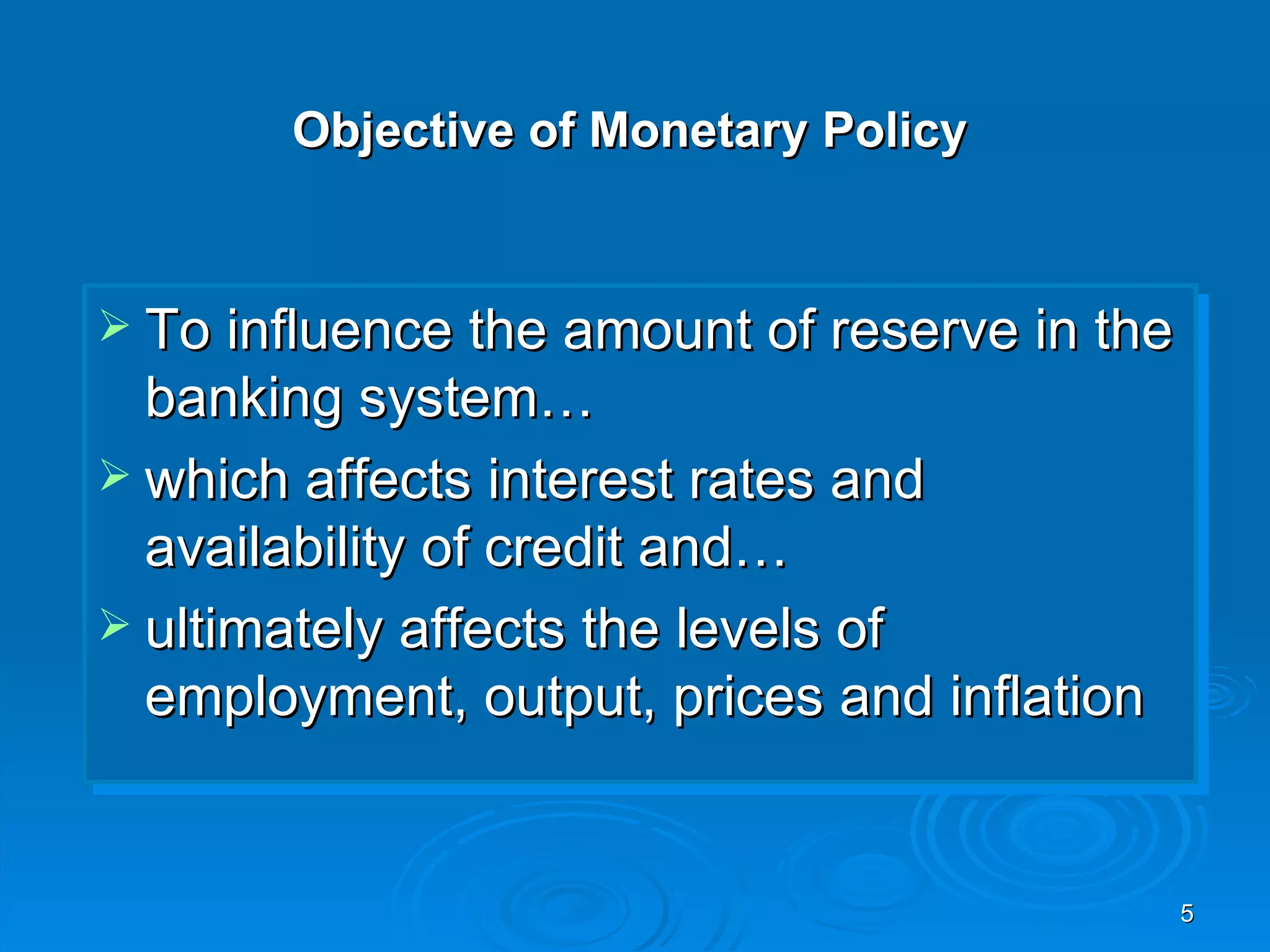
Objective of Monetary Policy


 To influence the amount of reserve in the
  banking system…
 which affects interest rates and
  availability of credit and…
 ultimately affects the levels of
  employment, output, prices and inflation


                                              5
Money Stock

 There are a number of measures of a
  nation’s money stock (M).
 The narrowest measure is the sum of
  currency in circulation and the amount of
  transactions deposits (TD) in the banking
  system.


                                              6
Money Multiplier

 Most nations require that a fraction of
  transactions deposits be held as reserves.
 The required fraction is determined by the
  reserve requirement (rr).
 This fraction determines the maximum
  change in the money stock that can result
  from a change in total reserves.


                                            7
Money Multiplier

 Under the assumption that the monetary
  base is comprised of transactions deposits
  only, the multiplier is determined by the
  reserve requirement only.
 In this case, the money multiplier (m) is
  equal to 1 divided by the reserve
  requirement,
                     m = 1/rr.

                                           8
Relating the Monetary Base and the Money Stock

 Under the assumptions above, we can
  write the money stock as the monetary
  base times the money multiplier.
           M = m•MB = m(C + TR).
 The change in the money stock is
  expressed as
           āˆ†M = m(āˆ†C + āˆ†TR).


                                            9
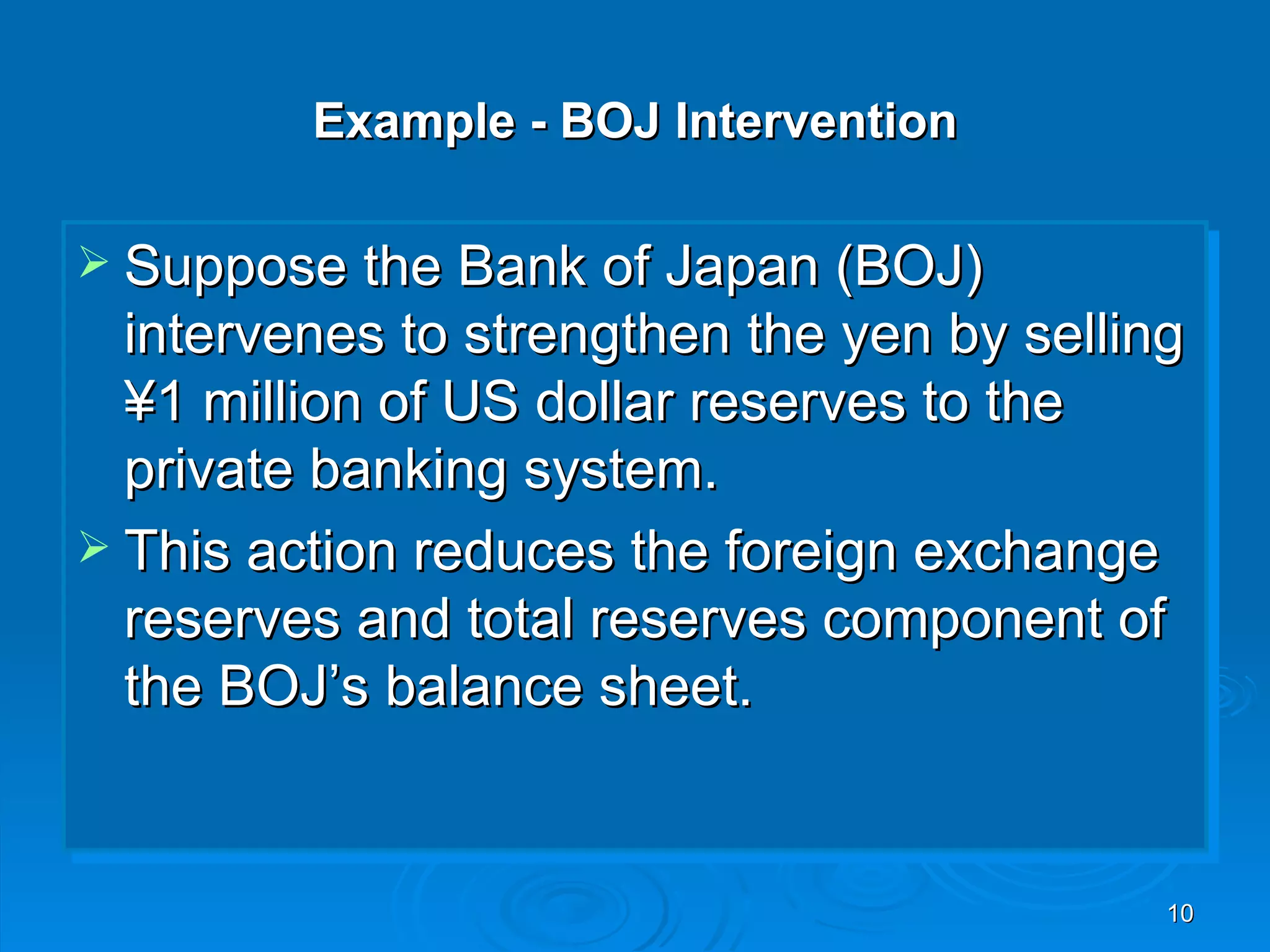
Example - BOJ Intervention

 Suppose the Bank of Japan (BOJ)
  intervenes to strengthen the yen by selling
  „1 million of US dollar reserves to the
  private banking system.
 This action reduces the foreign exchange
  reserves and total reserves component of
  the BOJ’s balance sheet.


                                            10
BOJ Balance Sheet


        Assets        Liabilities
            FER          TR
        -„1          -„1 million
        million


Result: R     „1 million, MB        „1 million


                                                 11
BOJ Intervention

 Because the monetary base declined, so
  will the money stock.
 Suppose the reserve requirement is 10
  percent. The change in the money stock
  is
           āˆ†M = m(āˆ†DC + āˆ†FER),
      āˆ†M = (1/.10)(-Ā„1 million) = -Ā„10 million.


                                              12
Monetary Policy Tools

   Open Market Operations
       primary determinate of changes in excess
        reserves in the banking system impacting the size
        of the money supply and/or interest rates
   The Discount Rate
       the rate of interest Central Bank charge on
        emergency loans to depository institutions
   Reserve Requirements
       determine the minimum amount of reserve assets that
        depository institutions must maintain by law to back
        transaction deposits held as liabilities

                                                           13
Tools of Monetary Policy

  Open Market Operations
    To change Reserves
    To offset other factors affecting Reserves


 Typically uses repos & reverse repos: Open market
  transactions to purchase gov. Securities with an
  aggrement that seller will repurchase them in a
  predetermined time period.
Advantages of Open Market Operations
    1. Central Bank has complete control

    2. Flexible and precise

    3. Easily reversed

    4. Implemented quickly

                                                      14
Open Market Operations

   Monetary Base = Currency + Reserves
 Open Market Purchase from Bank
    The Banking System                The Fed
 Assets      Liabilities      Assets    Liabilities
Securities                  Securities    Reserves
   - $100                    + $100       +$100
    Reserves
   + $100
           Result: R ↑ $100, MB ↑ $100

                                               15
Open Market Operations
             Open Market Purchase from Public
       Public                            The Fed
 Assets       Liabilities       Assets       Liabilities

Securities                      Securities    Reserves
 - $100                          + $100       +$100
Deposits
 + $100


    Banking System
Assets       Liabilities

Reserves       Deposits
+ $100        + $100        Result: R ↑ $100, MB ↑ $100

                                                           16
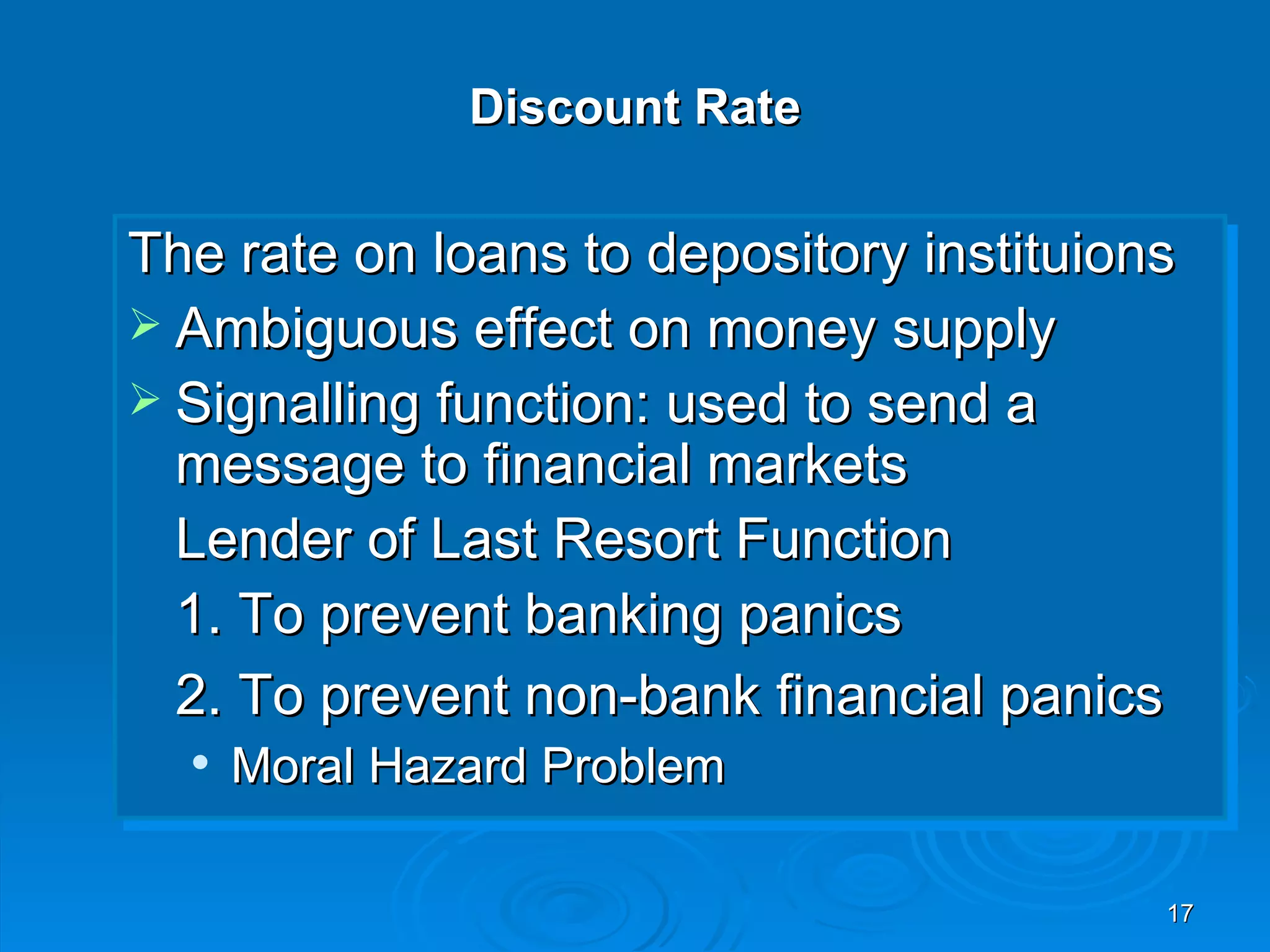
Discount Rate


The rate on loans to depository instituions
 Ambiguous effect on money supply
 Signalling function: used to send a
  message to financial markets
  Lender of Last Resort Function
  1. To prevent banking panics
  2. To prevent non-bank financial panics
     Moral Hazard Problem

                                          17
Discount Loans

     Banking System                The Fed
  Assets   Liabilities        Assets    Liabilities
Reserves      Discount         Discount     Reserves
 + $100      loan + $100      loan + $100   + $100


Result: R ↑ $100, MB ↑ $100


                                                   18
Reserve Requirements


 Advantages
    1. Powerful effect on money supply


 Disadvantages
    1. Small changes have very large effect on MS

    2. Raising reserve requirement ratio causes

     liquidity problems for banks
    3. Frequent changes cause uncertainty for

     banks


                                                 19
Goals of Monetary Policy

Goals
        1. Price Stability
        2. High Employment
        3. Economic Growth
        4. Interest Rate Stability
        5. Financial Market Stability
        6. Foreign Exchange Market Stability
   Goals often in conflict
    ā€œThe primary objective of the Bank shall be to achieve and
    maintain price stability.ā€
                       Cental Bank of the Republic of Turkey

                                                            20
A. Price Stability
      Unanticipated inflation leads to lender losses. Nominal contracts attempt to
       account for inflation.
      Effort successful if monetary policy able to maintain steady rate of inflation.
B. High Employment
      The movement of workers between jobs is referred to as frictional
       unemployment.
      All unemployment beyond frictional unemployment is classified as unintended
       unemployment. Reduction in this area is the target of macroeconomic policy.
C. Economic Growth
      Economic growth is enhanced by investment in technological advances in
       production.
      Encouragement of savings supplies funds that can be drawn upon for
       investment.
D. Interest Rate and Exchange Rate Stability
      Volatile interest and exchange rates generate costs to lenders and borrowers.
         Unexpected changes that cause damage, making policy formulation difficult.
E. Conflicts Among Goals
      Goals frequently cannot be separated from each other and often conflict.
       Costs must therefore be carefully weighed before policy implementation.

                                                                                  21
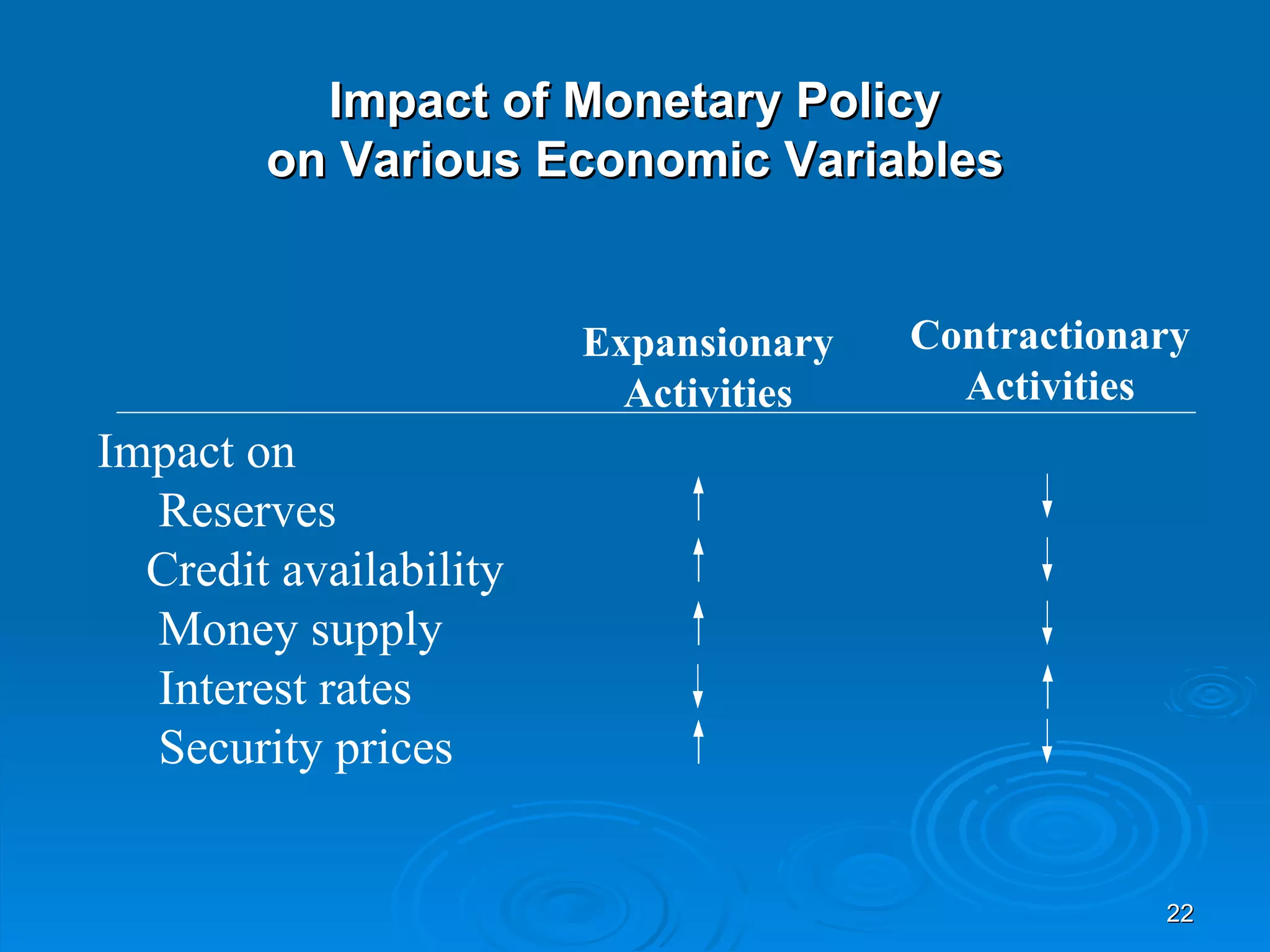
Impact of Monetary Policy
        on Various Economic Variables


                        Expansionary   Contractionary
                          Activities     Activities
Impact on
  Reserves
  Credit availability
  Money supply
  Interest rates
  Security prices


                                                   22
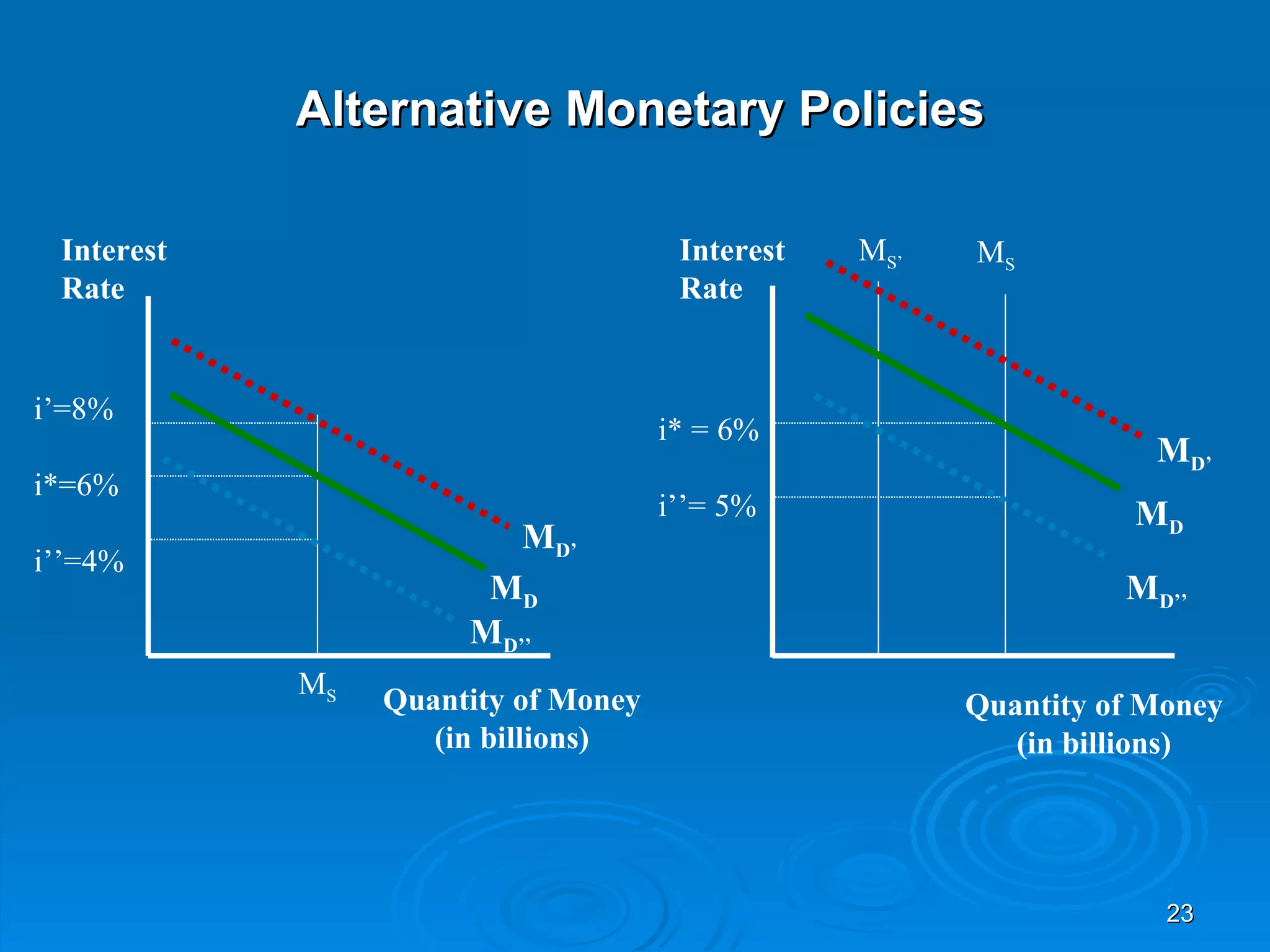
Alternative Monetary Policies

 Interest                             Interest   MS’   MS
 Rate                                 Rate


i’=8%
                                     i* = 6%
                                                                   MD’
i*=6%
                                     i’’= 5%                      MD
                         MD’
i’’=4%
                       MD                                        MD’’
                      MD’’
            MS
                 Quantity of Money                     Quantity of Money
                    (in billions)                         (in billions)


                                                                    23
International Monetary Policies
                    and Strategies


       Foreign Exchange Intervention
    1.   Controlled exchange rate regimes
         under ERBS Programs
    2.   To stabilize the unstable FX market
        similar to open market purchases and
         sales of Treasury securities

                                             24
Institutional Framework for a Credible Central
                    Bank


 Independence


 Accountability


 Transparency


                                             25

Central bank duties

  • 1.
    Major Duties andResponsibilities of Central Bank  Conducting monetary policy  Supervising and regulating depository institutions  Maintaining the stability of the financial system  Providing payment and other financial services to the government, the public, FIs and foreign official institutions 1
  • 2.
    Functions Performed bythe Central Banks  Assistance in the Conduct of Monetary Policy  Supervision and Regulation  Government Services  New Currency Issue  Check Clearing  Wire Transfer Services  Research Services 2
  • 3.
    Place of CentralBank in the Monetary System Central Bank Federal Reserve Sytem Facilitates transfer of Defines and regulates money through check Lender of last Resort money supply processing/clearing Banking System: 1. Creates money 2. Transfers money 3. Provides financial intermediation 4. Processes/clears checks First Bank Other Last Banks Bank 3
  • 4.
    Balance Sheet ofthe Federal Reserve (in billions of dollars, 2002) Assets Liabilities and Equity Gold and foreign exchange $ 25.5 Depository institution reserves $ 17.5 SDR certificates 2.2 Vault cash of commercial banks 47.3 Treasury currency 33.2 Deposits due to federal government 7.1 Federal Reserve Float 0.0 Deposits due to rest of the world 0.1 FR loans to domestic banks 0.0 Currency outside banks 596.2 Security repurchase agreements 50.3 Miscellaneous liabilities 7.8 U.S. Treasury securities 551..7 FR Bank stock 7.2 U.S. government securities 0.0 Miscellaneous assets 20.3 Total assets $683.2 Total liabilities and equity $683.2 4
  • 5.
    Objective of MonetaryPolicy  To influence the amount of reserve in the banking system…  which affects interest rates and availability of credit and…  ultimately affects the levels of employment, output, prices and inflation 5
  • 6.
    Money Stock  Thereare a number of measures of a nation’s money stock (M).  The narrowest measure is the sum of currency in circulation and the amount of transactions deposits (TD) in the banking system. 6
  • 7.
    Money Multiplier  Mostnations require that a fraction of transactions deposits be held as reserves.  The required fraction is determined by the reserve requirement (rr).  This fraction determines the maximum change in the money stock that can result from a change in total reserves. 7
  • 8.
    Money Multiplier  Underthe assumption that the monetary base is comprised of transactions deposits only, the multiplier is determined by the reserve requirement only.  In this case, the money multiplier (m) is equal to 1 divided by the reserve requirement,  m = 1/rr. 8
  • 9.
    Relating the MonetaryBase and the Money Stock  Under the assumptions above, we can write the money stock as the monetary base times the money multiplier. M = m•MB = m(C + TR).  The change in the money stock is expressed as āˆ†M = m(āˆ†C + āˆ†TR). 9
  • 10.
    Example - BOJIntervention  Suppose the Bank of Japan (BOJ) intervenes to strengthen the yen by selling Ā„1 million of US dollar reserves to the private banking system.  This action reduces the foreign exchange reserves and total reserves component of the BOJ’s balance sheet. 10
  • 11.
    BOJ Balance Sheet Assets Liabilities FER TR -„1 -„1 million million Result: R „1 million, MB „1 million 11
  • 12.
    BOJ Intervention  Becausethe monetary base declined, so will the money stock.  Suppose the reserve requirement is 10 percent. The change in the money stock is āˆ†M = m(āˆ†DC + āˆ†FER), āˆ†M = (1/.10)(-Ā„1 million) = -Ā„10 million. 12
  • 13.
    Monetary Policy Tools  Open Market Operations  primary determinate of changes in excess reserves in the banking system impacting the size of the money supply and/or interest rates  The Discount Rate  the rate of interest Central Bank charge on emergency loans to depository institutions  Reserve Requirements  determine the minimum amount of reserve assets that depository institutions must maintain by law to back transaction deposits held as liabilities 13
  • 14.
    Tools of MonetaryPolicy Open Market Operations  To change Reserves  To offset other factors affecting Reserves  Typically uses repos & reverse repos: Open market transactions to purchase gov. Securities with an aggrement that seller will repurchase them in a predetermined time period. Advantages of Open Market Operations  1. Central Bank has complete control  2. Flexible and precise  3. Easily reversed  4. Implemented quickly 14
  • 15.
    Open Market Operations  Monetary Base = Currency + Reserves  Open Market Purchase from Bank The Banking System The Fed Assets Liabilities Assets Liabilities Securities Securities Reserves - $100 + $100 +$100 Reserves + $100 Result: R ↑ $100, MB ↑ $100 15
  • 16.
    Open Market Operations Open Market Purchase from Public Public The Fed Assets Liabilities Assets Liabilities Securities Securities Reserves - $100 + $100 +$100 Deposits + $100 Banking System Assets Liabilities Reserves Deposits + $100 + $100 Result: R ↑ $100, MB ↑ $100 16
  • 17.
    Discount Rate The rateon loans to depository instituions  Ambiguous effect on money supply  Signalling function: used to send a message to financial markets Lender of Last Resort Function 1. To prevent banking panics 2. To prevent non-bank financial panics  Moral Hazard Problem 17
  • 18.
    Discount Loans Banking System The Fed Assets Liabilities Assets Liabilities Reserves Discount Discount Reserves + $100 loan + $100 loan + $100 + $100 Result: R ↑ $100, MB ↑ $100 18
  • 19.
    Reserve Requirements  Advantages  1. Powerful effect on money supply  Disadvantages  1. Small changes have very large effect on MS  2. Raising reserve requirement ratio causes liquidity problems for banks  3. Frequent changes cause uncertainty for banks 19
  • 20.
    Goals of MonetaryPolicy Goals 1. Price Stability 2. High Employment 3. Economic Growth 4. Interest Rate Stability 5. Financial Market Stability 6. Foreign Exchange Market Stability  Goals often in conflict ā€œThe primary objective of the Bank shall be to achieve and maintain price stability.ā€ Cental Bank of the Republic of Turkey 20
  • 21.
    A. Price Stability  Unanticipated inflation leads to lender losses. Nominal contracts attempt to account for inflation.  Effort successful if monetary policy able to maintain steady rate of inflation. B. High Employment  The movement of workers between jobs is referred to as frictional unemployment.  All unemployment beyond frictional unemployment is classified as unintended unemployment. Reduction in this area is the target of macroeconomic policy. C. Economic Growth  Economic growth is enhanced by investment in technological advances in production.  Encouragement of savings supplies funds that can be drawn upon for investment. D. Interest Rate and Exchange Rate Stability  Volatile interest and exchange rates generate costs to lenders and borrowers. Unexpected changes that cause damage, making policy formulation difficult. E. Conflicts Among Goals  Goals frequently cannot be separated from each other and often conflict. Costs must therefore be carefully weighed before policy implementation. 21
  • 22.
    Impact of MonetaryPolicy on Various Economic Variables Expansionary Contractionary Activities Activities Impact on Reserves Credit availability Money supply Interest rates Security prices 22
  • 23.
    Alternative Monetary Policies Interest Interest MS’ MS Rate Rate i’=8% i* = 6% MD’ i*=6% i’’= 5% MD MD’ i’’=4% MD MD’’ MD’’ MS Quantity of Money Quantity of Money (in billions) (in billions) 23
  • 24.
    International Monetary Policies and Strategies  Foreign Exchange Intervention 1. Controlled exchange rate regimes under ERBS Programs 2. To stabilize the unstable FX market  similar to open market purchases and sales of Treasury securities 24
  • 25.
    Institutional Framework fora Credible Central Bank  Independence  Accountability  Transparency 25