
MONEY AND
MONETARY POLICIES
A. Function of Money & Money
             Supply

Money as a medium of exchange
began to assume a significant role
in the advent of the market
economy       marked    by     1-3
specialization, interdependence
and trade.
Money Supply
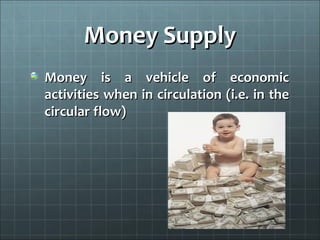
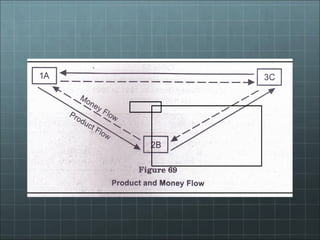
Money is a vehicle of economic
activities when in circulation (i.e. in the
circular flow)
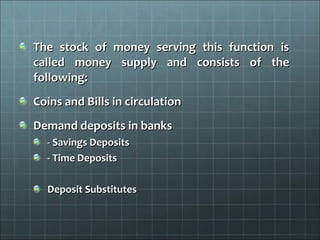
The stock of money serving this function is
called money supply and consists of the
following:
Coins and Bills in circulation
Demand deposits in banks
  - Savings Deposits
  - Time Deposits

  Deposit Substitutes
Dependencies and
   Resources
Money Velocity &
      Income
4. Money Supply as medium of exchange
multiplies into income. The multiplier
coefficient is only dependent on the rate of
money outflow.
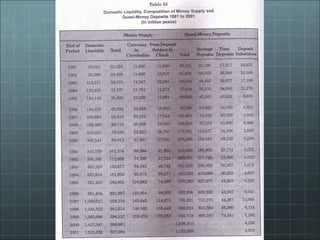
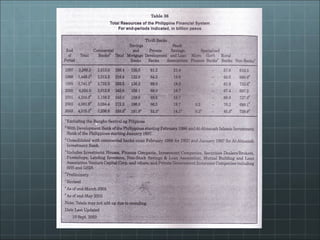
Table 33 represents the country’s domestic
liquidity from 1981 to 2001. The economic crisis
in 1997 was marked by declining levels of
production and increasing rates of inflation
(price increase) and unemployment.
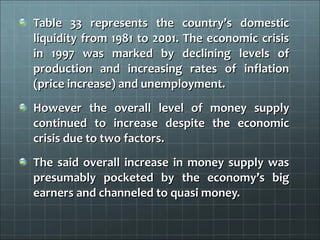
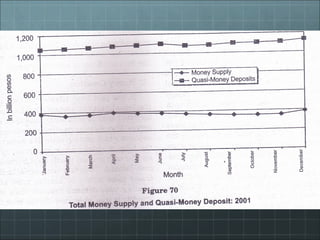
However the overall level of money supply
continued to increase despite the economic
crisis due to two factors.
The said overall increase in money supply was
presumably pocketed by the economy’s big
earners and channeled to quasi money.
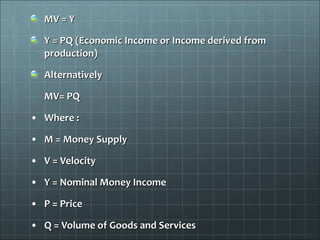
MV = Y

  Y = PQ (Economic Income or Income derived from
  production)

  Alternatively

  MV= PQ

• Where :

• M = Money Supply

• V = Velocity

• Y = Nominal Money Income

• P = Price

• Q = Volume of Goods and Services
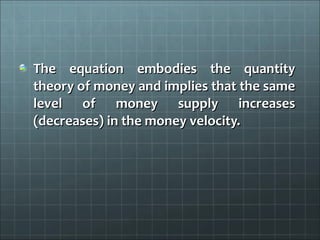
The equation embodies the quantity
theory of money and implies that the same
level of money supply increases
(decreases) in the money velocity.
B. BANKS AND
MONEY SUPPLY
The Fractional Reserve System
 5. Banks are supposed to be a conduits
 of funds linking investors or borrowers
 to the sources. As such, they accept
 deposits which chiefly supply their
 lending operations.
However, commercial banks in particular
can create deposit liabilities (i.e. to
depositors and borrowers) greater than
their reserves or money in vault which is
the essence of the fractional reserve
system.
Thus, a commercial bank can lend more
than its actual deposit by creating more
deposit liabilities while maintaining a
smaller reserve to meet fractional cash
demand.
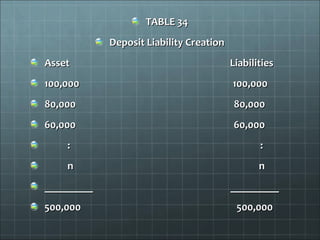
TABLE 34
            Deposit Liability Creation
Asset                                    Liabilities
100,000                                  100,000
80,000                                   80,000
60,000                                   60,000
    :                                           :
    n                                           n
_________                                _________
500,000                                   500,000
Money Creation
It has just been illustrated that the fractional
reserve system enables commercial banks to
lend more than their reserves. They do so by
creating more demand deposits which can
circulate like money in the form of checks
while supported by a smaller cash amount to
only meet fractional cash demand.
Therefore, 6. commercial banks create more
money by lending more and creating more
demand deposits while the opposite is true
when they tighten credit.
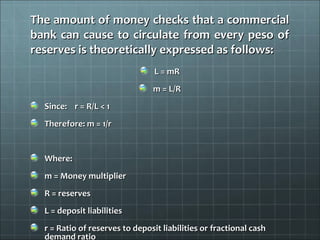
The amount of money checks that a commercial
bank can cause to circulate from every peso of
reserves is theoretically expressed as follows:
                                 L = mR
                                m = L/R
  Since: r = R/L < 1
  Therefore: m = 1/r


  Where:
  m = Money multiplier
  R = reserves
  L = deposit liabilities
  r = Ratio of reserves to deposit liabilities or fractional cash
  demand ratio
C . SOURCES OF MONEY
        SUPPLY
The 7. lending operation of the
banking systems determines the
volume of money checks it creates.
Thus , lending more/less within the
limits of the fractional cash
requirements of the deposits
increases/decreases money checks
and the level of money supply.
The government print new money at times ,
to help finance its expanding operations. This
increases currency in circulation and the
money checks that banks create from
currency deposits.


8. Money supply tend to increases with
foreign currency inflows while the opposite is
true with foreign currency outflows. However
, it is the net effect of foreign currency
inflows and outflows that changes the level of
money supply.
9. Taxes also changed the level
of money supply as leakages from
the circular flow. Taxes are
foregone consumption and savings
which could otherwise be part of
currency in circulation and reserves
which enables banks to create
money checks.
The unspent portion of the budget
surplus (unspent tax revenue) only
decreases money supply when kept in
the National Treasury and not in the
banking system where it can be
channeled back to circulation. On the
other hand , government borrows from
the banking system to finance deficit
spending.
D. MONEY AND THE
 CENTRAL BANK
It is the reponsibility of Bangko
Sentral     ng     Pilipinas   to
administer     the      monetary,
banking, and credit system of
the republic as embodied in
Section 2 , Articles of the
amended Republic Act 2656.
The Objectives are as follows:


  To maintain internal and external
  monetary stability in the Philippines; and
  to preserve the international value of the
  peso and its convertibility to other freely
  convertible currencies.

  To foster monetary , credit , and exchange
  conditions conducive to a balanced and
  sustainable growth of the economy.
The Confidence in Money
The 10. Central Bank is the only
authorized government entity to print
money and is responsible for the proper
administration of the monetary        ,
banking , and credit system of the
republic to achieve monetary stability
and create conditions conducive to
economic development.
MONETARY

POLICIES
1) Some policy concept
The central bank used monetary policy to
regulate money through the credit and
banking system in order to attain monetary
stability conducive to economic development.
2) short-run Tools
Affecting Money Supply
  A. RESERVE REQUIREMENTS
  It has been explained in section B.2 of this
  chapter that their actual deposits (reserves)
  and create money by creating more deposit
  liabilities.
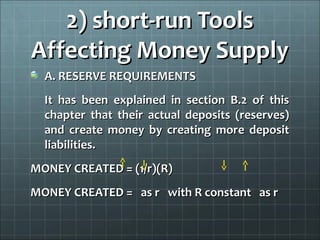
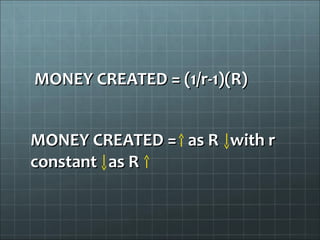
MONEY CREATED = (1/r)(R)
MONEY CREATED = as r with R constant as r
B. Rediscounting
      The central bank can infuse money into
the coffers (reserves) of the banking system by
buying its loan papers (i.e. loan receivables) at
rediscounted values.
      The central bank can raise the level of
reserves and credit money by widening its
rediscounting windows and buying more loan
papers at lower and more encouraging
rediscounting rate .
MONEY CREATED = (1/r-1)(R)


MONEY CREATED = as R with r
constant as R
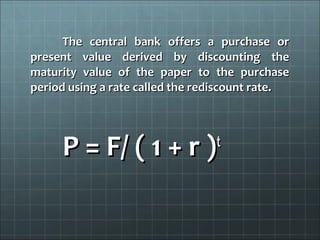
The central bank offers a purchase or
present value derived by discounting the
maturity value of the paper to the purchase
period using a rate called the rediscount rate.


     P = F/ ( 1 + r )            t
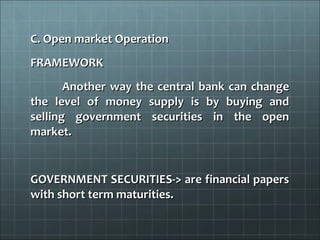
C. Open market Operation
FRAMEWORK
       Another way the central bank can change
the level of money supply is by buying and
selling government securities in the open
market.


GOVERNMENT SECURITIES-> are financial papers
with short term maturities.
COMPARATIVE ADVANTAGE
Central bank has more control over bank
reserves with this instrument. To decrease
money supply , it simply offers more treasury
bills at higher interest to draw a momentum
that it can control within the volume it aims
to transact.
EFFECTIVENESS IN
 TRIMMING LIQUIDITY
The central bank floated more treasury
bills with a weighted average interest rate
of 35% relatively attractive to the
prevailing rate of 20%-28% for short term
loans and placements.
D. Selective control
     The effective range of an instrument
may not necessarily lead to it’s target and
even if it does , may spill over to factors
which are not its concern and thud create
new problems.
E. The need for policy Coordination
It is not enough that an instrument be
confined to its target to create positive
effects. For one, applying the instrument
alone may be inadequate to solve the
problem.

Chap. 10. monetary policy

  • 1.
  • 2.
    A. Function ofMoney & Money Supply Money as a medium of exchange began to assume a significant role in the advent of the market economy marked by 1-3 specialization, interdependence and trade.
  • 4.
    Money Supply Money isa vehicle of economic activities when in circulation (i.e. in the circular flow)
  • 6.
    The stock ofmoney serving this function is called money supply and consists of the following: Coins and Bills in circulation Demand deposits in banks - Savings Deposits - Time Deposits Deposit Substitutes
  • 7.
  • 8.
    Money Velocity & Income 4. Money Supply as medium of exchange multiplies into income. The multiplier coefficient is only dependent on the rate of money outflow.
  • 10.
    Table 33 representsthe country’s domestic liquidity from 1981 to 2001. The economic crisis in 1997 was marked by declining levels of production and increasing rates of inflation (price increase) and unemployment. However the overall level of money supply continued to increase despite the economic crisis due to two factors. The said overall increase in money supply was presumably pocketed by the economy’s big earners and channeled to quasi money.
  • 12.
    MV = Y Y = PQ (Economic Income or Income derived from production) Alternatively MV= PQ • Where : • M = Money Supply • V = Velocity • Y = Nominal Money Income • P = Price • Q = Volume of Goods and Services
  • 13.
    The equation embodiesthe quantity theory of money and implies that the same level of money supply increases (decreases) in the money velocity.
  • 14.
  • 15.
    The Fractional ReserveSystem 5. Banks are supposed to be a conduits of funds linking investors or borrowers to the sources. As such, they accept deposits which chiefly supply their lending operations.
  • 16.
    However, commercial banksin particular can create deposit liabilities (i.e. to depositors and borrowers) greater than their reserves or money in vault which is the essence of the fractional reserve system. Thus, a commercial bank can lend more than its actual deposit by creating more deposit liabilities while maintaining a smaller reserve to meet fractional cash demand.
  • 17.
    TABLE 34 Deposit Liability Creation Asset Liabilities 100,000 100,000 80,000 80,000 60,000 60,000 : : n n _________ _________ 500,000 500,000
  • 18.
    Money Creation It hasjust been illustrated that the fractional reserve system enables commercial banks to lend more than their reserves. They do so by creating more demand deposits which can circulate like money in the form of checks while supported by a smaller cash amount to only meet fractional cash demand. Therefore, 6. commercial banks create more money by lending more and creating more demand deposits while the opposite is true when they tighten credit.
  • 19.
    The amount ofmoney checks that a commercial bank can cause to circulate from every peso of reserves is theoretically expressed as follows: L = mR m = L/R Since: r = R/L < 1 Therefore: m = 1/r Where: m = Money multiplier R = reserves L = deposit liabilities r = Ratio of reserves to deposit liabilities or fractional cash demand ratio
  • 20.
    C . SOURCESOF MONEY SUPPLY
  • 21.
    The 7. lendingoperation of the banking systems determines the volume of money checks it creates. Thus , lending more/less within the limits of the fractional cash requirements of the deposits increases/decreases money checks and the level of money supply.
  • 22.
    The government printnew money at times , to help finance its expanding operations. This increases currency in circulation and the money checks that banks create from currency deposits. 8. Money supply tend to increases with foreign currency inflows while the opposite is true with foreign currency outflows. However , it is the net effect of foreign currency inflows and outflows that changes the level of money supply.
  • 23.
    9. Taxes alsochanged the level of money supply as leakages from the circular flow. Taxes are foregone consumption and savings which could otherwise be part of currency in circulation and reserves which enables banks to create money checks.
  • 24.
    The unspent portionof the budget surplus (unspent tax revenue) only decreases money supply when kept in the National Treasury and not in the banking system where it can be channeled back to circulation. On the other hand , government borrows from the banking system to finance deficit spending.
  • 25.
    D. MONEY ANDTHE CENTRAL BANK
  • 26.
    It is thereponsibility of Bangko Sentral ng Pilipinas to administer the monetary, banking, and credit system of the republic as embodied in Section 2 , Articles of the amended Republic Act 2656.
  • 27.
    The Objectives areas follows: To maintain internal and external monetary stability in the Philippines; and to preserve the international value of the peso and its convertibility to other freely convertible currencies. To foster monetary , credit , and exchange conditions conducive to a balanced and sustainable growth of the economy.
  • 28.
    The Confidence inMoney The 10. Central Bank is the only authorized government entity to print money and is responsible for the proper administration of the monetary , banking , and credit system of the republic to achieve monetary stability and create conditions conducive to economic development.
  • 29.
  • 30.
    1) Some policyconcept The central bank used monetary policy to regulate money through the credit and banking system in order to attain monetary stability conducive to economic development.
  • 31.
    2) short-run Tools AffectingMoney Supply A. RESERVE REQUIREMENTS It has been explained in section B.2 of this chapter that their actual deposits (reserves) and create money by creating more deposit liabilities. MONEY CREATED = (1/r)(R) MONEY CREATED = as r with R constant as r
  • 32.
    B. Rediscounting The central bank can infuse money into the coffers (reserves) of the banking system by buying its loan papers (i.e. loan receivables) at rediscounted values. The central bank can raise the level of reserves and credit money by widening its rediscounting windows and buying more loan papers at lower and more encouraging rediscounting rate .
  • 34.
    MONEY CREATED =(1/r-1)(R) MONEY CREATED = as R with r constant as R
  • 35.
    The central bankoffers a purchase or present value derived by discounting the maturity value of the paper to the purchase period using a rate called the rediscount rate. P = F/ ( 1 + r ) t
  • 36.
    C. Open marketOperation FRAMEWORK Another way the central bank can change the level of money supply is by buying and selling government securities in the open market. GOVERNMENT SECURITIES-> are financial papers with short term maturities.
  • 38.
    COMPARATIVE ADVANTAGE Central bankhas more control over bank reserves with this instrument. To decrease money supply , it simply offers more treasury bills at higher interest to draw a momentum that it can control within the volume it aims to transact.
  • 39.
    EFFECTIVENESS IN TRIMMINGLIQUIDITY The central bank floated more treasury bills with a weighted average interest rate of 35% relatively attractive to the prevailing rate of 20%-28% for short term loans and placements.
  • 40.
    D. Selective control The effective range of an instrument may not necessarily lead to it’s target and even if it does , may spill over to factors which are not its concern and thud create new problems.
  • 41.
    E. The needfor policy Coordination It is not enough that an instrument be confined to its target to create positive effects. For one, applying the instrument alone may be inadequate to solve the problem.

Editor's Notes

  • #2 This template can be used as a starter file to give updates for project milestones. Sections Sections can help to organize your slides or facilitate collaboration between multiple authors. On the Home tab, under Slides , click Section , and then click Add Section . Notes Use the Notes pane for delivery notes or to provide additional details for the audience. You can see these notes in Presenter View during your presentation. Keep in mind the font size (important for accessibility, visibility, videotaping, and online production) Coordinated colors Pay particular attention to the graphs, charts, and text boxes. Consider that attendees will print in black and white or grayscale. Run a test print to make sure your colors work when printed in pure black and white and grayscale. Graphics, tables, and graphs Keep it simple: If possible, use consistent, non-distracting styles and colors. Label all graphs and tables.
  • #4 * If any of these issues caused a schedule delay or need to be discussed further, include details in next slide.
  • #8 What are the dependencies that affect the timeline, cost, and output of this project?