Early Christian
  Education

   Prepared by:
   Brien L. Naco


                   1
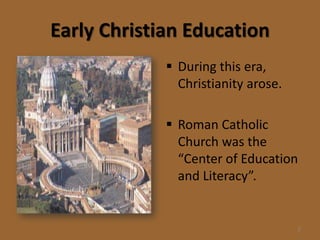
Early Christian Education
              During this era,
               Christianity arose.

              Roman Catholic
               Church was the
               “Center of Education
               and Literacy”.


                                     2
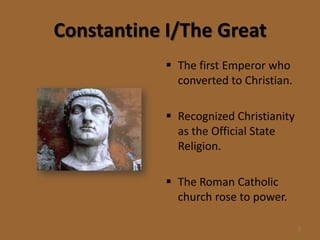
Constantine I/The Great
             The first Emperor who
              converted to Christian.

             Recognized Christianity
              as the Official State
              Religion.

             The Roman Catholic
              church rose to power.

                                        3
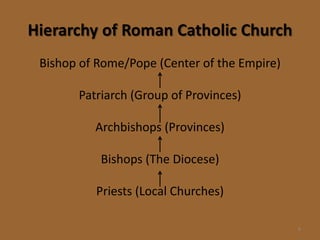
Hierarchy of Roman Catholic Church
 Bishop of Rome/Pope (Center of the Empire)

       Patriarch (Group of Provinces)

          Archbishops (Provinces)

           Bishops (The Diocese)

          Priests (Local Churches)

                                              4
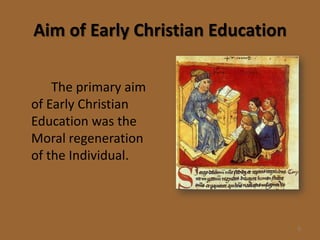
Aim of Early Christian Education

    The primary aim
of Early Christian
Education was the
Moral regeneration
of the Individual.


                                   5
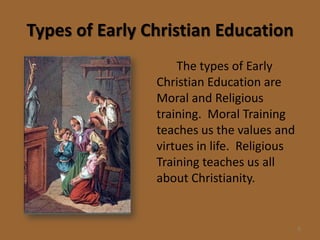
Types of Early Christian Education
                    The types of Early
                Christian Education are
                Moral and Religious
                training. Moral Training
                teaches us the values and
                virtues in life. Religious
                Training teaches us all
                about Christianity.


                                             6
Contents of Early Christian Education


    Basic elements of the
Church Doctrine, Church
Rituals and Moral virtues
of Christ are the contents
of Early Christian
Education.


                                        7
Agencies and Organization
    Christian Homes was second only to the church
as the agency of Early Christian Education.
    1. CATECHUMENAL SCHOOLS were organized for
the instruction of those who desired to become
members of the church but lacked the requisite
knowledge of church doctrine.
    CATECHUMENS are the probationers who receive
the instruction in religious discipline, moral values
and doctrine.

                                                    8
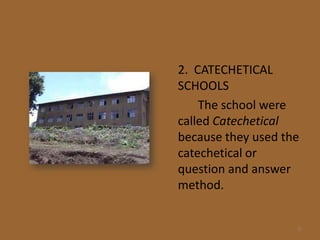
2. CATECHETICAL
SCHOOLS
    The school were
called Catechetical
because they used the
catechetical or
question and answer
method.


                    9
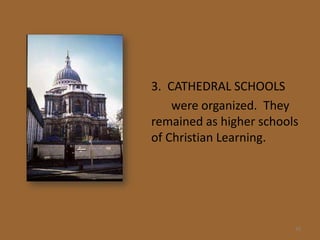
3. CATHEDRAL SCHOOLS
    were organized. They
remained as higher schools
of Christian Learning.


                         10
Methods Used

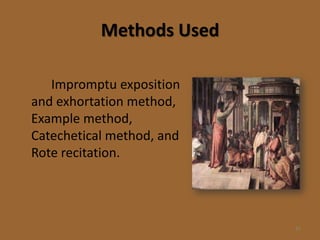
   Impromptu exposition
and exhortation method,
Example method,
Catechetical method, and
Rote recitation.


                           11

Educ. system

  • 1.
    Early Christian Education Prepared by: Brien L. Naco 1
  • 2.
    Early Christian Education  During this era, Christianity arose.  Roman Catholic Church was the “Center of Education and Literacy”. 2
  • 3.
    Constantine I/The Great  The first Emperor who converted to Christian.  Recognized Christianity as the Official State Religion.  The Roman Catholic church rose to power. 3
  • 4.
    Hierarchy of RomanCatholic Church Bishop of Rome/Pope (Center of the Empire) Patriarch (Group of Provinces) Archbishops (Provinces) Bishops (The Diocese) Priests (Local Churches) 4
  • 5.
    Aim of EarlyChristian Education The primary aim of Early Christian Education was the Moral regeneration of the Individual. 5
  • 6.
    Types of EarlyChristian Education The types of Early Christian Education are Moral and Religious training. Moral Training teaches us the values and virtues in life. Religious Training teaches us all about Christianity. 6
  • 7.
    Contents of EarlyChristian Education Basic elements of the Church Doctrine, Church Rituals and Moral virtues of Christ are the contents of Early Christian Education. 7
  • 8.
    Agencies and Organization Christian Homes was second only to the church as the agency of Early Christian Education. 1. CATECHUMENAL SCHOOLS were organized for the instruction of those who desired to become members of the church but lacked the requisite knowledge of church doctrine. CATECHUMENS are the probationers who receive the instruction in religious discipline, moral values and doctrine. 8
  • 9.
    2. CATECHETICAL SCHOOLS The school were called Catechetical because they used the catechetical or question and answer method. 9
  • 10.
    3. CATHEDRAL SCHOOLS were organized. They remained as higher schools of Christian Learning. 10
  • 11.
    Methods Used Impromptu exposition and exhortation method, Example method, Catechetical method, and Rote recitation. 11