BONUM MANE,
OMNIS!
EDUCATION OF
MEDIEVAL PERIOD
HISTORY
● The fall of Rome in 476 A.D.is
considered as the end of ancient
times and start of medieval
history
● Education was completely religions
● Only wealthy people could study
● Only upper class women could study
but according to a limited course
THREE MAIN TYPES OF SCHOOL
Song Schools
Monastic Schools
Grammar School
Song Schools
Boys were taught sing
religious song and
sometimes reading and
writing
Monastic Schools
Boys were connect
their lives into
religion.
Grammar School
Established in the
territory of church or
cathedral were taught
boys basic subject
Most important subjects
 Latin language
 Grammar
 Rhetoric
 Logic
 Basic Math & Science
 Arthrology & Philosophy
Grammar School
Monasticism
Scholasticism
Chivalry
Guild System of
Education
Educational System
Monasticism
A special form of religious
community life
based on Jesus passage “be
perfect, therefore as your
heavenly Father is perfect”
Matthew 5:48
Greek word “monos” meaning alone
Notable people
St. Patrick
–founded
the First
Monasticism
in Ireland
between AD
432-461
St. Anthony
founder of
Christian
Monasticism
Father of
Monasticism
Monasticism
Monk and Nuns
Monasticism
Aims
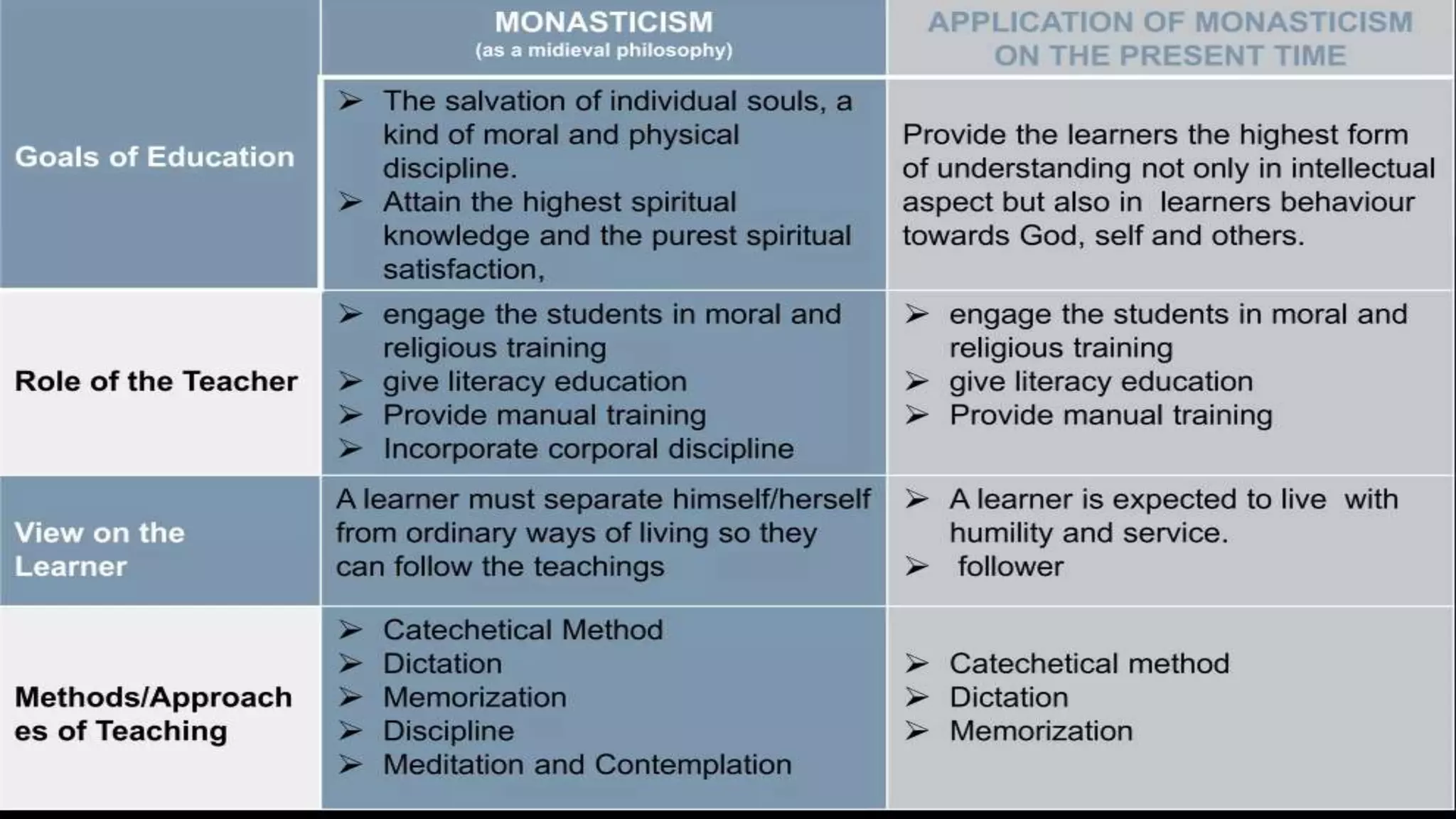
Spiritual
Moral
Spiritual Knowledge
Virtue
Monasticism
Agencies of Education
MONASTERIES and MONASTIC
SCHOOLS were the only
agencies for education
aside from the Parish and
Cathedral Schools
Contents Studied
The Seven Liberal Art was THE
CURRICULUM
A. The Trivium ( three roads)
Grammar - language and literature
Dialectic-logic or reasoning
Rhetoric-law and composition
B. The Quadrivium-(four roads)
Geometry- geometry, geography, natural
history
Arithmetic- numbers & the study of the
calendar
Music-plain chant & harmony used in church
Astronomy– the heavenly bodies, chemistry
& physics
Contents Studied
1. The Domestic Homes
- the strictest hermit lived alone,
in huts so placed that their inmates could
not see nor hear one another.
2. The Economics Structure
- by the vows of poverty, monks
promised not to possess anything as his
own or make use of it without the
permission from his superior.
Aspects of Social
Organizations
3. The Political State
- monks lived the same type
of life; they did not constitute a
formal community and commit
themselves to obey their superior.
Aspects of Social
Organizations
Type of Education
Moral and Religious
Training- monks engaged
themselves in religious
contemplation, meditation
ascetism, and religious
and writing
Type of Education
 Literary Education
- copying manuscripts with
other monasteries, collecting
writing original manuscripts
concerning religion historical
events and other matters
Type of Education
 Manual Training
- monks are skilled artisans
in wood, leather and metal and
skilled agriculturist
Methods of Instruction
 Catechetical method- the question
and answer method was generally used
as the tool of teaching
 Dictation-heavily used due to
scarcity of books
 Memorization-the pupils had to
memorize what was dictated to them
Methods of Instruction
 Language- Latin was the
only language for learning
 Discipline- teachers used
the rod to punish erring
pupils
Methods of Instruction
 Meditation &
Contemplation/thoughtful
reflection
- the monks believed that
the deepest spiritual experience
could be gained only through
divine inspiration
Greatest Contributions to Education
1.Preserving and spreading
learning and culture by
Christians Monasteries
2.Opposing Vices and
Corruption
3.Taming Warlike Spirits
4.Giving Dignity on Labor
SCHOLASTICISM
Scholasticism
 was a general designation for
particular methods and tendencies
to rationalize the doctrines of
Christian Church
 The term “scholastic” is derived
from the Latin word”
scholasticus” and the Greek “
scholastikos” (meaning literally
“devoting one’s leisure to
learning”)
What is Scholasticism?
 Aristotle had used logic to try
prove the existence of God.
 The revised beliefs and logical
methods of discussion were termed
Scholasticism
St. Anselm of Canterbury
 Father of Scholasticism
 Most Outstanding Philosopher
 Ontogical Argument in the
existence of God
Aims of Education
 Intellectual Discipline
- By Rational Argument
 Faith by Reason
- By Faith
AGENCIES OF EDUCATION
 Parish School-children
with special talents
 Monastic and Cathedral
Schools- men who became
leaders of the church as
well as the state
AGENCIES OF EDUCATION
 Palace School- established
by Charlemagne for scions of
nobility to train
intelligent leaders
 University- started as an
association of teachers
chartered by the Pope of
Holy Roman Emperor
Methods of Education
1.Argumentative Method
a. Starting a Proposition, Thesis
or Questions
b. Setting dorm objectives to
proposition
c. Proving one side, and
d. Answering or disputing
objections in order
Methods of Education
2. Lecture, Repetition,
Disputation, and Examination
Methods- were also conducted
according to recognized
principles and formalities. In
disputation, students were
opposed against one another
Methods of Education
3. Aristotelian Logic
Three Elements of Syllogism
1. A major premise or larger
class (term)
2. A minor premise, or
smaller or middle term
3. A conclusion or specific
case
Law of Syllogism
Major Premises: All women are
sensitive(all
inclusive)
Minor Premises: Evita is a
women(Predicate is
subject of the
major premises)
Conclusion: Therefore, Evita
is sensitive.(Subject
is the subject of the
minor premise and the
predicate is the
predicate of the major
Law of Syllogism
Major Premises: All women are
sensitive(all
inclusive)
Minor Premises: Evita is a
women(Predicate is
subject of the
major premises)
Conclusion: Therefore, Evita
is sensitive.(Subject
is the subject of the
minor premise and the
predicate is the
predicate of the major
Methods of Education
4. Problem Method
- aimed at
formulating a conclusion in
some topics after many
possible answer were
evaluated
Greatest Contributions
to Education
Organization of
University
Emphasis on the
Intellectual Training
Thank you

MedievalPeriod.pptx

  • 1.
  • 2.
  • 3.
    HISTORY ● The fallof Rome in 476 A.D.is considered as the end of ancient times and start of medieval history ● Education was completely religions ● Only wealthy people could study ● Only upper class women could study but according to a limited course
  • 4.
    THREE MAIN TYPESOF SCHOOL Song Schools Monastic Schools Grammar School
  • 5.
    Song Schools Boys weretaught sing religious song and sometimes reading and writing
  • 6.
    Monastic Schools Boys wereconnect their lives into religion.
  • 7.
    Grammar School Established inthe territory of church or cathedral were taught boys basic subject
  • 8.
    Most important subjects Latin language  Grammar  Rhetoric  Logic  Basic Math & Science  Arthrology & Philosophy Grammar School
  • 9.
  • 10.
    Monasticism A special formof religious community life based on Jesus passage “be perfect, therefore as your heavenly Father is perfect” Matthew 5:48 Greek word “monos” meaning alone
  • 11.
    Notable people St. Patrick –founded theFirst Monasticism in Ireland between AD 432-461 St. Anthony founder of Christian Monasticism Father of Monasticism Monasticism
  • 12.
  • 13.
  • 14.
    Agencies of Education MONASTERIESand MONASTIC SCHOOLS were the only agencies for education aside from the Parish and Cathedral Schools
  • 15.
    Contents Studied The SevenLiberal Art was THE CURRICULUM A. The Trivium ( three roads) Grammar - language and literature Dialectic-logic or reasoning Rhetoric-law and composition
  • 16.
    B. The Quadrivium-(fourroads) Geometry- geometry, geography, natural history Arithmetic- numbers & the study of the calendar Music-plain chant & harmony used in church Astronomy– the heavenly bodies, chemistry & physics Contents Studied
  • 17.
    1. The DomesticHomes - the strictest hermit lived alone, in huts so placed that their inmates could not see nor hear one another. 2. The Economics Structure - by the vows of poverty, monks promised not to possess anything as his own or make use of it without the permission from his superior. Aspects of Social Organizations
  • 18.
    3. The PoliticalState - monks lived the same type of life; they did not constitute a formal community and commit themselves to obey their superior. Aspects of Social Organizations
  • 19.
    Type of Education Moraland Religious Training- monks engaged themselves in religious contemplation, meditation ascetism, and religious and writing
  • 20.
    Type of Education Literary Education - copying manuscripts with other monasteries, collecting writing original manuscripts concerning religion historical events and other matters
  • 21.
    Type of Education Manual Training - monks are skilled artisans in wood, leather and metal and skilled agriculturist
  • 22.
    Methods of Instruction Catechetical method- the question and answer method was generally used as the tool of teaching  Dictation-heavily used due to scarcity of books  Memorization-the pupils had to memorize what was dictated to them
  • 23.
    Methods of Instruction Language- Latin was the only language for learning  Discipline- teachers used the rod to punish erring pupils
  • 24.
    Methods of Instruction Meditation & Contemplation/thoughtful reflection - the monks believed that the deepest spiritual experience could be gained only through divine inspiration
  • 25.
    Greatest Contributions toEducation 1.Preserving and spreading learning and culture by Christians Monasteries 2.Opposing Vices and Corruption 3.Taming Warlike Spirits 4.Giving Dignity on Labor
  • 27.
  • 28.
    Scholasticism  was ageneral designation for particular methods and tendencies to rationalize the doctrines of Christian Church  The term “scholastic” is derived from the Latin word” scholasticus” and the Greek “ scholastikos” (meaning literally “devoting one’s leisure to learning”)
  • 29.
    What is Scholasticism? Aristotle had used logic to try prove the existence of God.  The revised beliefs and logical methods of discussion were termed Scholasticism
  • 30.
    St. Anselm ofCanterbury  Father of Scholasticism  Most Outstanding Philosopher  Ontogical Argument in the existence of God
  • 31.
    Aims of Education Intellectual Discipline - By Rational Argument  Faith by Reason - By Faith
  • 32.
    AGENCIES OF EDUCATION Parish School-children with special talents  Monastic and Cathedral Schools- men who became leaders of the church as well as the state
  • 33.
    AGENCIES OF EDUCATION Palace School- established by Charlemagne for scions of nobility to train intelligent leaders  University- started as an association of teachers chartered by the Pope of Holy Roman Emperor
  • 34.
    Methods of Education 1.ArgumentativeMethod a. Starting a Proposition, Thesis or Questions b. Setting dorm objectives to proposition c. Proving one side, and d. Answering or disputing objections in order
  • 35.
    Methods of Education 2.Lecture, Repetition, Disputation, and Examination Methods- were also conducted according to recognized principles and formalities. In disputation, students were opposed against one another
  • 36.
    Methods of Education 3.Aristotelian Logic Three Elements of Syllogism 1. A major premise or larger class (term) 2. A minor premise, or smaller or middle term 3. A conclusion or specific case
  • 37.
    Law of Syllogism MajorPremises: All women are sensitive(all inclusive) Minor Premises: Evita is a women(Predicate is subject of the major premises) Conclusion: Therefore, Evita is sensitive.(Subject is the subject of the minor premise and the predicate is the predicate of the major
  • 38.
    Law of Syllogism MajorPremises: All women are sensitive(all inclusive) Minor Premises: Evita is a women(Predicate is subject of the major premises) Conclusion: Therefore, Evita is sensitive.(Subject is the subject of the minor premise and the predicate is the predicate of the major
  • 39.
    Methods of Education 4.Problem Method - aimed at formulating a conclusion in some topics after many possible answer were evaluated
  • 40.
    Greatest Contributions to Education Organizationof University Emphasis on the Intellectual Training
  • 41.