







Monarch Butterfly Life Cycle


          *Thump* *Thump* Is this Mike on? Quiet Please!
                 International Internet Collaboration
 Sid, photographer and writer, 76 years old living in New Zealand,
   Chuck, PowerPoint creator, 77 years old living in Florida, USA.
My name is Chuck Melvin, I am 77 and have Parkinson’s. Please visit
           our website at: http://www.butterflylifecycle.net
Monarch Butterfly Life Cycle
  My name is Chuck Melvin, I am 77 years old and have
Parkinson’s Disease. My wife, Marsha, and I have married
for 35 years. We need your help to pay for my increasing
        medical bills. Please visit our website:
        www.ButterflyLifeCycle.net
                My e-mail address is
   ChuckMelvin@ButterflyLifeCycle.net
    Please e-mail me to make suggestions or
   comments on how to improve our website.
Monarch Butterfly Egg


     Please visit Flickr and leave comments at:
http://www.flickr.com/photos/kiwinz/3351368918/
Monarch Butterfly Caterpillar


Please visit Flickr and leave comments for Lynda Tanner at:
http://www.flickr.com/photos/goingslo/2211013441/in/set-
                     72157603816746097
Monarch Butterfly Chrysalis


      Please visit Flickr and leave comments for Lynda at:
http://www.flickr.com/photos/27948818@N05/3159260742/in/set
                        -72157625489927354/
Monarch Butterfly


Please visit Flickr and leave comments for David and Rose Slater at:
      http://www.flickr.com/photos/davrozs/4246357793/in/set-
                           72157608514512609
The next 20 slides illustrate the Monarch Life Cycle. All the Photos
and technical writings were created by Sid and posted on Flickr.

Sid Mosdell, contributor to Flickr
Go see Sid’s genius on Flickr.
leave glowing comments
http://www.flickr.com/photos/
sidm/sets/72157624547070910/

Sid’s Bio - I'm 76, married, and have lived
with my wife in Picton (a small seaside town
of about 4000 in the South Island) since
retiring from the rat-race in Auckland
(New Zealand's biggest city) 11 years ago.
I've been a fairly keen amateur photographer
since my teen years. My switch from film
to digital occurred about 8 years ago and
I discovered on-line photo sharing via Flickr
about 5 years ago. My two current cameras
are a Micro Four Thirds format Panasonic
Lumix and a Panasonic Lumix FZ150.
Monarch Butterfly
Female Monarch butterfly deposits an egg onto the underside of a
milkweed (swan plant) leaf. The butterfly usually lays its eggs on
 leaves but occasionally they are found on milkweed stems. Last
year I posted three photos of a monarch caterpillar's transition to
 a chrysalis. Unfortunately at that time I never did get around to
 expanding the series any further. Now that we're well into a wet
mid-winter here in New Zealand I've had some time to sit indoors
  and sift through my Monarch photos. This is the first of twenty
         images depicting stages in a Monarch's life cycle.
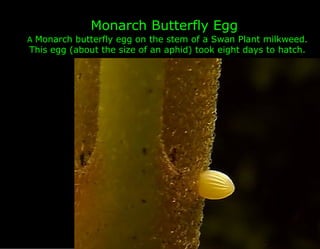
Monarch Butterfly Egg
A Monarch butterfly egg on the stem of a Swan Plant milkweed.
This egg (about the size of an aphid) took eight days to hatch.
Monarch Butterfly Caterpillar
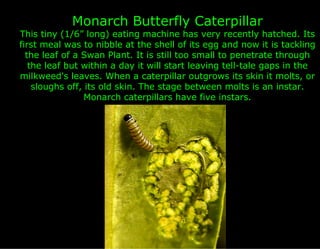
This tiny (1/6” long) eating machine has very recently hatched. Its
first meal was to nibble at the shell of its egg and now it is tackling
  the leaf of a Swan Plant. It is still too small to penetrate through
   the leaf but within a day it will start leaving tell-tale gaps in the
milkweed's leaves. When a caterpillar outgrows its skin it molts, or
    sloughs off, its old skin. The stage between molts is an instar.
                 Monarch caterpillars have five instars.
Monarch Butterfly Caterpillar
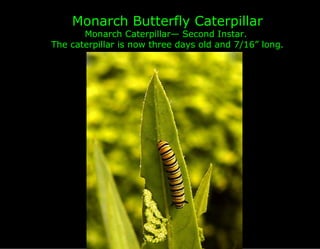
       Monarch Caterpillar— Second Instar.
The caterpillar is now three days old and 7/16” long.
Monarch Butterfly Caterpillar
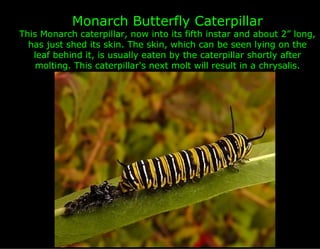
This Monarch caterpillar, now into its fifth instar and about 2” long,
  has just shed its skin. The skin, which can be seen lying on the
   leaf behind it, is usually eaten by the caterpillar shortly after
    molting. This caterpillar's next molt will result in a chrysalis.
Monarch Butterfly Caterpillar
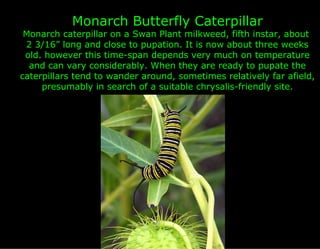
 Monarch caterpillar on a Swan Plant milkweed, fifth instar, about
 2 3/16” long and close to pupation. It is now about three weeks
 old. however this time-span depends very much on temperature
  and can vary considerably. When they are ready to pupate the
caterpillars tend to wander around, sometimes relatively far afield,
     presumably in search of a suitable chrysalis-friendly site.
Monarch Butterfly Caterpillar
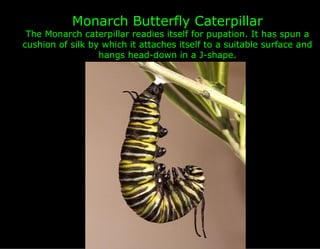
 The Monarch caterpillar readies itself for pupation. It has spun a
cushion of silk by which it attaches itself to a suitable surface and
                  hangs head-down in a J-shape.
Monarch Butterfly Caterpillar
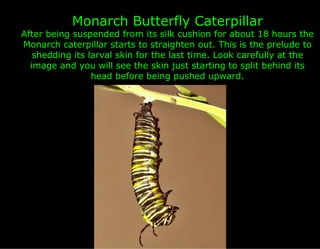
After being suspended from its silk cushion for about 18 hours the
Monarch caterpillar starts to straighten out. This is the prelude to
   shedding its larval skin for the last time. Look carefully at the
  image and you will see the skin just starting to split behind its
                 head before being pushed upward.
Monarch Butterfly Pupa
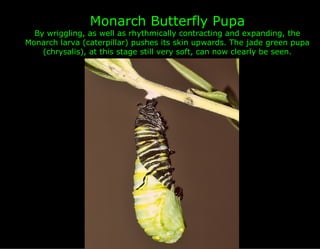
  By wriggling, as well as rhythmically contracting and expanding, the
Monarch larva (caterpillar) pushes its skin upwards. The jade green pupa
    (chrysalis), at this stage still very soft, can now clearly be seen.
Monarch Butterfly Pupa
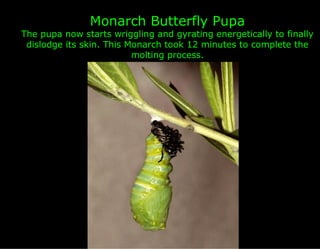
The pupa now starts wriggling and gyrating energetically to finally
 dislodge its skin. This Monarch took 12 minutes to complete the
                          molting process.
                                  .
Monarch Butterfly Pupa
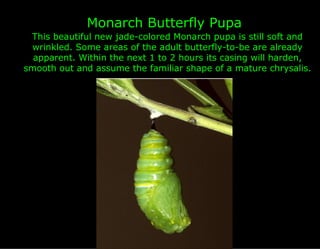
 This beautiful new jade-colored Monarch pupa is still soft and
 wrinkled. Some areas of the adult butterfly-to-be are already
  apparent. Within the next 1 to 2 hours its casing will harden,
smooth out and assume the familiar shape of a mature chrysalis.
Monarch Butterfly Chrysalis
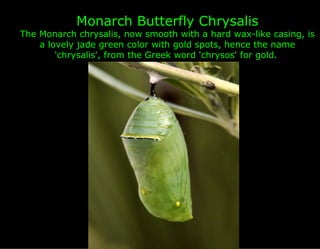
The Monarch chrysalis, now smooth with a hard wax-like casing, is
    a lovely jade green color with gold spots, hence the name
        'chrysalis', from the Greek word 'chrysos' for gold.
Monarch Butterfly Chrysalis To Butterfly
Shortly before the butterfly is due to emerge the Monarch chrysalis
  darkens significantly and the orange color of the wings can be
                  clearly seen through its casing.
Monarch Butterfly Chrysalis To Butterfly
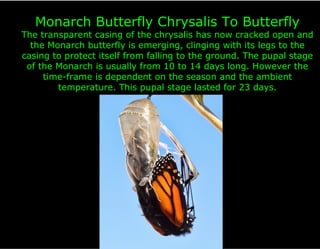
The transparent casing of the chrysalis has now cracked open and
  the Monarch butterfly is emerging, clinging with its legs to the
casing to protect itself from falling to the ground. The pupal stage
 of the Monarch is usually from 10 to 14 days long. However the
     time-frame is dependent on the season and the ambient
        temperature. This pupal stage lasted for 23 days.
Monarch Butterfly Chrysalis To Butterfly
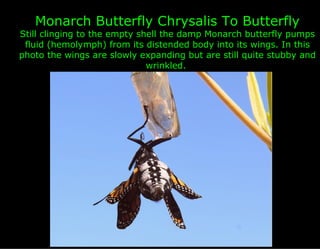
Still clinging to the empty shell the damp Monarch butterfly pumps
 fluid (hemolymph) from its distended body into its wings. In this
photo the wings are slowly expanding but are still quite stubby and
                              wrinkled.
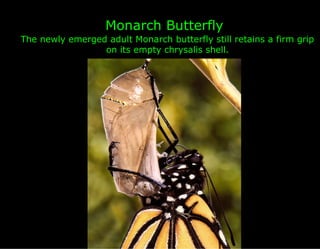
Monarch Butterfly
The newly emerged adult Monarch butterfly still retains a firm grip
                 on its empty chrysalis shell.
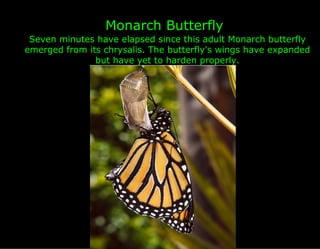
Monarch Butterfly
 Seven minutes have elapsed since this adult Monarch butterfly
emerged from its chrysalis. The butterfly's wings have expanded
               but have yet to harden properly.
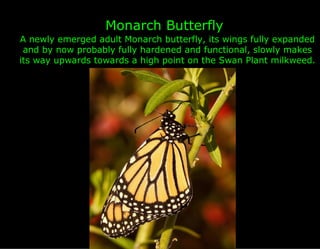
Monarch Butterfly
A newly emerged adult Monarch butterfly, its wings fully expanded
 and by now probably fully hardened and functional, slowly makes
its way upwards towards a high point on the Swan Plant milkweed.
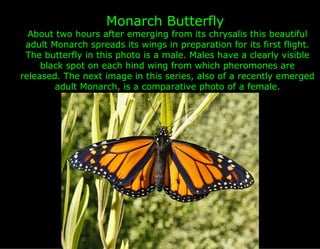
Monarch Butterfly
  About two hours after emerging from its chrysalis this beautiful
 adult Monarch spreads its wings in preparation for its first flight.
 The butterfly in this photo is a male. Males have a clearly visible
     black spot on each hind wing from which pheromones are
released. The next image in this series, also of a recently emerged
        adult Monarch, is a comparative photo of a female.
Monarch Butterfly
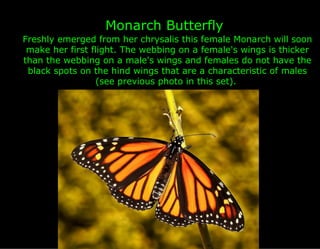
Freshly emerged from her chrysalis this female Monarch will soon
 make her first flight. The webbing on a female's wings is thicker
than the webbing on a male's wings and females do not have the
 black spots on the hind wings that are a characteristic of males
                  (see previous photo in this set).
End of Our
  Presentation
Slides beyond this page
 are related SlideShare
      presentations
      To view again click on

Monarch life cycle

  • 1.
    Monarch Butterfly LifeCycle *Thump* *Thump* Is this Mike on? Quiet Please! International Internet Collaboration Sid, photographer and writer, 76 years old living in New Zealand, Chuck, PowerPoint creator, 77 years old living in Florida, USA. My name is Chuck Melvin, I am 77 and have Parkinson’s. Please visit our website at: http://www.butterflylifecycle.net
  • 2.
    Monarch Butterfly LifeCycle My name is Chuck Melvin, I am 77 years old and have Parkinson’s Disease. My wife, Marsha, and I have married for 35 years. We need your help to pay for my increasing medical bills. Please visit our website: www.ButterflyLifeCycle.net My e-mail address is ChuckMelvin@ButterflyLifeCycle.net Please e-mail me to make suggestions or comments on how to improve our website.
  • 3.
    Monarch Butterfly Egg Please visit Flickr and leave comments at: http://www.flickr.com/photos/kiwinz/3351368918/
  • 4.
    Monarch Butterfly Caterpillar Pleasevisit Flickr and leave comments for Lynda Tanner at: http://www.flickr.com/photos/goingslo/2211013441/in/set- 72157603816746097
  • 5.
    Monarch Butterfly Chrysalis Please visit Flickr and leave comments for Lynda at: http://www.flickr.com/photos/27948818@N05/3159260742/in/set -72157625489927354/
  • 6.
    Monarch Butterfly Please visitFlickr and leave comments for David and Rose Slater at: http://www.flickr.com/photos/davrozs/4246357793/in/set- 72157608514512609
  • 7.
    The next 20slides illustrate the Monarch Life Cycle. All the Photos and technical writings were created by Sid and posted on Flickr. Sid Mosdell, contributor to Flickr Go see Sid’s genius on Flickr. leave glowing comments http://www.flickr.com/photos/ sidm/sets/72157624547070910/ Sid’s Bio - I'm 76, married, and have lived with my wife in Picton (a small seaside town of about 4000 in the South Island) since retiring from the rat-race in Auckland (New Zealand's biggest city) 11 years ago. I've been a fairly keen amateur photographer since my teen years. My switch from film to digital occurred about 8 years ago and I discovered on-line photo sharing via Flickr about 5 years ago. My two current cameras are a Micro Four Thirds format Panasonic Lumix and a Panasonic Lumix FZ150.
  • 8.
    Monarch Butterfly Female Monarchbutterfly deposits an egg onto the underside of a milkweed (swan plant) leaf. The butterfly usually lays its eggs on leaves but occasionally they are found on milkweed stems. Last year I posted three photos of a monarch caterpillar's transition to a chrysalis. Unfortunately at that time I never did get around to expanding the series any further. Now that we're well into a wet mid-winter here in New Zealand I've had some time to sit indoors and sift through my Monarch photos. This is the first of twenty images depicting stages in a Monarch's life cycle.
  • 9.
    Monarch Butterfly Egg AMonarch butterfly egg on the stem of a Swan Plant milkweed. This egg (about the size of an aphid) took eight days to hatch.
  • 10.
    Monarch Butterfly Caterpillar Thistiny (1/6” long) eating machine has very recently hatched. Its first meal was to nibble at the shell of its egg and now it is tackling the leaf of a Swan Plant. It is still too small to penetrate through the leaf but within a day it will start leaving tell-tale gaps in the milkweed's leaves. When a caterpillar outgrows its skin it molts, or sloughs off, its old skin. The stage between molts is an instar. Monarch caterpillars have five instars.
  • 11.
    Monarch Butterfly Caterpillar Monarch Caterpillar— Second Instar. The caterpillar is now three days old and 7/16” long.
  • 12.
    Monarch Butterfly Caterpillar ThisMonarch caterpillar, now into its fifth instar and about 2” long, has just shed its skin. The skin, which can be seen lying on the leaf behind it, is usually eaten by the caterpillar shortly after molting. This caterpillar's next molt will result in a chrysalis.
  • 13.
    Monarch Butterfly Caterpillar Monarch caterpillar on a Swan Plant milkweed, fifth instar, about 2 3/16” long and close to pupation. It is now about three weeks old. however this time-span depends very much on temperature and can vary considerably. When they are ready to pupate the caterpillars tend to wander around, sometimes relatively far afield, presumably in search of a suitable chrysalis-friendly site.
  • 14.
    Monarch Butterfly Caterpillar The Monarch caterpillar readies itself for pupation. It has spun a cushion of silk by which it attaches itself to a suitable surface and hangs head-down in a J-shape.
  • 15.
    Monarch Butterfly Caterpillar Afterbeing suspended from its silk cushion for about 18 hours the Monarch caterpillar starts to straighten out. This is the prelude to shedding its larval skin for the last time. Look carefully at the image and you will see the skin just starting to split behind its head before being pushed upward.
  • 16.
    Monarch Butterfly Pupa By wriggling, as well as rhythmically contracting and expanding, the Monarch larva (caterpillar) pushes its skin upwards. The jade green pupa (chrysalis), at this stage still very soft, can now clearly be seen.
  • 17.
    Monarch Butterfly Pupa Thepupa now starts wriggling and gyrating energetically to finally dislodge its skin. This Monarch took 12 minutes to complete the molting process. .
  • 18.
    Monarch Butterfly Pupa This beautiful new jade-colored Monarch pupa is still soft and wrinkled. Some areas of the adult butterfly-to-be are already apparent. Within the next 1 to 2 hours its casing will harden, smooth out and assume the familiar shape of a mature chrysalis.
  • 19.
    Monarch Butterfly Chrysalis TheMonarch chrysalis, now smooth with a hard wax-like casing, is a lovely jade green color with gold spots, hence the name 'chrysalis', from the Greek word 'chrysos' for gold.
  • 20.
    Monarch Butterfly ChrysalisTo Butterfly Shortly before the butterfly is due to emerge the Monarch chrysalis darkens significantly and the orange color of the wings can be clearly seen through its casing.
  • 21.
    Monarch Butterfly ChrysalisTo Butterfly The transparent casing of the chrysalis has now cracked open and the Monarch butterfly is emerging, clinging with its legs to the casing to protect itself from falling to the ground. The pupal stage of the Monarch is usually from 10 to 14 days long. However the time-frame is dependent on the season and the ambient temperature. This pupal stage lasted for 23 days.
  • 22.
    Monarch Butterfly ChrysalisTo Butterfly Still clinging to the empty shell the damp Monarch butterfly pumps fluid (hemolymph) from its distended body into its wings. In this photo the wings are slowly expanding but are still quite stubby and wrinkled.
  • 23.
    Monarch Butterfly The newlyemerged adult Monarch butterfly still retains a firm grip on its empty chrysalis shell.
  • 24.
    Monarch Butterfly Sevenminutes have elapsed since this adult Monarch butterfly emerged from its chrysalis. The butterfly's wings have expanded but have yet to harden properly.
  • 25.
    Monarch Butterfly A newlyemerged adult Monarch butterfly, its wings fully expanded and by now probably fully hardened and functional, slowly makes its way upwards towards a high point on the Swan Plant milkweed.
  • 26.
    Monarch Butterfly About two hours after emerging from its chrysalis this beautiful adult Monarch spreads its wings in preparation for its first flight. The butterfly in this photo is a male. Males have a clearly visible black spot on each hind wing from which pheromones are released. The next image in this series, also of a recently emerged adult Monarch, is a comparative photo of a female.
  • 27.
    Monarch Butterfly Freshly emergedfrom her chrysalis this female Monarch will soon make her first flight. The webbing on a female's wings is thicker than the webbing on a male's wings and females do not have the black spots on the hind wings that are a characteristic of males (see previous photo in this set).
  • 28.
    End of Our Presentation Slides beyond this page are related SlideShare presentations To view again click on