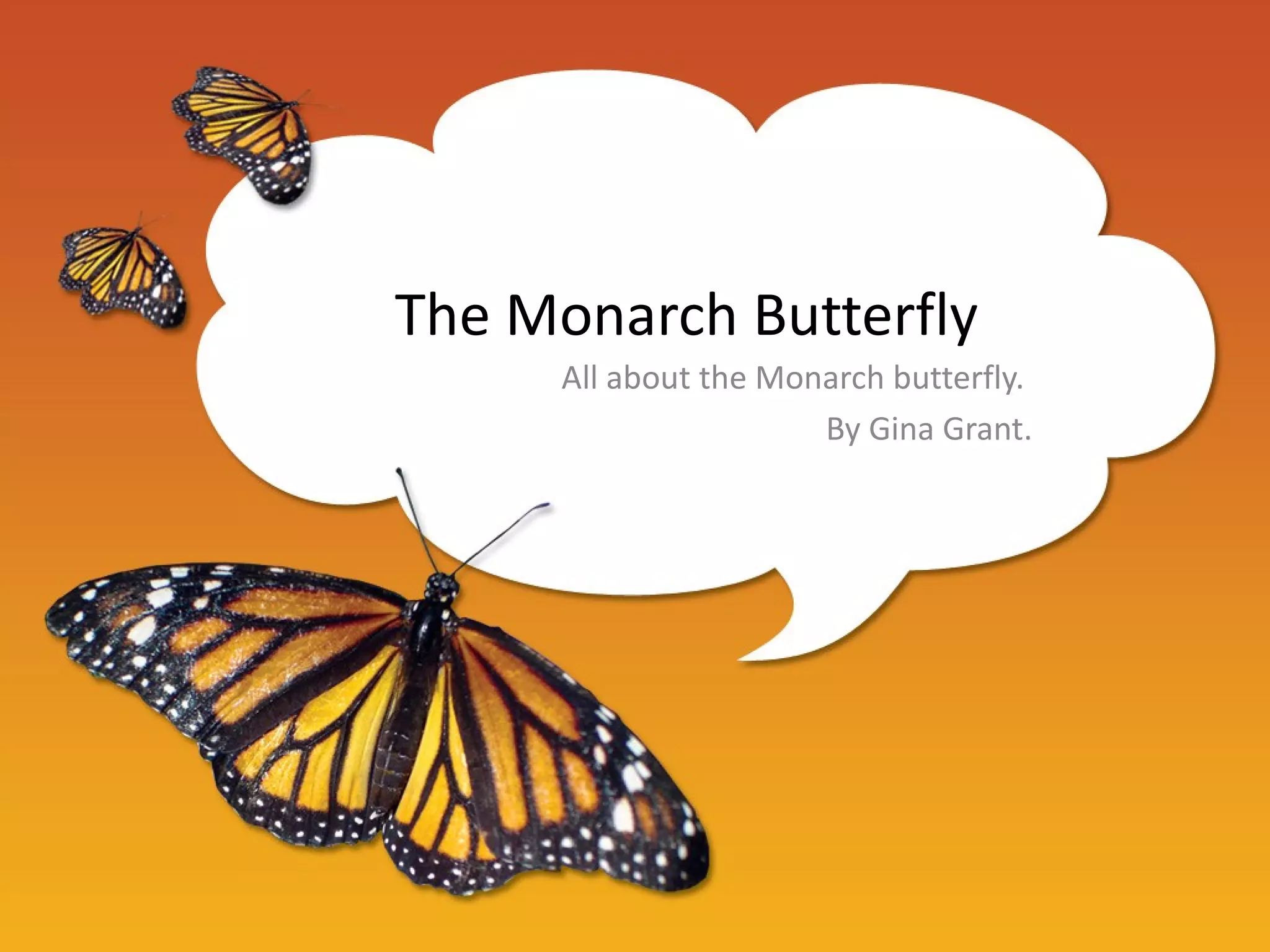
The Monarch Butterfly
     All about the Monarch butterfly.
                      By Gina Grant.
Life Cycle


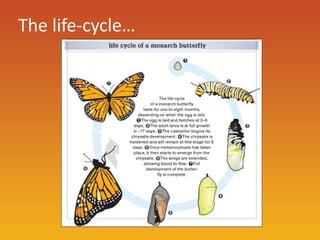
 The monarch butterfly has 4 stages to its life
 cycle.
 It starts it’s life as an egg, then turns into a
 caterpillar, before becoming a pupa and finally
 transforming into a butterfly.
 Lets learn more about each stage of its life
 cycle…
Stage 1… The Egg.


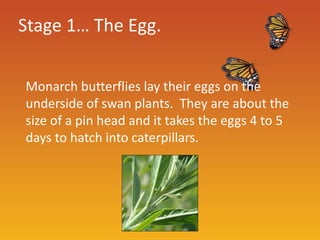
Monarch butterflies lay their eggs on the
underside of swan plants. They are about the
size of a pin head and it takes the eggs 4 to 5
days to hatch into caterpillars.
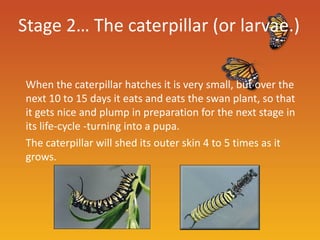
Stage 2… The caterpillar (or larvae.)

When the caterpillar hatches it is very small, but over the
next 10 to 15 days it eats and eats the swan plant, so that
it gets nice and plump in preparation for the next stage in
its life-cycle -turning into a pupa.
The caterpillar will shed its outer skin 4 to 5 times as it
grows.
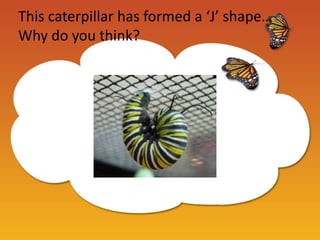
This caterpillar has formed a ‘J’ shape…
Why do you think?
Stage 3… The pupa

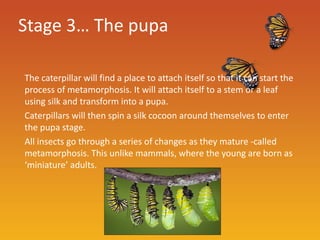
The caterpillar will find a place to attach itself so that it can start the
process of metamorphosis. It will attach itself to a stem or a leaf
using silk and transform into a pupa.
Caterpillars will then spin a silk cocoon around themselves to enter
the pupa stage.
All insects go through a series of changes as they mature -called
metamorphosis. This unlike mammals, where the young are born as
‘miniature’ adults.
Stage 3… The pupa

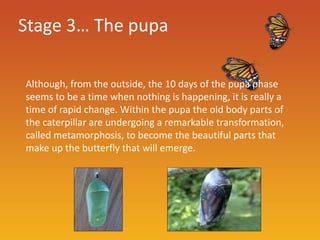
Although, from the outside, the 10 days of the pupa phase
seems to be a time when nothing is happening, it is really a
time of rapid change. Within the pupa the old body parts of
the caterpillar are undergoing a remarkable transformation,
called metamorphosis, to become the beautiful parts that
make up the butterfly that will emerge.
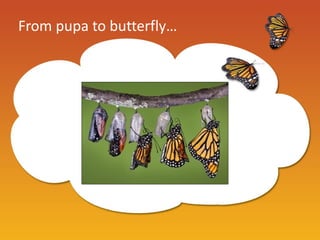
From pupa to butterfly…
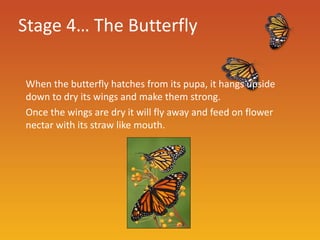
Stage 4… The Butterfly

When the butterfly hatches from its pupa, it hangs upside
down to dry its wings and make them strong.
Once the wings are dry it will fly away and feed on flower
nectar with its straw like mouth.
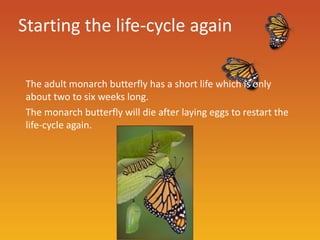
Starting the life-cycle again

 The adult monarch butterfly has a short life which is only
 about two to six weeks long.
 The monarch butterfly will die after laying eggs to restart the
 life-cycle again.
The life-cycle…
Marvelous Monarch Facts…


    Did you know that the swan plant is actually
    toxic, so when the caterpillars eat them they
    are less likely to be eaten by their predators
    (ants, praying mantis, birds and wasps) as the
    predators themselves will become sick if they
    do! -What a great tactic to try and avoid
    being eaten!
Marvelous Monarch Facts…


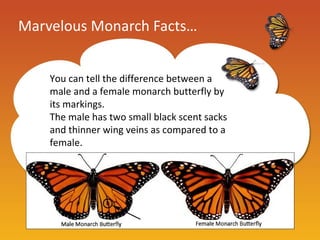
    You can tell the difference between a
    male and a female monarch butterfly by
    its markings.
    The male has two small black scent sacks
    and thinner wing veins as compared to a
    female.
Marvelous Monarch Facts…


  Although monarch butterflies in America migrate
  thousands of kilometers each winter, here is New Zealand
  it has been found that they usually don’t fly more than 20
  kilometers.
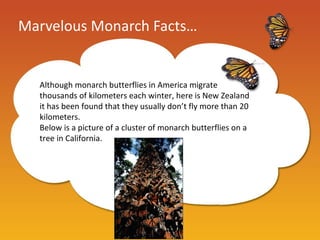
  Below is a picture of a cluster of monarch butterflies on a
  tree in California.
Marvelous Monarch Facts…


   Originally from America, the monarch butterfly
   has spread both naturally and by human
   intervention throughout the Pacific, Australia,
   parts of Southeast Asia, and to islands in the
   Atlantic. It is not known how monarchs first
   arrived in New Zealand but they have been
   here since at least the mid 1870s.
Marvelous Monarch Facts…


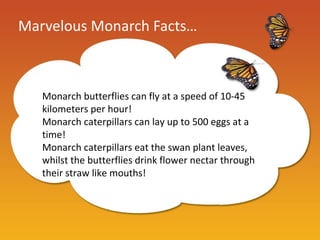
   Monarch butterflies can fly at a speed of 10-45
   kilometers per hour!
   Monarch caterpillars can lay up to 500 eggs at a
   time!
   Monarch caterpillars eat the swan plant leaves,
   whilst the butterflies drink flower nectar through
   their straw like mouths!
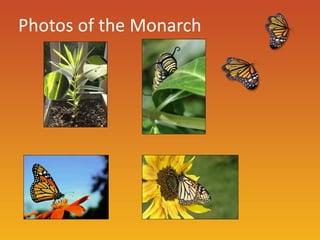
Photos of the Monarch
The Birth of a Monarch Butterfly…


   If you would like to watch a short video
   clip of The Birth of a Monarch Butterfly
   click on this link.

Monarch butterflies show

  • 1.
    The Monarch Butterfly All about the Monarch butterfly. By Gina Grant.
  • 2.
    Life Cycle Themonarch butterfly has 4 stages to its life cycle. It starts it’s life as an egg, then turns into a caterpillar, before becoming a pupa and finally transforming into a butterfly. Lets learn more about each stage of its life cycle…
  • 3.
    Stage 1… TheEgg. Monarch butterflies lay their eggs on the underside of swan plants. They are about the size of a pin head and it takes the eggs 4 to 5 days to hatch into caterpillars.
  • 4.
    Stage 2… Thecaterpillar (or larvae.) When the caterpillar hatches it is very small, but over the next 10 to 15 days it eats and eats the swan plant, so that it gets nice and plump in preparation for the next stage in its life-cycle -turning into a pupa. The caterpillar will shed its outer skin 4 to 5 times as it grows.
  • 5.
    This caterpillar hasformed a ‘J’ shape… Why do you think?
  • 6.
    Stage 3… Thepupa The caterpillar will find a place to attach itself so that it can start the process of metamorphosis. It will attach itself to a stem or a leaf using silk and transform into a pupa. Caterpillars will then spin a silk cocoon around themselves to enter the pupa stage. All insects go through a series of changes as they mature -called metamorphosis. This unlike mammals, where the young are born as ‘miniature’ adults.
  • 7.
    Stage 3… Thepupa Although, from the outside, the 10 days of the pupa phase seems to be a time when nothing is happening, it is really a time of rapid change. Within the pupa the old body parts of the caterpillar are undergoing a remarkable transformation, called metamorphosis, to become the beautiful parts that make up the butterfly that will emerge.
  • 8.
    From pupa tobutterfly…
  • 9.
    Stage 4… TheButterfly When the butterfly hatches from its pupa, it hangs upside down to dry its wings and make them strong. Once the wings are dry it will fly away and feed on flower nectar with its straw like mouth.
  • 10.
    Starting the life-cycleagain The adult monarch butterfly has a short life which is only about two to six weeks long. The monarch butterfly will die after laying eggs to restart the life-cycle again.
  • 11.
  • 12.
    Marvelous Monarch Facts… Did you know that the swan plant is actually toxic, so when the caterpillars eat them they are less likely to be eaten by their predators (ants, praying mantis, birds and wasps) as the predators themselves will become sick if they do! -What a great tactic to try and avoid being eaten!
  • 13.
    Marvelous Monarch Facts… You can tell the difference between a male and a female monarch butterfly by its markings. The male has two small black scent sacks and thinner wing veins as compared to a female.
  • 14.
    Marvelous Monarch Facts… Although monarch butterflies in America migrate thousands of kilometers each winter, here is New Zealand it has been found that they usually don’t fly more than 20 kilometers. Below is a picture of a cluster of monarch butterflies on a tree in California.
  • 15.
    Marvelous Monarch Facts… Originally from America, the monarch butterfly has spread both naturally and by human intervention throughout the Pacific, Australia, parts of Southeast Asia, and to islands in the Atlantic. It is not known how monarchs first arrived in New Zealand but they have been here since at least the mid 1870s.
  • 16.
    Marvelous Monarch Facts… Monarch butterflies can fly at a speed of 10-45 kilometers per hour! Monarch caterpillars can lay up to 500 eggs at a time! Monarch caterpillars eat the swan plant leaves, whilst the butterflies drink flower nectar through their straw like mouths!
  • 17.
  • 18.
    The Birth ofa Monarch Butterfly… If you would like to watch a short video clip of The Birth of a Monarch Butterfly click on this link.