




















Monarch Butterfly Habitat
and Mine Reclamation
2015 PA Abandoned Mine Reclamation Conference
“Reclaiming Our Communities”
June 26, 2015
.
Michael C. “Mike” Korb, P.E.
“Monarch” Butterfly & “William of Orange”
1689-1702
Monarch Popularity
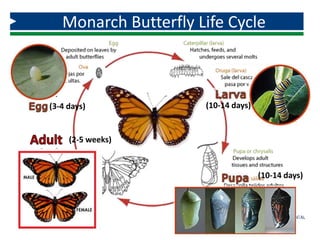
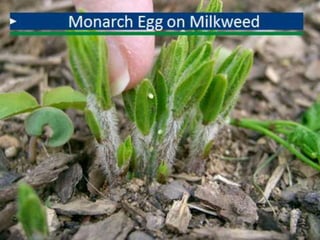
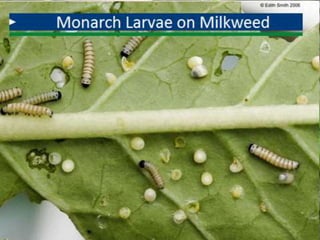
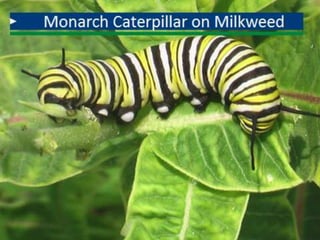
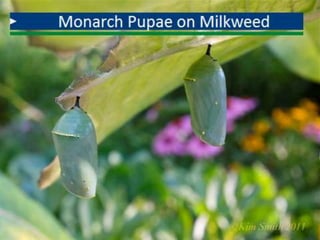
Monarch Butterfly Life Cycle
(3-4 days) (10-14 days)
(10-14 days)
(2-5 weeks)
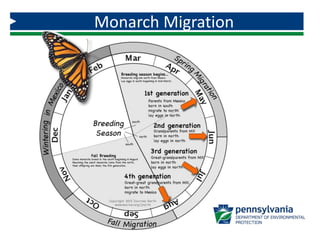
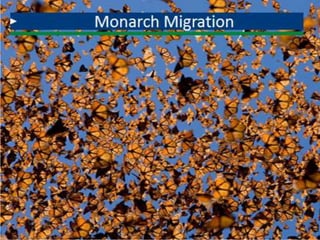
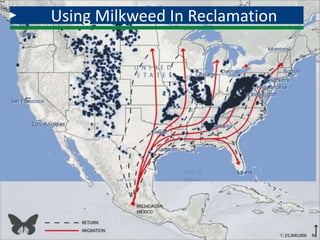
Monarch Migration
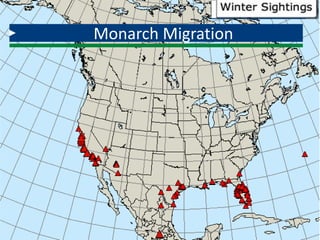
Monarch Migration
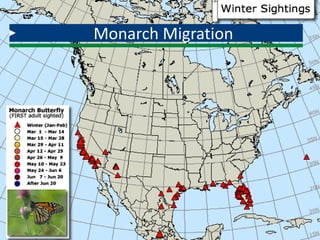
Monarch Migration
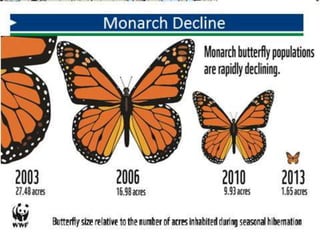
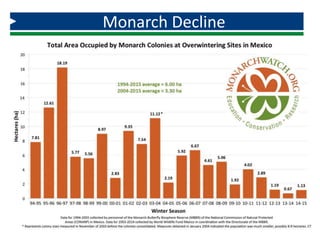
Monarch Decline
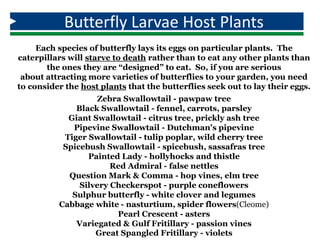
Each species of butterfly lays its eggs on particular plants. The
caterpillars will starve to death rather than to eat any other plants than
the ones they are “designed” to eat. So, if you are serious
about attracting more varieties of butterflies to your garden, you need
to consider the host plants that the butterflies seek out to lay their eggs.
Zebra Swallowtail - pawpaw tree
Black Swallowtail - fennel, carrots, parsley
Giant Swallowtail - citrus tree, prickly ash tree
Pipevine Swallowtail - Dutchman's pipevine
Tiger Swallowtail - tulip poplar, wild cherry tree
Spicebush Swallowtail - spicebush, sassafras tree
Painted Lady - hollyhocks and thistle
Red Admiral - false nettles
Question Mark & Comma - hop vines, elm tree
Silvery Checkerspot - purple coneflowers
Sulphur butterfly - white clover and legumes
Cabbage white - nasturtium, spider flowers(Cleome)
Pearl Crescent - asters
Variegated & Gulf Fritillary - passion vines
Great Spangled Fritillary - violets
Butterfly Larvae Host Plants
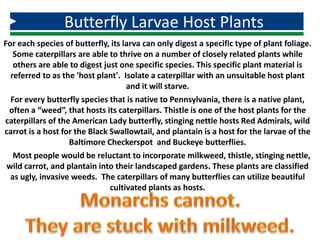
For each species of butterfly, its larva can only digest a specific type of plant foliage.
Some caterpillars are able to thrive on a number of closely related plants while
others are able to digest just one specific species. This specific plant material is
referred to as the 'host plant'. Isolate a caterpillar with an unsuitable host plant
and it will starve.
For every butterfly species that is native to Pennsylvania, there is a native plant,
often a “weed”, that hosts its caterpillars. Thistle is one of the host plants for the
caterpillars of the American Lady butterfly, stinging nettle hosts Red Admirals, wild
carrot is a host for the Black Swallowtail, and plantain is a host for the larvae of the
Baltimore Checkerspot and Buckeye butterflies.
Most people would be reluctant to incorporate milkweed, thistle, stinging nettle,
wild carrot, and plantain into their landscaped gardens. These plants are classified
as ugly, invasive weeds. The caterpillars of many butterflies can utilize beautiful
cultivated plants as hosts.
Butterfly Larvae Host Plants
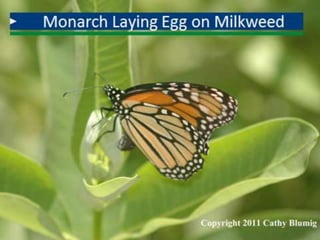
Milkweed
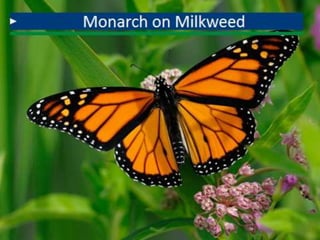
Monarch butterfly habitat is anywhere
milkweed grows.
Monarch larvae feeds only on milkweed.
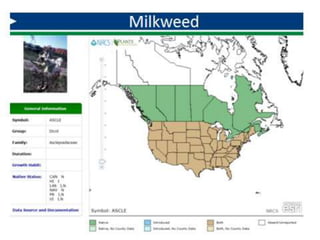
Milkweed is native to all of the lower-48 US
states and the eight southern provinces of
Canada. Pennsylvania has 11 native species and
New Mexico, 24. There are 73 species of native
milkweeds in the United States. Many of these
species are rare, and 21 are threatened, and/or
endangered.
Milkweed
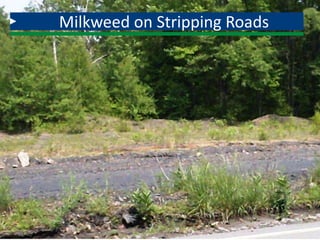
This plant is a pioneer plant - a fugitive species -
a disturbed habitat specialist, it grows in sandy,
clayey, chalky or rocky soils. It occurs along
roadsides, railroad tracks, bike paths, highway
medians, and farm field and forest margins; on
vacant land, old fields, small clearings, fence
rows and waste places. It is ideal in semi-dry
places where it can spread without presenting
problems for other ornamental species.
Milkweed on Stripping Roads
Milkweed
It reproduces by seeds, underground stems, and
roots, and is easily propagated by both seed and
rhizome cuttings. It is very recognizable - the
plants can be recognized at highway speeds by
their distinct form. Seeds can be harvested
easily by hand in the fall.
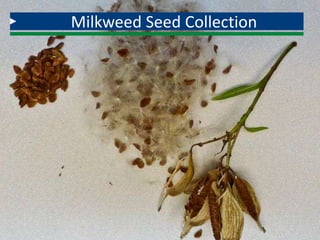
Timing of collection of milkweed pods or seeds is
critical. If you squeeze the pods and they don’t open
easily, they don’t contain mature brown seeds. Pale or
white seeds should be not collected. Dry collected pods
in an open area with good air circulation. Once the pods
are thoroughly dry, the seeds can be separated from the
coma, or silk-like ballooning material, by hand, or by
stripping the seeds and coma from the pods into a
paper bag. Shake the contents of the bag vigorously to
separate the seeds from the coma and then cut a small
hole in a corner of the bottom of the bag and shake out
the seeds. `
Milkweed Seed Collection
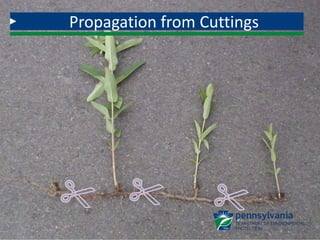
Propagation by cuttings of the tuberous rhizome is easy
and reliable. The cuttings should be made when the
plant is dormant. Each piece of the rhizome should
have at least one bud (they are about two inches apart).
Timing of propagation is important. Harvest or divide
plants and get the plants in the ground by late fall so
they can develop enough root growth to survive the
winter. Irrigation the first year will improve survival, and
by the second year the root system should be well
enough established so plants will survive without.
Propagation from Cuttings
Milkweed Seeds & Plants
Seeds and plants are available from many
nurseries. Ernst Seed in Meadville PA currently
is producing 3 species of milkweed:
Common Milkweed (Asclepias syriaca), Swamp
Milkweed (A. incarnata), and Butterfly Milkweed
(A. tuberosa). If planting onto mine land in
Pennsylvania, Common Milkweed on dry sites
and Swamp Milkweed on wet sites are
recommended.
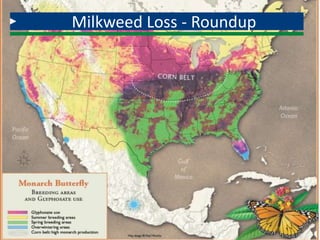
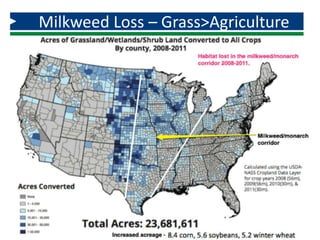
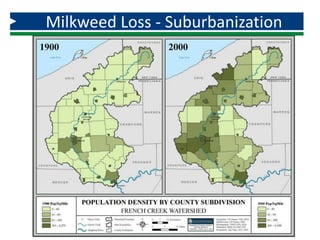
Milkweed Habitat Loss
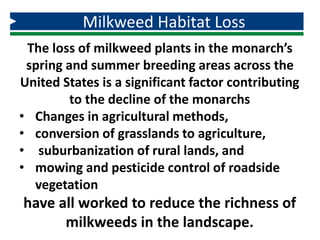
The loss of milkweed plants in the monarch’s
spring and summer breeding areas across the
United States is a significant factor contributing
to the decline of the monarchs
• Changes in agricultural methods,
• conversion of grasslands to agriculture,
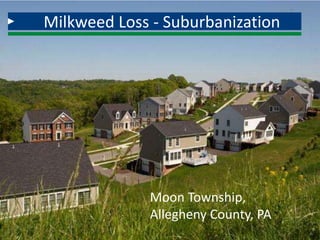
• suburbanization of rural lands, and
• mowing and pesticide control of roadside
vegetation
have all worked to reduce the richness of
milkweeds in the landscape.
Milkweed Habitat Loss
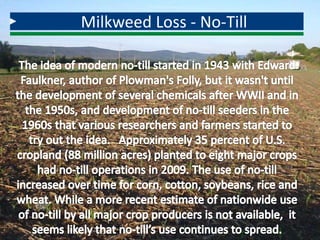
Milkweed Loss - No-Till
Milkweed Decline – No-Till
No-till farming appears to be a
tremendous step forward for
agriculture. However, as it's currently
practiced in the U.S., no-till farming
might more appropriately be called
no-till/chemical agriculture.
Milkweed Loss - Roundup
Milkweed Loss – Grass>Agriculture
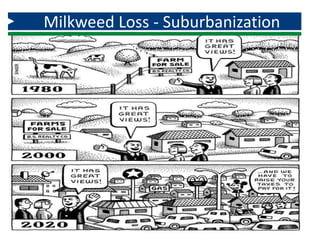
Milkweed Loss - Suburbanization
Moon Township,
Allegheny County, PA
Milkweed Loss - Suburbanization
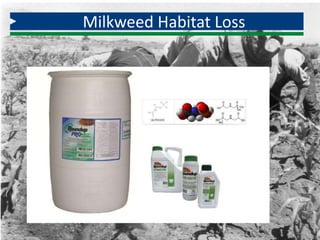
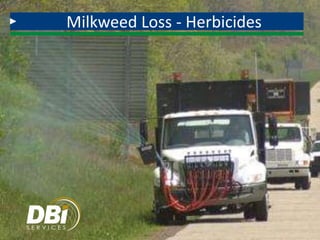
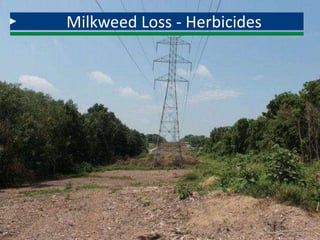
Milkweed Loss - Herbicides
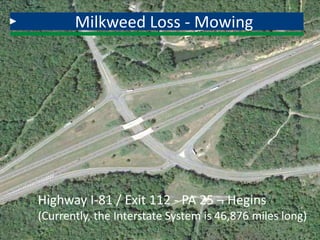
Milkweed Loss - Mowing
Highway I-81 / Exit 112 - PA 25 – Hegins
(Currently, the Interstate System is 46,876 miles long)
What Can We Do to Help?
So…we’ve got a plant that is the required host
plant for one of America’s most recognizable,
beautiful and recognizable animals, and the plant
is a critical component in that animal’s life cycle.
Changes in agricultural methods, intensification
of agriculture, development of rural lands and
pesticide control of roadside vegetation have all
have reduced the richness of the plants in the
landscape, helping cause a dramatic drop in the
animal’s numbers.
What Can We Do to Help?
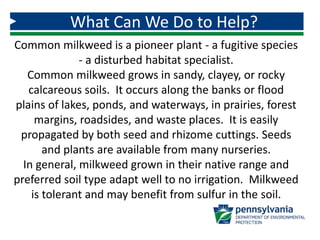
Common milkweed is a pioneer plant - a fugitive species
- a disturbed habitat specialist.
Common milkweed grows in sandy, clayey, or rocky
calcareous soils. It occurs along the banks or flood
plains of lakes, ponds, and waterways, in prairies, forest
margins, roadsides, and waste places. It is easily
propagated by both seed and rhizome cuttings. Seeds
and plants are available from many nurseries.
In general, milkweed grown in their native range and
preferred soil type adapt well to no irrigation. Milkweed
is tolerant and may benefit from sulfur in the soil.
Use Milkweed In Reclamation
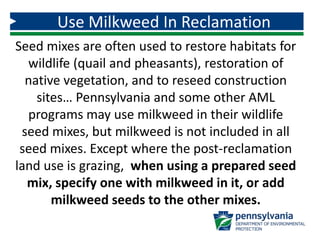
Seed mixes are often used to restore habitats for
wildlife (quail and pheasants), restoration of
native vegetation, and to reseed construction
sites… Pennsylvania and some other AML
programs may use milkweed in their wildlife
seed mixes, but milkweed is not included in all
seed mixes. Except where the post-reclamation
land use is grazing, when using a prepared seed
mix, specify one with milkweed in it, or add
milkweed seeds to the other mixes.
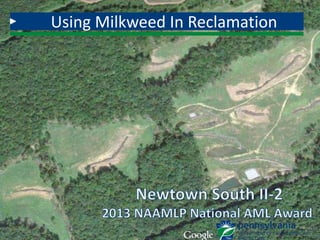
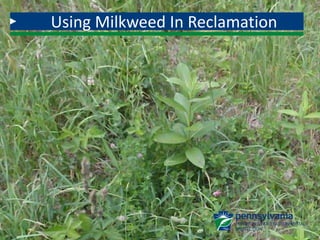
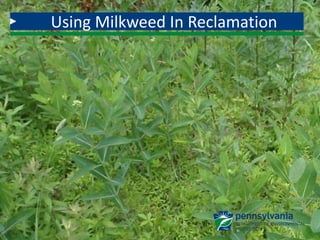
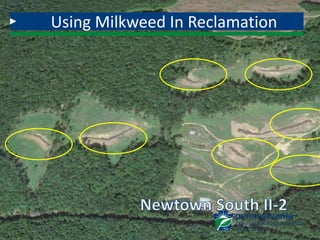
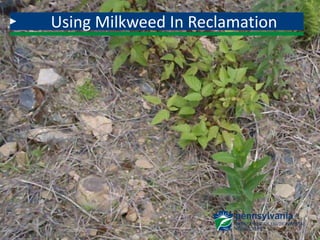
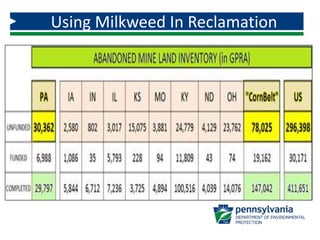
Using Milkweed In Reclamation
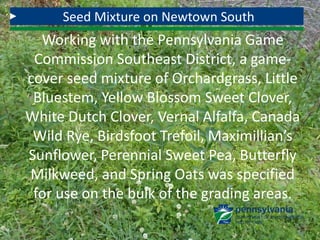
Seed Mixture on Newtown South
Working with the Pennsylvania Game
Commission Southeast District, a game-
cover seed mixture of Orchardgrass, Little
Bluestem, Yellow Blossom Sweet Clover,
White Dutch Clover, Vernal Alfalfa, Canada
Wild Rye, Birdsfoot Trefoil, Maximillian’s
Sunflower, Perennial Sweet Pea, Butterfly
Milkweed, and Spring Oats was specified
for use on the bulk of the grading areas.
Using Milkweed In Reclamation
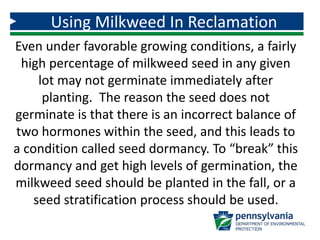
Even under favorable growing conditions, a fairly
high percentage of milkweed seed in any given
lot may not germinate immediately after
planting. The reason the seed does not
germinate is that there is an incorrect balance of
two hormones within the seed, and this leads to
a condition called seed dormancy. To “break” this
dormancy and get high levels of germination, the
milkweed seed should be planted in the fall, or a
seed stratification process should be used.
Using Milkweed In Reclamation
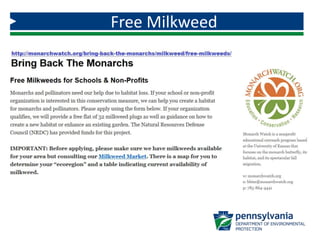
Free Milkweed
• Ernst Conservation Seeds, Inc. http://www.ernstseed.com/
Mark Fiely, hortpath@ernstseed.com
• Monarch Joint Venture, http://monarchjointventure.org/
• Monarch Watch, www.monarchwatch.org/
• National Wildlife Federation, http://www.nwf.org/wildlife/
• US Department of Agriculture Forest Service,
www.fs.fed.us/wildflowers/pollinators/Monarch_Butterfly/
• University of Minnesota Monarch Lab http://monarchlab.org/
• Xerces Society for Invertebrate Conservation,
http://www.xerces.org/monarchs/
Resources
A Gift to Take Home!
Michael C. “Mike” Korb, P.E.
570.826.2371
mkorb@pa.gov
Mike Korb, PA DEP, “Mine Reclamation and Monarch Butterfly Habitat”

Mike Korb, PA DEP, “Mine Reclamation and Monarch Butterfly Habitat”

  • 1.
    Monarch Butterfly Habitat andMine Reclamation 2015 PA Abandoned Mine Reclamation Conference “Reclaiming Our Communities” June 26, 2015 . Michael C. “Mike” Korb, P.E.
  • 6.
    “Monarch” Butterfly &“William of Orange” 1689-1702
  • 8.
  • 10.
    Monarch Butterfly LifeCycle (3-4 days) (10-14 days) (10-14 days) (2-5 weeks)
  • 11.
  • 14.
  • 15.
  • 17.
  • 18.
    Each species ofbutterfly lays its eggs on particular plants. The caterpillars will starve to death rather than to eat any other plants than the ones they are “designed” to eat. So, if you are serious about attracting more varieties of butterflies to your garden, you need to consider the host plants that the butterflies seek out to lay their eggs. Zebra Swallowtail - pawpaw tree Black Swallowtail - fennel, carrots, parsley Giant Swallowtail - citrus tree, prickly ash tree Pipevine Swallowtail - Dutchman's pipevine Tiger Swallowtail - tulip poplar, wild cherry tree Spicebush Swallowtail - spicebush, sassafras tree Painted Lady - hollyhocks and thistle Red Admiral - false nettles Question Mark & Comma - hop vines, elm tree Silvery Checkerspot - purple coneflowers Sulphur butterfly - white clover and legumes Cabbage white - nasturtium, spider flowers(Cleome) Pearl Crescent - asters Variegated & Gulf Fritillary - passion vines Great Spangled Fritillary - violets Butterfly Larvae Host Plants
  • 19.
    For each speciesof butterfly, its larva can only digest a specific type of plant foliage. Some caterpillars are able to thrive on a number of closely related plants while others are able to digest just one specific species. This specific plant material is referred to as the 'host plant'. Isolate a caterpillar with an unsuitable host plant and it will starve. For every butterfly species that is native to Pennsylvania, there is a native plant, often a “weed”, that hosts its caterpillars. Thistle is one of the host plants for the caterpillars of the American Lady butterfly, stinging nettle hosts Red Admirals, wild carrot is a host for the Black Swallowtail, and plantain is a host for the larvae of the Baltimore Checkerspot and Buckeye butterflies. Most people would be reluctant to incorporate milkweed, thistle, stinging nettle, wild carrot, and plantain into their landscaped gardens. These plants are classified as ugly, invasive weeds. The caterpillars of many butterflies can utilize beautiful cultivated plants as hosts. Butterfly Larvae Host Plants
  • 28.
    Milkweed Monarch butterfly habitatis anywhere milkweed grows. Monarch larvae feeds only on milkweed. Milkweed is native to all of the lower-48 US states and the eight southern provinces of Canada. Pennsylvania has 11 native species and New Mexico, 24. There are 73 species of native milkweeds in the United States. Many of these species are rare, and 21 are threatened, and/or endangered.
  • 29.
    Milkweed This plant isa pioneer plant - a fugitive species - a disturbed habitat specialist, it grows in sandy, clayey, chalky or rocky soils. It occurs along roadsides, railroad tracks, bike paths, highway medians, and farm field and forest margins; on vacant land, old fields, small clearings, fence rows and waste places. It is ideal in semi-dry places where it can spread without presenting problems for other ornamental species.
  • 30.
  • 31.
    Milkweed It reproduces byseeds, underground stems, and roots, and is easily propagated by both seed and rhizome cuttings. It is very recognizable - the plants can be recognized at highway speeds by their distinct form. Seeds can be harvested easily by hand in the fall.
  • 32.
    Timing of collectionof milkweed pods or seeds is critical. If you squeeze the pods and they don’t open easily, they don’t contain mature brown seeds. Pale or white seeds should be not collected. Dry collected pods in an open area with good air circulation. Once the pods are thoroughly dry, the seeds can be separated from the coma, or silk-like ballooning material, by hand, or by stripping the seeds and coma from the pods into a paper bag. Shake the contents of the bag vigorously to separate the seeds from the coma and then cut a small hole in a corner of the bottom of the bag and shake out the seeds. ` Milkweed Seed Collection
  • 33.
    Propagation by cuttingsof the tuberous rhizome is easy and reliable. The cuttings should be made when the plant is dormant. Each piece of the rhizome should have at least one bud (they are about two inches apart). Timing of propagation is important. Harvest or divide plants and get the plants in the ground by late fall so they can develop enough root growth to survive the winter. Irrigation the first year will improve survival, and by the second year the root system should be well enough established so plants will survive without. Propagation from Cuttings
  • 34.
    Milkweed Seeds &Plants Seeds and plants are available from many nurseries. Ernst Seed in Meadville PA currently is producing 3 species of milkweed: Common Milkweed (Asclepias syriaca), Swamp Milkweed (A. incarnata), and Butterfly Milkweed (A. tuberosa). If planting onto mine land in Pennsylvania, Common Milkweed on dry sites and Swamp Milkweed on wet sites are recommended.
  • 35.
    Milkweed Habitat Loss Theloss of milkweed plants in the monarch’s spring and summer breeding areas across the United States is a significant factor contributing to the decline of the monarchs • Changes in agricultural methods, • conversion of grasslands to agriculture, • suburbanization of rural lands, and • mowing and pesticide control of roadside vegetation have all worked to reduce the richness of milkweeds in the landscape.
  • 36.
  • 37.
  • 38.
    Milkweed Decline –No-Till No-till farming appears to be a tremendous step forward for agriculture. However, as it's currently practiced in the U.S., no-till farming might more appropriately be called no-till/chemical agriculture.
  • 39.
  • 40.
    Milkweed Loss –Grass>Agriculture
  • 41.
    Milkweed Loss -Suburbanization
  • 42.
    Milkweed Loss -Suburbanization Moon Township, Allegheny County, PA
  • 43.
    Milkweed Loss -Suburbanization
  • 44.
    Milkweed Loss -Herbicides
  • 45.
    Milkweed Loss -Herbicides
  • 46.
  • 47.
    Milkweed Loss -Mowing Highway I-81 / Exit 112 - PA 25 – Hegins (Currently, the Interstate System is 46,876 miles long)
  • 48.
    What Can WeDo to Help?
  • 50.
    What Can WeDo to Help?
  • 51.
    What Can WeDo to Help? So…we’ve got a plant that is the required host plant for one of America’s most recognizable, beautiful and recognizable animals, and the plant is a critical component in that animal’s life cycle. Changes in agricultural methods, intensification of agriculture, development of rural lands and pesticide control of roadside vegetation have all have reduced the richness of the plants in the landscape, helping cause a dramatic drop in the animal’s numbers.
  • 52.
    What Can WeDo to Help? Common milkweed is a pioneer plant - a fugitive species - a disturbed habitat specialist. Common milkweed grows in sandy, clayey, or rocky calcareous soils. It occurs along the banks or flood plains of lakes, ponds, and waterways, in prairies, forest margins, roadsides, and waste places. It is easily propagated by both seed and rhizome cuttings. Seeds and plants are available from many nurseries. In general, milkweed grown in their native range and preferred soil type adapt well to no irrigation. Milkweed is tolerant and may benefit from sulfur in the soil.
  • 53.
    Use Milkweed InReclamation Seed mixes are often used to restore habitats for wildlife (quail and pheasants), restoration of native vegetation, and to reseed construction sites… Pennsylvania and some other AML programs may use milkweed in their wildlife seed mixes, but milkweed is not included in all seed mixes. Except where the post-reclamation land use is grazing, when using a prepared seed mix, specify one with milkweed in it, or add milkweed seeds to the other mixes.
  • 54.
    Using Milkweed InReclamation
  • 55.
    Seed Mixture onNewtown South Working with the Pennsylvania Game Commission Southeast District, a game- cover seed mixture of Orchardgrass, Little Bluestem, Yellow Blossom Sweet Clover, White Dutch Clover, Vernal Alfalfa, Canada Wild Rye, Birdsfoot Trefoil, Maximillian’s Sunflower, Perennial Sweet Pea, Butterfly Milkweed, and Spring Oats was specified for use on the bulk of the grading areas.
  • 56.
    Using Milkweed InReclamation
  • 57.
    Using Milkweed InReclamation
  • 58.
    Using Milkweed InReclamation
  • 59.
    Using Milkweed InReclamation
  • 60.
    Using Milkweed InReclamation
  • 61.
    Using Milkweed InReclamation
  • 62.
    Using Milkweed InReclamation Even under favorable growing conditions, a fairly high percentage of milkweed seed in any given lot may not germinate immediately after planting. The reason the seed does not germinate is that there is an incorrect balance of two hormones within the seed, and this leads to a condition called seed dormancy. To “break” this dormancy and get high levels of germination, the milkweed seed should be planted in the fall, or a seed stratification process should be used.
  • 63.
    Using Milkweed InReclamation
  • 64.
  • 67.
    • Ernst ConservationSeeds, Inc. http://www.ernstseed.com/ Mark Fiely, hortpath@ernstseed.com • Monarch Joint Venture, http://monarchjointventure.org/ • Monarch Watch, www.monarchwatch.org/ • National Wildlife Federation, http://www.nwf.org/wildlife/ • US Department of Agriculture Forest Service, www.fs.fed.us/wildflowers/pollinators/Monarch_Butterfly/ • University of Minnesota Monarch Lab http://monarchlab.org/ • Xerces Society for Invertebrate Conservation, http://www.xerces.org/monarchs/ Resources
  • 68.
    A Gift toTake Home!
  • 69.
    Michael C. “Mike”Korb, P.E. 570.826.2371 mkorb@pa.gov