Amjad Khan Afridi
MOLECULAR TARGET
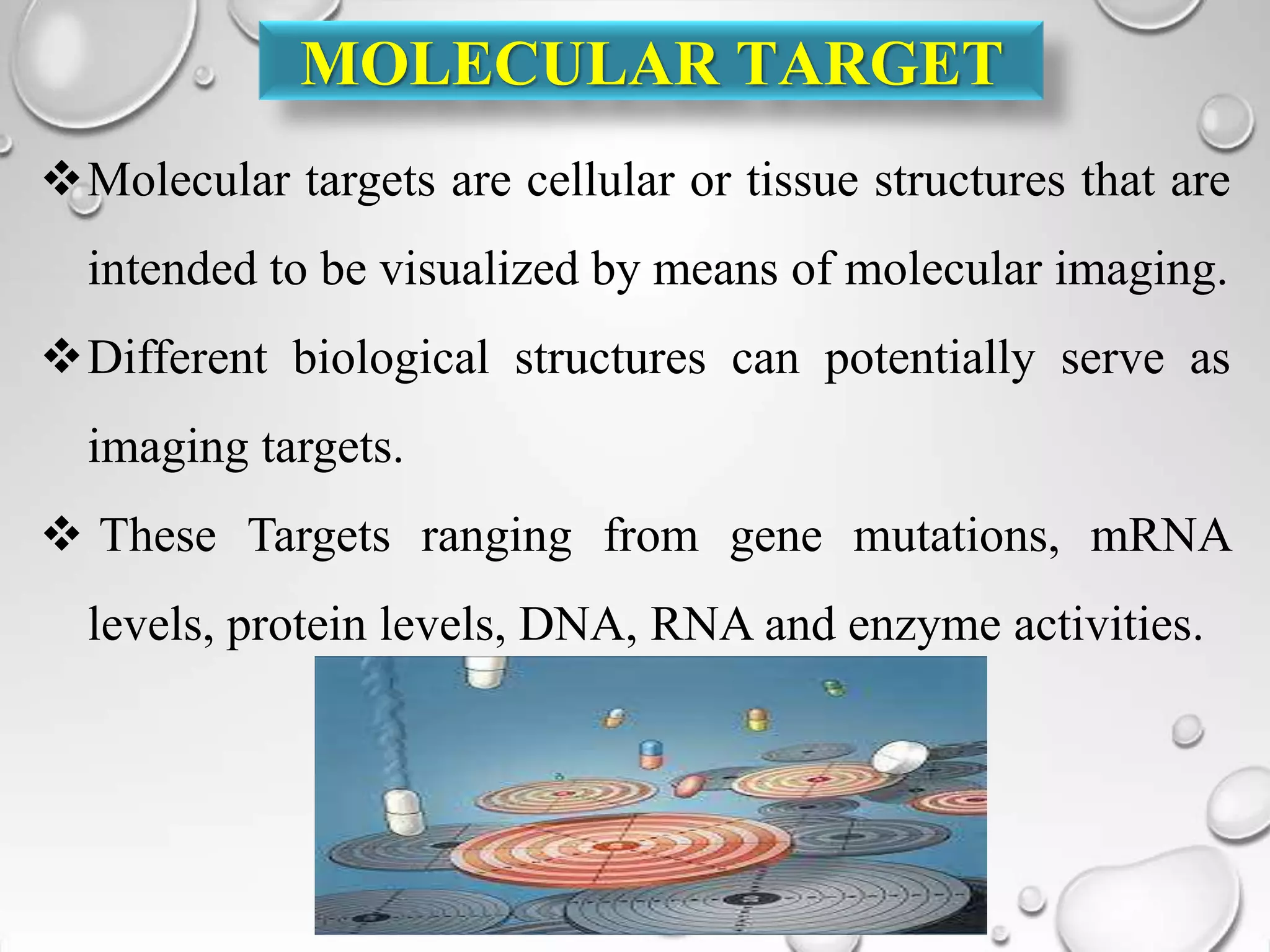
Molecular targets are cellular or tissue structures that are
intended to be visualized by means of molecular imaging.
Different biological structures can potentially serve as
imaging targets.
 These Targets ranging from gene mutations, mRNA
levels, protein levels, DNA, RNA and enzyme activities.
 Those targets are basically associated with a particular disease
process and that could be addressed by a drug to produce a
desired therapeutic effect.
 The researchers have obtained samples from the National Cancer
Institute panel of 60 human tumor cell lines and measured a
variety of targets in these cell lines.
 Targets include gene mutations, mRNA levels, protein levels and
enzyme activities.
Cont…
TargetDiscovery
 Target discovery is the start of the drug development
pipeline, where the goal is to identify genes that can be
modulated to affect the clinical indicators and outcome
of specific diseases.
 High value target candidates can be defined as genes
that, when modified, affect disease progression without
having severe harmful effects on the physiology of the
organism.
Others MolecularTarget ofDrug
There are four main targets for drug action: like; receptors,
ion channels, enzymes and carrier molecules.
In each of these four cases, most drugs are effective because
they bind to particular target proteins.
Endogenous hormones and some drugs pass through the
cell membrane and attach to receptors in the cytoplasm.
The Target Identification & Characterization
 Target identification and characterization begins with
identifying the function of a possible therapeutic
target (gene/protein) and its role in the disease.
 A good target should be effective, safe, meet clinical
and commercial requirements and be "druggable".
Target Validation
 Target validation is the first step in discovering a
new drug and can typically take 2-6 months.
 A molecular target is directly involved in a
disease process, and that modulation of the target
is likely to have a therapeutic effect.
Development Models
 Molecular modelling is one of the fastest growing fields
in science.
 Actually, based on conceptual stage (to created concept
regarding to develop drug)
 It may vary from building and visualizing simple
molecules in three dimensions (3D) to performing
complex computer simulations on large proteins and
nanostructures.
Development Models
 Most currently used therapeutic drugs have an
enzyme or a membrane-bound receptor as site of
action.
 The sequencing of the human and other genomes has
provided a potential to identify many previously
unknown proteins that might serve as new drug
targets.
Development Models
 To study three-dimensional structures of
protein/biomolecule, it is critical for the
understanding of their functional mechanisms, and for
a rational drug design.
 Over the last decade atomic resolution crystal
structures of soluble proteins have been reported in a
rapidly increasing number, but the detailed three-
dimensional structures are still unknown for the
majority of membrane proteins since their membrane
association makes experimental structure
determinations complicated.
Development Models
Computerized modelling of protein structures, based
on experimentally determined structures of
homologue proteins, may be a useful methodological
alternative, especially for membrane proteins.
Approaches
 Data mining using bioinformatics — identifying,
selecting and listing potential disease targets
 Genetic association — genetic polymorphism and
connection with the disease
 Expression profile — changes in mRNA/protein
levels
 Pathway and phenotypic analysis — In vitro cell-
based mechanistic studies
 Functional screening — knockdown, knockout or
using target specific tools
Approaches
 Genetic manipulation of target genes (in vitro) —
knocking down the gene (shRNA, siRNA, miRNA),
knocking out the gene (CRISPR, ZFNs), knocking in
the gene (viral transfection of mutant genes)
 Antibodies — interacting to the target with high
affinity and blocking further interactions
 Chemical genomics — chemical approaches against
genome encoding protein
Thank You
26th October, 2021

Molecular target and development models

  • 1.
  • 2.
    MOLECULAR TARGET Molecular targetsare cellular or tissue structures that are intended to be visualized by means of molecular imaging. Different biological structures can potentially serve as imaging targets.  These Targets ranging from gene mutations, mRNA levels, protein levels, DNA, RNA and enzyme activities.
  • 3.
     Those targetsare basically associated with a particular disease process and that could be addressed by a drug to produce a desired therapeutic effect.  The researchers have obtained samples from the National Cancer Institute panel of 60 human tumor cell lines and measured a variety of targets in these cell lines.  Targets include gene mutations, mRNA levels, protein levels and enzyme activities. Cont…
  • 4.
    TargetDiscovery  Target discoveryis the start of the drug development pipeline, where the goal is to identify genes that can be modulated to affect the clinical indicators and outcome of specific diseases.  High value target candidates can be defined as genes that, when modified, affect disease progression without having severe harmful effects on the physiology of the organism.
  • 5.
    Others MolecularTarget ofDrug Thereare four main targets for drug action: like; receptors, ion channels, enzymes and carrier molecules. In each of these four cases, most drugs are effective because they bind to particular target proteins. Endogenous hormones and some drugs pass through the cell membrane and attach to receptors in the cytoplasm.
  • 6.
    The Target Identification& Characterization  Target identification and characterization begins with identifying the function of a possible therapeutic target (gene/protein) and its role in the disease.  A good target should be effective, safe, meet clinical and commercial requirements and be "druggable".
  • 7.
    Target Validation  Targetvalidation is the first step in discovering a new drug and can typically take 2-6 months.  A molecular target is directly involved in a disease process, and that modulation of the target is likely to have a therapeutic effect.
  • 8.
    Development Models  Molecularmodelling is one of the fastest growing fields in science.  Actually, based on conceptual stage (to created concept regarding to develop drug)  It may vary from building and visualizing simple molecules in three dimensions (3D) to performing complex computer simulations on large proteins and nanostructures.
  • 9.
    Development Models  Mostcurrently used therapeutic drugs have an enzyme or a membrane-bound receptor as site of action.  The sequencing of the human and other genomes has provided a potential to identify many previously unknown proteins that might serve as new drug targets.
  • 10.
    Development Models  Tostudy three-dimensional structures of protein/biomolecule, it is critical for the understanding of their functional mechanisms, and for a rational drug design.  Over the last decade atomic resolution crystal structures of soluble proteins have been reported in a rapidly increasing number, but the detailed three- dimensional structures are still unknown for the majority of membrane proteins since their membrane association makes experimental structure determinations complicated.
  • 11.
    Development Models Computerized modellingof protein structures, based on experimentally determined structures of homologue proteins, may be a useful methodological alternative, especially for membrane proteins.
  • 12.
    Approaches  Data miningusing bioinformatics — identifying, selecting and listing potential disease targets  Genetic association — genetic polymorphism and connection with the disease  Expression profile — changes in mRNA/protein levels  Pathway and phenotypic analysis — In vitro cell- based mechanistic studies  Functional screening — knockdown, knockout or using target specific tools
  • 13.
    Approaches  Genetic manipulationof target genes (in vitro) — knocking down the gene (shRNA, siRNA, miRNA), knocking out the gene (CRISPR, ZFNs), knocking in the gene (viral transfection of mutant genes)  Antibodies — interacting to the target with high affinity and blocking further interactions  Chemical genomics — chemical approaches against genome encoding protein
  • 14.

Editor's Notes

  • #3 The four main targets for drug action: receptors, ion channels, enzymes, carrier molecules. In each of these four cases, most drugs are effective because they bind to particular target proteins.
  • #5 Clinical indicators are measures of elements of clinical care which may, when assessed over time, provide a method of assessing the quality and safety of care at a system level. Background. Clinical and performance indicators have been in use by health services since the 1980s.
  • #6 Carrier molecules are usually proteins bound to a nonprotein group;  Estrogen or oestrogen, is a category of sex hormone responsible for the development and regulation of the female reproductive system and secondary sex characteristics. There are three major endogenous estrogens that have estrogenic hormonal activity: estrone (E1), estradiol (E2), and estriol (E3).
  • #7 Therapeutic target may refer to: Biological target, a protein or nucleic acid whose activity can be modified by an external stimulus. 
  • #8 Target validation is the process by which the predicted molecular target – for example protein or nucleic acid – of a small molecule is verified.
  • #9 A nanostructure is defined as any structure with one or more dimension, measuring in the nanometer scale range, that is, 10–9 m.
  • #11 atomic resolution crystal :  in which individual atoms can be distinguished.