The Mole Q: how long would it take to spend a mole of $1 coins if they were being spent at a rate of 1 billion per second?
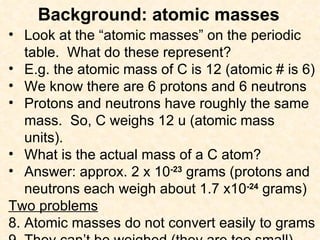
Background: atomic masses Look at the “atomic masses” on the periodic table.  What do these represent? E.g. the atomic mass of C is 12 (atomic # is 6) We know there are 6 protons and 6 neutrons Protons and neutrons have roughly the same mass.  So, C weighs 12 u (atomic mass units). What is the actual mass of a C atom? Answer: approx. 2 x 10 -23  grams (protons and neutrons each weigh about 1.7 x10 -24  grams) Two problems Atomic masses do not convert easily to grams They can’t be weighed (they are too small)
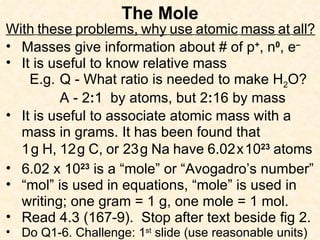
The Mole With   these   problems,   why   use   atomic   mass   at   all? Masses give information about # of p + , n 0 , e – It is useful to know relative mass E.g.  Q - What ratio is needed to make H 2 O? A - 2 : 1  by atoms, but 2 : 16 by mass It is useful to associate atomic mass with a mass in grams. It has been found that 1   g   H,   12   g   C,   or 23   g   Na   have   6.02   x   10 23   atoms 6.02 x 10 23  is a “mole” or “Avogadro’s number” “ mol” is used in equations, “mole” is used in writing; one gram = 1 g, one mole = 1 mol. Read 4.3 (167-9).  Stop after text beside fig 2. Do Q1-6. Challenge: 1 st  slide (use reasonable units)
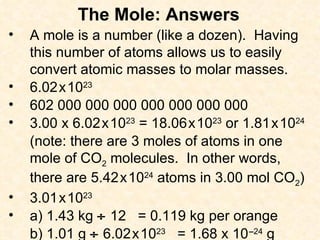
The Mole: Answers A mole is a number (like a dozen).  Having this number of atoms allows us to easily convert atomic masses to molar masses. 6.02   x   10 23 602 000 000 000 000 000 000 000 3.00 x 6.02   x   10 23  = 18.06   x   10 23  or 1.81   x   10 24 (note: there are 3 moles of atoms in one mole of CO 2  molecules.  In other words, there are 5.42   x   10 24  atoms in 3.00 mol CO 2 ) 3.01   x   10 23 a) 1.43 kg    12  = 0.119 kg per orange b) 1.01 g    6.02   x   10 23   = 1.68 x 10   – 24  g
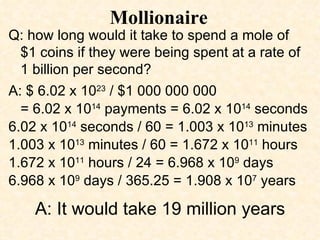
Mollionaire Q: how long would it take to spend a mole of  $1 coins if they were being spent at a rate of  1 billion per second? A: $ 6.02 x 10 23  / $1 000 000 000  = 6.02 x 10 14  payments = 6.02 x 10 14  seconds 6.02 x 10 14  seconds / 60 = 1.003 x 10 13  minutes 1.003 x 10 13  minutes / 60 = 1.672 x 10 11  hours 1.672 x 10 11  hours / 24 = 6.968 x 10 9  days 6.968 x 10 9  days / 365.25 = 1.908 x 10 7  years A: It would take 19 million years
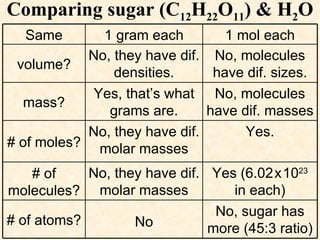
Comparing sugar (C 12 H 22 O 11 ) & H 2 O No, sugar has more (45:3 ratio) Yes (6.02   x   10 23  in each) Yes. No, molecules have dif. masses No, molecules have dif. sizes. 1 mol each Yes, that’s what grams are. mass? No, they have dif. molar masses # of moles? No, they have dif. molar masses # of molecules? No # of atoms? No, they have dif. densities. volume? 1 gram each Same
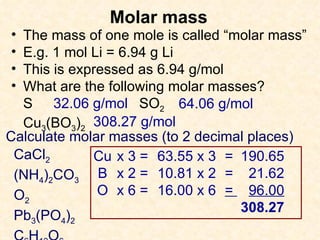
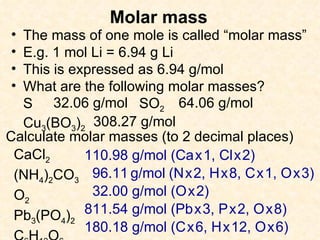
Molar mass The mass of one mole is called “molar mass” E.g. 1 mol Li = 6.94 g Li This is expressed as 6.94 g/mol What are the following molar masses? S SO 2 Cu 3 (BO 3 ) 2 32.06 g/mol 64.06 g/mol 308.27 g/mol Calculate molar masses (to 2 decimal places)  CaCl 2 (NH 4 ) 2 CO 3 O 2 Pb 3 (PO 4 ) 2 C 6 H 12 O 6 Cu x 3 =  63.55 x 3 =  190.65 B x 2 =  10.81 x 2 =  21.62 O x 6 =  16.00 x 6 =  96.00 308.27
Molar mass The mass of one mole is called “molar mass” E.g. 1 mol Li = 6.94 g Li This is expressed as 6.94 g/mol What are the following molar masses? S SO 2 Cu 3 (BO 3 ) 2 32.06 g/mol 64.06 g/mol 308.27 g/mol Calculate molar masses (to 2 decimal places)  CaCl 2 (NH 4 ) 2 CO 3 O 2 Pb 3 (PO 4 ) 2 C 6 H 12 O 6 110.98 g/mol (Ca   x   1, Cl   x   2) 96.11   g/mol   (N   x   2, H   x   8, C   x   1, O   x   3) 32.00 g/mol (O   x   2) 811.54 g/mol (Pb   x   3, P   x   2, O   x   8) 180.18 g/mol (C   x   6, H   x   12, O   x   6)
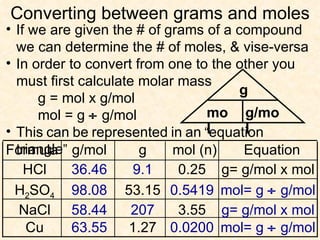
Converting between grams and moles If we are given the # of grams of a compound we can determine the # of moles, & vise-versa In order to convert from one to the other you must first calculate molar mass g = mol x g/mol mol = g    g/mol This   can   be   represented   in   an   “ equation   triangle ” 9.1 36.46 mol= g    g/mol 0.5419 98.08 g= g/mol x mol 207 58.44 mol= g    g/mol 0.0200 63.55 g mol g/mol g= g/mol x mol 0.25 HCl 53.15 H 2 SO 4 3.55 NaCl 1.27 Cu Equation mol (n) g g/mol Formula
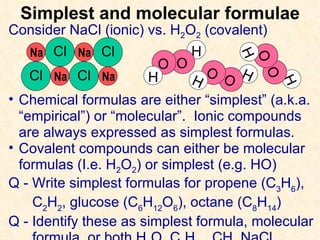
Simplest and molecular formulae Consider NaCl (ionic) vs. H 2 O 2  (covalent) Chemical formulas are either “simplest” (a.k.a. “empirical”) or “molecular”.  Ionic compounds are always expressed as simplest formulas. Covalent compounds can either be molecular formulas (I.e. H 2 O 2 ) or simplest (e.g. HO) Q - Write simplest formulas for propene (C 3 H 6 ),  C 2 H 2 , glucose (C 6 H 12 O 6 ), octane (C 8 H 14 ) Q - Identify these as simplest formula, molecular formula, or both H 2 O, C 4 H 10 , CH, NaCl Cl Na Na Cl Cl Cl Na Na H O O H H O O H H O O H
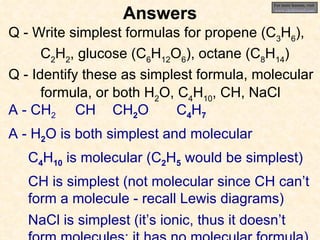
Answers Q - Write simplest formulas for propene (C 3 H 6 ),  C 2 H 2 , glucose (C 6 H 12 O 6 ), octane (C 8 H 14 ) Q - Identify these as simplest formula, molecular formula, or both H 2 O, C 4 H 10 , CH, NaCl A - CH 2 A - H 2 O is both simplest and molecular C 4 H 10  is molecular (C 2 H 5  would be simplest) CH is simplest (not molecular since CH can’t form a molecule - recall Lewis diagrams) NaCl is simplest (it’s ionic, thus it doesn’t form molecules; it has no molecular formula) CH CH 2 O C 4 H 7 For more lessons, visit  www.chalkbored.com

Mole

  • 1.
    The Mole Q:how long would it take to spend a mole of $1 coins if they were being spent at a rate of 1 billion per second?
  • 2.
    Background: atomic massesLook at the “atomic masses” on the periodic table. What do these represent? E.g. the atomic mass of C is 12 (atomic # is 6) We know there are 6 protons and 6 neutrons Protons and neutrons have roughly the same mass. So, C weighs 12 u (atomic mass units). What is the actual mass of a C atom? Answer: approx. 2 x 10 -23 grams (protons and neutrons each weigh about 1.7 x10 -24 grams) Two problems Atomic masses do not convert easily to grams They can’t be weighed (they are too small)
  • 3.
    The Mole With these problems, why use atomic mass at all? Masses give information about # of p + , n 0 , e – It is useful to know relative mass E.g. Q - What ratio is needed to make H 2 O? A - 2 : 1 by atoms, but 2 : 16 by mass It is useful to associate atomic mass with a mass in grams. It has been found that 1 g H, 12 g C, or 23 g Na have 6.02 x 10 23 atoms 6.02 x 10 23 is a “mole” or “Avogadro’s number” “ mol” is used in equations, “mole” is used in writing; one gram = 1 g, one mole = 1 mol. Read 4.3 (167-9). Stop after text beside fig 2. Do Q1-6. Challenge: 1 st slide (use reasonable units)
  • 4.
    The Mole: AnswersA mole is a number (like a dozen). Having this number of atoms allows us to easily convert atomic masses to molar masses. 6.02 x 10 23 602 000 000 000 000 000 000 000 3.00 x 6.02 x 10 23 = 18.06 x 10 23 or 1.81 x 10 24 (note: there are 3 moles of atoms in one mole of CO 2 molecules. In other words, there are 5.42 x 10 24 atoms in 3.00 mol CO 2 ) 3.01 x 10 23 a) 1.43 kg  12 = 0.119 kg per orange b) 1.01 g  6.02 x 10 23 = 1.68 x 10 – 24 g
  • 5.
    Mollionaire Q: howlong would it take to spend a mole of $1 coins if they were being spent at a rate of 1 billion per second? A: $ 6.02 x 10 23 / $1 000 000 000 = 6.02 x 10 14 payments = 6.02 x 10 14 seconds 6.02 x 10 14 seconds / 60 = 1.003 x 10 13 minutes 1.003 x 10 13 minutes / 60 = 1.672 x 10 11 hours 1.672 x 10 11 hours / 24 = 6.968 x 10 9 days 6.968 x 10 9 days / 365.25 = 1.908 x 10 7 years A: It would take 19 million years
  • 6.
    Comparing sugar (C12 H 22 O 11 ) & H 2 O No, sugar has more (45:3 ratio) Yes (6.02 x 10 23 in each) Yes. No, molecules have dif. masses No, molecules have dif. sizes. 1 mol each Yes, that’s what grams are. mass? No, they have dif. molar masses # of moles? No, they have dif. molar masses # of molecules? No # of atoms? No, they have dif. densities. volume? 1 gram each Same
  • 7.
    Molar mass Themass of one mole is called “molar mass” E.g. 1 mol Li = 6.94 g Li This is expressed as 6.94 g/mol What are the following molar masses? S SO 2 Cu 3 (BO 3 ) 2 32.06 g/mol 64.06 g/mol 308.27 g/mol Calculate molar masses (to 2 decimal places) CaCl 2 (NH 4 ) 2 CO 3 O 2 Pb 3 (PO 4 ) 2 C 6 H 12 O 6 Cu x 3 = 63.55 x 3 = 190.65 B x 2 = 10.81 x 2 = 21.62 O x 6 = 16.00 x 6 = 96.00 308.27
  • 8.
    Molar mass Themass of one mole is called “molar mass” E.g. 1 mol Li = 6.94 g Li This is expressed as 6.94 g/mol What are the following molar masses? S SO 2 Cu 3 (BO 3 ) 2 32.06 g/mol 64.06 g/mol 308.27 g/mol Calculate molar masses (to 2 decimal places) CaCl 2 (NH 4 ) 2 CO 3 O 2 Pb 3 (PO 4 ) 2 C 6 H 12 O 6 110.98 g/mol (Ca x 1, Cl x 2) 96.11 g/mol (N x 2, H x 8, C x 1, O x 3) 32.00 g/mol (O x 2) 811.54 g/mol (Pb x 3, P x 2, O x 8) 180.18 g/mol (C x 6, H x 12, O x 6)
  • 9.
    Converting between gramsand moles If we are given the # of grams of a compound we can determine the # of moles, & vise-versa In order to convert from one to the other you must first calculate molar mass g = mol x g/mol mol = g  g/mol This can be represented in an “ equation triangle ” 9.1 36.46 mol= g  g/mol 0.5419 98.08 g= g/mol x mol 207 58.44 mol= g  g/mol 0.0200 63.55 g mol g/mol g= g/mol x mol 0.25 HCl 53.15 H 2 SO 4 3.55 NaCl 1.27 Cu Equation mol (n) g g/mol Formula
  • 10.
    Simplest and molecularformulae Consider NaCl (ionic) vs. H 2 O 2 (covalent) Chemical formulas are either “simplest” (a.k.a. “empirical”) or “molecular”. Ionic compounds are always expressed as simplest formulas. Covalent compounds can either be molecular formulas (I.e. H 2 O 2 ) or simplest (e.g. HO) Q - Write simplest formulas for propene (C 3 H 6 ), C 2 H 2 , glucose (C 6 H 12 O 6 ), octane (C 8 H 14 ) Q - Identify these as simplest formula, molecular formula, or both H 2 O, C 4 H 10 , CH, NaCl Cl Na Na Cl Cl Cl Na Na H O O H H O O H H O O H
  • 11.
    Answers Q -Write simplest formulas for propene (C 3 H 6 ), C 2 H 2 , glucose (C 6 H 12 O 6 ), octane (C 8 H 14 ) Q - Identify these as simplest formula, molecular formula, or both H 2 O, C 4 H 10 , CH, NaCl A - CH 2 A - H 2 O is both simplest and molecular C 4 H 10 is molecular (C 2 H 5 would be simplest) CH is simplest (not molecular since CH can’t form a molecule - recall Lewis diagrams) NaCl is simplest (it’s ionic, thus it doesn’t form molecules; it has no molecular formula) CH CH 2 O C 4 H 7 For more lessons, visit www.chalkbored.com