What’s up with
the Mole?
How do we measure matter?
By weight:
We buy bananas by the _______________.
By volume:
Milk is sold by the ____________________.
By counting:
There are ________ students in class.
kilo
ml
Chemical Quantities
Many words are used to express a specific quantity.
 Pair =
 Dozen =
2
12
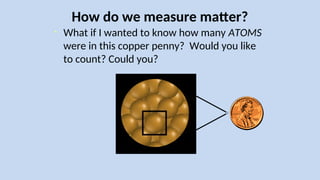
How do we measure matter?
• What if I wanted to know how many ATOMS
were in this copper penny? Would you like
to count? Could you?
Avogadro’s Number
• You can count particles if you introduce a term
that represents a specified number of particles.
• In chemistry, the term used to express a specific
number of particles is a mole.
Avogadro’s Number
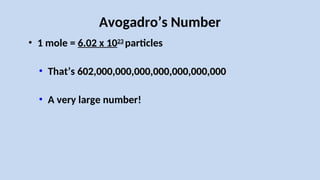
• 1 mole = 6.02 x 10²³
particles
• That’s 602,000,000,000,000,000,000,000
602,000,000,000,000,000,000,000
• A very large number!
Avogadro’s Number
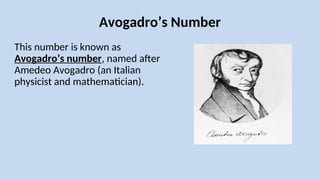
This number is known as
Avogadro’s number, named after
Amedeo Avogadro (an Italian
physicist and mathematician).
Representative Particles
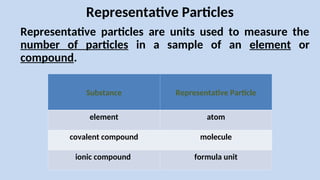
Representative particles are units used to measure the
number of particles in a sample of an element or
compound.
Substance Representative Particle
element atom
covalent compound molecule
ionic compound formula unit
Representative Particles
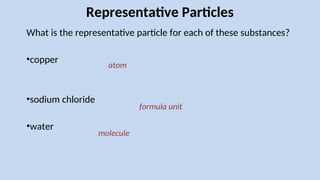
What is the representative particle for each of these substances?
•copper
•sodium chloride
•water
atom
molecule
formula unit
MOLE
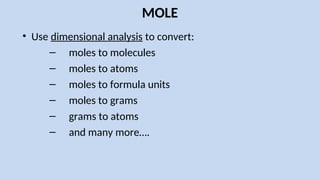
• Use dimensional analysis to convert:
– moles to molecules
– moles to atoms
– moles to formula units
– moles to grams
– grams to atoms
– and many more….
MOLE
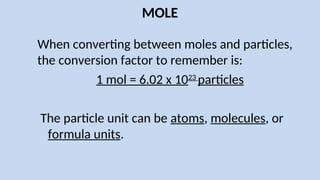
When converting between moles and particles,
the conversion factor to remember is:
1 mol = 6.02 x 10²³
particles
The particle unit can be atoms, molecules, or
formula units.
Mole/Particle Examples
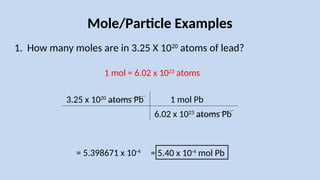
1. How many moles are in 3.25 X 10²⁰
atoms of lead?
3.25 x 10²⁰
atoms Pb
1 mol = 6.02 x 10²³
atoms
6.02 x 10²³
atoms Pb
1 mol Pb
= 5.398671 x 10-4
= 5.40 x 10⁻⁴
mol Pb
Mole/Particle Examples
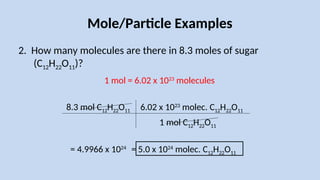
2. How many molecules are there in 8.3 moles of sugar
(C12H22O11)?
8.3 mol C12H22O11
1 mol = 6.02 x 10²³
molecules
6.02 x 10²³
molec. C12H22O11
1 mol C12H22O11
= 5.0 x 1024
molec. C12H22O11
= 4.9966 x 1024
Mole/Particle Examples
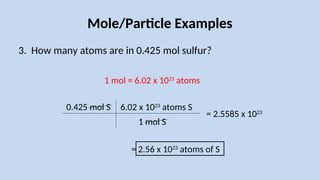
3. How many atoms are in 0.425 mol sulfur?
0.425 mol S
1 mol = 6.02 x 10²³
atoms
6.02 x 10²³
atoms S
1 mol S
= 2.56 x 10²³
atoms of S
= 2.5585 x 10²³
Mole/Particle Examples
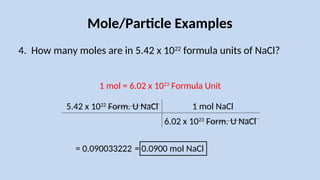
4. How many moles are in 5.42 x 10²²
formula units of NaCl?
5.42 x 10²²
Form. U NaCl
1 mol = 6.02 x 10²³
Formula Unit
6.02 x 10²³
Form. U NaCl
1 mol NaCl
= 0.090033222 = 0.0900 mol NaCl
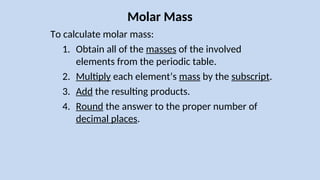
Molar Mass
molar mass – the mass in grams of one mole of an element or
compound.
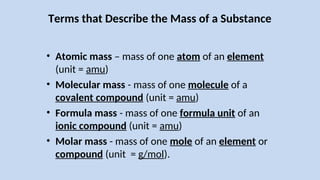
Terms that Describe the Mass of a Substance
• Atomic mass – mass of one atom of an element
(unit = amu)
• Molecular mass - mass of one molecule of a
covalent compound (unit = amu)
• Formula mass - mass of one formula unit of an
ionic compound (unit = amu)
• Molar mass - mass of one mole of an element or
compound (unit = g/mol).
Molar Mass
To calculate molar mass:
1. Obtain all of the masses of the involved
elements from the periodic table.
2. Multiply each element’s mass by the subscript.
3. Add the resulting products.
4. Round the answer to the proper number of
decimal places.
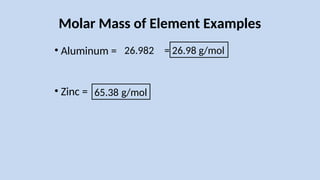
Molar Mass of Element Examples
• Aluminum =
• Zinc =
26.982 = 26.98 g/mol
65.38 g/mol
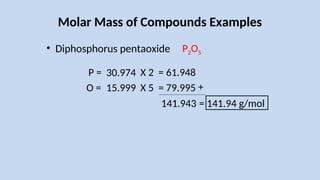
Molar Mass of Compounds Examples
• Diphosphorus pentaoxide P2O5
P =
O =
30.974
15.999
X 2
X 5
= 61.948
= 79.995 +
141.943 = 141.94 g/mol
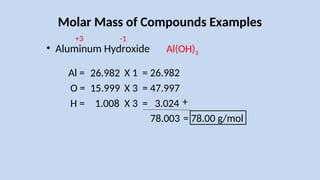
Molar Mass of Compounds Examples
• Aluminum Hydroxide Al(OH)3
Al =
O =
26.982
15.999
X 1
X 3
= 26.982
= 47.997
+
78.003 = 78.00 g/mol
H = 1.008 X 3 = 3.024
+3 -1
Molar Mass of Compounds
Examples
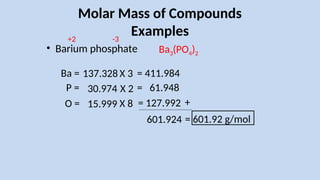
• Barium phosphate Ba3(PO4)2
Ba =
P =
137.328
30.974
X 3
X 2
= 411.984
= 61.948
+
601.924 = 601.92 g/mol
O = 15.999 X 8 = 127.992
+2 -3
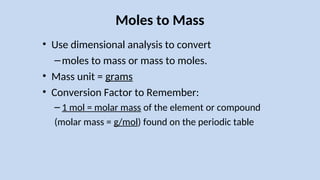
Moles to Mass
• Use dimensional analysis to convert
–moles to mass or mass to moles.
• Mass unit = grams
• Conversion Factor to Remember:
– 1 mol = molar mass of the element or compound
(molar mass = g/mol) found on the periodic table
Moles to Mass Examples
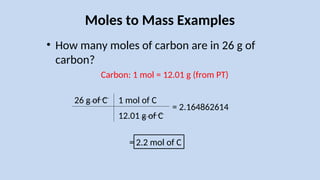
• How many moles of carbon are in 26 g of
carbon?
26 g of C
Carbon: 1 mol = 12.01 g (from PT)
1 mol of C
12.01 g of C
= 2.2 mol of C
= 2.164862614
Moles to Mass Examples
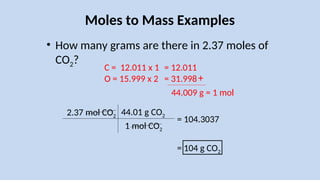
• How many grams are there in 2.37 moles of
CO2?
2.37 mol CO2
C = 12.011 x 1
O = 15.999 x 2
44.01 g CO2
1 mol CO2
= 104 g CO2
= 104.3037
= 12.011
= 31.998+
44.009 g = 1 mol
Moles to Mass Examples
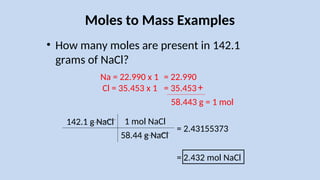
• How many moles are present in 142.1
grams of NaCl?
142.1 g NaCl
Na = 22.990 x 1
Cl = 35.453 x 1
1 mol NaCl
58.44 g NaCl
= 2.432 mol NaCl
= 2.43155373
= 22.990
= 35.453+
58.443 g = 1 mol
Moles to Mass Examples
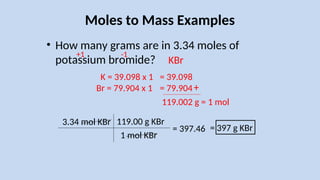
• How many grams are in 3.34 moles of
potassium bromide?
3.34 mol KBr
K = 39.098 x 1
Br = 79.904 x 1
119.00 g KBr
1 mol KBr
= 397 g KBr
= 397.46
= 39.098
= 79.904+
119.002 g = 1 mol
+1 -1
KBr
Molar Volume of a Gas
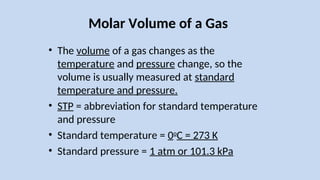
• The volume of a gas changes as the
temperature and pressure change, so the
volume is usually measured at standard
temperature and pressure.
• STP = abbreviation for standard temperature
and pressure
• Standard temperature = 0o
C = 273 K
• Standard pressure = 1 atm or 101.3 kPa
Molar Volume of a Gas
• At STP, one mole of any gas occupies the same
volume: 22.4 L.
Molar Volume of a Gas
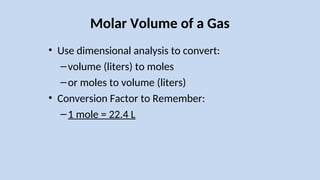
• Use dimensional analysis to convert:
–volume (liters) to moles
–or moles to volume (liters)
• Conversion Factor to Remember:
–1 mole = 22.4 L
Molar Volume of a Gas
Examples
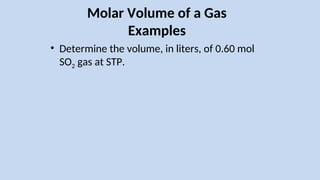
• Determine the volume, in liters, of 0.60 mol
SO2 gas at STP.
Molar Volume of a Gas
Examples
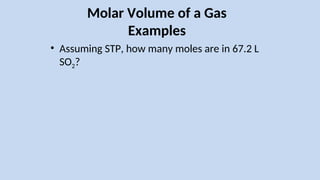
• Assuming STP, how many moles are in 67.2 L
SO2?
Molar Volume of a Gas
Examples
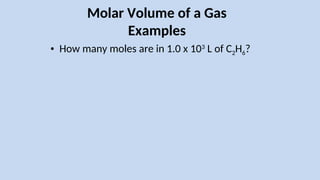
• How many moles are in 1.0 x 10³
L of C2H6?
Molar Volume of a Gas
Examples
• What is the volume at STP of 3.20 x10⁻³
mol
CO2?
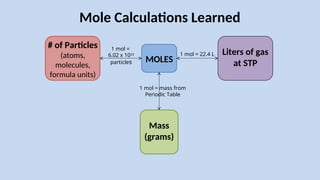
Mole Calculations Learned
MOLES
# of Particles
(atoms,
molecules,
formula units)
Mass
(grams)
Liters of gas
at STP
1 mol =
6.02 x 10²³
particles
1 mol = 22.4 L
1 mol = mass from
Periodic Table
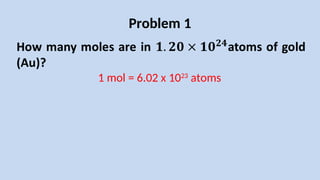
Problem 1
1 mol = 6.02 x 10²³
atoms
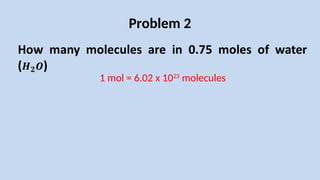
Problem 2
1 mol = 6.02 x 10²³
molecules
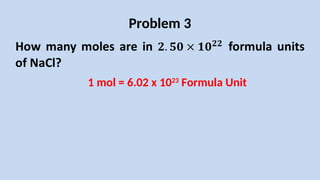
Problem 3
1 mol = 6.02 x 10²³
Formula Unit
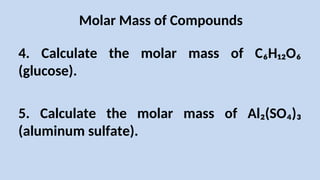
Molar Mass of Compounds
4. Calculate the molar mass of C₆H₁₂O₆
(glucose).
5. Calculate the molar mass of Al₂(SO₄)₃
(aluminum sulfate).

Grade 11 Physical Science Mole Notes.ppt

  • 1.
  • 2.
    How do wemeasure matter? By weight: We buy bananas by the _______________. By volume: Milk is sold by the ____________________. By counting: There are ________ students in class. kilo ml
  • 3.
    Chemical Quantities Many wordsare used to express a specific quantity.  Pair =  Dozen = 2 12
  • 4.
    How do wemeasure matter? • What if I wanted to know how many ATOMS were in this copper penny? Would you like to count? Could you?
  • 5.
    Avogadro’s Number • Youcan count particles if you introduce a term that represents a specified number of particles. • In chemistry, the term used to express a specific number of particles is a mole.
  • 6.
    Avogadro’s Number • 1mole = 6.02 x 10²³ particles • That’s 602,000,000,000,000,000,000,000 602,000,000,000,000,000,000,000 • A very large number!
  • 7.
    Avogadro’s Number This numberis known as Avogadro’s number, named after Amedeo Avogadro (an Italian physicist and mathematician).
  • 8.
    Representative Particles Representative particlesare units used to measure the number of particles in a sample of an element or compound. Substance Representative Particle element atom covalent compound molecule ionic compound formula unit
  • 9.
    Representative Particles What isthe representative particle for each of these substances? •copper •sodium chloride •water atom molecule formula unit
  • 10.
    MOLE • Use dimensionalanalysis to convert: – moles to molecules – moles to atoms – moles to formula units – moles to grams – grams to atoms – and many more….
  • 11.
    MOLE When converting betweenmoles and particles, the conversion factor to remember is: 1 mol = 6.02 x 10²³ particles The particle unit can be atoms, molecules, or formula units.
  • 12.
    Mole/Particle Examples 1. Howmany moles are in 3.25 X 10²⁰ atoms of lead? 3.25 x 10²⁰ atoms Pb 1 mol = 6.02 x 10²³ atoms 6.02 x 10²³ atoms Pb 1 mol Pb = 5.398671 x 10-4 = 5.40 x 10⁻⁴ mol Pb
  • 13.
    Mole/Particle Examples 2. Howmany molecules are there in 8.3 moles of sugar (C12H22O11)? 8.3 mol C12H22O11 1 mol = 6.02 x 10²³ molecules 6.02 x 10²³ molec. C12H22O11 1 mol C12H22O11 = 5.0 x 1024 molec. C12H22O11 = 4.9966 x 1024
  • 14.
    Mole/Particle Examples 3. Howmany atoms are in 0.425 mol sulfur? 0.425 mol S 1 mol = 6.02 x 10²³ atoms 6.02 x 10²³ atoms S 1 mol S = 2.56 x 10²³ atoms of S = 2.5585 x 10²³
  • 15.
    Mole/Particle Examples 4. Howmany moles are in 5.42 x 10²² formula units of NaCl? 5.42 x 10²² Form. U NaCl 1 mol = 6.02 x 10²³ Formula Unit 6.02 x 10²³ Form. U NaCl 1 mol NaCl = 0.090033222 = 0.0900 mol NaCl
  • 16.
    Molar Mass molar mass– the mass in grams of one mole of an element or compound.
  • 17.
    Terms that Describethe Mass of a Substance • Atomic mass – mass of one atom of an element (unit = amu) • Molecular mass - mass of one molecule of a covalent compound (unit = amu) • Formula mass - mass of one formula unit of an ionic compound (unit = amu) • Molar mass - mass of one mole of an element or compound (unit = g/mol).
  • 18.
    Molar Mass To calculatemolar mass: 1. Obtain all of the masses of the involved elements from the periodic table. 2. Multiply each element’s mass by the subscript. 3. Add the resulting products. 4. Round the answer to the proper number of decimal places.
  • 19.
    Molar Mass ofElement Examples • Aluminum = • Zinc = 26.982 = 26.98 g/mol 65.38 g/mol
  • 20.
    Molar Mass ofCompounds Examples • Diphosphorus pentaoxide P2O5 P = O = 30.974 15.999 X 2 X 5 = 61.948 = 79.995 + 141.943 = 141.94 g/mol
  • 21.
    Molar Mass ofCompounds Examples • Aluminum Hydroxide Al(OH)3 Al = O = 26.982 15.999 X 1 X 3 = 26.982 = 47.997 + 78.003 = 78.00 g/mol H = 1.008 X 3 = 3.024 +3 -1
  • 22.
    Molar Mass ofCompounds Examples • Barium phosphate Ba3(PO4)2 Ba = P = 137.328 30.974 X 3 X 2 = 411.984 = 61.948 + 601.924 = 601.92 g/mol O = 15.999 X 8 = 127.992 +2 -3
  • 23.
    Moles to Mass •Use dimensional analysis to convert –moles to mass or mass to moles. • Mass unit = grams • Conversion Factor to Remember: – 1 mol = molar mass of the element or compound (molar mass = g/mol) found on the periodic table
  • 24.
    Moles to MassExamples • How many moles of carbon are in 26 g of carbon? 26 g of C Carbon: 1 mol = 12.01 g (from PT) 1 mol of C 12.01 g of C = 2.2 mol of C = 2.164862614
  • 25.
    Moles to MassExamples • How many grams are there in 2.37 moles of CO2? 2.37 mol CO2 C = 12.011 x 1 O = 15.999 x 2 44.01 g CO2 1 mol CO2 = 104 g CO2 = 104.3037 = 12.011 = 31.998+ 44.009 g = 1 mol
  • 26.
    Moles to MassExamples • How many moles are present in 142.1 grams of NaCl? 142.1 g NaCl Na = 22.990 x 1 Cl = 35.453 x 1 1 mol NaCl 58.44 g NaCl = 2.432 mol NaCl = 2.43155373 = 22.990 = 35.453+ 58.443 g = 1 mol
  • 27.
    Moles to MassExamples • How many grams are in 3.34 moles of potassium bromide? 3.34 mol KBr K = 39.098 x 1 Br = 79.904 x 1 119.00 g KBr 1 mol KBr = 397 g KBr = 397.46 = 39.098 = 79.904+ 119.002 g = 1 mol +1 -1 KBr
  • 28.
    Molar Volume ofa Gas • The volume of a gas changes as the temperature and pressure change, so the volume is usually measured at standard temperature and pressure. • STP = abbreviation for standard temperature and pressure • Standard temperature = 0o C = 273 K • Standard pressure = 1 atm or 101.3 kPa
  • 29.
    Molar Volume ofa Gas • At STP, one mole of any gas occupies the same volume: 22.4 L.
  • 30.
    Molar Volume ofa Gas • Use dimensional analysis to convert: –volume (liters) to moles –or moles to volume (liters) • Conversion Factor to Remember: –1 mole = 22.4 L
  • 31.
    Molar Volume ofa Gas Examples • Determine the volume, in liters, of 0.60 mol SO2 gas at STP.
  • 32.
    Molar Volume ofa Gas Examples • Assuming STP, how many moles are in 67.2 L SO2?
  • 33.
    Molar Volume ofa Gas Examples • How many moles are in 1.0 x 10³ L of C2H6?
  • 34.
    Molar Volume ofa Gas Examples • What is the volume at STP of 3.20 x10⁻³ mol CO2?
  • 35.
    Mole Calculations Learned MOLES #of Particles (atoms, molecules, formula units) Mass (grams) Liters of gas at STP 1 mol = 6.02 x 10²³ particles 1 mol = 22.4 L 1 mol = mass from Periodic Table

  • 36.
    Problem 1 1 mol= 6.02 x 10²³ atoms
  • 37.
    Problem 2 1 mol= 6.02 x 10²³ molecules
  • 38.
    Problem 3 1 mol= 6.02 x 10²³ Formula Unit
  • 39.
    Molar Mass ofCompounds 4. Calculate the molar mass of C₆H₁₂O₆ (glucose). 5. Calculate the molar mass of Al₂(SO₄)₃ (aluminum sulfate).