Gwen Joy C.Tandoc
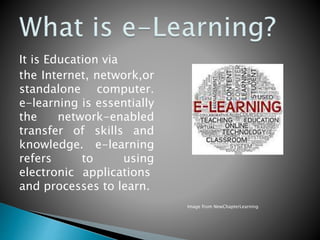
It is Education via
the Internet, network,or
standalone computer.
e-learning is essentially
the network-enabled
transfer of skills and
knowledge. e-learning
refers to using
electronic applications
and processes to learn.
Image from NewChapterLearning
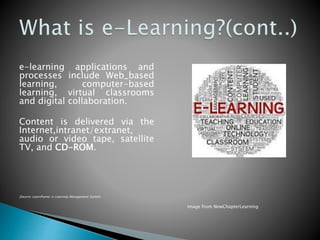
e-learning applications and
processes include Web_based
learning, computer-based
learning, virtual classrooms
and digital collaboration.
Content is delivered via the
Internet,intranet/extranet,
audio or video tape, satellite
TV, and CD-ROM.
[Source: Learnframe: e-Learning Management System
Image from NewChapterLearning
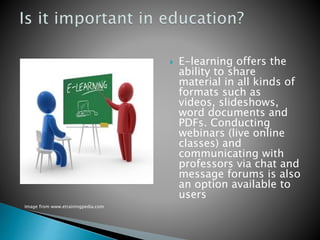
 E-learning offers the
ability to share
material in all kinds of
formats such as
videos, slideshows,
word documents and
PDFs. Conducting
webinars (live online
classes) and
communicating with
professors via chat and
message forums is also
an option available to
users
Image from www.etrainingpedia.com
 The importance of
E-learning is now a
given fact and it
can offer an
alternative that is
much faster,
cheaper and
potentially better
 www.talentlms.com
Image from blogs.articulate.com
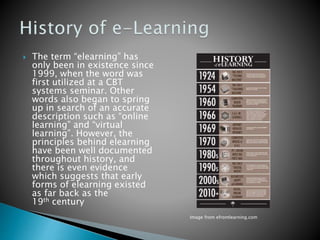
 The term “elearning” has
only been in existence since
1999, when the word was
first utilized at a CBT
systems seminar. Other
words also began to spring
up in search of an accurate
description such as “online
learning” and “virtual
learning”. However, the
principles behind elearning
have been well documented
throughout history, and
there is even evidence
which suggests that early
forms of elearning existed
as far back as the
19th century
Image from efrontlearning.com
 Filipino culture places a high
value on education. For the
majority of the Filipinos, the
only best thing for a child to
acquire and secure a better
future is through education.
So, they want more effective
education system. E-Learning
is still an emerging market in
the Philippines. Its use is still
sporadic and most users
represent only a small segment
of the Philippines education
and business communities.
 www.researchgate.net
Image from newsbytes.ph
 The use of e-
Learning is still
sporadic in the
Philippines. The
same is true with
the Philippine
College of Science
and Technology.
 Lower costs. When corporations replace
instructor-based training with e-learning,
they save big. Thanks to e-learning, trainers
can build a course once and use it over and
over again. This means they can focus their
efforts on creating new training courses,
resulting in increased productivity. Not to
mention that employees spend less time
traveling, so they have more time to
concentrate on doing the actual work
 Faster delivery. Organizing training sessions
can be time-consuming and expensive. With
e-learning, employees can get the training
they need, when they need it. And the sooner
your employees learn new skills, the sooner
your organization will reap the benefit
 Increased reach. The world is moving faster
than ever. Employees expect their training to
be mobile, just like they are.
 Eco-friendly. Reduced travel means reduced
CO2 emissions! That’s something
you and your learners can feel good about.
 Personalized training experience. One of the
hardest things about face-to-face instruction
is that you have to adapt your course for
learners coming from a variety of
backgrounds. With e-learning, learners can
advance at their own pace. You can even
build different learning paths into your
course, providing learners with a more
personalized experience
 Motivation. Some people contend that
employees have to be extremely motivated to
get something out of online training. I would
argue that the same is true for in-class
training. Just because you’re in the room
doesn’t mean you’re learning. As e-learning
course developers, it’s our job to make our
courses engaging to ensure our learners pay
attention and soak up the information
 Less face-to-face interaction. One thing
people worry about with e-learning is
isolation. Won’t learners miss out on
discussions with peers? How will learners ask
questions? There are many ways to
counteract this potential for isolation, for
example, by recreating the social aspect of
training online, via discussion boards or
instant messaging, or by supplementing e-
learning courses with in-class sessions
 Access to technology. By definition, e-
learning requires learners to access courses
using some sort of technology. If they don’t
have the device or Internet connection
required, they won’t be able to take the
course. The best way to avoid this kind of
problem is to identify the learner
environment prior to development.
elearningindustry.com/advantages-and-disadvantages-of-online-learning

The Impact of E learning

  • 1.
  • 2.
    It is Educationvia the Internet, network,or standalone computer. e-learning is essentially the network-enabled transfer of skills and knowledge. e-learning refers to using electronic applications and processes to learn. Image from NewChapterLearning
  • 3.
    e-learning applications and processesinclude Web_based learning, computer-based learning, virtual classrooms and digital collaboration. Content is delivered via the Internet,intranet/extranet, audio or video tape, satellite TV, and CD-ROM. [Source: Learnframe: e-Learning Management System Image from NewChapterLearning
  • 4.
     E-learning offersthe ability to share material in all kinds of formats such as videos, slideshows, word documents and PDFs. Conducting webinars (live online classes) and communicating with professors via chat and message forums is also an option available to users Image from www.etrainingpedia.com
  • 5.
     The importanceof E-learning is now a given fact and it can offer an alternative that is much faster, cheaper and potentially better  www.talentlms.com Image from blogs.articulate.com
  • 6.
     The term“elearning” has only been in existence since 1999, when the word was first utilized at a CBT systems seminar. Other words also began to spring up in search of an accurate description such as “online learning” and “virtual learning”. However, the principles behind elearning have been well documented throughout history, and there is even evidence which suggests that early forms of elearning existed as far back as the 19th century Image from efrontlearning.com
  • 7.
     Filipino cultureplaces a high value on education. For the majority of the Filipinos, the only best thing for a child to acquire and secure a better future is through education. So, they want more effective education system. E-Learning is still an emerging market in the Philippines. Its use is still sporadic and most users represent only a small segment of the Philippines education and business communities.  www.researchgate.net Image from newsbytes.ph
  • 8.
     The useof e- Learning is still sporadic in the Philippines. The same is true with the Philippine College of Science and Technology.
  • 9.
     Lower costs.When corporations replace instructor-based training with e-learning, they save big. Thanks to e-learning, trainers can build a course once and use it over and over again. This means they can focus their efforts on creating new training courses, resulting in increased productivity. Not to mention that employees spend less time traveling, so they have more time to concentrate on doing the actual work
  • 10.
     Faster delivery.Organizing training sessions can be time-consuming and expensive. With e-learning, employees can get the training they need, when they need it. And the sooner your employees learn new skills, the sooner your organization will reap the benefit
  • 11.
     Increased reach.The world is moving faster than ever. Employees expect their training to be mobile, just like they are.  Eco-friendly. Reduced travel means reduced CO2 emissions! That’s something you and your learners can feel good about.
  • 12.
     Personalized trainingexperience. One of the hardest things about face-to-face instruction is that you have to adapt your course for learners coming from a variety of backgrounds. With e-learning, learners can advance at their own pace. You can even build different learning paths into your course, providing learners with a more personalized experience
  • 13.
     Motivation. Somepeople contend that employees have to be extremely motivated to get something out of online training. I would argue that the same is true for in-class training. Just because you’re in the room doesn’t mean you’re learning. As e-learning course developers, it’s our job to make our courses engaging to ensure our learners pay attention and soak up the information
  • 14.
     Less face-to-faceinteraction. One thing people worry about with e-learning is isolation. Won’t learners miss out on discussions with peers? How will learners ask questions? There are many ways to counteract this potential for isolation, for example, by recreating the social aspect of training online, via discussion boards or instant messaging, or by supplementing e- learning courses with in-class sessions
  • 15.
     Access totechnology. By definition, e- learning requires learners to access courses using some sort of technology. If they don’t have the device or Internet connection required, they won’t be able to take the course. The best way to avoid this kind of problem is to identify the learner environment prior to development. elearningindustry.com/advantages-and-disadvantages-of-online-learning