1
2
Title…
7.2
7.3
Why invest into the design and development of CE tools?
Tools for delivering and facilitating CE are many and varied.
Understanding the breadth of tools available, ensures you are best
positioned to design, develop or make an informed selection. Selecting
the right tool for the right job is key to respond effectively to the
specific consumer context and learning preferences of your customers
and to achieve your CEBB objectives.
Why invest into the design and development of CE tools?
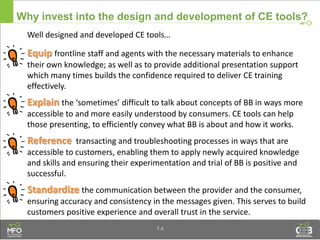
Well designed and developed CE tools…
Equip frontline staff and agents with the necessary materials to enhance
their own knowledge; as well as to provide additional presentation support
which many times builds the confidence required to deliver CE training
effectively.
Explain the ‘sometimes’ difficult to talk about concepts of BB in ways more
accessible to and more easily understood by consumers. CE tools can help
those presenting, to efficiently convey what BB is about and how it works.
Reference transacting and troubleshooting processes in ways that are
accessible to customers, enabling them to apply newly acquired knowledge
and skills and ensuring their experimentation and trial of BB is positive and
successful.
Standardize the communication between the provider and the consumer,
ensuring accuracy and consistency in the messages given. This serves to build
customers positive experience and overall trust in the service.
7.4
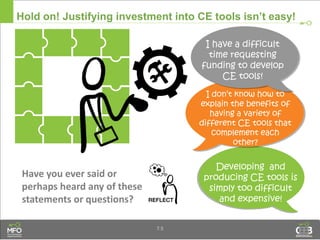
Have you ever said or
perhaps heard any of these
statements or questions?
I have a difficult
time requesting
funding to develop
CE tools!
I don’t know how to
explain the benefits of
having a variety of
different CE tools that
complement each
other?
Developing and
producing CE tools is
simply too difficult
and expensive!
Hold on! Justifying investment into CE tools isn’t easy!
7.5
6
CASE STUDY…
What do you think you could do to help
merchant’s solve this problem?
Have you faced a similar challenge in your
organization? If so, how did you manage it?
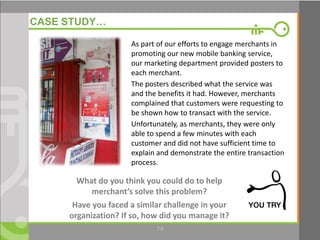
As part of our efforts to engage merchants in
promoting our new mobile banking service,
our marketing department provided posters to
each merchant.
The posters described what the service was
and the benefits it had. However, merchants
complained that customers were requesting to
be shown how to transact with the service.
Unfortunately, as merchants, they were only
able to spend a few minutes with each
customer and did not have sufficient time to
explain and demonstrate the entire transaction
process.
7.6
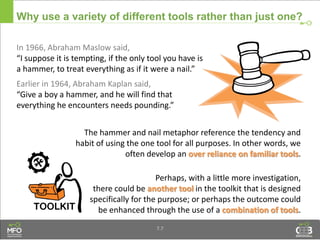
In 1966, Abraham Maslow said,
“I suppose it is tempting, if the only tool you have is
a hammer, to treat everything as if it were a nail.”
Earlier in 1964, Abraham Kaplan said,
“Give a boy a hammer, and he will find that
everything he encounters needs pounding.”
Why use a variety of different tools rather than just one?
The hammer and nail metaphor reference the tendency and
habit of using the one tool for all purposes. In other words, we
often develop an over reliance on familiar tools.
Perhaps, with a little more investigation,
there could be another tool in the toolkit that is designed
specifically for the purpose; or perhaps the outcome could
be enhanced through the use of a combination of tools.
7.7
Why use a variety of different tools rather than just one?
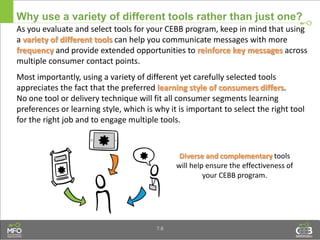
As you evaluate and select tools for your CEBB program, keep in mind that using
a variety of different tools can help you communicate messages with more
frequency and provide extended opportunities to reinforce key messages across
multiple consumer contact points.
Most importantly, using a variety of different yet carefully selected tools
appreciates the fact that the preferred learning style of consumers differs.
No one tool or delivery technique will fit all consumer segments learning
preferences or learning style, which is why it is important to select the right tool
for the right job and to engage multiple tools.
Diverse and complementary tools
will help ensure the effectiveness of
your CEBB program.
7.8
9
Why is it important to carefully
evaluate CE tools before
selecting which tools to use in
your CEBB program?
7.9
10
Title…
7.10
Sometimes a really simple tool is all you need to create meaningful impact.
On other occasions, a more multifaceted repertoire is needed to be effective.
It is important when building out your CEBB strategy, to select the most fitting
tools for the job depending on the the objective that you want to achieve
through the tool, the learning preferences of your customer, the depth of
message that you need to convey, the outreach target, and your available
budget.
Building out your CEBB Strategy…
But how does one choose the
right tool or tools to use in
their CEBB strategy, especially
when there are so many options
and combinations available?
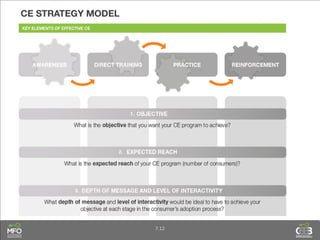
As you take the time to consider which tools will be the most effective in helping you
achieve your CEBB outcomes, keep in mind the component parts of your CEBB strategy…
7.11
7.12
7.13
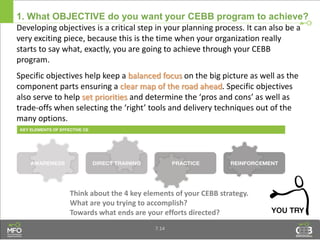
1. What OBJECTIVE do you want your CEBB program to achieve?
Developing objectives is a critical step in your planning process. It can also be a
very exciting piece, because this is the time when your organization really
starts to say what, exactly, you are going to achieve through your CEBB
program.
Specific objectives help keep a balanced focus on the big picture as well as the
component parts ensuring a clear map of the road ahead. Specific objectives
also serve to help set priorities and determine the ‘pros and cons’ as well as
trade-offs when selecting the ‘right’ tools and delivery techniques out of the
many options.
Think about the 4 key elements of your CEBB strategy.
What are you trying to accomplish?
Towards what ends are your efforts directed?
7.14
15
CASE STUDY… Selecting the Right Tools
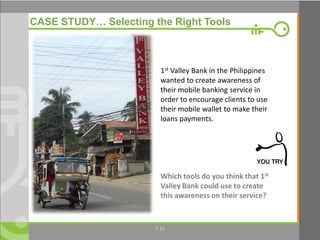
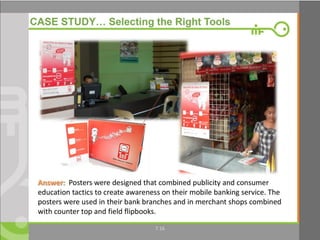
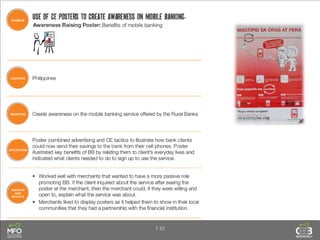
1st Valley Bank in the Philippines
wanted to create awareness of
their mobile banking service in
order to encourage clients to use
their mobile wallet to make their
loans payments.
Which tools do you think that 1st
Valley Bank could use to create
this awareness on their service?
7.15
2. What is the expected REACH of your CEBB program?
7.17
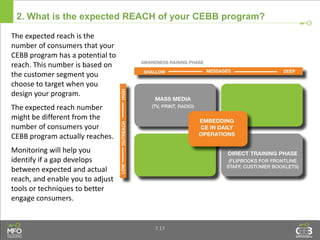
The expected reach is the
number of consumers that your
CEBB program has a potential to
reach. This number is based on
the customer segment you
choose to target when you
design your program.
The expected reach number
might be different from the
number of consumers your
CEBB program actually reaches.
Monitoring will help you
identify if a gap develops
between expected and actual
reach, and enable you to adjust
tools or techniques to better
engage consumers.
2. What is the expected REACH of your CEBB program?
7.18
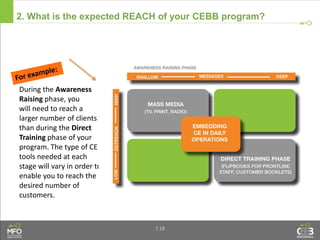
During the Awareness
Raising phase, you
will need to reach a
larger number of clients
than during the Direct
Training phase of your
program. The type of CE
tools needed at each
stage will vary in order to
enable you to reach the
desired number of
customers.
3. What DEPTH OF MESSAGE is required?
7.19
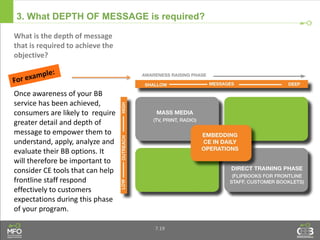
What is the depth of message
that is required to achieve the
objective?
Once awareness of your BB
service has been achieved,
consumers are likely to require
greater detail and depth of
message to empower them to
understand, apply, analyze and
evaluate their BB options. It
will therefore be important to
consider CE tools that can help
frontline staff respond
effectively to customers
expectations during this phase
of your program.
3. What level of INTERACTIVITY would be ideal?
7.20
The aspect of experience is an important consideration in creating an effective learning
opportunity for consumers. When considering what level of interactivity should be
incorporated into the tool design or selection, it is important to remember: Consumers
have the need to know why they are learning something; Consumers learn through
doing; Consumers are problem-solvers; and Consumers absorb and retain the most
when the information is of immediate use.
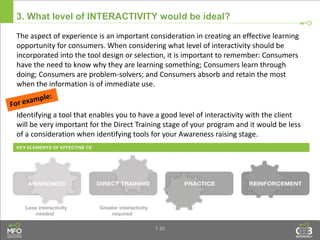
Identifying a tool that enables you to have a good level of interactivity with the client
will be very important for the Direct Training stage of your program and it would be less
of a consideration when identifying tools for your Awareness raising stage.
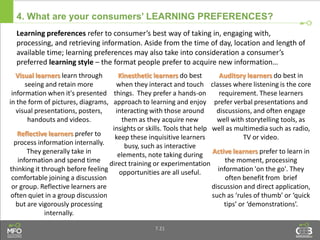
4. What are your consumers’ LEARNING PREFERENCES?
Learning preferences refer to consumer’s best way of taking in, engaging with,
processing, and retrieving information. Aside from the time of day, location and length of
available time; learning preferences may also take into consideration a consumer’s
preferred learning style – the format people prefer to acquire new information…
7.21
Visual learners learn through
seeing and retain more
information when it's presented
in the form of pictures, diagrams,
visual presentations, posters,
handouts and videos.
Reflective learners prefer to
process information internally.
They generally take in
information and spend time
thinking it through before feeling
comfortable joining a discussion
or group. Reflective learners are
often quiet in a group discussion
but are vigorously processing
internally.
Kinesthetic learners do best
when they interact and touch
things. They prefer a hands-on
approach to learning and enjoy
interacting with those around
them as they acquire new
insights or skills. Tools that help
keep these inquisitive learners
busy, such as interactive
elements, note taking during
direct training or experimentation
opportunities are all useful.
Auditory learners do best in
classes where listening is the core
requirement. These learners
prefer verbal presentations and
discussions, and often engage
well with storytelling tools, as
well as multimedia such as radio,
TV or video.
Active learners prefer to learn in
the moment, processing
information 'on the go'. They
often benefit from brief
discussion and direct application,
such as ‘rules of thumb’ or ‘quick
tips’ or ‘demonstrations’.
4. What are your consumers’ LEARNING PREFERENCES?
Review the results of your MR findings in Module 4 Identifying Consumer
Needs (time of day, location, length of available time, preferred learning
style) to identify the way in which your customers prefer to learn, including
time of day, location, etc…
Consider the accessibility of the tool to the customer.
If the majority of your customers have low literacy levels and speak a variety of
local languages which are mainly oral and not written languages you might want to
consider using posters with a lot of illustrations and very few text or DVDs rather
than tools that would require customers to read through messages.
7.22
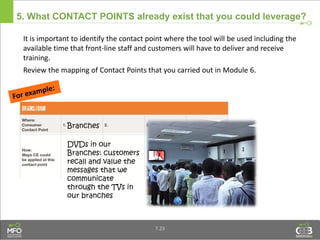
5. What CONTACT POINTS already exist that you could leverage?
It is important to identify the contact point where the tool will be used including the
available time that front-line staff and customers will have to deliver and receive
training.
Review the mapping of Contact Points that you carried out in Module 6.
7.23
DVDs in our
Branches: customers
recall and value the
messages that we
communicate
through the TVs in
our branches
Branches
© Microfinance Opportunities 2013 24
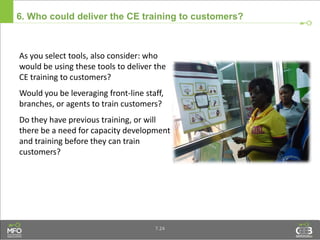
6. Who could deliver the CE training to customers?
7.24
As you select tools, also consider: who
would be using these tools to deliver the
CE training to customers?
Would you be leveraging front-line staff,
branches, or agents to train customers?
Do they have previous training, or will
there be a need for capacity development
and training before they can train
customers?
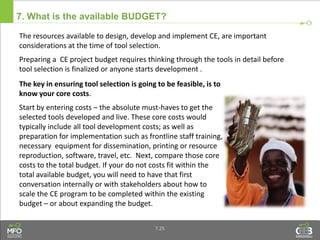
7. What is the available BUDGET?
The key in ensuring tool selection is going to be feasible, is to
know your core costs.
Start by entering costs – the absolute must-haves to get the
selected tools developed and live. These core costs would
typically include all tool development costs; as well as
preparation for implementation such as frontline staff training,
necessary equipment for dissemination, printing or resource
reproduction, software, travel, etc. Next, compare those core
costs to the total budget. If your do not costs fit within the
total available budget, you will need to have that first
conversation internally or with stakeholders about how to
scale the CE program to be completed within the existing
budget – or about expanding the budget.
The resources available to design, develop and implement CE, are important
considerations at the time of tool selection.
Preparing a CE project budget requires thinking through the tools in detail before
tool selection is finalized or anyone starts development .
7.25
26
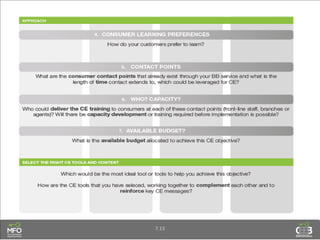
What are the component parts of
your CEBB strategy, that determine
the selection of the right tools for
each CE element: awareness, direct
training, practice, reinforcement?
7.26
277.27
How can various tools be used for CEBB?
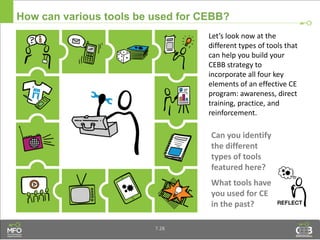
Let’s look now at the
different types of tools that
can help you build your
CEBB strategy to
incorporate all four key
elements of an effective CE
program: awareness, direct
training, practice, and
reinforcement.
Can you identify
the different
types of tools
featured here?
What tools have
you used for CE
in the past?
7.28
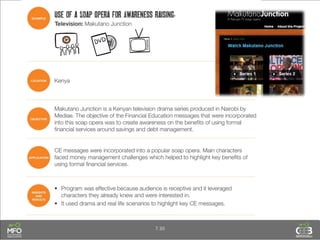
Mass Media…
Other considerations:
Messages need to be concise and efficient
Messages might need to be not too deep
Can be costly if it fails to reach scale
Used in isolation without complementary tools and
techniques, there may be little or no interactivity
between the customer and the tool, and the
customer might have no way to practice the new
learning
Requires more time and collaboration with mass
media channels to implement
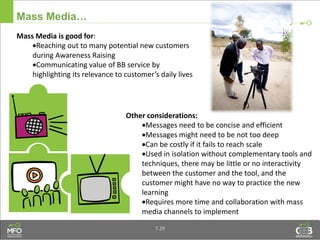
Mass Media is good for:
Reaching out to many potential new customers
during Awareness Raising
Communicating value of BB service by
highlighting its relevance to customer’s daily lives
7.29
7.30
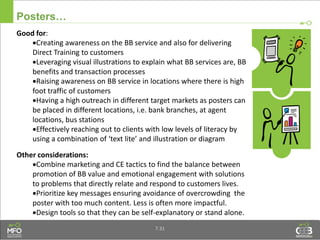
Posters…
Good for:
Creating awareness on the BB service and also for delivering
Direct Training to customers
Leveraging visual illustrations to explain what BB services are, BB
benefits and transaction processes
Raising awareness on BB service in locations where there is high
foot traffic of customers
Having a high outreach in different target markets as posters can
be placed in different locations, i.e. bank branches, at agent
locations, bus stations
Effectively reaching out to clients with low levels of literacy by
using a combination of ‘text lite’ and illustration or diagram
Other considerations:
Combine marketing and CE tactics to find the balance between
promotion of BB value and emotional engagement with solutions
to problems that directly relate and respond to customers lives.
Prioritize key messages ensuring avoidance of overcrowding the
poster with too much content. Less is often more impactful.
Design tools so that they can be self-explanatory or stand alone.
7.31
7.32
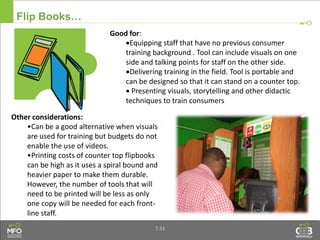
Flip Books…
Other considerations:
•Can be a good alternative when visuals
are used for training but budgets do not
enable the use of videos.
•Printing costs of counter top flipbooks
can be high as it uses a spiral bound and
heavier paper to make them durable.
However, the number of tools that will
need to be printed will be less as only
one copy will be needed for each front-
line staff.
Good for:
Equipping staff that have no previous consumer
training background . Tool can include visuals on one
side and talking points for staff on the other side.
Delivering training in the field. Tool is portable and
can be designed so that it can stand on a counter top.
 Presenting visuals, storytelling and other didactic
techniques to train consumers
7.33
7.34
Customer Activity Books…
Other considerations:
•Can expand and complement messages delivered through the
flip book or posters, for customers that do decide to sign up for
service.
•Can also be used as a take away for customers that sign up to
use the service.
•Printing costs could be high. However, investment in tool can
pay off as it can have an important multiplier effect - customers
can share the booklets with family and friends increasing the
potential number of people who receive CE. To keep costs down,
reduce the number of pages and print tool in two colors.
Good for:
Supporting customers through the trial phase of the BB service: Presenting step-by-
step the process for transacting so that customers can use it as a reference material
Illustrating how security (PIN) and proof of transaction (SMS) features work;
providing answers to FAQ and communicating troubleshooting tips.
Taking learning one step further by enabling customers to put into practice
knowledge and skills acquired.
7.35
7.36
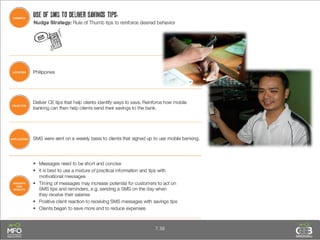
SMS or Automated Voice Messaging…
Good for:
Reinforcing key CE messages on the BB service and money
management
Highlighting synergies between BB and money management,
i.e. BB enables you to send your savings to the bank no matter how
small the amount is.
Communicating tips around money management topics such as
savings or debt management
Other considerations:
•Requires capacity to deliver SMS to customers that signed up to use service.
•Cell phone numbers of customers need to be updated and accurate.
•Who will pay for the SMS? If customers have to pay for the SMS received they will be less
likely to be willing or able to receive them.
•Customers might already be saturated with SMS as promotional tools or reminders for
loan payments therefore may be desensitized to incoming messages through this channel.
•Customers may be suspicious of or distrust the source of the SMS unless aware that the
message come from a recognized number associated to their telco or financial institution.
•SMS have potential to increase outreach (cascade) as customers share messages with
family, friends and co-workers
•Use of SMS allow learning to occur conveniently, integrating CE into learner’s daily life
7.37
7.38
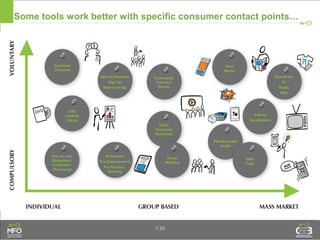
Some tools work better with specific consumer contact points…
7.39
Pre-Recorded
Jingle
40
How are the CE tools you have
selected for your CEBB
program, working together to
complement each other and
reinforce key BB messages?
7.40
417.41
Review the CE tools identified for your CEBB program…
Now that you have seen a selection of different types of CE tools that could be used in a
CEBB program, let’s revisit the choice of tools that you had included in the
brainstorming exercise in Module Six ‘Mapping Consumer Contact Points’.
As you revise your choice of CE tools for your CEBB program, keep in mind the
considerations outlined at the beginning of the module, including :
the objective that you want to achieve through the tool…
the learning preferences of your customers…
the outreach target…
the depth of message that you need to convey…
the level of interactivity that would be ideal to provide…
the contact points where the tool will be used ...
the available time that frontline staff have to deliver CE…
the available time consumers have to receive CE…
the accessibility of the tool to the consumer…
your available budget…
7.42
43
Apply …Take each CE tool you have
selected, content and dissemination
possibilities, and evaluate their ability
to support the ultimate achievement
of your CEBB objectives.
Integrate your final tool selection into
your CEBB strategy.
7.43
Integrate your tool selection into your CEBB strategy…
7.44
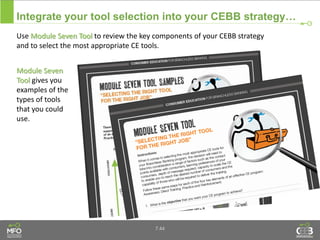
Use Module Seven Tool to review the key components of your CEBB strategy
and to select the most appropriate CE tools.
Module Seven
Tool gives you
examples of the
types of tools
that you could
use.

Module 7 selecting the right tools for the right job ppt slideshare

  • 1.
  • 2.
  • 3.
    7.3 Why invest intothe design and development of CE tools? Tools for delivering and facilitating CE are many and varied. Understanding the breadth of tools available, ensures you are best positioned to design, develop or make an informed selection. Selecting the right tool for the right job is key to respond effectively to the specific consumer context and learning preferences of your customers and to achieve your CEBB objectives.
  • 4.
    Why invest intothe design and development of CE tools? Well designed and developed CE tools… Equip frontline staff and agents with the necessary materials to enhance their own knowledge; as well as to provide additional presentation support which many times builds the confidence required to deliver CE training effectively. Explain the ‘sometimes’ difficult to talk about concepts of BB in ways more accessible to and more easily understood by consumers. CE tools can help those presenting, to efficiently convey what BB is about and how it works. Reference transacting and troubleshooting processes in ways that are accessible to customers, enabling them to apply newly acquired knowledge and skills and ensuring their experimentation and trial of BB is positive and successful. Standardize the communication between the provider and the consumer, ensuring accuracy and consistency in the messages given. This serves to build customers positive experience and overall trust in the service. 7.4
  • 5.
    Have you eversaid or perhaps heard any of these statements or questions? I have a difficult time requesting funding to develop CE tools! I don’t know how to explain the benefits of having a variety of different CE tools that complement each other? Developing and producing CE tools is simply too difficult and expensive! Hold on! Justifying investment into CE tools isn’t easy! 7.5
  • 6.
    6 CASE STUDY… What doyou think you could do to help merchant’s solve this problem? Have you faced a similar challenge in your organization? If so, how did you manage it? As part of our efforts to engage merchants in promoting our new mobile banking service, our marketing department provided posters to each merchant. The posters described what the service was and the benefits it had. However, merchants complained that customers were requesting to be shown how to transact with the service. Unfortunately, as merchants, they were only able to spend a few minutes with each customer and did not have sufficient time to explain and demonstrate the entire transaction process. 7.6
  • 7.
    In 1966, AbrahamMaslow said, “I suppose it is tempting, if the only tool you have is a hammer, to treat everything as if it were a nail.” Earlier in 1964, Abraham Kaplan said, “Give a boy a hammer, and he will find that everything he encounters needs pounding.” Why use a variety of different tools rather than just one? The hammer and nail metaphor reference the tendency and habit of using the one tool for all purposes. In other words, we often develop an over reliance on familiar tools. Perhaps, with a little more investigation, there could be another tool in the toolkit that is designed specifically for the purpose; or perhaps the outcome could be enhanced through the use of a combination of tools. 7.7
  • 8.
    Why use avariety of different tools rather than just one? As you evaluate and select tools for your CEBB program, keep in mind that using a variety of different tools can help you communicate messages with more frequency and provide extended opportunities to reinforce key messages across multiple consumer contact points. Most importantly, using a variety of different yet carefully selected tools appreciates the fact that the preferred learning style of consumers differs. No one tool or delivery technique will fit all consumer segments learning preferences or learning style, which is why it is important to select the right tool for the right job and to engage multiple tools. Diverse and complementary tools will help ensure the effectiveness of your CEBB program. 7.8
  • 9.
    9 Why is itimportant to carefully evaluate CE tools before selecting which tools to use in your CEBB program? 7.9
  • 10.
  • 11.
    Sometimes a reallysimple tool is all you need to create meaningful impact. On other occasions, a more multifaceted repertoire is needed to be effective. It is important when building out your CEBB strategy, to select the most fitting tools for the job depending on the the objective that you want to achieve through the tool, the learning preferences of your customer, the depth of message that you need to convey, the outreach target, and your available budget. Building out your CEBB Strategy… But how does one choose the right tool or tools to use in their CEBB strategy, especially when there are so many options and combinations available? As you take the time to consider which tools will be the most effective in helping you achieve your CEBB outcomes, keep in mind the component parts of your CEBB strategy… 7.11
  • 12.
  • 13.
  • 14.
    1. What OBJECTIVEdo you want your CEBB program to achieve? Developing objectives is a critical step in your planning process. It can also be a very exciting piece, because this is the time when your organization really starts to say what, exactly, you are going to achieve through your CEBB program. Specific objectives help keep a balanced focus on the big picture as well as the component parts ensuring a clear map of the road ahead. Specific objectives also serve to help set priorities and determine the ‘pros and cons’ as well as trade-offs when selecting the ‘right’ tools and delivery techniques out of the many options. Think about the 4 key elements of your CEBB strategy. What are you trying to accomplish? Towards what ends are your efforts directed? 7.14
  • 15.
    15 CASE STUDY… Selectingthe Right Tools 1st Valley Bank in the Philippines wanted to create awareness of their mobile banking service in order to encourage clients to use their mobile wallet to make their loans payments. Which tools do you think that 1st Valley Bank could use to create this awareness on their service? 7.15
  • 17.
    2. What isthe expected REACH of your CEBB program? 7.17 The expected reach is the number of consumers that your CEBB program has a potential to reach. This number is based on the customer segment you choose to target when you design your program. The expected reach number might be different from the number of consumers your CEBB program actually reaches. Monitoring will help you identify if a gap develops between expected and actual reach, and enable you to adjust tools or techniques to better engage consumers.
  • 18.
    2. What isthe expected REACH of your CEBB program? 7.18 During the Awareness Raising phase, you will need to reach a larger number of clients than during the Direct Training phase of your program. The type of CE tools needed at each stage will vary in order to enable you to reach the desired number of customers.
  • 19.
    3. What DEPTHOF MESSAGE is required? 7.19 What is the depth of message that is required to achieve the objective? Once awareness of your BB service has been achieved, consumers are likely to require greater detail and depth of message to empower them to understand, apply, analyze and evaluate their BB options. It will therefore be important to consider CE tools that can help frontline staff respond effectively to customers expectations during this phase of your program.
  • 20.
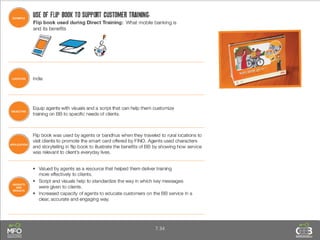
    3. What levelof INTERACTIVITY would be ideal? 7.20 The aspect of experience is an important consideration in creating an effective learning opportunity for consumers. When considering what level of interactivity should be incorporated into the tool design or selection, it is important to remember: Consumers have the need to know why they are learning something; Consumers learn through doing; Consumers are problem-solvers; and Consumers absorb and retain the most when the information is of immediate use. Identifying a tool that enables you to have a good level of interactivity with the client will be very important for the Direct Training stage of your program and it would be less of a consideration when identifying tools for your Awareness raising stage.
  • 21.
    4. What areyour consumers’ LEARNING PREFERENCES? Learning preferences refer to consumer’s best way of taking in, engaging with, processing, and retrieving information. Aside from the time of day, location and length of available time; learning preferences may also take into consideration a consumer’s preferred learning style – the format people prefer to acquire new information… 7.21 Visual learners learn through seeing and retain more information when it's presented in the form of pictures, diagrams, visual presentations, posters, handouts and videos. Reflective learners prefer to process information internally. They generally take in information and spend time thinking it through before feeling comfortable joining a discussion or group. Reflective learners are often quiet in a group discussion but are vigorously processing internally. Kinesthetic learners do best when they interact and touch things. They prefer a hands-on approach to learning and enjoy interacting with those around them as they acquire new insights or skills. Tools that help keep these inquisitive learners busy, such as interactive elements, note taking during direct training or experimentation opportunities are all useful. Auditory learners do best in classes where listening is the core requirement. These learners prefer verbal presentations and discussions, and often engage well with storytelling tools, as well as multimedia such as radio, TV or video. Active learners prefer to learn in the moment, processing information 'on the go'. They often benefit from brief discussion and direct application, such as ‘rules of thumb’ or ‘quick tips’ or ‘demonstrations’.
  • 22.
    4. What areyour consumers’ LEARNING PREFERENCES? Review the results of your MR findings in Module 4 Identifying Consumer Needs (time of day, location, length of available time, preferred learning style) to identify the way in which your customers prefer to learn, including time of day, location, etc… Consider the accessibility of the tool to the customer. If the majority of your customers have low literacy levels and speak a variety of local languages which are mainly oral and not written languages you might want to consider using posters with a lot of illustrations and very few text or DVDs rather than tools that would require customers to read through messages. 7.22
  • 23.
    5. What CONTACTPOINTS already exist that you could leverage? It is important to identify the contact point where the tool will be used including the available time that front-line staff and customers will have to deliver and receive training. Review the mapping of Contact Points that you carried out in Module 6. 7.23 DVDs in our Branches: customers recall and value the messages that we communicate through the TVs in our branches Branches
  • 24.
    © Microfinance Opportunities2013 24 6. Who could deliver the CE training to customers? 7.24 As you select tools, also consider: who would be using these tools to deliver the CE training to customers? Would you be leveraging front-line staff, branches, or agents to train customers? Do they have previous training, or will there be a need for capacity development and training before they can train customers?
  • 25.
    7. What isthe available BUDGET? The key in ensuring tool selection is going to be feasible, is to know your core costs. Start by entering costs – the absolute must-haves to get the selected tools developed and live. These core costs would typically include all tool development costs; as well as preparation for implementation such as frontline staff training, necessary equipment for dissemination, printing or resource reproduction, software, travel, etc. Next, compare those core costs to the total budget. If your do not costs fit within the total available budget, you will need to have that first conversation internally or with stakeholders about how to scale the CE program to be completed within the existing budget – or about expanding the budget. The resources available to design, develop and implement CE, are important considerations at the time of tool selection. Preparing a CE project budget requires thinking through the tools in detail before tool selection is finalized or anyone starts development . 7.25
  • 26.
    26 What are thecomponent parts of your CEBB strategy, that determine the selection of the right tools for each CE element: awareness, direct training, practice, reinforcement? 7.26
  • 27.
  • 28.
    How can varioustools be used for CEBB? Let’s look now at the different types of tools that can help you build your CEBB strategy to incorporate all four key elements of an effective CE program: awareness, direct training, practice, and reinforcement. Can you identify the different types of tools featured here? What tools have you used for CE in the past? 7.28
  • 29.
    Mass Media… Other considerations: Messagesneed to be concise and efficient Messages might need to be not too deep Can be costly if it fails to reach scale Used in isolation without complementary tools and techniques, there may be little or no interactivity between the customer and the tool, and the customer might have no way to practice the new learning Requires more time and collaboration with mass media channels to implement Mass Media is good for: Reaching out to many potential new customers during Awareness Raising Communicating value of BB service by highlighting its relevance to customer’s daily lives 7.29
  • 30.
  • 31.
    Posters… Good for: Creating awarenesson the BB service and also for delivering Direct Training to customers Leveraging visual illustrations to explain what BB services are, BB benefits and transaction processes Raising awareness on BB service in locations where there is high foot traffic of customers Having a high outreach in different target markets as posters can be placed in different locations, i.e. bank branches, at agent locations, bus stations Effectively reaching out to clients with low levels of literacy by using a combination of ‘text lite’ and illustration or diagram Other considerations: Combine marketing and CE tactics to find the balance between promotion of BB value and emotional engagement with solutions to problems that directly relate and respond to customers lives. Prioritize key messages ensuring avoidance of overcrowding the poster with too much content. Less is often more impactful. Design tools so that they can be self-explanatory or stand alone. 7.31
  • 32.
  • 33.
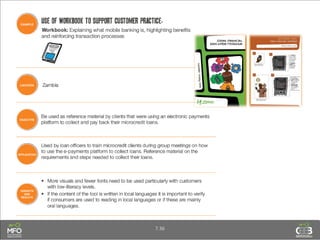
    Flip Books… Other considerations: •Canbe a good alternative when visuals are used for training but budgets do not enable the use of videos. •Printing costs of counter top flipbooks can be high as it uses a spiral bound and heavier paper to make them durable. However, the number of tools that will need to be printed will be less as only one copy will be needed for each front- line staff. Good for: Equipping staff that have no previous consumer training background . Tool can include visuals on one side and talking points for staff on the other side. Delivering training in the field. Tool is portable and can be designed so that it can stand on a counter top.  Presenting visuals, storytelling and other didactic techniques to train consumers 7.33
  • 34.
  • 35.
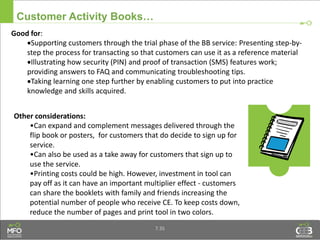
    Customer Activity Books… Otherconsiderations: •Can expand and complement messages delivered through the flip book or posters, for customers that do decide to sign up for service. •Can also be used as a take away for customers that sign up to use the service. •Printing costs could be high. However, investment in tool can pay off as it can have an important multiplier effect - customers can share the booklets with family and friends increasing the potential number of people who receive CE. To keep costs down, reduce the number of pages and print tool in two colors. Good for: Supporting customers through the trial phase of the BB service: Presenting step-by- step the process for transacting so that customers can use it as a reference material Illustrating how security (PIN) and proof of transaction (SMS) features work; providing answers to FAQ and communicating troubleshooting tips. Taking learning one step further by enabling customers to put into practice knowledge and skills acquired. 7.35
  • 36.
  • 37.
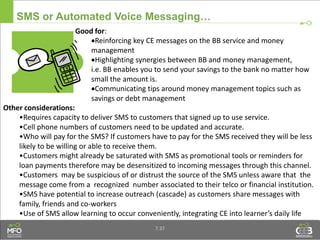
    SMS or AutomatedVoice Messaging… Good for: Reinforcing key CE messages on the BB service and money management Highlighting synergies between BB and money management, i.e. BB enables you to send your savings to the bank no matter how small the amount is. Communicating tips around money management topics such as savings or debt management Other considerations: •Requires capacity to deliver SMS to customers that signed up to use service. •Cell phone numbers of customers need to be updated and accurate. •Who will pay for the SMS? If customers have to pay for the SMS received they will be less likely to be willing or able to receive them. •Customers might already be saturated with SMS as promotional tools or reminders for loan payments therefore may be desensitized to incoming messages through this channel. •Customers may be suspicious of or distrust the source of the SMS unless aware that the message come from a recognized number associated to their telco or financial institution. •SMS have potential to increase outreach (cascade) as customers share messages with family, friends and co-workers •Use of SMS allow learning to occur conveniently, integrating CE into learner’s daily life 7.37
  • 38.
  • 39.
    Some tools workbetter with specific consumer contact points… 7.39 Pre-Recorded Jingle
  • 40.
    40 How are theCE tools you have selected for your CEBB program, working together to complement each other and reinforce key BB messages? 7.40
  • 41.
  • 42.
    Review the CEtools identified for your CEBB program… Now that you have seen a selection of different types of CE tools that could be used in a CEBB program, let’s revisit the choice of tools that you had included in the brainstorming exercise in Module Six ‘Mapping Consumer Contact Points’. As you revise your choice of CE tools for your CEBB program, keep in mind the considerations outlined at the beginning of the module, including : the objective that you want to achieve through the tool… the learning preferences of your customers… the outreach target… the depth of message that you need to convey… the level of interactivity that would be ideal to provide… the contact points where the tool will be used ... the available time that frontline staff have to deliver CE… the available time consumers have to receive CE… the accessibility of the tool to the consumer… your available budget… 7.42
  • 43.
    43 Apply …Take eachCE tool you have selected, content and dissemination possibilities, and evaluate their ability to support the ultimate achievement of your CEBB objectives. Integrate your final tool selection into your CEBB strategy. 7.43
  • 44.
    Integrate your toolselection into your CEBB strategy… 7.44 Use Module Seven Tool to review the key components of your CEBB strategy and to select the most appropriate CE tools. Module Seven Tool gives you examples of the types of tools that you could use.