Copyright ©2015 Pearson Education, Inc.
6-*
Chapter
6
Copyright ©2015 Pearson Education, Inc.
6-*
Chapter
6
Continuous Probability Distributions
CHAPTER 6 MAP
6.1 Continuous Random Variables
6.2 Normal Probability Distributions
6.3 Exponential Probability Distributions
6.4 Uniform Probability Distributions
Copyright ©2015 Pearson Education, Inc.
6-*
Probability Distributions
Discrete
Probability Distributions
Continuous Probability Distributions
Ch. 5
Ch. 6
Copyright ©2015 Pearson Education, Inc.
6-*
6.1 Continuous Random Variables
Continuous random variables are outcomes that take on any
numerical value in an interval, as determined by conducting an
experimentUsually measured rather than countedExamples of
continuous data include time, distance, and weight
The purpose of this chapter is to identify the probability that a
specified range of values will occur for continuous random
variables, using continuous probability distributions
Copyright ©2015 Pearson Education, Inc.
6-*
Continuous Random Variables
Continuous random variables can take on any value within a
specified interval
Because there are an infinite number of possible values, the
probability of one specific value occurring is theoretically equal
to zero
Probabilities are based on intervals, not individual
valuesProbability is represented by an area under the
probability distribution
Copyright ©2015 Pearson Education, Inc.
6-*
Continuous Probability Distributions
The remaining sections in chapter 6 address specific continuous
probability distributions
Normal
Uniform
Exponential
Specific Continuous
Probability Distributions
Section 6.2
Section 6.3
Section 6.4
Copyright ©2015 Pearson Education, Inc.
6-*
Continuous Probability Distributions
Continuous probability distributions can have a variety of
shapes
Shapes of the three common continuous distributions to be
discussed in this chapter:
Copyright ©2015 Pearson Education, Inc.
6-*
Continuous Probability Distributions
The normal probability distribution is useful when the data tend
to fall into the center of the distribution and when very high and
very low values are fairly rare
The exponential distribution is used to describe data where
lower values tend to dominate and higher values don’t occur
very often
The uniform distribution describes data where all the values
have the same chance of occurring
Normal
Uniform
Exponential
Copyright ©2015 Pearson Education, Inc.
6-*
6.2 Normal Probability Distributions
Normal
Uniform
Exponential
Specific Continuous
Probability Distributions
Copyright ©2015 Pearson Education, Inc.
6-*
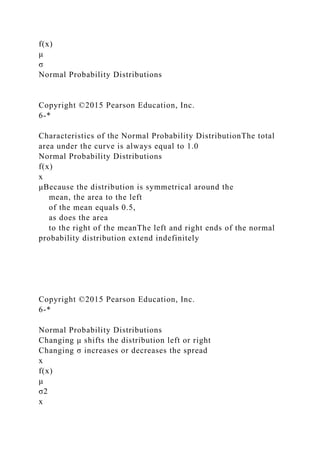
Characteristics of the Normal Probability DistributionThe
distribution is bell-shaped and symmetrical around the
meanBecause the shape of the
distribution is symmetrical,
the mean and median
are the same valueValues near the mean, where
the curve is the tallest, have
a higher likelihood of occurring
than values far from the mean,
where the curve is shorter
Mean
= Median
x
f(x)
μ
σ
Normal Probability Distributions
Copyright ©2015 Pearson Education, Inc.
6-*
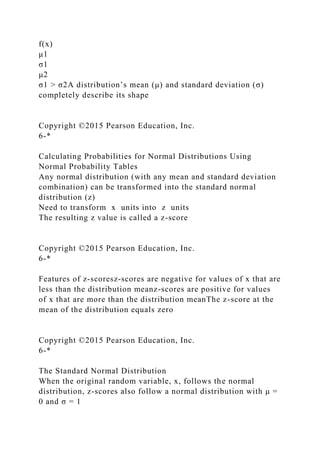
Characteristics of the Normal Probability DistributionThe total
area under the curve is always equal to 1.0
Normal Probability Distributions
f(x)
x
μBecause the distribution is symmetrical around the
mean, the area to the left
of the mean equals 0.5,
as does the area
to the right of the meanThe left and right ends of the normal
probability distribution extend indefinitely
Copyright ©2015 Pearson Education, Inc.
6-*
Normal Probability Distributions
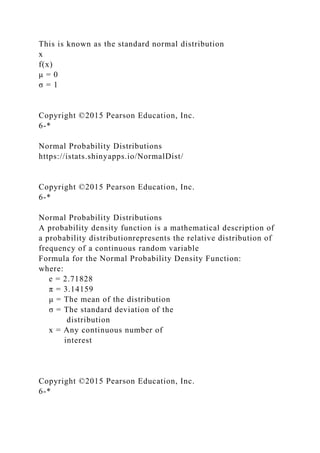
Changing μ shifts the distribution left or right
Changing σ increases or decreases the spread
x
f(x)
μ
σ2
x
f(x)
μ1
σ1
μ2
σ1 > σ2A distribution’s mean (μ) and standard deviation (σ)
completely describe its shape
Copyright ©2015 Pearson Education, Inc.
6-*
Calculating Probabilities for Normal Distributions Using
Normal Probability Tables
Any normal distribution (with any mean and standard deviation
combination) can be transformed into the standard normal
distribution (z)
Need to transform x units into z units
The resulting z value is called a z-score
Copyright ©2015 Pearson Education, Inc.
6-*
Features of z-scoresz-scores are negative for values of x that are
less than the distribution meanz-scores are positive for values
of x that are more than the distribution meanThe z-score at the
mean of the distribution equals zero
Copyright ©2015 Pearson Education, Inc.
6-*
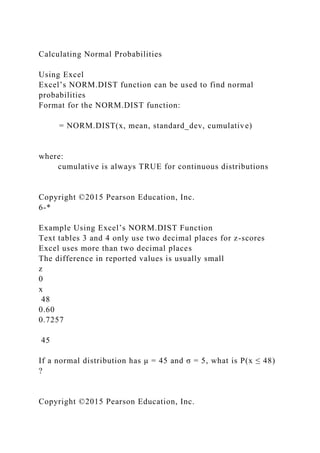
The Standard Normal Distribution
When the original random variable, x, follows the normal
distribution, z-scores also follow a normal distribution with μ =
0 and σ = 1
This is known as the standard normal distribution
x
f(x)
μ = 0
σ = 1
Copyright ©2015 Pearson Education, Inc.
6-*
Normal Probability Distributions
https://istats.shinyapps.io/NormalDist/
Copyright ©2015 Pearson Education, Inc.
6-*
Normal Probability Distributions
A probability density function is a mathematical description of
a probability distributionrepresents the relative distribution of
frequency of a continuous random variable
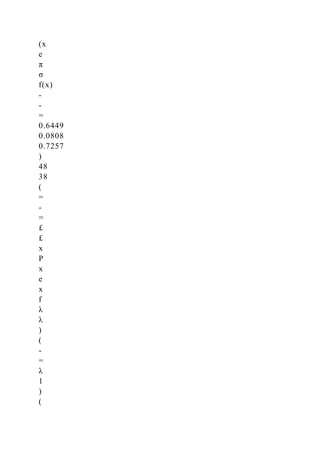
Formula for the Normal Probability Density Function:
where:
e = 2.71828
π = 3.14159
μ = The mean of the distribution
σ = The standard deviation of the
distribution
x = Any continuous number of
interest
Copyright ©2015 Pearson Education, Inc.
6-*
Calculating Normal Probabilities
Using Excel
Excel’s NORM.DIST function can be used to find normal
probabilities
Format for the NORM.DIST function:
= NORM.DIST(x, mean, standard_dev, cumulative)
where:
cumulative is always TRUE for continuous distributions
Copyright ©2015 Pearson Education, Inc.
6-*
Example Using Excel’s NORM.DIST Function
Text tables 3 and 4 only use two decimal places for z-scores
Excel uses more than two decimal places
The difference in reported values is usually small
z
0
x
48
0.60
0.7257
45
If a normal distribution has μ = 45 and σ = 5, what is P(x ≤ 48)
?
Copyright ©2015 Pearson Education, Inc.
6-*
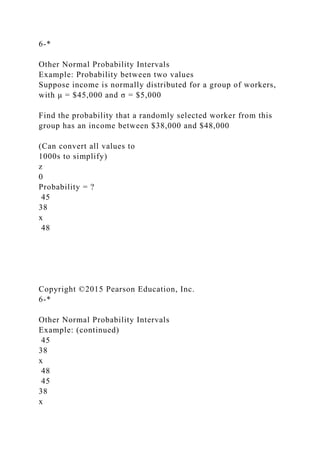
Other Normal Probability Intervals
Example: Probability between two values
Suppose income is normally distributed for a group of workers,
with μ = $45,000 and σ = $5,000
Find the probability that a randomly selected worker from this
group has an income between $38,000 and $48,000
(Can convert all values to
1000s to simplify)
z
0
Probability = ?
45
38
x
48
Copyright ©2015 Pearson Education, Inc.
6-*
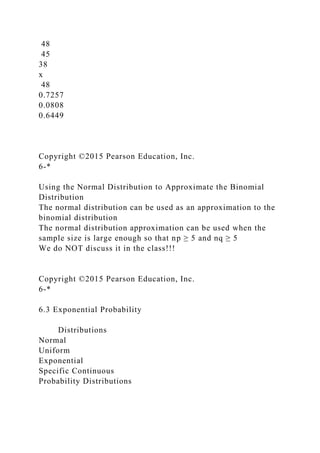
Other Normal Probability Intervals
Example: (continued)
45
38
x
48
45
38
x
48
45
38
x
48
0.7257
0.0808
0.6449
Copyright ©2015 Pearson Education, Inc.
6-*
Using the Normal Distribution to Approximate the Binomial
Distribution
The normal distribution can be used as an approximation to the
binomial distribution
The normal distribution approximation can be used when the
sample size is large enough so that np ≥ 5 and nq ≥ 5
We do NOT discuss it in the class!!!
Copyright ©2015 Pearson Education, Inc.
6-*
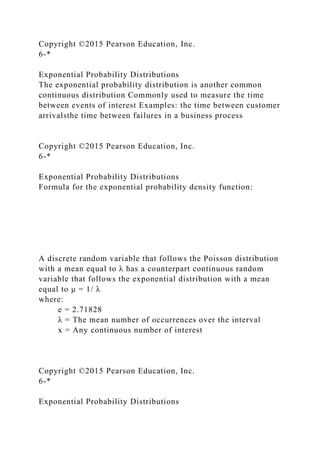
6.3 Exponential Probability
Distributions
Normal
Uniform
Exponential
Specific Continuous
Probability Distributions
Copyright ©2015 Pearson Education, Inc.
6-*
Exponential Probability Distributions
The exponential probability distribution is another common
continuous distribution Commonly used to measure the time
between events of interest Examples: the time between customer
arrivalsthe time between failures in a business process
Copyright ©2015 Pearson Education, Inc.
6-*
Exponential Probability Distributions
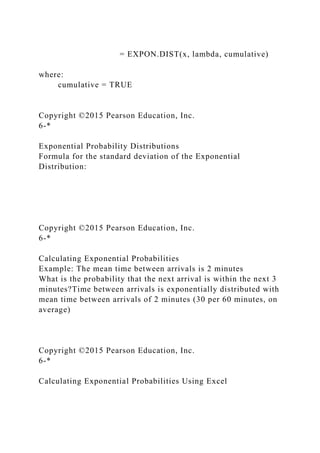
Formula for the exponential probability density function:
A discrete random variable that follows the Poisson distribution
with a mean equal to λ has a counterpart continuous random
variable that follows the exponential distribution with a mean
equal to μ = 1/ λ
where:
e = 2.71828
λ = The mean number of occurrences over the interval
x = Any continuous number of interest
Copyright ©2015 Pearson Education, Inc.
6-*
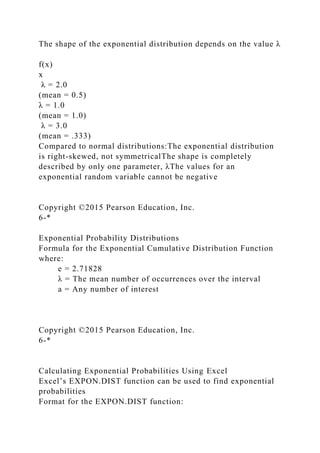
Exponential Probability Distributions
The shape of the exponential distribution depends on the value λ
f(x)
x
λ = 2.0
(mean = 0.5)
λ = 1.0
(mean = 1.0)
λ = 3.0
(mean = .333)
Compared to normal distributions:The exponential distribution
is right-skewed, not symmetricalThe shape is completely
described by only one parameter, λThe values for an
exponential random variable cannot be negative
Copyright ©2015 Pearson Education, Inc.
6-*
Exponential Probability Distributions
Formula for the Exponential Cumulative Distribution Function
where:
e = 2.71828
λ = The mean number of occurrences over the interval
a = Any number of interest
Copyright ©2015 Pearson Education, Inc.
6-*
Calculating Exponential Probabilities Using Excel
Excel’s EXPON.DIST function can be used to find exponential
probabilities
Format for the EXPON.DIST function:
= EXPON.DIST(x, lambda, cumulative)
where:
cumulative = TRUE
Copyright ©2015 Pearson Education, Inc.
6-*
Exponential Probability Distributions
Formula for the standard deviation of the Exponential
Distribution:
Copyright ©2015 Pearson Education, Inc.
6-*
Calculating Exponential Probabilities
Example: The mean time between arrivals is 2 minutes
What is the probability that the next arrival is within the next 3
minutes?Time between arrivals is exponentially distributed with
mean time between arrivals of 2 minutes (30 per 60 minutes, on
average)
Copyright ©2015 Pearson Education, Inc.
6-*
Calculating Exponential Probabilities Using Excel
Copyright ©2015 Pearson Education, Inc.
6-*
6.4 Uniform Probability Distributions
Normal
Uniform
Exponential
Specific Continuous
Probability Distributions
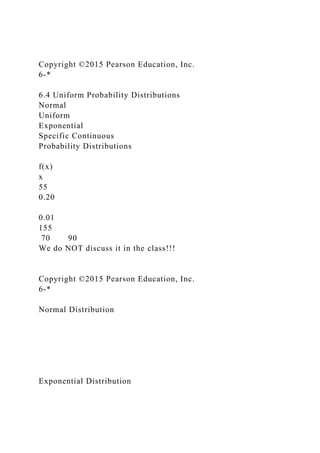
f(x)
x
55
0.20
0.01
155
70 90
We do NOT discuss it in the class!!!
Copyright ©2015 Pearson Education, Inc.
6-*
Normal Distribution
Exponential Distribution
Probability on left = Value from Excel
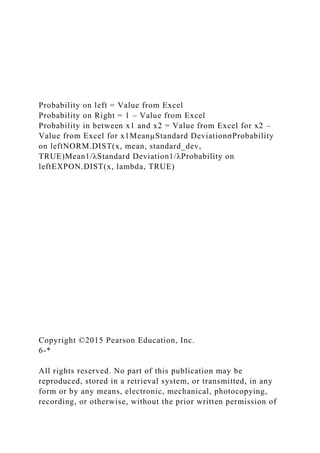
Probability on Right = 1 – Value from Excel
Probability in between x1 and x2 = Value from Excel for x2 –
Value from Excel for x1MeanµStandard DeviationσProbability
on leftNORM.DIST(x, mean, standard_dev,
TRUE)Mean1/λStandard Deviation1/λProbability on
leftEXPON.DIST(x, lambda, TRUE)
Copyright ©2015 Pearson Education, Inc.
6-*
All rights reserved. No part of this publication may be
reproduced, stored in a retrieval system, or transmitted, in any
form or by any means, electronic, mechanical, photocopying,
recording, or otherwise, without the prior written permission of
the publisher.
Printed in the United States of America.
0.5
=
<
<
¥
-
μ)
x
P(
0.5
=
¥
<
<
)
x
P(
μ
1.0
=
¥
<
<
¥
-
)
x
P(
2
2
1
]
(1/2)[
μ)/σ
(x
e
π
σ
f(x)
-
-
=
0.6449
0.0808
0.7257
)
48
38
(
=
-
=
£
£
x
P
x
e
x
f
λ
λ
)
(
-
=
λ
1
)
(
a
e
a
x
P
-
-
=
£
λ
1
=
=
m
s

Copyright ©2015 Pearson Education, Inc.6-Chapter 6.docx

  • 1.
    Copyright ©2015 PearsonEducation, Inc. 6-* Chapter 6 Copyright ©2015 Pearson Education, Inc. 6-* Chapter 6 Continuous Probability Distributions CHAPTER 6 MAP 6.1 Continuous Random Variables 6.2 Normal Probability Distributions 6.3 Exponential Probability Distributions 6.4 Uniform Probability Distributions Copyright ©2015 Pearson Education, Inc. 6-*
  • 2.
    Probability Distributions Probability Distributions Discrete ProbabilityDistributions Continuous Probability Distributions Ch. 5 Ch. 6 Copyright ©2015 Pearson Education, Inc. 6-* 6.1 Continuous Random Variables Continuous random variables are outcomes that take on any numerical value in an interval, as determined by conducting an experimentUsually measured rather than countedExamples of continuous data include time, distance, and weight The purpose of this chapter is to identify the probability that a specified range of values will occur for continuous random variables, using continuous probability distributions Copyright ©2015 Pearson Education, Inc. 6-* Continuous Random Variables Continuous random variables can take on any value within a specified interval Because there are an infinite number of possible values, the probability of one specific value occurring is theoretically equal to zero Probabilities are based on intervals, not individual valuesProbability is represented by an area under the probability distribution
  • 3.
    Copyright ©2015 PearsonEducation, Inc. 6-* Continuous Probability Distributions The remaining sections in chapter 6 address specific continuous probability distributions Normal Uniform Exponential Specific Continuous Probability Distributions Section 6.2 Section 6.3 Section 6.4 Copyright ©2015 Pearson Education, Inc. 6-* Continuous Probability Distributions Continuous probability distributions can have a variety of shapes Shapes of the three common continuous distributions to be discussed in this chapter: Copyright ©2015 Pearson Education, Inc. 6-* Continuous Probability Distributions The normal probability distribution is useful when the data tend to fall into the center of the distribution and when very high and very low values are fairly rare The exponential distribution is used to describe data where lower values tend to dominate and higher values don’t occur
  • 4.
    very often The uniformdistribution describes data where all the values have the same chance of occurring Normal Uniform Exponential Copyright ©2015 Pearson Education, Inc. 6-* 6.2 Normal Probability Distributions Normal Uniform Exponential Specific Continuous Probability Distributions Copyright ©2015 Pearson Education, Inc. 6-* Characteristics of the Normal Probability DistributionThe distribution is bell-shaped and symmetrical around the meanBecause the shape of the distribution is symmetrical, the mean and median are the same valueValues near the mean, where the curve is the tallest, have a higher likelihood of occurring than values far from the mean, where the curve is shorter Mean = Median x
  • 5.
    f(x) μ σ Normal Probability Distributions Copyright©2015 Pearson Education, Inc. 6-* Characteristics of the Normal Probability DistributionThe total area under the curve is always equal to 1.0 Normal Probability Distributions f(x) x μBecause the distribution is symmetrical around the mean, the area to the left of the mean equals 0.5, as does the area to the right of the meanThe left and right ends of the normal probability distribution extend indefinitely Copyright ©2015 Pearson Education, Inc. 6-* Normal Probability Distributions Changing μ shifts the distribution left or right Changing σ increases or decreases the spread x f(x) μ σ2 x
  • 6.
    f(x) μ1 σ1 μ2 σ1 > σ2Adistribution’s mean (μ) and standard deviation (σ) completely describe its shape Copyright ©2015 Pearson Education, Inc. 6-* Calculating Probabilities for Normal Distributions Using Normal Probability Tables Any normal distribution (with any mean and standard deviation combination) can be transformed into the standard normal distribution (z) Need to transform x units into z units The resulting z value is called a z-score Copyright ©2015 Pearson Education, Inc. 6-* Features of z-scoresz-scores are negative for values of x that are less than the distribution meanz-scores are positive for values of x that are more than the distribution meanThe z-score at the mean of the distribution equals zero Copyright ©2015 Pearson Education, Inc. 6-* The Standard Normal Distribution When the original random variable, x, follows the normal distribution, z-scores also follow a normal distribution with μ = 0 and σ = 1
  • 7.
    This is knownas the standard normal distribution x f(x) μ = 0 σ = 1 Copyright ©2015 Pearson Education, Inc. 6-* Normal Probability Distributions https://istats.shinyapps.io/NormalDist/ Copyright ©2015 Pearson Education, Inc. 6-* Normal Probability Distributions A probability density function is a mathematical description of a probability distributionrepresents the relative distribution of frequency of a continuous random variable Formula for the Normal Probability Density Function: where: e = 2.71828 π = 3.14159 μ = The mean of the distribution σ = The standard deviation of the distribution x = Any continuous number of interest Copyright ©2015 Pearson Education, Inc. 6-*
  • 8.
    Calculating Normal Probabilities UsingExcel Excel’s NORM.DIST function can be used to find normal probabilities Format for the NORM.DIST function: = NORM.DIST(x, mean, standard_dev, cumulative) where: cumulative is always TRUE for continuous distributions Copyright ©2015 Pearson Education, Inc. 6-* Example Using Excel’s NORM.DIST Function Text tables 3 and 4 only use two decimal places for z-scores Excel uses more than two decimal places The difference in reported values is usually small z 0 x 48 0.60 0.7257 45 If a normal distribution has μ = 45 and σ = 5, what is P(x ≤ 48) ? Copyright ©2015 Pearson Education, Inc.
  • 9.
    6-* Other Normal ProbabilityIntervals Example: Probability between two values Suppose income is normally distributed for a group of workers, with μ = $45,000 and σ = $5,000 Find the probability that a randomly selected worker from this group has an income between $38,000 and $48,000 (Can convert all values to 1000s to simplify) z 0 Probability = ? 45 38 x 48 Copyright ©2015 Pearson Education, Inc. 6-* Other Normal Probability Intervals Example: (continued) 45 38 x 48 45 38 x
  • 10.
    48 45 38 x 48 0.7257 0.0808 0.6449 Copyright ©2015 PearsonEducation, Inc. 6-* Using the Normal Distribution to Approximate the Binomial Distribution The normal distribution can be used as an approximation to the binomial distribution The normal distribution approximation can be used when the sample size is large enough so that np ≥ 5 and nq ≥ 5 We do NOT discuss it in the class!!! Copyright ©2015 Pearson Education, Inc. 6-* 6.3 Exponential Probability Distributions Normal Uniform Exponential Specific Continuous Probability Distributions
  • 11.
    Copyright ©2015 PearsonEducation, Inc. 6-* Exponential Probability Distributions The exponential probability distribution is another common continuous distribution Commonly used to measure the time between events of interest Examples: the time between customer arrivalsthe time between failures in a business process Copyright ©2015 Pearson Education, Inc. 6-* Exponential Probability Distributions Formula for the exponential probability density function: A discrete random variable that follows the Poisson distribution with a mean equal to λ has a counterpart continuous random variable that follows the exponential distribution with a mean equal to μ = 1/ λ where: e = 2.71828 λ = The mean number of occurrences over the interval x = Any continuous number of interest Copyright ©2015 Pearson Education, Inc. 6-* Exponential Probability Distributions
  • 12.
    The shape ofthe exponential distribution depends on the value λ f(x) x λ = 2.0 (mean = 0.5) λ = 1.0 (mean = 1.0) λ = 3.0 (mean = .333) Compared to normal distributions:The exponential distribution is right-skewed, not symmetricalThe shape is completely described by only one parameter, λThe values for an exponential random variable cannot be negative Copyright ©2015 Pearson Education, Inc. 6-* Exponential Probability Distributions Formula for the Exponential Cumulative Distribution Function where: e = 2.71828 λ = The mean number of occurrences over the interval a = Any number of interest Copyright ©2015 Pearson Education, Inc. 6-* Calculating Exponential Probabilities Using Excel Excel’s EXPON.DIST function can be used to find exponential probabilities Format for the EXPON.DIST function:
  • 13.
    = EXPON.DIST(x, lambda,cumulative) where: cumulative = TRUE Copyright ©2015 Pearson Education, Inc. 6-* Exponential Probability Distributions Formula for the standard deviation of the Exponential Distribution: Copyright ©2015 Pearson Education, Inc. 6-* Calculating Exponential Probabilities Example: The mean time between arrivals is 2 minutes What is the probability that the next arrival is within the next 3 minutes?Time between arrivals is exponentially distributed with mean time between arrivals of 2 minutes (30 per 60 minutes, on average) Copyright ©2015 Pearson Education, Inc. 6-* Calculating Exponential Probabilities Using Excel
  • 14.
    Copyright ©2015 PearsonEducation, Inc. 6-* 6.4 Uniform Probability Distributions Normal Uniform Exponential Specific Continuous Probability Distributions f(x) x 55 0.20 0.01 155 70 90 We do NOT discuss it in the class!!! Copyright ©2015 Pearson Education, Inc. 6-* Normal Distribution Exponential Distribution
  • 15.
    Probability on left= Value from Excel Probability on Right = 1 – Value from Excel Probability in between x1 and x2 = Value from Excel for x2 – Value from Excel for x1MeanµStandard DeviationσProbability on leftNORM.DIST(x, mean, standard_dev, TRUE)Mean1/λStandard Deviation1/λProbability on leftEXPON.DIST(x, lambda, TRUE) Copyright ©2015 Pearson Education, Inc. 6-* All rights reserved. No part of this publication may be reproduced, stored in a retrieval system, or transmitted, in any form or by any means, electronic, mechanical, photocopying, recording, or otherwise, without the prior written permission of
  • 16.
    the publisher. Printed inthe United States of America. 0.5 = < < ¥ - μ) x P( 0.5 = ¥ < < ) x P( μ 1.0 = ¥ < < ¥ - ) x P( 2 2 1 ] (1/2)[ μ)/σ
  • 17.
  • 18.