I N N O V A T I O N S I N F O O D S E R V I C E
let’s stop
wasting!
In collaboration with over 100 restaurateurs and experts from all
over the world, the Saviva F&B Chair has sought to understand
which best practices restaurateurs should adopt in order to
minimize and improve the management of the various types of
waste they produce.
This booklet presents simple and innovative ideas that will
help Swiss restaurateurs reduce and manage waste in their
establishment. We hope that these poorly known or uncommon
solutions will provide food for thought for foodservice
professionals.
Saviva Food & Beverage Chair
Study conducted in 2015
In the foodservice industry, 12% of food products are wasted.
This entails that 12% of the agricultural land that could be used to
produce quality crops or raise cattle goes to waste, and so does the
work required to grow and harvest the unconsumed products. For
ethical, moral and economic reasons, we should not and cannot
accept this situation.
Saviva supports a research chair dedicated to F&B at École
hôtelière de Lausanne (EHL), thus contributing to the
improvement of the foodservice industry – which is very
important for us. This long-term approach, rooted in a reflection
on sustainability, corresponds to Saviva’s values. We are proud of
this partnership with EHL.
André Hüsler
CEO, Saviva
P R E V E N T I O N 	
8
Offering different portion sizes	
8
Mobile POS terminals	
10
R E D U C T I O N 	
1 2Anti-food waste discounts	
12Doggy bags	
14Organic containers and utensils	
16Electrolyzed water	
18
R E U S E 	 2 0
Trash-to-table concepts	 20
Collaborative reuse	 22
R E C Y C L I N G A N D C O M P O S T I N G 	2 4Smart trash cans	
24Awareness-raising installations	
26
M O R E A D V A N C E D S O L U T I O N S 	 2 8
Waste monitoring software and scales	 28
Hydrosoluble packaging	
30
Customer responsibility	
32
Grinders	
34
Dehydrators	
36
Table of Contents
Facts & figures for
the foodservice industry
R E V E N U E I N 2 0 1 5
Composition of restaurant waste:
44%
Organic waste
3%
Used cooking oil
42%
Packaging
11%
Greasy residues
Source : Ademe
1/3 O F A L L T H E F O O D
I S W A S T E D E A C H Y E A R
F O O D L O S T ( P R O D U C T I O N & D I S T R I B U T I O N )
F O O D W A S T E D ( R E T A I L E R S & C O N S U M E R S )
5
4
2 8 9 ’ 6 5 0
T O N S O F W A S T E
P R O D U C E D E A C H Y E A R
I N T H E S W I S S F O O D S E R V I C E I N D U S T R Y
7 0 % O F T H I S W A S T E
I S A V O I D A B L E
1 2 4  G O F W A S T E
P E R M E A L S E R V E D I N R E S T A U R A N T S O N A V E R A G E
How to use this booklet
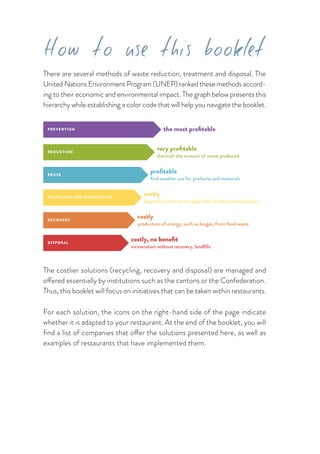
There are several methods of waste reduction, treatment and disposal. The
United Nations Environment Program (UNEP) ranked these methods accord-
ing to their economic and environmental impact. The graph below presents this
hierarchy while establishing a color code that will help you navigate the booklet.
very profitable
diminish the amount of waste produced
REDUCTION
profitable
find another use for products and materials
REUSE
costly
depends on the norms applicable in the country/canton
RECYCLING AND COMPOSTING
costly
production of energy, such as biogas, from food waste
RECOVERY
costly, no benefit
incineration without recovery, landfills
DISPOSAL
the most profitablePREVENTION
The costlier solutions (recycling, recovery and disposal) are managed and
offered essentially by institutions such as the cantons or the Confederation.
Thus, this booklet will focus on initiatives that can be taken within restaurants.
For each solution, the icons on the right-hand side of the page indicate
whether it is adapted to your restaurant. At the end of the booklet, you will
find a list of companies that offer the solutions presented here, as well as
examples of restaurants that have implemented them.
7
6
Icon glossary
Full-service restaurants
Restaurants which offer full table service and focus on food more than on
beverages. Meal preparation has several steps.
Cafés/Bars
Establishments which focus on beverages (alcoholic and non-alcoholic) and
offer various snacks.
Take-away & Home delivery
Establishments where on-site eating is not possible, but where customers can
purchase meals to eat elsewhere or have them delivered. Restaurants which
offer on-site consumption and take-away/delivery are not included in this
category, but in the “full-service restaurants” category. Compared to kiosks
and street stalls, take-away & 100% home delivery restaurants offer a larger,
more permanent and more elaborate range of dishes.
Fast food
Restaurants which offer a limited number of dishes prepared in a quick and
standardized manner. Customers place orders, pay and are brought their food
at the counter. These restaurants are generally specialized (hamburgers, pizza,
ice cream…).
Self-service cafeterias
Restaurants located for instance in schools, hospitals or corporate environ-
ments in which service is limited or nonexistent, menu options are varied,
and the price point is generally low. Customers often help themselves to the
dishes exposed and place them on trays, though there can also be stations
where clients order their dishes.
Street stalls & Kiosks
Small and potentially mobile, these indoor (e.g. in shopping malls) or outdoor
(street stalls, foodtrucks…) outlets are characterized by a limited offer and a
low price point. Service takes place exclusively at the counter.
Event catering
Event catering includes all instances of temporary off-site catering (party
with caterer, festival, etc.).
P R E V E N T I O N
Offering different
portion sizes
Type of waste: food
Offer various portion sizes
Adapt to customers’ expectations (personalization)
Requires an adaptation of the tableware
9
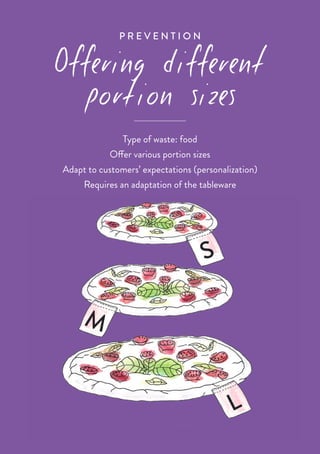
8Plate scraps are a source of food waste on which restaurateurs
can effectively act. Offering different portion sizes adapted to
customers’ appetite would reduce food waste while also allowing for
greater personalization. Using clothing sizes as a basis (e.g. S, M, L)
would help customers quickly understand and adopt this change.
P R O S
•	 Direct and significant impact on food waste
•	 In line with increasingly high expectations
regarding customization and nutrition
•	 Control of food costs
C O N S
•	 An adaptation period will be needed
•	 Not necessarily possible for all dishes
•	 Requires a large stock of tableware
•	 The price differences should make sense and be easily understandable
•	 The system must be clearly communicated
•	 For self-service buffets, a pay-per-weight
system would be a better choice
P R E V E N T I O N
Mobile POS
terminals
Types of waste: paper and food
Can be connected to stock
and/or waste management software
Energy-intensive
11
10Menus and notepads are waste sources that can be eliminated thanks to
technology, for instance mobile point-of-sale terminals or smartphones.
Moreover, several companies are developing connections between
POS systems, stock management and purchases in order to reduce
both the time spent on orders and the amount of food waste.
P R O S
•	 Potentially interesting for paper waste reduction
•	 Interesting if the terminals are connected to stock management
•	 Enables better traceability of food products, and therefore less waste
•	 Time-saving
•	 Using smartphones makes the investment reasonable
C O N S
•	 Programming takes time
•	 Energy-intensive
R E D U C T I O N
Anti-food
waste discounts
Type of waste: food
Possible use of technology
Increases revenue
13
12There are two kinds of discounts that help avoid wasting prepared meals.
Some restaurants systematically offer a discount on their
meals at the end of the day (for instance “half-price 30
minutes before closing time”), much like supermarkets do.
Some restaurants use smartphone applications to put
on sale the preparations they have left at the end of
the day; the listing can be modified in real time. These
products are generally offered at a discounted price.
Apps allow customers to easily browse the products
and locate those they wish to purchase.
P R O S
•	 Reduces food waste while increasing revenue
•	 Easy to implement
•	 Helps reach new clients
•	 Low cost
•	 Increases visibility and creates a positive image for the business
C O N S
•	 The use of a smartphone can be necessary
•	 Customers might not be reactive enough
•	 No such platform in Switzerland yet
•	 Being affiliated to restaurant booking websites
(e.g. LaFourchette) can also help avoid costs related to
food waste by increasing visibility and reservations
•	 In cafeterias, inform customers (staff, students)
about leftovers via the institution’s intranet
R E D U C T I O N
Doggy bags
Type of waste: food
Simple
Marketing tool
15
14Allowing customers to take home their plate scraps in a doggy bag is
a common practice in many countries, but not in Switzerland. For the
past few years, due to growing concern about food waste, initiatives
have been seeking to change this situation by offering doggy bags that
are aesthetically pleasing, customizable (and therefore can be used
for advertising purposes), microwave-compatible and/or recyclable.
P R O S
•	 Simple way to avoid food waste
•	 If spontaneously offered or readily available,
should generate an ultimately sustainable interest
•	 Marketing tool
C O N S
•	 Cultural perception might be an impediment
•	 Wine bags being more commonly accepted,
they could be a way to introduce doggy bags in a restaurant
•	 Offer the service spontaneously, inform customers
•	 Aesthetics are important
•	 The material must be ecological, recyclable, cheap
•	 Integrate the cost of the doggy bags in the dishes’ retail price
•	 Use customers’ containers (e.g. Tupperware) if they request it
R E D U C T I O N
Organic containers
and utensils
Type of waste: packaging (paper, plastic…)
Recycling of organic waste
Fun
17
16Many companies have created edible or fully
biodegradable cutlery and containers.
Edible utensils (cutlery, cups, packaging…) can be made from
seaweed, flour or potato starch, for example. They resist
heat and liquids (soups, sauces…) for a long period of time.
Should they not be consumed, they can be composted.
Biodegradable packaging and napkins are manufactured
using agricultural waste and can also be composted.
They are certified for food use and resist heat and liquids.
P R O S
•	 Can be recycled or composted
•	 The fabrication process often includes organic
waste reuse (e.g. agricultural waste)
•	 Fun
•	 Helps create a positive image for the restaurant
C O N S
•	 Their composting requires a commitment from customers
•	 Psychological barrier
•	 Costlier than traditional utensils and packaging
•	 Gadget
•	 Provide clear explanations to customers
R E D U C T I O N
Electrolyzed water
Types of waste: packaging (plastic) and cleaning products
Cleanses and disinfects
19
18Electrolysis transforms tap water into a cleansing and disinfecting
agent that can be used on floors, work surfaces, utensils, food products
and employees’ hands. While it has been available in Switzerland since
the 90s, this product has had difficulty achieving commercial success
because the 3 following characteristics make it seem inefficient:
•	 It is colorless
•	 It does not “smell clean”
•	 It does not lather
Electrolyzed water is nonetheless as effective as traditional cleaning
products, but without the toxicity and packaging waste issues.
There are electrolysis machines made specifically for restaurants;
the smaller models are hooked up to the kitchen sink, while the
larger ones have their own connection to the water supply.
P R O S
•	 Reduction of packaging waste
•	 Non-toxic
•	 Environment-friendly
•	 Profitable
C O N S
•	 Psychological barrier (does not seem effective)
•	 High investment
R E U S E
Trash-to-table
concepts
Type of waste: food
Use food that is usually considered waste
Reduction in ingredient costs
21
20There are simple, well-known, “archaic” solutions which tend
to be overlooked, but can be adopted without waiting.
Fruits and vegetables which are “faulty” (ugly, too big/small,
unusual color, etc.) or not fresh enough are generally thrown
away, which causes a huge waste not only of food, but also of
several other resources: water, energy, fertilizers, land…
In an effort to diminish this waste, an increasing number of companies
have developed recipes that integrate such products. Restaurants
have started to follow suit; purchasing faulty fruits and vegetables
is all the more interesting for restaurant managers in that they
are generally 15 to 20% cheaper than traditional products.
While “waste” from producers and retailers is a potential resource,
so is the waste produced within one’s restaurant. Indeed, many
elements that are usually thrown away can actually be used: bones and
crustacean shells can be used to make broth, peelings and trimmings
can be turned into soups, juice, compotes and purees, etc.
It is in the interest of all restaurants to draw inspiration from the trash-
to-table movement. Indeed, in addition to its environmental impact, food
waste represents a financial loss which is often crucial in an industry where
64% of the companies sustain a 5% loss every year (Source: GastroSuisse).
Trash-to-table concepts
P R O S
•	 Interesting marketing tool
•	 Financial gain
C O N S
•	 None
Using faulty products
P R O S
•	 Positive environmental impact
•	 Profitable
•	 Would help change habits and norms
•	 Positive impact on the restaurant’s image
C O N S
•	 Products potentially more difficult to
prepare (longer to peel, for example)
•	 Possibly not suitable to standardized kitchens
•	 A distribution channel needs to be established
R E U S E
Collaborative reuse
Types of waste: appliances and furniture
Solidarity action
23
22There are two ways for appliances and furniture to be reused:
•	 Some websites allow people to give or exchange objects
they don’t use. Giving and reusing naturally leads to
a reduction in waste. Restaurateurs could use such
websites for appliances they don’t employ anymore.
•	 In some countries, “eco-organizations” (private organizations
with a public-service mission) collect and recycle furniture
that professionals do not use anymore. These organizations are
financed by a tax included in the retail price of the furniture.
P R O S
•	 Positive impact on the restaurant’s image
•	 Simple
•	 Everyone can participate
•	 No cost
•	 Helps avoid illegal waste dumping
C O N S
•	 No financial gain
•	 A website dedicated exclusively to restaurateurs
would limit the pool of users, but ensure that they
already know the products and their limits
R E C Y C L I N G A N D C O M P O S T I N G
Smart trash cans
Types of waste: packaging and liquid/solid
Automatic sorting of beverage-related waste
Separation of liquid and solid waste
Waste compacting
25
24Intelligent trash cans sort and compact several types of packaging
waste linked to beverages: PET bottles, plastic cups and aluminum
cans. Some can sort up to 30 items per minute. The companies
guarantee the collection and treatment of the waste.
Other kinds of trash cans do not sort different types of waste,
but separate liquid and solid waste. This improves the efficiency
of waste treatment processes (recycling, incineration) while
reducing storage and collection costs and constraints.
Intelligent trash cans are especially suited to fast food
restaurants and self-service cafeterias. However, they require
a commitment from customers. As an incentive, some reward
the users (e.g. voucher for a free or discounted drink).
Some companies do not sell their self-sorting trash cans,
but rather rent them. Their monthly fee includes not only
the installation and maintenance of the appliance, but
also the collection and treatment of the waste.
P R O S
•	 Makes sorting waste more fun
•	 Provides data on the treatment
and the environmental impact of the waste
•	 Time-saving for the staff
•	 Waste compacting makes for more efficient storage
and transportation as well as lower collection costs
•	 Easy to implement
•	 Customizable
C O N S
•	 Energy-intensive
•	 Costly investment/rental fee
R E C Y C L I N G A N D C O M P O S T I N G
Awareness-raising
installations
Types of waste: all
Increases staff and customer awareness of waste
Encourages waste sorting
Weighing of the waste
27
26Several companies offer waste sorting stations or specialized trash cans
designed for restaurants. They can often be customized, in terms both of
usage (types of waste, size…) and of aesthetics. Some also help reduce
waste, for instance by weighing the various materials they receive.
The communication supports provided by the company give these
installations an educational dimension. However, they do require
that customers – or, if they are used in back-of-the-house
operations, the staff – be committed to using them properly.
P R O S
•	 Some models help both with waste management and reduction
•	 Communication media provided by the company
•	 Makes customers/staff aware of their responsibility
•	 Encourages waste sorting by making it simple and more appealing
›› Back-office: more aesthetically pleasing and customizable
›› Front-office: well designed, compliments the restaurant
•	 Easy to implement and use
•	 Positive impact on the restaurant’s image
C O N S
•	 Does not guarantee a rigorous sorting process
•	 Voluminous installations
•	 Staff training/customer education is necessary
•	 Accessibility, signage and communication
are crucial (frequent reminders)
•	 Waste collection companies recommend waste sorting stations,
but advise that the containers be easy to move (i.e. have wheels),
as it facilitates waste collection and thus reduces costs
M O R E A D V A N C E D S O L U T I O N S
Waste monitoring
software
and scales
Purpose: reduction
Type of waste: food
29
28Waste monitoring software and scales allow restaurateurs to
measure waste production and identify food waste reduction
opportunities. They also help raise staff awareness of food waste.
The scales function similarly to supermarket scales
in that they are connected to a tablet on which one
enters data (type of waste, description…).
The scales and software are generally rented for a yearly fee, but
are also available for shorter periods of time (e.g. a month).
P R O S
•	 Helps raise awareness among staff
•	 Helps get a better understanding of food waste in the restaurant
•	 Reduction of food waste
•	 Reduction of food costs
C O N S
•	 Requires discipline and training from the staff
•	 Very repetitive
•	 Time-consuming
Using these tools for short but regular periods of time would provide a
quick and relatively unconstraining way to assess internal food waste.
M O R E A D V A N C E D S O L U T I O N S
Hydrosoluble
packaging
Purpose: waste reduction
Type of waste: packaging (plastic)
31
30Overpackaging, which is common when it comes to food
products, is a major concern due to new legislation on
packaging waste. Restaurateurs therefore seek to reduce
the amount of packaging they need to throw away.
Hydrosoluble packaging is a solution to this issue. Such packaging
indeed protects food products, but dissolves in water and aqueous
liquids (milk, juice, alcohol…). It is currently used for pasta,
spices, flour, instant coffee, food coloring, etc. The material is
robust, transparent, odorless and insipid; since it is made with
food ingredients, it can be safely consumed once dissolved.
P R O S
•	 Easy to use
•	 Time-saving
•	 Simplifies preparation
•	 Reduction of plastic waste
C O N S
•	 None
M O R E A D V A N C E D S O L U T I O N S
Customer
responsibility
Purpose: waste reduction
Type of waste: food
33
32Because waste reduction depends partly on customers’ awareness
of the issue, some establishments – mostly school cafeterias –
have instituted systems to reduce the amount of plate scraps.
For example, in some school restaurants, children help themselves to
starters and side dishes and can ask the staff to adapt the meat and fish
portions they are served. The cheese and desserts, on the other hand,
come in pre-determined sizes. To progress from one course to the
next, they must have eaten everything on their plate; both their plate
and their glass must be empty when collected at the end of the meal.
Thanks to the savings realized by avoiding food waste,
the quality of the food products can be improved.
P R O S
•	 Educational, awareness-raising approach
C O N S
•	 Can only be applied in school restaurants
•	 Staff must follow the rules
•	 Staff and customer training is necessary
M O R E A D V A N C E D S O L U T I O N S
Grinders
Purpose: recycling and composting
Type of waste: food
35
34A grinder is a compact biowaste treatment system
(smaller than 1 m3
) which sorts, treats and stores
the organic waste – solid or liquid – produced by restaurants.
Some are specifically made for restaurants which serve more
than 100 meals/day. Up to 450 kg of waste can be treated per hour.
The waste is grinded, after which its mass is reduced through
centrifugation. This process reduces waste volume by
80%, which in turn reduces treatment costs. Waste is then
automatically transported to a central storage unit (containers
or vat, open-air or underground) by suction hoses.
The containers or vats are designed so as to need emptying only once
per month. The waste itself is transformed into methane or composted.
P R O S
•	 Diminishes waste volume
•	 Hygiene is guaranteed
•	 Interesting when connected to several kitchens
C O N S
•	 High costs
•	 Difficult to implement in an existing restaurant
•	 Potential odor problems
M O R E A D V A N C E D S O L U T I O N S
Dehydrators
Purpose: recovery
Type of waste: food
37
36There are several kinds of machines that pre-treat food waste
and can be installed in restaurants. Digestors, for instance,
use micro-organisms to decompose organic waste and
produce biogas. However, these machines can be intimidating
(chemical process); moreover, most emit disagreeable odors
and require frequent renewal of the micro-organisms.
Dehydrators function in a simpler way: they heat up food waste until
its water content has evaporated, hence turning the waste into powder.
The volume of food waste is thus reduced by about 80%, meaning
that it requires less frequent collecting than non-treated waste. The
powder is easy to store, as it has been sanitized by the heat and is
odorless, and is collected by the dehydrator supplier. As for the water
extracted from the waste, it is eliminated along with the wastewater.
There are several sizes of dehydrators. Smaller models (2m2
) treat
30kg of waste per day (6-8h cycles), while larger ones can treat up
to 1 ton of waste (approx.. 20h cycles). They are designed to stop
automatically if there is any issue (e.g. hatch not properly closed).
P R O S
•	 Safe and easy to use
•	 Reduces collection and transport costs
•	 Food waste no longer needs to be stored in a refrigerated place
•	 Hygiene is guaranteed
C O N S
•	 Requires space (but can be kept outside)
•	 May require small construction work (evacuation of wastewater)
•	 Some companies rent dehydrators
•	 One dehydrator can be used by several restaurants
Offering different portion sizes › implemented by SMLXL Les Arcades
Mobile POS terminals › iSmartCaisse, PI Electronique
Anti-food waste discounts › implemented by Itsu, Auparager
Dehydrators › Closed Loop, Geb Solution, Oklin, Electrolux
Professional, Eco-safe Digester, Serveco; in Switzerland,
available exclusively from Swiss Recycling Services
Grinders › Meiko
Customer responsibility › Mille et Un Repas (label Zéro Gaspil’)
Doggy bags › TakeAway, Trop Bon Pour Gaspiller
Hydrosoluble packaging › MonoSol (Vivos Film)
Organic containers and utensils › Loliware, Bakey’s,
Recyclaholics, Zelfo Technology, Upgrading
Waste monitoring software/scales › Leanpath, United
Against Waste, Syrus, MintScraps, Winnow
Electrolysed water › Prominent, Tennant (ec-H2O &
ec-H2O NanoClean), Hoshizaki (ROX system), Kangen;
implemented by École hôtelière de Lausanne, Silo
Awareness-raising installations › Geb Solutions (Chef’Eco), Ekokook
Trash-to-table concepts › Imperfect, Hungry Harvest; implemented by
Auparager, The Real Junk Food Project, Silo, La Maison Plisson, Skipchen
Smart trash cans › Co.Ma.Ri (Supperlizzy), Lemon tri, Cannibal,
Greencreative (R3D3); implemented by Ecole hôtelière de
Lausanne, Quick France, Big Fernand, McDonald’s France
Collaborative reuse › Recyclons Ensemble, Valdelia
Give us examples!
Here are a few examples of companies and restaurants that have
practical experience with the innovations presented in this booket:
p.9
p.11
p.13
p.15
p.17
p.19
p.21
p.23
p.25
p.27
p.29
p.31
p.33
p.35
p.37
39
38
In conclusion
Whatever solution you consider, there are 3 keywords to keep in mind:
C R E A T I V I T Y
R E Q U I R E D T O A D A P T
A N I N N O V A T I O N T O A C O N C E P T
C O O P E R A T I O N
R E S O U R C E P O O L I N G M A K E S S O M E S O L U T I O N S
M U C H M O R E E F F I C I E N T , E S P E C I A L L Y F O R
I N D E P E N D E N T R E S T A U R A N T S
C O U R A G E
A N E C E S S A R Y Q U A L I T Y W H E N T R Y I N G T O C H A N G E
T H E S T A T U S Q U O A N D T E S T I N G N E W O P T I O N S
For more information on our methodology and results,
you can visit the F&B Chair’s website
http://www.ehl.edu/en/research/chaire-food-beverage-saviva
or contact the research team:
Dr Christine Demen Meier • Chair holder
christine.demen-meier@ehl.ch
Stéphanie Buri • Chair coordinator
stephanie.buri@ehl.ch
Clémence Cornuz • Research associate
clemence.cornuz@ehl.ch
For this study, we interviewed approximately 90
restaurateurs who explained how they manage their
waste and what kind of challenges they meet. Then,
with the help of an international group of experts, we
evaluated 100 innovations in waste management and
reduction according to 2 criteria: usefulness and ease
of implementation. This guide presents the solutions
that passed our 4 selection steps.

f-and-b-innovations-web-EN

  • 1.
    I N NO V A T I O N S I N F O O D S E R V I C E let’s stop wasting!
  • 2.
    In collaboration withover 100 restaurateurs and experts from all over the world, the Saviva F&B Chair has sought to understand which best practices restaurateurs should adopt in order to minimize and improve the management of the various types of waste they produce. This booklet presents simple and innovative ideas that will help Swiss restaurateurs reduce and manage waste in their establishment. We hope that these poorly known or uncommon solutions will provide food for thought for foodservice professionals. Saviva Food & Beverage Chair Study conducted in 2015 In the foodservice industry, 12% of food products are wasted. This entails that 12% of the agricultural land that could be used to produce quality crops or raise cattle goes to waste, and so does the work required to grow and harvest the unconsumed products. For ethical, moral and economic reasons, we should not and cannot accept this situation. Saviva supports a research chair dedicated to F&B at École hôtelière de Lausanne (EHL), thus contributing to the improvement of the foodservice industry – which is very important for us. This long-term approach, rooted in a reflection on sustainability, corresponds to Saviva’s values. We are proud of this partnership with EHL. André Hüsler CEO, Saviva
  • 3.
    P R EV E N T I O N 8 Offering different portion sizes 8 Mobile POS terminals 10 R E D U C T I O N 1 2Anti-food waste discounts 12Doggy bags 14Organic containers and utensils 16Electrolyzed water 18 R E U S E 2 0 Trash-to-table concepts 20 Collaborative reuse 22 R E C Y C L I N G A N D C O M P O S T I N G 2 4Smart trash cans 24Awareness-raising installations 26 M O R E A D V A N C E D S O L U T I O N S 2 8 Waste monitoring software and scales 28 Hydrosoluble packaging 30 Customer responsibility 32 Grinders 34 Dehydrators 36 Table of Contents
  • 4.
    Facts & figuresfor the foodservice industry R E V E N U E I N 2 0 1 5 Composition of restaurant waste: 44% Organic waste 3% Used cooking oil 42% Packaging 11% Greasy residues Source : Ademe 1/3 O F A L L T H E F O O D I S W A S T E D E A C H Y E A R F O O D L O S T ( P R O D U C T I O N & D I S T R I B U T I O N ) F O O D W A S T E D ( R E T A I L E R S & C O N S U M E R S )
  • 5.
    5 4 2 8 9’ 6 5 0 T O N S O F W A S T E P R O D U C E D E A C H Y E A R I N T H E S W I S S F O O D S E R V I C E I N D U S T R Y 7 0 % O F T H I S W A S T E I S A V O I D A B L E 1 2 4  G O F W A S T E P E R M E A L S E R V E D I N R E S T A U R A N T S O N A V E R A G E
  • 6.
    How to usethis booklet There are several methods of waste reduction, treatment and disposal. The United Nations Environment Program (UNEP) ranked these methods accord- ing to their economic and environmental impact. The graph below presents this hierarchy while establishing a color code that will help you navigate the booklet. very profitable diminish the amount of waste produced REDUCTION profitable find another use for products and materials REUSE costly depends on the norms applicable in the country/canton RECYCLING AND COMPOSTING costly production of energy, such as biogas, from food waste RECOVERY costly, no benefit incineration without recovery, landfills DISPOSAL the most profitablePREVENTION The costlier solutions (recycling, recovery and disposal) are managed and offered essentially by institutions such as the cantons or the Confederation. Thus, this booklet will focus on initiatives that can be taken within restaurants. For each solution, the icons on the right-hand side of the page indicate whether it is adapted to your restaurant. At the end of the booklet, you will find a list of companies that offer the solutions presented here, as well as examples of restaurants that have implemented them.
  • 7.
    7 6 Icon glossary Full-service restaurants Restaurantswhich offer full table service and focus on food more than on beverages. Meal preparation has several steps. Cafés/Bars Establishments which focus on beverages (alcoholic and non-alcoholic) and offer various snacks. Take-away & Home delivery Establishments where on-site eating is not possible, but where customers can purchase meals to eat elsewhere or have them delivered. Restaurants which offer on-site consumption and take-away/delivery are not included in this category, but in the “full-service restaurants” category. Compared to kiosks and street stalls, take-away & 100% home delivery restaurants offer a larger, more permanent and more elaborate range of dishes. Fast food Restaurants which offer a limited number of dishes prepared in a quick and standardized manner. Customers place orders, pay and are brought their food at the counter. These restaurants are generally specialized (hamburgers, pizza, ice cream…). Self-service cafeterias Restaurants located for instance in schools, hospitals or corporate environ- ments in which service is limited or nonexistent, menu options are varied, and the price point is generally low. Customers often help themselves to the dishes exposed and place them on trays, though there can also be stations where clients order their dishes. Street stalls & Kiosks Small and potentially mobile, these indoor (e.g. in shopping malls) or outdoor (street stalls, foodtrucks…) outlets are characterized by a limited offer and a low price point. Service takes place exclusively at the counter. Event catering Event catering includes all instances of temporary off-site catering (party with caterer, festival, etc.).
  • 8.
    P R EV E N T I O N Offering different portion sizes Type of waste: food Offer various portion sizes Adapt to customers’ expectations (personalization) Requires an adaptation of the tableware
  • 9.
    9 8Plate scraps area source of food waste on which restaurateurs can effectively act. Offering different portion sizes adapted to customers’ appetite would reduce food waste while also allowing for greater personalization. Using clothing sizes as a basis (e.g. S, M, L) would help customers quickly understand and adopt this change. P R O S • Direct and significant impact on food waste • In line with increasingly high expectations regarding customization and nutrition • Control of food costs C O N S • An adaptation period will be needed • Not necessarily possible for all dishes • Requires a large stock of tableware • The price differences should make sense and be easily understandable • The system must be clearly communicated • For self-service buffets, a pay-per-weight system would be a better choice
  • 10.
    P R EV E N T I O N Mobile POS terminals Types of waste: paper and food Can be connected to stock and/or waste management software Energy-intensive
  • 11.
    11 10Menus and notepadsare waste sources that can be eliminated thanks to technology, for instance mobile point-of-sale terminals or smartphones. Moreover, several companies are developing connections between POS systems, stock management and purchases in order to reduce both the time spent on orders and the amount of food waste. P R O S • Potentially interesting for paper waste reduction • Interesting if the terminals are connected to stock management • Enables better traceability of food products, and therefore less waste • Time-saving • Using smartphones makes the investment reasonable C O N S • Programming takes time • Energy-intensive
  • 12.
    R E DU C T I O N Anti-food waste discounts Type of waste: food Possible use of technology Increases revenue
  • 13.
    13 12There are twokinds of discounts that help avoid wasting prepared meals. Some restaurants systematically offer a discount on their meals at the end of the day (for instance “half-price 30 minutes before closing time”), much like supermarkets do. Some restaurants use smartphone applications to put on sale the preparations they have left at the end of the day; the listing can be modified in real time. These products are generally offered at a discounted price. Apps allow customers to easily browse the products and locate those they wish to purchase. P R O S • Reduces food waste while increasing revenue • Easy to implement • Helps reach new clients • Low cost • Increases visibility and creates a positive image for the business C O N S • The use of a smartphone can be necessary • Customers might not be reactive enough • No such platform in Switzerland yet • Being affiliated to restaurant booking websites (e.g. LaFourchette) can also help avoid costs related to food waste by increasing visibility and reservations • In cafeterias, inform customers (staff, students) about leftovers via the institution’s intranet
  • 14.
    R E DU C T I O N Doggy bags Type of waste: food Simple Marketing tool
  • 15.
    15 14Allowing customers totake home their plate scraps in a doggy bag is a common practice in many countries, but not in Switzerland. For the past few years, due to growing concern about food waste, initiatives have been seeking to change this situation by offering doggy bags that are aesthetically pleasing, customizable (and therefore can be used for advertising purposes), microwave-compatible and/or recyclable. P R O S • Simple way to avoid food waste • If spontaneously offered or readily available, should generate an ultimately sustainable interest • Marketing tool C O N S • Cultural perception might be an impediment • Wine bags being more commonly accepted, they could be a way to introduce doggy bags in a restaurant • Offer the service spontaneously, inform customers • Aesthetics are important • The material must be ecological, recyclable, cheap • Integrate the cost of the doggy bags in the dishes’ retail price • Use customers’ containers (e.g. Tupperware) if they request it
  • 16.
    R E DU C T I O N Organic containers and utensils Type of waste: packaging (paper, plastic…) Recycling of organic waste Fun
  • 17.
    17 16Many companies havecreated edible or fully biodegradable cutlery and containers. Edible utensils (cutlery, cups, packaging…) can be made from seaweed, flour or potato starch, for example. They resist heat and liquids (soups, sauces…) for a long period of time. Should they not be consumed, they can be composted. Biodegradable packaging and napkins are manufactured using agricultural waste and can also be composted. They are certified for food use and resist heat and liquids. P R O S • Can be recycled or composted • The fabrication process often includes organic waste reuse (e.g. agricultural waste) • Fun • Helps create a positive image for the restaurant C O N S • Their composting requires a commitment from customers • Psychological barrier • Costlier than traditional utensils and packaging • Gadget • Provide clear explanations to customers
  • 18.
    R E DU C T I O N Electrolyzed water Types of waste: packaging (plastic) and cleaning products Cleanses and disinfects
  • 19.
    19 18Electrolysis transforms tapwater into a cleansing and disinfecting agent that can be used on floors, work surfaces, utensils, food products and employees’ hands. While it has been available in Switzerland since the 90s, this product has had difficulty achieving commercial success because the 3 following characteristics make it seem inefficient: • It is colorless • It does not “smell clean” • It does not lather Electrolyzed water is nonetheless as effective as traditional cleaning products, but without the toxicity and packaging waste issues. There are electrolysis machines made specifically for restaurants; the smaller models are hooked up to the kitchen sink, while the larger ones have their own connection to the water supply. P R O S • Reduction of packaging waste • Non-toxic • Environment-friendly • Profitable C O N S • Psychological barrier (does not seem effective) • High investment
  • 20.
    R E US E Trash-to-table concepts Type of waste: food Use food that is usually considered waste Reduction in ingredient costs
  • 21.
    21 20There are simple,well-known, “archaic” solutions which tend to be overlooked, but can be adopted without waiting. Fruits and vegetables which are “faulty” (ugly, too big/small, unusual color, etc.) or not fresh enough are generally thrown away, which causes a huge waste not only of food, but also of several other resources: water, energy, fertilizers, land… In an effort to diminish this waste, an increasing number of companies have developed recipes that integrate such products. Restaurants have started to follow suit; purchasing faulty fruits and vegetables is all the more interesting for restaurant managers in that they are generally 15 to 20% cheaper than traditional products. While “waste” from producers and retailers is a potential resource, so is the waste produced within one’s restaurant. Indeed, many elements that are usually thrown away can actually be used: bones and crustacean shells can be used to make broth, peelings and trimmings can be turned into soups, juice, compotes and purees, etc. It is in the interest of all restaurants to draw inspiration from the trash- to-table movement. Indeed, in addition to its environmental impact, food waste represents a financial loss which is often crucial in an industry where 64% of the companies sustain a 5% loss every year (Source: GastroSuisse). Trash-to-table concepts P R O S • Interesting marketing tool • Financial gain C O N S • None Using faulty products P R O S • Positive environmental impact • Profitable • Would help change habits and norms • Positive impact on the restaurant’s image C O N S • Products potentially more difficult to prepare (longer to peel, for example) • Possibly not suitable to standardized kitchens • A distribution channel needs to be established
  • 22.
    R E US E Collaborative reuse Types of waste: appliances and furniture Solidarity action
  • 23.
    23 22There are twoways for appliances and furniture to be reused: • Some websites allow people to give or exchange objects they don’t use. Giving and reusing naturally leads to a reduction in waste. Restaurateurs could use such websites for appliances they don’t employ anymore. • In some countries, “eco-organizations” (private organizations with a public-service mission) collect and recycle furniture that professionals do not use anymore. These organizations are financed by a tax included in the retail price of the furniture. P R O S • Positive impact on the restaurant’s image • Simple • Everyone can participate • No cost • Helps avoid illegal waste dumping C O N S • No financial gain • A website dedicated exclusively to restaurateurs would limit the pool of users, but ensure that they already know the products and their limits
  • 24.
    R E CY C L I N G A N D C O M P O S T I N G Smart trash cans Types of waste: packaging and liquid/solid Automatic sorting of beverage-related waste Separation of liquid and solid waste Waste compacting
  • 25.
    25 24Intelligent trash canssort and compact several types of packaging waste linked to beverages: PET bottles, plastic cups and aluminum cans. Some can sort up to 30 items per minute. The companies guarantee the collection and treatment of the waste. Other kinds of trash cans do not sort different types of waste, but separate liquid and solid waste. This improves the efficiency of waste treatment processes (recycling, incineration) while reducing storage and collection costs and constraints. Intelligent trash cans are especially suited to fast food restaurants and self-service cafeterias. However, they require a commitment from customers. As an incentive, some reward the users (e.g. voucher for a free or discounted drink). Some companies do not sell their self-sorting trash cans, but rather rent them. Their monthly fee includes not only the installation and maintenance of the appliance, but also the collection and treatment of the waste. P R O S • Makes sorting waste more fun • Provides data on the treatment and the environmental impact of the waste • Time-saving for the staff • Waste compacting makes for more efficient storage and transportation as well as lower collection costs • Easy to implement • Customizable C O N S • Energy-intensive • Costly investment/rental fee
  • 26.
    R E CY C L I N G A N D C O M P O S T I N G Awareness-raising installations Types of waste: all Increases staff and customer awareness of waste Encourages waste sorting Weighing of the waste
  • 27.
    27 26Several companies offerwaste sorting stations or specialized trash cans designed for restaurants. They can often be customized, in terms both of usage (types of waste, size…) and of aesthetics. Some also help reduce waste, for instance by weighing the various materials they receive. The communication supports provided by the company give these installations an educational dimension. However, they do require that customers – or, if they are used in back-of-the-house operations, the staff – be committed to using them properly. P R O S • Some models help both with waste management and reduction • Communication media provided by the company • Makes customers/staff aware of their responsibility • Encourages waste sorting by making it simple and more appealing ›› Back-office: more aesthetically pleasing and customizable ›› Front-office: well designed, compliments the restaurant • Easy to implement and use • Positive impact on the restaurant’s image C O N S • Does not guarantee a rigorous sorting process • Voluminous installations • Staff training/customer education is necessary • Accessibility, signage and communication are crucial (frequent reminders) • Waste collection companies recommend waste sorting stations, but advise that the containers be easy to move (i.e. have wheels), as it facilitates waste collection and thus reduces costs
  • 28.
    M O RE A D V A N C E D S O L U T I O N S Waste monitoring software and scales Purpose: reduction Type of waste: food
  • 29.
    29 28Waste monitoring softwareand scales allow restaurateurs to measure waste production and identify food waste reduction opportunities. They also help raise staff awareness of food waste. The scales function similarly to supermarket scales in that they are connected to a tablet on which one enters data (type of waste, description…). The scales and software are generally rented for a yearly fee, but are also available for shorter periods of time (e.g. a month). P R O S • Helps raise awareness among staff • Helps get a better understanding of food waste in the restaurant • Reduction of food waste • Reduction of food costs C O N S • Requires discipline and training from the staff • Very repetitive • Time-consuming Using these tools for short but regular periods of time would provide a quick and relatively unconstraining way to assess internal food waste.
  • 30.
    M O RE A D V A N C E D S O L U T I O N S Hydrosoluble packaging Purpose: waste reduction Type of waste: packaging (plastic)
  • 31.
    31 30Overpackaging, which iscommon when it comes to food products, is a major concern due to new legislation on packaging waste. Restaurateurs therefore seek to reduce the amount of packaging they need to throw away. Hydrosoluble packaging is a solution to this issue. Such packaging indeed protects food products, but dissolves in water and aqueous liquids (milk, juice, alcohol…). It is currently used for pasta, spices, flour, instant coffee, food coloring, etc. The material is robust, transparent, odorless and insipid; since it is made with food ingredients, it can be safely consumed once dissolved. P R O S • Easy to use • Time-saving • Simplifies preparation • Reduction of plastic waste C O N S • None
  • 32.
    M O RE A D V A N C E D S O L U T I O N S Customer responsibility Purpose: waste reduction Type of waste: food
  • 33.
    33 32Because waste reductiondepends partly on customers’ awareness of the issue, some establishments – mostly school cafeterias – have instituted systems to reduce the amount of plate scraps. For example, in some school restaurants, children help themselves to starters and side dishes and can ask the staff to adapt the meat and fish portions they are served. The cheese and desserts, on the other hand, come in pre-determined sizes. To progress from one course to the next, they must have eaten everything on their plate; both their plate and their glass must be empty when collected at the end of the meal. Thanks to the savings realized by avoiding food waste, the quality of the food products can be improved. P R O S • Educational, awareness-raising approach C O N S • Can only be applied in school restaurants • Staff must follow the rules • Staff and customer training is necessary
  • 34.
    M O RE A D V A N C E D S O L U T I O N S Grinders Purpose: recycling and composting Type of waste: food
  • 35.
    35 34A grinder isa compact biowaste treatment system (smaller than 1 m3 ) which sorts, treats and stores the organic waste – solid or liquid – produced by restaurants. Some are specifically made for restaurants which serve more than 100 meals/day. Up to 450 kg of waste can be treated per hour. The waste is grinded, after which its mass is reduced through centrifugation. This process reduces waste volume by 80%, which in turn reduces treatment costs. Waste is then automatically transported to a central storage unit (containers or vat, open-air or underground) by suction hoses. The containers or vats are designed so as to need emptying only once per month. The waste itself is transformed into methane or composted. P R O S • Diminishes waste volume • Hygiene is guaranteed • Interesting when connected to several kitchens C O N S • High costs • Difficult to implement in an existing restaurant • Potential odor problems
  • 36.
    M O RE A D V A N C E D S O L U T I O N S Dehydrators Purpose: recovery Type of waste: food
  • 37.
    37 36There are severalkinds of machines that pre-treat food waste and can be installed in restaurants. Digestors, for instance, use micro-organisms to decompose organic waste and produce biogas. However, these machines can be intimidating (chemical process); moreover, most emit disagreeable odors and require frequent renewal of the micro-organisms. Dehydrators function in a simpler way: they heat up food waste until its water content has evaporated, hence turning the waste into powder. The volume of food waste is thus reduced by about 80%, meaning that it requires less frequent collecting than non-treated waste. The powder is easy to store, as it has been sanitized by the heat and is odorless, and is collected by the dehydrator supplier. As for the water extracted from the waste, it is eliminated along with the wastewater. There are several sizes of dehydrators. Smaller models (2m2 ) treat 30kg of waste per day (6-8h cycles), while larger ones can treat up to 1 ton of waste (approx.. 20h cycles). They are designed to stop automatically if there is any issue (e.g. hatch not properly closed). P R O S • Safe and easy to use • Reduces collection and transport costs • Food waste no longer needs to be stored in a refrigerated place • Hygiene is guaranteed C O N S • Requires space (but can be kept outside) • May require small construction work (evacuation of wastewater) • Some companies rent dehydrators • One dehydrator can be used by several restaurants
  • 38.
    Offering different portionsizes › implemented by SMLXL Les Arcades Mobile POS terminals › iSmartCaisse, PI Electronique Anti-food waste discounts › implemented by Itsu, Auparager Dehydrators › Closed Loop, Geb Solution, Oklin, Electrolux Professional, Eco-safe Digester, Serveco; in Switzerland, available exclusively from Swiss Recycling Services Grinders › Meiko Customer responsibility › Mille et Un Repas (label Zéro Gaspil’) Doggy bags › TakeAway, Trop Bon Pour Gaspiller Hydrosoluble packaging › MonoSol (Vivos Film) Organic containers and utensils › Loliware, Bakey’s, Recyclaholics, Zelfo Technology, Upgrading Waste monitoring software/scales › Leanpath, United Against Waste, Syrus, MintScraps, Winnow Electrolysed water › Prominent, Tennant (ec-H2O & ec-H2O NanoClean), Hoshizaki (ROX system), Kangen; implemented by École hôtelière de Lausanne, Silo Awareness-raising installations › Geb Solutions (Chef’Eco), Ekokook Trash-to-table concepts › Imperfect, Hungry Harvest; implemented by Auparager, The Real Junk Food Project, Silo, La Maison Plisson, Skipchen Smart trash cans › Co.Ma.Ri (Supperlizzy), Lemon tri, Cannibal, Greencreative (R3D3); implemented by Ecole hôtelière de Lausanne, Quick France, Big Fernand, McDonald’s France Collaborative reuse › Recyclons Ensemble, Valdelia Give us examples! Here are a few examples of companies and restaurants that have practical experience with the innovations presented in this booket: p.9 p.11 p.13 p.15 p.17 p.19 p.21 p.23 p.25 p.27 p.29 p.31 p.33 p.35 p.37
  • 39.
    39 38 In conclusion Whatever solutionyou consider, there are 3 keywords to keep in mind: C R E A T I V I T Y R E Q U I R E D T O A D A P T A N I N N O V A T I O N T O A C O N C E P T C O O P E R A T I O N R E S O U R C E P O O L I N G M A K E S S O M E S O L U T I O N S M U C H M O R E E F F I C I E N T , E S P E C I A L L Y F O R I N D E P E N D E N T R E S T A U R A N T S C O U R A G E A N E C E S S A R Y Q U A L I T Y W H E N T R Y I N G T O C H A N G E T H E S T A T U S Q U O A N D T E S T I N G N E W O P T I O N S For more information on our methodology and results, you can visit the F&B Chair’s website http://www.ehl.edu/en/research/chaire-food-beverage-saviva or contact the research team: Dr Christine Demen Meier • Chair holder christine.demen-meier@ehl.ch Stéphanie Buri • Chair coordinator stephanie.buri@ehl.ch Clémence Cornuz • Research associate clemence.cornuz@ehl.ch
  • 40.
    For this study,we interviewed approximately 90 restaurateurs who explained how they manage their waste and what kind of challenges they meet. Then, with the help of an international group of experts, we evaluated 100 innovations in waste management and reduction according to 2 criteria: usefulness and ease of implementation. This guide presents the solutions that passed our 4 selection steps.