DOCUMENTS AND
RECORDS
Documents & Records-Module 15
Learning Objectives
At the conclusion of this session, you will
be
able to:
 Explain the difference between documents
and records;
 Describe the hierarchy of documents and
the role of each level;
 Outline the contents of a quality manual;
 Outline the content that should be included
in a standard operating procedure;
 Explain the important steps, or elements, of
a laboratory document management
2
Learning Objectives
 Describe methods and tools to properly
store documents and records.
 Develop the relevant document for the
QMS
 Develop the document control system
 Develop the records for the QMS
 Develop and maintain the storage and
retrieval system
 Ensure proper characteristics of records
Documents & Records-Module 15 3
Documents & Records-Module 15
Scenario
 testing algorithm
 safety manual
 client test results
 standard operation
procedures (SOPs) for
an approved HIV rapid
test
 manufacturer test kit
inserts
 summary of findings
from on-site evaluation
visit
 report of corrective
actions
 temperature log (blank
form)
 quality control record
(blank form)
 daily maintenance log
(completed)
 stock cards and stock
book (completed)
 EQA specimen transfer
log (completed) 4
You have found all these papers lying on a desk.
Which of these are documents and which are
records?
Answers’
 testing algorithm
 safety manual
 client test results
 standard operation
procedures (SOPs) for
an approved HIV rapid
test
 manufacturer test kit
inserts
 summary of findings
from on-site evaluation
visit
 report of corrective
actions
 temperature log (blank
form)
 quality control record
(blank form)
 daily maintenance log
(completed)
 stock cards and stock
book (completed)
 EQA sample transfer
log (completed)
Documents & Records-Module 15 5
Documents & Records-Module 15 6
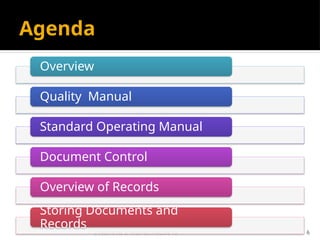
Agenda
Overview
Quality Manual
Standard Operating Manual
Document Control
Overview of Records
Storing Documents and
Records
Documents & Records-Module 15 7
Introduction
 Provide written information about
policies, processes and procedures.
 Paper-based or computer-based.
 Should be permanent, secure,
traceable and approved, up-to-date
and easily accessible.
 Should be regularly updated or
maintained when a policy, process or
procedure changes.
Documents & Records-Module 15 8
Purpose of Documents……
 Communicate information to all users
of lab.
 Point of reference for establishing facts
regarding an incident.
 An aid in the recognition of trends and
resolution of problems.
 To establish credibility of the laboratory.
Documents & Records-Module 15 9
Why do laboratories need to
manage documents and records?
To find information
whenever it is needed!
Documents and Records—How do they
differ?
Documents
 communicate
information via policies,
processes, and
procedures
 need updating
Records
 capture information on
worksheets, forms,
labels, and charts
 permanent, do not
change
Documents & Records-Module 15 10
RECORDS
Documents & Records-Module 15 11
Information is the
major product
of the laboratory
Documents & Records-Module 15 12
Policies
Processes
Procedures /
Work Instructions
“What to do”
“How it happens”
“How to do it” -
(SOPs)
Documents & Records-Module 15 13
Level 1 Quality Manual: Governing document that defines the QMS.
Defines the Quality policy statement i.e. statement of intent and the
objectives . The manual makes reference to
supporting management and technical documents.
Level 2Quality Procedures: Describe the processes to be followed
when carrying out activities involved in the system implementation
Level 3Technical Requirements /Operating
Procedures/Supporting documents: Provide step by step instructions for
carrying out testing activities at various levels of pre-examination,
examination and post-examination
Level 4 Records: Provide evidence of implementation. Can be in the
form of completed worksheets, books, filled-in forms, computer printouts.
Records can be either electronic or hard copies.
Documents & Records-Module 15 14
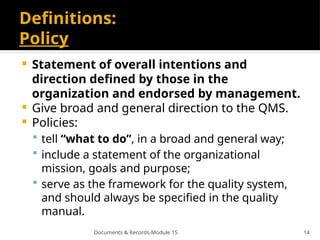
Definitions:
Policy
 Statement of overall intentions and
direction defined by those in the
organization and endorsed by management.
 Give broad and general direction to the QMS.
 Policies:
 tell “what to do”, in a broad and general way;
 include a statement of the organizational
mission, goals and purpose;
 serve as the framework for the quality system,
and should always be specified in the quality
manual.
Documents & Records-Module 15 15
Processes
 Steps involved in carrying out quality
policies.
 ‘‘Set of interrelated or interacting
activities that transform inputs into
outputs.’’ ISO 9000.
 ‘‘How it happens”.
 Processes can generally be represented in
a flow chart, with a series of steps to
indicate how events should occur over a
period of time.
Documents & Records-Module 15 16
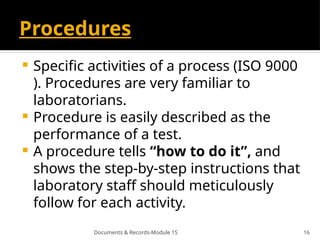
Procedures
 Specific activities of a process (ISO 9000
). Procedures are very familiar to
laboratorians.
 Procedure is easily described as the
performance of a test.
 A procedure tells “how to do it”, and
shows the step-by-step instructions that
laboratory staff should meticulously
follow for each activity.
Documents & Records-Module 15 17
Job Aids
 Or work instructions, are shortened
versions of SOPs that can be posted at
the bench for easy reference on
performing a procedure.
 Meant to supplement, not replace the
SOPs.
Documents & Records-Module 15 18
Examples of Laboratory
Documents
Overall guiding document for the
quality system and provides the
framework for its design and
implementation.
Quality
manual
• contain step-by-step written
instructions for each procedure
performed in the laboratory.
everyone in the laboratory
SOPs
• to find scientific and clinical
information about diseases,
laboratory methods, and procedures
Reference
materials
.
Documents & Records-Module 15 19
Characteristics of Good
Documents
 Written clearly and concisely
 Written in a user-friendly style
 Explicit and accurate
 Always up to date.
 Accessible to all staff.
Documents & Records-Module 15 20
Quality Manual
 Describes the quality management
system of an organization (ISO 15189).
Its purpose is to:
 clearly communicate information
 serve as a framework for meeting
quality system requirements
 convey managerial commitment to
the quality system.
Documents & Records-Module 15 21
The Quality Manual
is a document describing the
quality management system
of an organization
(ISO 15189)
Documents & Records-Module 15 22
Key Points
One official version
Never finished—always being
improved
Read, understood and accepted by
everyone
Written in clear, easily understood
language
Dated and signed by management.
Documents & Records-Module 15 23
Standard Operating
Procedures
 Written step-by-step instructions to follow when
performing a procedure.
 Ensures:
a) Consistency—everyone should perform the tests
exactly the same way so that the same result can be
expected from all staff.
b) Accuracy—produce more accurate results than relying
on memory alone because they will not forget steps in
the process.
c) Quality—consistent (reliable) and accurate results are
primary goals of the laboratory, and could be
considered as the definition of quality in the
laboratory.
Documents & Records-Module 15 24
A Good SOP
1. Detailed, clear and concise.
2. Easily understood by new personnel or
students in training.
3. Reviewed and approved by the
laboratory management—signature and
a date.
4. Updated on a regular basis.
5. Complete standardized header—typically
the standardized header would appear
on the first page of each SOP.
Complete Standardized
Header
Use at the top of the first page only
Documents & Records-Module 15 25
Reduced Standardized
Header
 other pages of every procedure
 use at the top of all other pages
Documents & Records-Module 15 26
Documents & Records-Module 15 27
Information on SOPs
1. Title—name of test.
2. Purpose—include information about the
test (why it is important, how it is used,
screening, to diagnose, or to follow
treatment.
3. Instructions—detailed information for
the entire testing process.
4. Name of the person preparing the SOP.
5. Signatures of approving officials and
dates of approval.
Documents & Records-Module 15 28
Job Aid
 Shortened version of an SOP.
 Used directly at the testing site.
 Placed in a visible location, and serves as
a reminder of the steps that need to be
completed.
 Job aid and the SOP must include the
same instructions.
 Job aids supplement—not replace—
the SOP.
Documents & Records-Module 15 29
Job Aids
30
Documents & Records-Module 15
Job Aids
Documents & Records-Module 15 31
Scenario
 The following information was provided
about your facility lab:
 Serum Glucose – Cobas c111 Analyzer SOPs
were first written on June 4th
06. SOPs were
revised on Jan 15th
07 and later on April
15th
09.
 The effective dates of distribution were June
4th
2006, Jan 20th
07 and April 20th
09
respectively.
 Input this information into the relevant
document.
Documents & Records-Module 15
Master File Index
Document Name # Version Date Effective Date Distribution Location (s)
Serum Glucose – Cobas c111
Analyzer Procedure
1 June 4, 2006 June 4, 2006 #1 Master File
2 Jan 15, 2007 #2 Chemistry Department
3 April 15, 2009 #1 Cobas c111 Analyzer Workstation
Acid Fast Bacilli (AFB) Direct
Smear Procedure
1 Aug 3, 2006 Aug 3, 2006 #1 Master File
#2 Microbiology Department
Reporting Critical Result
Procedure
1 Feb 3, 2006 Feb 3, 2006 #1 Master File
#2 Chemistry Department
#3 Hematology Department
#4 Urinalysis and Serology Depart.
#5 Microbiology Department
Documents & Records-Module 15 33
Document Control
 Procedures for formatting and maintaining
documents and should:
 ensure that the most current version of any
document is in use
 ensure availability and ease of use
 provide for the appropriate archiving of documents
 a uniform format that includes a numbering system
 a process for formal approval of each new document,
a distribution plan or list, and a procedure for
updating and revising laboratory documents
 a master log or inventory of all documents.
Documents & Records-Module 15 34
Considerations
1. System for standardizing the format
and/or numbering.
2. Approval, distribution and revision
process.
3. Master log.
4. Accessibility—provide a process for
ensuring that relevant versions of
documents are available.
5. System for archiving—old versions of
documents archived.
Documents & Records-Module 15 35
Requirements for
Implementation
1. Collect, review and update all existing
documents and records.
2. Determine additional needs.
3. Develop Quality Manual if not present.
4. Develop or obtain examples of
documents, including forms and
worksheets, if needed.
5. To help with formatting, examples from
other labs can be used.
6. Involve stakeholders—involve all staff
who will be using them.
Documents & Records-Module 15 36
Common Challenges
 Outdated documents in circulation.
 Distribution problems—multiple copies
of documents are dispersed
throughout different areas of the
laboratory
 Failure to account for documents of
external origin – need updating as well.
Documents & Records-Module 15 37
Purpose of Records
 Records are laboratory information, either written
by hand or computer-printed.
 Permanent, and are not revised or modified.
 Should be complete, legible and carefully
maintained.
 Purposes:
1. Continuous monitoring— access to all the data
collected .
2. Tracking of samples—throughout testing
process; essential for troubleshooting.
3. Evaluating problems that arise.
4. Management tool.
Documents & Records-Module 15 38
Examples
 Sample logbook
 Registers
 Laboratory workbooks
or worksheets
 Instrument printouts
 Quality control data
 External quality
assessment or
proficiency testing
records
 Patient test reports
 Personnel records
 Results of internal
and external audits
 Continuous
improvement projects
 Incident reports
 User surveys and
customer feedback
 Critical
communications
Documents & Records-Module 15 39
Important Information to record:
 Management and handling of rejected
samples.
 Sample referral to another laboratory
 Adverse occurrences or problems.
 Inventory and storage records.
 Equipment records.
 Test reports.
Documents & Records-Module 15 40
Test Reports ……
 Identification of test
 Identification of laboratory
 Unique identification and location of patient
 Name and address of requestor
 Date and time of collection, and time of receipt in
laboratory
 Date and time of release of report
 Primary sample type
 Results reported in SI units or units traceable to SI units
 Biological reference intervals
 Interpretation of results
 Comments
 Identification and signature of the person authorizing
release of the report;
 If relevant, notation of original and corrected results.
Documents & Records-Module 15 41
Storing Documents and Records
Considerations for paper-based records
1. Permanence—last as long as needed -
binding pages or using a bound book (log
register); numbered for ease of access,
permanent ink.
2. Accessibility—easily retrieved whenever
needed.
3. Security—kept in a secure place, safe
from spills, fires, floods or other
environmental hazards.
4. Traceability—trace a sample throughout
all processes in the laboratory.
Documents & Records-Module 15 42
Storing …..
Requirements for electronic records
1. Permanence—backup systems; regular
maintenance of computer system.
2. Security—ensure computer access
codes protect the data.
3. Traceability—electronic record
systems should be designed in a way
that allows for tracing the specimen
throughout the entire process in the
laboratory.
Documents & Records-Module 15 43
Storing …..
Factors determining Retention times for records
1. Length of time the laboratory will need
to have access to its records.
2. Government requirements or standards
that dictate record retention times.
3. Whether the laboratory is engaged in
ongoing research requiring many years
of data.
4. Time interval between the laboratory’s
assessments or audits.
Documents & Records-Module 15 44
Activity: What Would You
Do?
Purpose
To integrate the module’s
lessons and apply them to
the case scenario.
What will you need?
Handout: Case Study
Scenarios
What will you do?
Divide into groups of 4-5
 Select a spokesperson
for your group
 Formulate specific
action steps to address
the scenario from the
Handout.
 The group’s
spokesperson presents
the proposed steps
during the 2 minute
class report.
5 minutes
Documents & Records-Module 15 45
What Would You Do?
You recently updated a policy to prevent the
reoccurrence of a serious issue. Later in the
month, the same situation occurred again
resulting in a serious injury to a patient.
When you questioned the staff member, you
discovered he/she only had access to the old
version of the policy that did not reflect the
updated changes. You realize there are
several copies of this policy, but you cannot
recall where they are all located.
What actions can you take in managing your
documents and records?
Documents & Records-Module 15 46
What Would You Do?
You have heard rumors that patients in
your community are hesitant to come
to your facility because of
confidentiality issues.
 What actions do you take to ensure the
confidentiality of the laboratory results?
 When asked, how will you assure your
patients that the laboratory maintains
confidentiality?
Documents & Records-Module 15 47
Tasks
 10.1 Maintain a library of documents
(policies, guidelines, SOPs, references,
etc.); review and update annually
 10.2 Maintain integrity, organization, and
confidentiality of records (client test
results, specimen transfer logs,
maintenance logs, inventory logs, etc.)
Documents & Records-Module 15 48
Tasks ………
 10.3 Assure proper record retention,
rotation to storage, and disposal
according to protocol
 1.1 Organize work area to allow for
smooth, efficient service operations.
 6.1 Ensure that the Quality Manual with
quality assurance policies and
procedures is accessible to and reviewed
by all staff.
Documents & Records-Module 15 49
Summary
 Documents include written policies, processes and
procedures
 Need to be updated and maintained.
 Records include information captured in the process of
performing and reporting a lab test.
 Records are permanent and does not require
updating.
 Good document control programme ensures that the
most current version of a document is used, and
ensures availability and ease of access when a
document is needed.
 Information is our product.
 Documents are essential for assuring accuracy and
consistency in the laboratory.
What have
we learned?

Module 15 Documents and Records.pptxDavid

  • 1.
  • 2.
    Documents & Records-Module15 Learning Objectives At the conclusion of this session, you will be able to:  Explain the difference between documents and records;  Describe the hierarchy of documents and the role of each level;  Outline the contents of a quality manual;  Outline the content that should be included in a standard operating procedure;  Explain the important steps, or elements, of a laboratory document management 2
  • 3.
    Learning Objectives  Describemethods and tools to properly store documents and records.  Develop the relevant document for the QMS  Develop the document control system  Develop the records for the QMS  Develop and maintain the storage and retrieval system  Ensure proper characteristics of records Documents & Records-Module 15 3
  • 4.
    Documents & Records-Module15 Scenario  testing algorithm  safety manual  client test results  standard operation procedures (SOPs) for an approved HIV rapid test  manufacturer test kit inserts  summary of findings from on-site evaluation visit  report of corrective actions  temperature log (blank form)  quality control record (blank form)  daily maintenance log (completed)  stock cards and stock book (completed)  EQA specimen transfer log (completed) 4 You have found all these papers lying on a desk. Which of these are documents and which are records?
  • 5.
    Answers’  testing algorithm safety manual  client test results  standard operation procedures (SOPs) for an approved HIV rapid test  manufacturer test kit inserts  summary of findings from on-site evaluation visit  report of corrective actions  temperature log (blank form)  quality control record (blank form)  daily maintenance log (completed)  stock cards and stock book (completed)  EQA sample transfer log (completed) Documents & Records-Module 15 5
  • 6.
    Documents & Records-Module15 6 Agenda Overview Quality Manual Standard Operating Manual Document Control Overview of Records Storing Documents and Records
  • 7.
    Documents & Records-Module15 7 Introduction  Provide written information about policies, processes and procedures.  Paper-based or computer-based.  Should be permanent, secure, traceable and approved, up-to-date and easily accessible.  Should be regularly updated or maintained when a policy, process or procedure changes.
  • 8.
    Documents & Records-Module15 8 Purpose of Documents……  Communicate information to all users of lab.  Point of reference for establishing facts regarding an incident.  An aid in the recognition of trends and resolution of problems.  To establish credibility of the laboratory.
  • 9.
    Documents & Records-Module15 9 Why do laboratories need to manage documents and records? To find information whenever it is needed!
  • 10.
    Documents and Records—Howdo they differ? Documents  communicate information via policies, processes, and procedures  need updating Records  capture information on worksheets, forms, labels, and charts  permanent, do not change Documents & Records-Module 15 10 RECORDS
  • 11.
    Documents & Records-Module15 11 Information is the major product of the laboratory
  • 12.
    Documents & Records-Module15 12 Policies Processes Procedures / Work Instructions “What to do” “How it happens” “How to do it” - (SOPs)
  • 13.
    Documents & Records-Module15 13 Level 1 Quality Manual: Governing document that defines the QMS. Defines the Quality policy statement i.e. statement of intent and the objectives . The manual makes reference to supporting management and technical documents. Level 2Quality Procedures: Describe the processes to be followed when carrying out activities involved in the system implementation Level 3Technical Requirements /Operating Procedures/Supporting documents: Provide step by step instructions for carrying out testing activities at various levels of pre-examination, examination and post-examination Level 4 Records: Provide evidence of implementation. Can be in the form of completed worksheets, books, filled-in forms, computer printouts. Records can be either electronic or hard copies.
  • 14.
    Documents & Records-Module15 14 Definitions: Policy  Statement of overall intentions and direction defined by those in the organization and endorsed by management.  Give broad and general direction to the QMS.  Policies:  tell “what to do”, in a broad and general way;  include a statement of the organizational mission, goals and purpose;  serve as the framework for the quality system, and should always be specified in the quality manual.
  • 15.
    Documents & Records-Module15 15 Processes  Steps involved in carrying out quality policies.  ‘‘Set of interrelated or interacting activities that transform inputs into outputs.’’ ISO 9000.  ‘‘How it happens”.  Processes can generally be represented in a flow chart, with a series of steps to indicate how events should occur over a period of time.
  • 16.
    Documents & Records-Module15 16 Procedures  Specific activities of a process (ISO 9000 ). Procedures are very familiar to laboratorians.  Procedure is easily described as the performance of a test.  A procedure tells “how to do it”, and shows the step-by-step instructions that laboratory staff should meticulously follow for each activity.
  • 17.
    Documents & Records-Module15 17 Job Aids  Or work instructions, are shortened versions of SOPs that can be posted at the bench for easy reference on performing a procedure.  Meant to supplement, not replace the SOPs.
  • 18.
    Documents & Records-Module15 18 Examples of Laboratory Documents Overall guiding document for the quality system and provides the framework for its design and implementation. Quality manual • contain step-by-step written instructions for each procedure performed in the laboratory. everyone in the laboratory SOPs • to find scientific and clinical information about diseases, laboratory methods, and procedures Reference materials .
  • 19.
    Documents & Records-Module15 19 Characteristics of Good Documents  Written clearly and concisely  Written in a user-friendly style  Explicit and accurate  Always up to date.  Accessible to all staff.
  • 20.
    Documents & Records-Module15 20 Quality Manual  Describes the quality management system of an organization (ISO 15189). Its purpose is to:  clearly communicate information  serve as a framework for meeting quality system requirements  convey managerial commitment to the quality system.
  • 21.
    Documents & Records-Module15 21 The Quality Manual is a document describing the quality management system of an organization (ISO 15189)
  • 22.
    Documents & Records-Module15 22 Key Points One official version Never finished—always being improved Read, understood and accepted by everyone Written in clear, easily understood language Dated and signed by management.
  • 23.
    Documents & Records-Module15 23 Standard Operating Procedures  Written step-by-step instructions to follow when performing a procedure.  Ensures: a) Consistency—everyone should perform the tests exactly the same way so that the same result can be expected from all staff. b) Accuracy—produce more accurate results than relying on memory alone because they will not forget steps in the process. c) Quality—consistent (reliable) and accurate results are primary goals of the laboratory, and could be considered as the definition of quality in the laboratory.
  • 24.
    Documents & Records-Module15 24 A Good SOP 1. Detailed, clear and concise. 2. Easily understood by new personnel or students in training. 3. Reviewed and approved by the laboratory management—signature and a date. 4. Updated on a regular basis. 5. Complete standardized header—typically the standardized header would appear on the first page of each SOP.
  • 25.
    Complete Standardized Header Use atthe top of the first page only Documents & Records-Module 15 25
  • 26.
    Reduced Standardized Header  otherpages of every procedure  use at the top of all other pages Documents & Records-Module 15 26
  • 27.
    Documents & Records-Module15 27 Information on SOPs 1. Title—name of test. 2. Purpose—include information about the test (why it is important, how it is used, screening, to diagnose, or to follow treatment. 3. Instructions—detailed information for the entire testing process. 4. Name of the person preparing the SOP. 5. Signatures of approving officials and dates of approval.
  • 28.
    Documents & Records-Module15 28 Job Aid  Shortened version of an SOP.  Used directly at the testing site.  Placed in a visible location, and serves as a reminder of the steps that need to be completed.  Job aid and the SOP must include the same instructions.  Job aids supplement—not replace— the SOP.
  • 29.
  • 30.
  • 31.
    Documents & Records-Module15 31 Scenario  The following information was provided about your facility lab:  Serum Glucose – Cobas c111 Analyzer SOPs were first written on June 4th 06. SOPs were revised on Jan 15th 07 and later on April 15th 09.  The effective dates of distribution were June 4th 2006, Jan 20th 07 and April 20th 09 respectively.  Input this information into the relevant document.
  • 32.
    Documents & Records-Module15 Master File Index Document Name # Version Date Effective Date Distribution Location (s) Serum Glucose – Cobas c111 Analyzer Procedure 1 June 4, 2006 June 4, 2006 #1 Master File 2 Jan 15, 2007 #2 Chemistry Department 3 April 15, 2009 #1 Cobas c111 Analyzer Workstation Acid Fast Bacilli (AFB) Direct Smear Procedure 1 Aug 3, 2006 Aug 3, 2006 #1 Master File #2 Microbiology Department Reporting Critical Result Procedure 1 Feb 3, 2006 Feb 3, 2006 #1 Master File #2 Chemistry Department #3 Hematology Department #4 Urinalysis and Serology Depart. #5 Microbiology Department
  • 33.
    Documents & Records-Module15 33 Document Control  Procedures for formatting and maintaining documents and should:  ensure that the most current version of any document is in use  ensure availability and ease of use  provide for the appropriate archiving of documents  a uniform format that includes a numbering system  a process for formal approval of each new document, a distribution plan or list, and a procedure for updating and revising laboratory documents  a master log or inventory of all documents.
  • 34.
    Documents & Records-Module15 34 Considerations 1. System for standardizing the format and/or numbering. 2. Approval, distribution and revision process. 3. Master log. 4. Accessibility—provide a process for ensuring that relevant versions of documents are available. 5. System for archiving—old versions of documents archived.
  • 35.
    Documents & Records-Module15 35 Requirements for Implementation 1. Collect, review and update all existing documents and records. 2. Determine additional needs. 3. Develop Quality Manual if not present. 4. Develop or obtain examples of documents, including forms and worksheets, if needed. 5. To help with formatting, examples from other labs can be used. 6. Involve stakeholders—involve all staff who will be using them.
  • 36.
    Documents & Records-Module15 36 Common Challenges  Outdated documents in circulation.  Distribution problems—multiple copies of documents are dispersed throughout different areas of the laboratory  Failure to account for documents of external origin – need updating as well.
  • 37.
    Documents & Records-Module15 37 Purpose of Records  Records are laboratory information, either written by hand or computer-printed.  Permanent, and are not revised or modified.  Should be complete, legible and carefully maintained.  Purposes: 1. Continuous monitoring— access to all the data collected . 2. Tracking of samples—throughout testing process; essential for troubleshooting. 3. Evaluating problems that arise. 4. Management tool.
  • 38.
    Documents & Records-Module15 38 Examples  Sample logbook  Registers  Laboratory workbooks or worksheets  Instrument printouts  Quality control data  External quality assessment or proficiency testing records  Patient test reports  Personnel records  Results of internal and external audits  Continuous improvement projects  Incident reports  User surveys and customer feedback  Critical communications
  • 39.
    Documents & Records-Module15 39 Important Information to record:  Management and handling of rejected samples.  Sample referral to another laboratory  Adverse occurrences or problems.  Inventory and storage records.  Equipment records.  Test reports.
  • 40.
    Documents & Records-Module15 40 Test Reports ……  Identification of test  Identification of laboratory  Unique identification and location of patient  Name and address of requestor  Date and time of collection, and time of receipt in laboratory  Date and time of release of report  Primary sample type  Results reported in SI units or units traceable to SI units  Biological reference intervals  Interpretation of results  Comments  Identification and signature of the person authorizing release of the report;  If relevant, notation of original and corrected results.
  • 41.
    Documents & Records-Module15 41 Storing Documents and Records Considerations for paper-based records 1. Permanence—last as long as needed - binding pages or using a bound book (log register); numbered for ease of access, permanent ink. 2. Accessibility—easily retrieved whenever needed. 3. Security—kept in a secure place, safe from spills, fires, floods or other environmental hazards. 4. Traceability—trace a sample throughout all processes in the laboratory.
  • 42.
    Documents & Records-Module15 42 Storing ….. Requirements for electronic records 1. Permanence—backup systems; regular maintenance of computer system. 2. Security—ensure computer access codes protect the data. 3. Traceability—electronic record systems should be designed in a way that allows for tracing the specimen throughout the entire process in the laboratory.
  • 43.
    Documents & Records-Module15 43 Storing ….. Factors determining Retention times for records 1. Length of time the laboratory will need to have access to its records. 2. Government requirements or standards that dictate record retention times. 3. Whether the laboratory is engaged in ongoing research requiring many years of data. 4. Time interval between the laboratory’s assessments or audits.
  • 44.
    Documents & Records-Module15 44 Activity: What Would You Do? Purpose To integrate the module’s lessons and apply them to the case scenario. What will you need? Handout: Case Study Scenarios What will you do? Divide into groups of 4-5  Select a spokesperson for your group  Formulate specific action steps to address the scenario from the Handout.  The group’s spokesperson presents the proposed steps during the 2 minute class report. 5 minutes
  • 45.
    Documents & Records-Module15 45 What Would You Do? You recently updated a policy to prevent the reoccurrence of a serious issue. Later in the month, the same situation occurred again resulting in a serious injury to a patient. When you questioned the staff member, you discovered he/she only had access to the old version of the policy that did not reflect the updated changes. You realize there are several copies of this policy, but you cannot recall where they are all located. What actions can you take in managing your documents and records?
  • 46.
    Documents & Records-Module15 46 What Would You Do? You have heard rumors that patients in your community are hesitant to come to your facility because of confidentiality issues.  What actions do you take to ensure the confidentiality of the laboratory results?  When asked, how will you assure your patients that the laboratory maintains confidentiality?
  • 47.
    Documents & Records-Module15 47 Tasks  10.1 Maintain a library of documents (policies, guidelines, SOPs, references, etc.); review and update annually  10.2 Maintain integrity, organization, and confidentiality of records (client test results, specimen transfer logs, maintenance logs, inventory logs, etc.)
  • 48.
    Documents & Records-Module15 48 Tasks ………  10.3 Assure proper record retention, rotation to storage, and disposal according to protocol  1.1 Organize work area to allow for smooth, efficient service operations.  6.1 Ensure that the Quality Manual with quality assurance policies and procedures is accessible to and reviewed by all staff.
  • 49.
    Documents & Records-Module15 49 Summary  Documents include written policies, processes and procedures  Need to be updated and maintained.  Records include information captured in the process of performing and reporting a lab test.  Records are permanent and does not require updating.  Good document control programme ensures that the most current version of a document is used, and ensures availability and ease of access when a document is needed.  Information is our product.  Documents are essential for assuring accuracy and consistency in the laboratory.
  • 50.

Editor's Notes

  • #12 Policies are broad statements that describe the intent of the organization, for example, “The organization will have a safety plan that encompasses….” Processes are a series of actions to produce a desired outcome or output. Procedures are step by step instructions about how to do something, for example, “Incubate for 10 minutes.” Sometimes a fourth tier is included in the document hierarchy representing the templates (blank documents) for forms/ tags/ labels. Once information is entered, the forms/ tags/ labels become records.
  • #50 DO: Review day’s material. SAY: Tomorrow we will look at Steps 2 & 3. DO: Distribute Day 1 evaluation form.