Data Management & Warehousing


     Data Quality:
Common Problems & Checks
              Date: 24 April 2009
           Location: Zagreb, Croatia

                  David M. Walker
               davidw@datamgmt.com
   +44 (0) 7050 028 911 - http://www.datamgmt.com
Agenda
•!    Introduction
•!    Common Problems
•!    Automated Checking
•!    Profiling Checks
•!    Conclusions


24 April 2009        © 2009 Data Management & Warehousing   Page 2
Introduction
•! Data Quality problems are a SOURCE SYSTEM
   issue and an ETL issue
        –! They just manifest themselves in the data warehouse
•! Prevention is better than cure
        –! Fixing the source system or the ETL is ALWAYS
           cheaper and more effective than cleaning the data in
           the ETL or in the Data Warehouse itself
•! Data Quality is a continuous process
        –! It is never finished and always needs to be monitored

24 April 2009            © 2009 Data Management & Warehousing   Page 3
The Impact of Poor Data Quality

•! Devalues the data warehouse
        –! Discourages people from trusting or using the
           system and therefore curtailing the life of the
           data warehouse
•! Highlights failings in the source system
   and/or the business process
        –! Businesses would rather fix at any cost in the
           data warehouse and pretend that there isn’t a
           source system problem
24 April 2009           © 2009 Data Management & Warehousing   Page 4
Common Problems
•! 11 types of problem that account for the
   most common problems
•! They usually reflect poor design and/or
   implementation of systems
•! Most can be fixed or monitored and
   managed to limit the impact


24 April 2009         © 2009 Data Management & Warehousing   Page 5
Referential Issues
•! Keys that are not unique
        –! Systems that do not enforce the unique
           primary key or flat files or spreadsheets
        –! Also generated by ETL that creates a
           surrogate key incorrectly
•! Referential Integrity Failures
        –! Where referentially integrity is not enforced
           values in the child table are created that are
           not in the parent table
24 April 2009           © 2009 Data Management & Warehousing   Page 6
Data Type Issues
•! Format Errors
        –! Typically in Date/Time type fields
        –! 02/04/2009 2nd April (UK) or 4th Feb (US)
•! Inappropriate Data Types
        –! Storing Dates in Character Strings
           20090624 as YYYYMMDD format string
        –! But what about 20090230?


24 April 2009          © 2009 Data Management & Warehousing   Page 7
Data Model Issues
•! De-normalised tables
        –! Commonly created for performance reasons
        –! Inherently duplicates data
        –! Often gets out of sync
•! Data/Column Retirement
        –! Upgrade to system retires a column
        –! ETL continues to use the old column
•! Poor Table/Column Naming
        –! Don’t assume that a column does what it says
        –! Don’t assume that a column is still being used for it’s original
           purpose

24 April 2009                 © 2009 Data Management & Warehousing            Page 8
Data Content Issues
•! Null Values
        –! Systems that have many optional fields will
           often have missing values
        –! Null values allow rows to be silently omitted
           from queries
•! Inappropriate Values
        –! Databases allow special characters and/or
           leading/trailing white space
        –! “DataspaceQuality” != “DatatabQuality”
24 April 2009          © 2009 Data Management & Warehousing   Page 9
Data Feed Issues
•! Missing Data
        –! Where a stream of files are loaded by ETL if
           one is dropped it can go un-noticed
        –! Common with CDR type loads in Telcos
•! Late Data
        –! A short term data quality issue
        –! Leaves users believing there is a problem
        –! Produces inconsistent reporting over time

24 April 2009          © 2009 Data Management & Warehousing   Page 10
Automated Checking
•! Regularly run checks
•! Broad Coverage across systems
        –! 100s and 1000s not 10s of queries
        –! Run in a low priority loop in the background
•! Used against:
        –! Sources
        –! Data Staging
        –! Data Warehouse
•! No Product Required
        –! We often implement this as a controlling shell script and lots of
           small scripts, one for each check

24 April 2009                 © 2009 Data Management & Warehousing        Page 11
Trending
•! Absolute Trending
        –! Track an expected value over time
                •! e.g. Returned Mail is usually less than 500 items per day
                •! If the value is <500 status is green, 501 to 1000 amber and >1000
                   red
•! Statistical Process Control (SPC) Trending
        –! Track an expected value where the value changes over time
                •!   e.g. Telco CDRs – expect more as the company grows
                •!   Don’t want to be continuously changing the threshold
                •!   Compare current load to historical means
                •!   If current load within 2 Standard Deviations – Green,
                     3 Standard Deviations – Amber,
                     4 or more Standard Deviations - Red

24 April 2009                        © 2009 Data Management & Warehousing        Page 12
Flow Control
•! Flow Control
        –! ETL manipulates data
                •! Joins, De-duplicates, Filters, Aggregates, etc
        –! Use the formula:
                Source Count - Filtered Count – DeDup Count – Target Count = 0

•! Trusted Source
        –! Compare the result with a third system
        –! e.g. Does the Count of Switch CDRs =
           Count of those processed by the billing system
           Count of those processed in the DWH

24 April 2009                         © 2009 Data Management & Warehousing       Page 13
Business Rules Based
•! Specific rules to match known business
   rules
        –! Account holders > 18 (Sys Date – DoB)
        –! Account holders < 115
        –! Credit Card numbers are 16 digits long
        –! Number of accounts without a status
•! Result should yield Zero


24 April 2009         © 2009 Data Management & Warehousing   Page 14
Automated Checking - Ops
•! Managed by exception
        –! Red given priority
        –! Amber are always followed up
•! Massive number of checks
        –! 100’s are good
        –! 1000’s are better
•! Presentation
        –! Alerts, RAG, Graphical, Numerical, etc.
24 April 2009           © 2009 Data Management & Warehousing   Page 15
Data Profiling Checks
•! Run manually because they need to be
   interpreted by a human
•! Leads to new business rules being added
   to the automated checks
•! Can be done with simple reporting tools or
   commercial data profiling tools


24 April 2009          © 2009 Data Management & Warehousing   Page 16
Frequency Outliers
•! Count discreet values in a table and check
   items with many more or less than normal
        –! e.g. DoB 01-01-01 many times more common
           than any other value indicates source default
           and something that needs work
        –! e.g. Count of SMS messages significantly
           lower on a given day may equate to a genuine
           system failure and therefore not a DQ
           problem
24 April 2009          © 2009 Data Management & Warehousing   Page 17
Maximum & Minimum
•! Determine what a valid range for any
   value should be
        –! e.g. age between 18 and 115
        –! Immediately finds individual data quality
           issues that can be resolved
        –! Allows an analyst to create new business
           rules to prevent future problems


24 April 2009          © 2009 Data Management & Warehousing   Page 18
Sequential Keys
•! If a system has a sequential key:

      Max Value – Min Value – Count = 0

•! If this is true – is it too perfect for an
   operational system and therefore test data
•! If this is false – what has caused the gaps,
   are the deletions intentional?
24 April 2009          © 2009 Data Management & Warehousing   Page 19
Data Types
•! Validation of mis-used data types before
   loading
        –! e.g. Dates in Character fields
        –! Format: YYYYMMDD
        –! Check MM between 01 and 12
        –! Check DD between 01 and 31
        –! Check MMDD does not include 0230, 0231
        –! etc.

24 April 2009         © 2009 Data Management & Warehousing   Page 20
Skewed Pattern Profiling
•! Looking for specific patterns in data
        –! e.g. UK National Insurance Numbers (?) have
           the format AA 99 99 99 A
        –! Pattern match all values looking for
           exceptions
•! Number Lengths are a special case
        –! e.g Credit Card Numbers are 16 digits long


24 April 2009          © 2009 Data Management & Warehousing   Page 21
Content Checking
•! Content Checking is the manual review of
   character strings
•! Needs a good understanding of the nature
   of the data
•! Often determines the need to do analysis
   of other types


24 April 2009         © 2009 Data Management & Warehousing   Page 22
Nulls & White Space
•! Nulls
        –! Fields that have large proportion of nulls are usually
           not useful
        –! Also common is default status of null
           (e.g. Account us either closed or null)
•! White Space
        –! Not Null fields with a single space
        –! Tab instead of space
        –! Leading/Trailing white space
        –! Double White Space: “DavidSpaceSpaceWalker”
24 April 2009             © 2009 Data Management & Warehousing   Page 23
Punctuation & Control Chars
•! Punctuation
        –! CSV files that are not properly quoted perform
           field shifts
        –! Address lines with extra commas
•! Control Characters
        –! Data fields that contain ASCII character codes
           0 to 31 and 127 to 159 are often ‘invisible’
           when viewed in queries but cause failures
        –! Also be aware of ‘code-page’ specifics
24 April 2009          © 2009 Data Management & Warehousing   Page 24
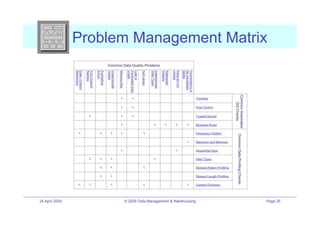
Problem Management Matrix


24 April 2009         © 2009 Data Management & Warehousing   Page 25
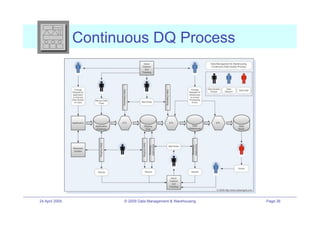
Continuous DQ Process


24 April 2009         © 2009 Data Management & Warehousing   Page 26
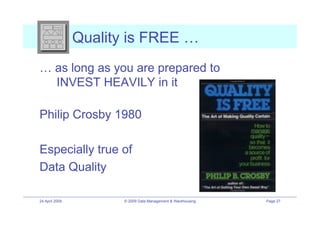
Quality is FREE …
… as long as you are prepared to
  INVEST HEAVILY in it

Philip Crosby 1980

Especially true of
Data Quality

24 April 2009         © 2009 Data Management & Warehousing   Page 27
Data Management & Warehousing


     Data Quality:
Common Problems & Checks

      Thank You
                  David M. Walker
               davidw@datamgmt.com
   +44 (0) 7050 028 911 - http://www.datamgmt.com

ETIS09 - Data Quality: Common Problems & Checks - Presentation

  • 1.
    Data Management &Warehousing Data Quality: Common Problems & Checks Date: 24 April 2009 Location: Zagreb, Croatia David M. Walker davidw@datamgmt.com +44 (0) 7050 028 911 - http://www.datamgmt.com
  • 2.
    Agenda •! Introduction •! Common Problems •! Automated Checking •! Profiling Checks •! Conclusions 24 April 2009 © 2009 Data Management & Warehousing Page 2
  • 3.
    Introduction •! Data Qualityproblems are a SOURCE SYSTEM issue and an ETL issue –! They just manifest themselves in the data warehouse •! Prevention is better than cure –! Fixing the source system or the ETL is ALWAYS cheaper and more effective than cleaning the data in the ETL or in the Data Warehouse itself •! Data Quality is a continuous process –! It is never finished and always needs to be monitored 24 April 2009 © 2009 Data Management & Warehousing Page 3
  • 4.
    The Impact ofPoor Data Quality •! Devalues the data warehouse –! Discourages people from trusting or using the system and therefore curtailing the life of the data warehouse •! Highlights failings in the source system and/or the business process –! Businesses would rather fix at any cost in the data warehouse and pretend that there isn’t a source system problem 24 April 2009 © 2009 Data Management & Warehousing Page 4
  • 5.
    Common Problems •! 11types of problem that account for the most common problems •! They usually reflect poor design and/or implementation of systems •! Most can be fixed or monitored and managed to limit the impact 24 April 2009 © 2009 Data Management & Warehousing Page 5
  • 6.
    Referential Issues •! Keysthat are not unique –! Systems that do not enforce the unique primary key or flat files or spreadsheets –! Also generated by ETL that creates a surrogate key incorrectly •! Referential Integrity Failures –! Where referentially integrity is not enforced values in the child table are created that are not in the parent table 24 April 2009 © 2009 Data Management & Warehousing Page 6
  • 7.
    Data Type Issues •!Format Errors –! Typically in Date/Time type fields –! 02/04/2009 2nd April (UK) or 4th Feb (US) •! Inappropriate Data Types –! Storing Dates in Character Strings 20090624 as YYYYMMDD format string –! But what about 20090230? 24 April 2009 © 2009 Data Management & Warehousing Page 7
  • 8.
    Data Model Issues •!De-normalised tables –! Commonly created for performance reasons –! Inherently duplicates data –! Often gets out of sync •! Data/Column Retirement –! Upgrade to system retires a column –! ETL continues to use the old column •! Poor Table/Column Naming –! Don’t assume that a column does what it says –! Don’t assume that a column is still being used for it’s original purpose 24 April 2009 © 2009 Data Management & Warehousing Page 8
  • 9.
    Data Content Issues •!Null Values –! Systems that have many optional fields will often have missing values –! Null values allow rows to be silently omitted from queries •! Inappropriate Values –! Databases allow special characters and/or leading/trailing white space –! “DataspaceQuality” != “DatatabQuality” 24 April 2009 © 2009 Data Management & Warehousing Page 9
  • 10.
    Data Feed Issues •!Missing Data –! Where a stream of files are loaded by ETL if one is dropped it can go un-noticed –! Common with CDR type loads in Telcos •! Late Data –! A short term data quality issue –! Leaves users believing there is a problem –! Produces inconsistent reporting over time 24 April 2009 © 2009 Data Management & Warehousing Page 10
  • 11.
    Automated Checking •! Regularlyrun checks •! Broad Coverage across systems –! 100s and 1000s not 10s of queries –! Run in a low priority loop in the background •! Used against: –! Sources –! Data Staging –! Data Warehouse •! No Product Required –! We often implement this as a controlling shell script and lots of small scripts, one for each check 24 April 2009 © 2009 Data Management & Warehousing Page 11
  • 12.
    Trending •! Absolute Trending –! Track an expected value over time •! e.g. Returned Mail is usually less than 500 items per day •! If the value is <500 status is green, 501 to 1000 amber and >1000 red •! Statistical Process Control (SPC) Trending –! Track an expected value where the value changes over time •! e.g. Telco CDRs – expect more as the company grows •! Don’t want to be continuously changing the threshold •! Compare current load to historical means •! If current load within 2 Standard Deviations – Green, 3 Standard Deviations – Amber, 4 or more Standard Deviations - Red 24 April 2009 © 2009 Data Management & Warehousing Page 12
  • 13.
    Flow Control •! FlowControl –! ETL manipulates data •! Joins, De-duplicates, Filters, Aggregates, etc –! Use the formula: Source Count - Filtered Count – DeDup Count – Target Count = 0 •! Trusted Source –! Compare the result with a third system –! e.g. Does the Count of Switch CDRs = Count of those processed by the billing system Count of those processed in the DWH 24 April 2009 © 2009 Data Management & Warehousing Page 13
  • 14.
    Business Rules Based •!Specific rules to match known business rules –! Account holders > 18 (Sys Date – DoB) –! Account holders < 115 –! Credit Card numbers are 16 digits long –! Number of accounts without a status •! Result should yield Zero 24 April 2009 © 2009 Data Management & Warehousing Page 14
  • 15.
    Automated Checking -Ops •! Managed by exception –! Red given priority –! Amber are always followed up •! Massive number of checks –! 100’s are good –! 1000’s are better •! Presentation –! Alerts, RAG, Graphical, Numerical, etc. 24 April 2009 © 2009 Data Management & Warehousing Page 15
  • 16.
    Data Profiling Checks •!Run manually because they need to be interpreted by a human •! Leads to new business rules being added to the automated checks •! Can be done with simple reporting tools or commercial data profiling tools 24 April 2009 © 2009 Data Management & Warehousing Page 16
  • 17.
    Frequency Outliers •! Countdiscreet values in a table and check items with many more or less than normal –! e.g. DoB 01-01-01 many times more common than any other value indicates source default and something that needs work –! e.g. Count of SMS messages significantly lower on a given day may equate to a genuine system failure and therefore not a DQ problem 24 April 2009 © 2009 Data Management & Warehousing Page 17
  • 18.
    Maximum & Minimum •!Determine what a valid range for any value should be –! e.g. age between 18 and 115 –! Immediately finds individual data quality issues that can be resolved –! Allows an analyst to create new business rules to prevent future problems 24 April 2009 © 2009 Data Management & Warehousing Page 18
  • 19.
    Sequential Keys •! Ifa system has a sequential key: Max Value – Min Value – Count = 0 •! If this is true – is it too perfect for an operational system and therefore test data •! If this is false – what has caused the gaps, are the deletions intentional? 24 April 2009 © 2009 Data Management & Warehousing Page 19
  • 20.
    Data Types •! Validationof mis-used data types before loading –! e.g. Dates in Character fields –! Format: YYYYMMDD –! Check MM between 01 and 12 –! Check DD between 01 and 31 –! Check MMDD does not include 0230, 0231 –! etc. 24 April 2009 © 2009 Data Management & Warehousing Page 20
  • 21.
    Skewed Pattern Profiling •!Looking for specific patterns in data –! e.g. UK National Insurance Numbers (?) have the format AA 99 99 99 A –! Pattern match all values looking for exceptions •! Number Lengths are a special case –! e.g Credit Card Numbers are 16 digits long 24 April 2009 © 2009 Data Management & Warehousing Page 21
  • 22.
    Content Checking •! ContentChecking is the manual review of character strings •! Needs a good understanding of the nature of the data •! Often determines the need to do analysis of other types 24 April 2009 © 2009 Data Management & Warehousing Page 22
  • 23.
    Nulls & WhiteSpace •! Nulls –! Fields that have large proportion of nulls are usually not useful –! Also common is default status of null (e.g. Account us either closed or null) •! White Space –! Not Null fields with a single space –! Tab instead of space –! Leading/Trailing white space –! Double White Space: “DavidSpaceSpaceWalker” 24 April 2009 © 2009 Data Management & Warehousing Page 23
  • 24.
    Punctuation & ControlChars •! Punctuation –! CSV files that are not properly quoted perform field shifts –! Address lines with extra commas •! Control Characters –! Data fields that contain ASCII character codes 0 to 31 and 127 to 159 are often ‘invisible’ when viewed in queries but cause failures –! Also be aware of ‘code-page’ specifics 24 April 2009 © 2009 Data Management & Warehousing Page 24
  • 25.
    Problem Management Matrix 24April 2009 © 2009 Data Management & Warehousing Page 25
  • 26.
    Continuous DQ Process 24April 2009 © 2009 Data Management & Warehousing Page 26
  • 27.
    Quality is FREE… … as long as you are prepared to INVEST HEAVILY in it Philip Crosby 1980 Especially true of Data Quality 24 April 2009 © 2009 Data Management & Warehousing Page 27
  • 28.
    Data Management &Warehousing Data Quality: Common Problems & Checks Thank You David M. Walker davidw@datamgmt.com +44 (0) 7050 028 911 - http://www.datamgmt.com