DocumentsandRecords-
Module16
1
Scenario
• Inspection Reports
• Quality Manual
• Audit Results
• Standard Operation
Procedures (SOPs)
• Summary of Audit
findings from on-site
Audits
• report of corrective actions
• Non conformances form
(blank form)
• Quality Control record (blank
form)
• Daily Maintenance log
(completed)
• Stock Cards and Stock Book
(completed)
• ETC
You have found all these papers lying on a
desk. Which of these are documents and
which are records?
Why do Organizations need to manage
documents and records?
To find information whenever it is needed!
 provides individuals with the information to
perform a job properly
 ensure permanence irrespective of personnel
change/turnover
 provide concise set of requirements
 facilitate consistency of quality activities
 facilitate monitoring activities and
 quality system audits
DocumentsandRecords-
Module16
2
Why do Organizations need to
manage documents and records?
It minimizes opportunities for
miscommunication
When historical data are being evaluated for
current use, documents can also be valuable
 convey requirements simultaneously to all
concerned personnel
 facilitate effective change control
indicate compliance with organizational
governmental requirements
DocumentsandRecords-
Module16
3
DocumentsandRecords-
Module16
4
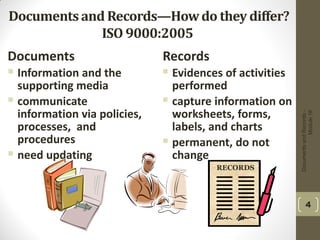
Documentsand Records—Howdo they differ?
ISO 9000:2005
Documents
 Information and the
supporting media
 communicate
information via policies,
processes, and
procedures
 need updating
Records
 Evidences of activities
performed
 capture information on
worksheets, forms,
labels, and charts
 permanent, do not
change
RECORDS
5
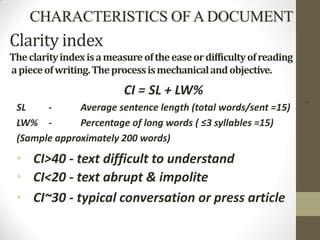
Clarity index
Theclarityindexisameasureoftheeaseordifficultyofreading
apieceofwriting.Theprocessismechanicalandobjective.
CI = SL + LW%
SL - Average sentence length (total words/sent =15)
LW% - Percentage of long words ( ≤3 syllables =15)
(Sample approximately 200 words)
• CI>40 - text difficult to understand
• CI<20 - text abrupt & impolite
• CI~30 - typical conversation or press article
CHARACTERISTICS OF A DOCUMENT
DocumentsandRecords-
Module16
6
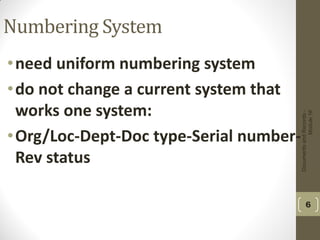
Numbering System
•need uniform numbering system
•do not change a current system that
works one system:
•Org/Loc-Dept-Doc type-Serial number-
Rev status
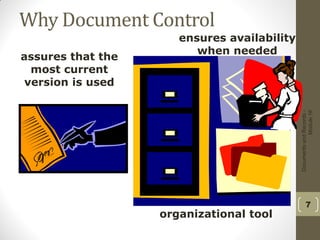
Why Document Control
DocumentsandRecords-
Module16
7
assures that the
most current
version is used
ensures availability
when needed
organizational tool
DocumentsandRecords-
Module16
8
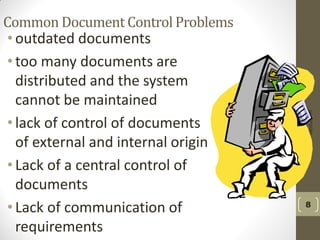
Common Document Control Problems
•outdated documents
•too many documents are
distributed and the system
cannot be maintained
•lack of control of documents
of external and internal origin
•Lack of a central control of
documents
•Lack of communication of
requirements
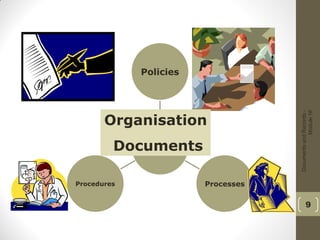
Policies
ProcessesProcedures
DocumentsandRecords-
Module16
9
Organisation
Documents
DocumentsandRecords-
Module16
10
Policies - The “WHAT TO DO”
“A written statement of overall intentions and
directions defined by those in the organization and
endorsed by management.”
Policies:
tell “what to do” in a broad and general way
include the organizational mission, goals, and
purpose
serve as the framework for the quality system
should always be specified in the quality manual
DocumentsandRecords-
Module16
11
Processes- The “HOWIT HAPPENS”
A “set of interrelated or interacting activities
that transform inputs into outputs.” (ISO
9000 4.3.1)
Processes:
• describe the steps involved to carry out quality
policies
• easily represented in flow charts
• involve a series of steps, usually occurring over a
period of time
DocumentsandRecords-
Module16
12
Procedures- The “HOWTO DO IT”
Procedures, Standard operating procedures (SOP)
 step-by-step instructions for performing a single activity
Job aid
a shortened version of the SOP
does not replace the SOP
Work Instruction
a detailed version of the SOP
does not replace the SOP
Needed where more information is required
DocumentsandRecords-
Module16
13
Good Documents are:
•clear
•concise
•user-friendly
•explicit
•accurate
•up-to-date
14
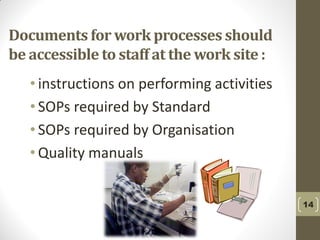
Documents for work processes should
be accessible to staff at the work site :
• instructions on performing activities
• SOPs required by Standard
• SOPs required by Organisation
• Quality manuals
DocumentsandRecords-
Module16
15
Standard Operating Procedures
(SOPs) are documents that:
describe how to perform a activities using
step-by-step instructions
written SOPs help ensure:
•consistency
•accuracy
•quality
16
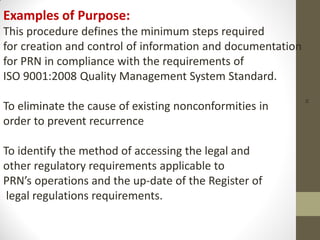
Examples of Purpose:
This procedure defines the minimum steps required
for creation and control of information and documentation
for PRN in compliance with the requirements of
ISO 9001:2008 Quality Management System Standard.
To eliminate the cause of existing nonconformities in
order to prevent recurrence
To identify the method of accessing the legal and
other regulatory requirements applicable to
PRN’s operations and the up-date of the Register of
legal regulations requirements.
DocumentsandRecords-
Module16
17
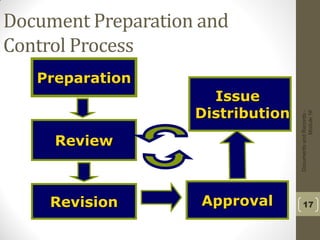
Document Preparation and
Control Process
Preparation
Review
Issue
Distribution
Revision Approval

Documentation course

  • 1.
    DocumentsandRecords- Module16 1 Scenario • Inspection Reports •Quality Manual • Audit Results • Standard Operation Procedures (SOPs) • Summary of Audit findings from on-site Audits • report of corrective actions • Non conformances form (blank form) • Quality Control record (blank form) • Daily Maintenance log (completed) • Stock Cards and Stock Book (completed) • ETC You have found all these papers lying on a desk. Which of these are documents and which are records?
  • 2.
    Why do Organizationsneed to manage documents and records? To find information whenever it is needed!  provides individuals with the information to perform a job properly  ensure permanence irrespective of personnel change/turnover  provide concise set of requirements  facilitate consistency of quality activities  facilitate monitoring activities and  quality system audits DocumentsandRecords- Module16 2
  • 3.
    Why do Organizationsneed to manage documents and records? It minimizes opportunities for miscommunication When historical data are being evaluated for current use, documents can also be valuable  convey requirements simultaneously to all concerned personnel  facilitate effective change control indicate compliance with organizational governmental requirements DocumentsandRecords- Module16 3
  • 4.
    DocumentsandRecords- Module16 4 Documentsand Records—Howdo theydiffer? ISO 9000:2005 Documents  Information and the supporting media  communicate information via policies, processes, and procedures  need updating Records  Evidences of activities performed  capture information on worksheets, forms, labels, and charts  permanent, do not change RECORDS
  • 5.
    5 Clarity index Theclarityindexisameasureoftheeaseordifficultyofreading apieceofwriting.Theprocessismechanicalandobjective. CI =SL + LW% SL - Average sentence length (total words/sent =15) LW% - Percentage of long words ( ≤3 syllables =15) (Sample approximately 200 words) • CI>40 - text difficult to understand • CI<20 - text abrupt & impolite • CI~30 - typical conversation or press article CHARACTERISTICS OF A DOCUMENT
  • 6.
    DocumentsandRecords- Module16 6 Numbering System •need uniformnumbering system •do not change a current system that works one system: •Org/Loc-Dept-Doc type-Serial number- Rev status
  • 7.
    Why Document Control DocumentsandRecords- Module16 7 assuresthat the most current version is used ensures availability when needed organizational tool
  • 8.
    DocumentsandRecords- Module16 8 Common Document ControlProblems •outdated documents •too many documents are distributed and the system cannot be maintained •lack of control of documents of external and internal origin •Lack of a central control of documents •Lack of communication of requirements
  • 9.
  • 10.
    DocumentsandRecords- Module16 10 Policies - The“WHAT TO DO” “A written statement of overall intentions and directions defined by those in the organization and endorsed by management.” Policies: tell “what to do” in a broad and general way include the organizational mission, goals, and purpose serve as the framework for the quality system should always be specified in the quality manual
  • 11.
    DocumentsandRecords- Module16 11 Processes- The “HOWITHAPPENS” A “set of interrelated or interacting activities that transform inputs into outputs.” (ISO 9000 4.3.1) Processes: • describe the steps involved to carry out quality policies • easily represented in flow charts • involve a series of steps, usually occurring over a period of time
  • 12.
    DocumentsandRecords- Module16 12 Procedures- The “HOWTODO IT” Procedures, Standard operating procedures (SOP)  step-by-step instructions for performing a single activity Job aid a shortened version of the SOP does not replace the SOP Work Instruction a detailed version of the SOP does not replace the SOP Needed where more information is required
  • 13.
  • 14.
    14 Documents for workprocesses should be accessible to staff at the work site : • instructions on performing activities • SOPs required by Standard • SOPs required by Organisation • Quality manuals
  • 15.
    DocumentsandRecords- Module16 15 Standard Operating Procedures (SOPs)are documents that: describe how to perform a activities using step-by-step instructions written SOPs help ensure: •consistency •accuracy •quality
  • 16.
    16 Examples of Purpose: Thisprocedure defines the minimum steps required for creation and control of information and documentation for PRN in compliance with the requirements of ISO 9001:2008 Quality Management System Standard. To eliminate the cause of existing nonconformities in order to prevent recurrence To identify the method of accessing the legal and other regulatory requirements applicable to PRN’s operations and the up-date of the Register of legal regulations requirements.
  • 17.
    DocumentsandRecords- Module16 17 Document Preparation and ControlProcess Preparation Review Issue Distribution Revision Approval