INFANCY AND TODDLERHOOD
(PHYSICAL,COGNITIVE & SOCIO-EMOTIONAL
DEVELOPMENT)
PHYSICAL DEVELOPMENT OF
INFANTS AND TODDLERS
Cephalocaudal and Proximodistal Pattterns
Cephalocaudal Trend
• Postnatal growth from conception to 5 months
• When the head grows more than the body
• Applies to the development of the fetus; also appplies in the
first month after birth.
Cephalocaudal and Proximodistal
Pattterns
PROXIMODISTAL TREND
• Pre-natal growth from 5 months to birth
• Refers to the development of motor skills from the center of the
body outward
• Also applies in the first months after birth as shown in the earlier
maturation of muscular control of the trunk and arms followed by
that of the hands and fingers
HEIGHT AND WEIGHT
• It’s normal for newborn babies to drop 5 to 10 percent of their body
weight within a couple of weeks of birth.
• Breastfeed babies are typically heavier than bottle-fed babies
through the first six months. After six months, breastfeed babies
usually weigh less than bottle-fed babies.
• A baby’s weight usually triples during the first year but slows down in
the second year of life.
• In general, an infant’s length increases by about 30% in the first five
months.
BRAIN DEVELOPMENT
• At birth, the newborn’s brain is about 25% of it’s adult weight.
• Brains that grew up in enriched environment developed better than
the brains of reared in standard or isolated conditions.
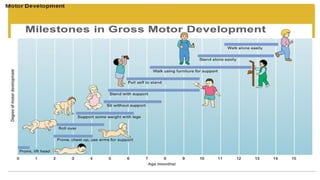
MOTOR DEVELOPMENT
REFLEXES
• SUCKING REFLEX- is initiated when something touches the roof of
an infant’s mouth.
• ROOTING REFLEX- is the most evident when an infant’s cheek is
stroked. Baby responds by turning his or head in the direction of the
touch.
• Gripping Reflex- babies will grasp anything that is placed in their
palm.
• CURLING REFLEX- when the inner sole of a baby’s foot is stroked.
• STARTLE/MORO REFLEX- infants will respond to sudden sounds or
movements.
• Galant reflex- is shown when an infant’s middle or lower back is
stroked next to the spinal cord.
• TONIC NECK REFLEX- position of the infant’s arms and head,
whichever side the child’s head is facing, the limbs on that side will
straighten while the opposite limbs will curl.
FINE MOTOR SKILLS
• Skills that involve a refined use of the small muscles controlling the
hand,fingers, and thumb.
CAN NEWBORNS SEE?
• The newborn’s vision is 10 to 30 times lower than normal adult
vision. By 6 months of age, visio becomes better and by the first
birthday, the infant’s vision approximates that of an adult.
• Infants look at different things for different lengths of time.
CAN NEWBORNS HEAR?
• The sense of hearing in an infant develops much more before the
birth of the baby.
• Infant’s sensory thresholds are somewhat higher than those of
adult.
CAN NEWBORN DIFFERENTIATE
ODOR?
• It requires several days of experience to recognize their mother’s
breast pad odor.
CAN NEWBORNs feel pain? Do they
respond to touch?
• They do feel pain.
• Babies respond to touch.
CAN NEWBORN DISTINGUISH THE
DIFFERENT TASTES?
• Yes. In a study conducted with babies, babies made different
facial expressions when they tasted sweet,sour,and bitter
solutions.
• Sensitivity to taste might be present before birth.
Andes, Angel A.
BSE- ENG 1-1

infancy-toddlerhood-physical-development.pptx

  • 1.
    INFANCY AND TODDLERHOOD (PHYSICAL,COGNITIVE& SOCIO-EMOTIONAL DEVELOPMENT)
  • 2.
  • 3.
    Cephalocaudal and ProximodistalPattterns Cephalocaudal Trend • Postnatal growth from conception to 5 months • When the head grows more than the body • Applies to the development of the fetus; also appplies in the first month after birth.
  • 4.
    Cephalocaudal and Proximodistal Pattterns PROXIMODISTALTREND • Pre-natal growth from 5 months to birth • Refers to the development of motor skills from the center of the body outward • Also applies in the first months after birth as shown in the earlier maturation of muscular control of the trunk and arms followed by that of the hands and fingers
  • 5.
    HEIGHT AND WEIGHT •It’s normal for newborn babies to drop 5 to 10 percent of their body weight within a couple of weeks of birth. • Breastfeed babies are typically heavier than bottle-fed babies through the first six months. After six months, breastfeed babies usually weigh less than bottle-fed babies. • A baby’s weight usually triples during the first year but slows down in the second year of life. • In general, an infant’s length increases by about 30% in the first five months.
  • 6.
    BRAIN DEVELOPMENT • Atbirth, the newborn’s brain is about 25% of it’s adult weight. • Brains that grew up in enriched environment developed better than the brains of reared in standard or isolated conditions.
  • 7.
    MOTOR DEVELOPMENT REFLEXES • SUCKINGREFLEX- is initiated when something touches the roof of an infant’s mouth. • ROOTING REFLEX- is the most evident when an infant’s cheek is stroked. Baby responds by turning his or head in the direction of the touch. • Gripping Reflex- babies will grasp anything that is placed in their palm.
  • 8.
    • CURLING REFLEX-when the inner sole of a baby’s foot is stroked. • STARTLE/MORO REFLEX- infants will respond to sudden sounds or movements. • Galant reflex- is shown when an infant’s middle or lower back is stroked next to the spinal cord. • TONIC NECK REFLEX- position of the infant’s arms and head, whichever side the child’s head is facing, the limbs on that side will straighten while the opposite limbs will curl.
  • 11.
    FINE MOTOR SKILLS •Skills that involve a refined use of the small muscles controlling the hand,fingers, and thumb.
  • 12.
    CAN NEWBORNS SEE? •The newborn’s vision is 10 to 30 times lower than normal adult vision. By 6 months of age, visio becomes better and by the first birthday, the infant’s vision approximates that of an adult. • Infants look at different things for different lengths of time.
  • 13.
    CAN NEWBORNS HEAR? •The sense of hearing in an infant develops much more before the birth of the baby. • Infant’s sensory thresholds are somewhat higher than those of adult.
  • 14.
    CAN NEWBORN DIFFERENTIATE ODOR? •It requires several days of experience to recognize their mother’s breast pad odor. CAN NEWBORNs feel pain? Do they respond to touch? • They do feel pain. • Babies respond to touch.
  • 15.
    CAN NEWBORN DISTINGUISHTHE DIFFERENT TASTES? • Yes. In a study conducted with babies, babies made different facial expressions when they tasted sweet,sour,and bitter solutions. • Sensitivity to taste might be present before birth.
  • 16.