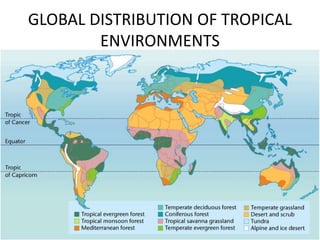
GLOBAL DISTRIBUTION OF TROPICAL
ENVIRONMENTS
AIR MASSES AND TROPICAL
ENVIRONMENTS
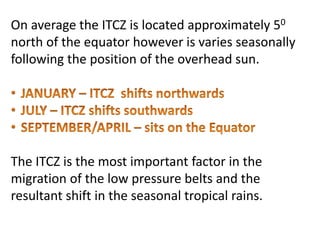
On average the ITCZ is located approximately 50
north of the equator however is varies seasonally
following the position of the overhead sun.
The ITCZ is the most important factor in the
migration of the low pressure belts and the
resultant shift in the seasonal tropical rains.
TROPICAL RAINFOREST CLIMATE
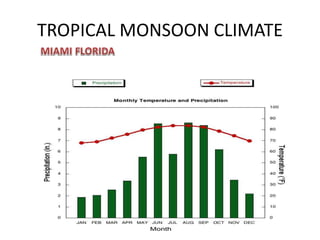
TROPICAL MONSOON CLIMATE
TROPICAL SAVANNA CLIMATE
Landscapes: Granite
Task:
1. What is granite like?
2. Watch the following video clip (7mins) about the
granite in Yosemite National Park, USA and try to
list everything you hear about Granite
http://www.youtube.com/watch?v=Y5RQp77uVPA
Amazing rock climbers (who use granite!)
Climbing El Capitan in Yosemite -
http://www.boredpanda.com/el-capitan-free-
climb-ascent-kevin-jorgeson-tommy-caldwell/
Characteristics of Granite:
• Granite is made up of three minerals: quartz,
feldspar and mica.
• It is a hard, crystalline rock, which is very
resistant to erosion.
• It is an intrusive igneous rock.
• The main processes that affect it are freeze-
thaw and hydrolysis.
Task:
Annotate (add detailed labels) your photo to show key features of
the Dartmoor Tors
Field sketch of Hay Tor, Dartmoor UK
a
b
c
--- - - - - - -
I I
Tor Formation: DartmoorAs this rock was
removed there was a
reduction of
pressure on the
granite as there was
less above it. This
caused it to crack
creating joints.Where the joints were close
together weathering quickly
broke down the rock. However
there were also areas where
there were very few joints and so
slower weathering occurred.
This process continued over
millions of years, leaving behind
the tors and valleys seen on
Dartmoor.
TOWER KARST
CONES
RAINFOREST AND SAVANNA
ECOSYSTEMS
• Each stage of succession is characterized by a group of species that
have adapted to the micro-environment.
• In the early stages there is limited nutrients as such these species
survive under hash conditions – PIONEER SPECIES
• In late succession there is more organic matter available – CLIMATIC
CLIMAX
• sometimes the succession is prevented from reaching climatic
climax due to physical intervention and stops at a stage prior to this
– SUB-CLIMAX
• PLAGIO CLIMAX – succession is prevented from reaching climatic
climax due to human intervention.
TROPICAL RAINFOREST VEGETATION
• NET PRIMARY PRODUCTIVITY (NPP) – is the amount
of organic material produced by plants and is
available to herbivores. It is determined by:
- heat
- water
- availability of nutrients
-age and the health of plant species
• Tropical rainforest vegetation has a higher NPP as
compared to Savanna vegetation
EMERGENT LAYER – trees grow rapidly up to
50m tall to reach the sunlight
CANOPY LAYER – tress grow up to between 25
and 30m tall forming a dense canopy which
blocks 70 to 80% of the sunlight
UNDERSTORY – this layer only receives about
5% of the available light. The vegetation in this
layer is large colorful flowers
dense broad leaved plants with
SAVANNA VEGETATION
This type of vegetation includes GRASS, TREES and SHRUBS that have
adapted to survive in dry climates
Species are:
• XEROPHYTIC – adapted to survive in drought conditions – have deep tap
roots and a sunken stomata which reduces moisture loss.
• PYROPHYTIC – adapted to survive in fire – have thick barks and a large
amount of biomass which enables it to regrow quickly after being burnt
Examples of savanna vegetation are:
- Acacia
- Palm
- Baobab
- Elephant grass

Tropical environments

  • 2.
    GLOBAL DISTRIBUTION OFTROPICAL ENVIRONMENTS
  • 5.
    AIR MASSES ANDTROPICAL ENVIRONMENTS
  • 7.
    On average theITCZ is located approximately 50 north of the equator however is varies seasonally following the position of the overhead sun. The ITCZ is the most important factor in the migration of the low pressure belts and the resultant shift in the seasonal tropical rains.
  • 10.
  • 12.
  • 14.
  • 16.
    Landscapes: Granite Task: 1. Whatis granite like? 2. Watch the following video clip (7mins) about the granite in Yosemite National Park, USA and try to list everything you hear about Granite http://www.youtube.com/watch?v=Y5RQp77uVPA Amazing rock climbers (who use granite!) Climbing El Capitan in Yosemite - http://www.boredpanda.com/el-capitan-free- climb-ascent-kevin-jorgeson-tommy-caldwell/
  • 17.
    Characteristics of Granite: •Granite is made up of three minerals: quartz, feldspar and mica. • It is a hard, crystalline rock, which is very resistant to erosion. • It is an intrusive igneous rock. • The main processes that affect it are freeze- thaw and hydrolysis.
  • 19.
    Task: Annotate (add detailedlabels) your photo to show key features of the Dartmoor Tors
  • 20.
    Field sketch ofHay Tor, Dartmoor UK
  • 21.
    a b c --- - -- - - - I I
  • 22.
    Tor Formation: DartmoorAsthis rock was removed there was a reduction of pressure on the granite as there was less above it. This caused it to crack creating joints.Where the joints were close together weathering quickly broke down the rock. However there were also areas where there were very few joints and so slower weathering occurred. This process continued over millions of years, leaving behind the tors and valleys seen on Dartmoor.
  • 27.
  • 28.
  • 29.
  • 30.
    • Each stageof succession is characterized by a group of species that have adapted to the micro-environment. • In the early stages there is limited nutrients as such these species survive under hash conditions – PIONEER SPECIES • In late succession there is more organic matter available – CLIMATIC CLIMAX • sometimes the succession is prevented from reaching climatic climax due to physical intervention and stops at a stage prior to this – SUB-CLIMAX • PLAGIO CLIMAX – succession is prevented from reaching climatic climax due to human intervention.
  • 32.
    TROPICAL RAINFOREST VEGETATION •NET PRIMARY PRODUCTIVITY (NPP) – is the amount of organic material produced by plants and is available to herbivores. It is determined by: - heat - water - availability of nutrients -age and the health of plant species • Tropical rainforest vegetation has a higher NPP as compared to Savanna vegetation
  • 34.
    EMERGENT LAYER –trees grow rapidly up to 50m tall to reach the sunlight CANOPY LAYER – tress grow up to between 25 and 30m tall forming a dense canopy which blocks 70 to 80% of the sunlight UNDERSTORY – this layer only receives about 5% of the available light. The vegetation in this layer is large colorful flowers dense broad leaved plants with
  • 35.
    SAVANNA VEGETATION This typeof vegetation includes GRASS, TREES and SHRUBS that have adapted to survive in dry climates Species are: • XEROPHYTIC – adapted to survive in drought conditions – have deep tap roots and a sunken stomata which reduces moisture loss. • PYROPHYTIC – adapted to survive in fire – have thick barks and a large amount of biomass which enables it to regrow quickly after being burnt Examples of savanna vegetation are: - Acacia - Palm - Baobab - Elephant grass