Optical Modulation
of light sources
Modulation of light sources
1. Optical sources can be modulated either
directly or externally.
2. Direct modulation is done by modulating the
driving current according to the message signal
(digital or analog)
3. In external modulation, the laser emits
continuous wave (CW) light and the
modulation is done in the fiber
Types of Optical Modulation
1. Direct modulation is done by superimposing the
modulating (message) signal on the driving current
2. Indirect (external modulation)
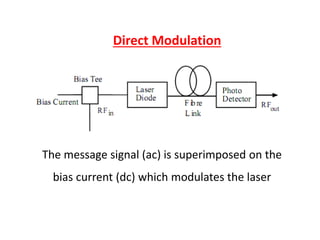
Direct Modulation
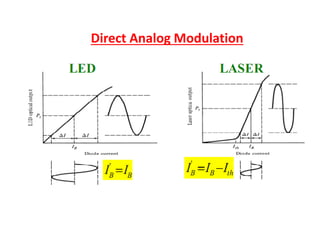
The message signal (ac) is superimposed on the
bias current (dc) which modulates the laser
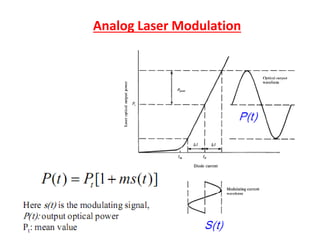
Direct Analog Modulation
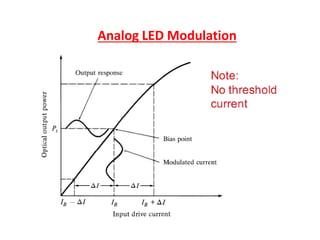
Analog LED Modulation
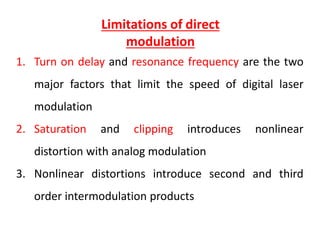
Limitations of direct
modulation
1. Turn on delay and resonance frequency are the two
major factors that limit the speed of digital laser
modulation
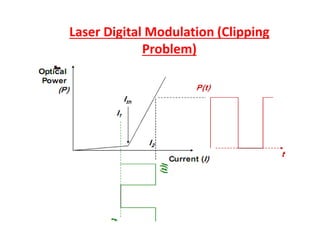
2. Saturation and clipping introduces nonlinear
distortion with analog modulation
3. Nonlinear distortions introduce second and third
order intermodulation products
Laser Digital Modulation (Clipping
Problem)
Analog Laser Modulation
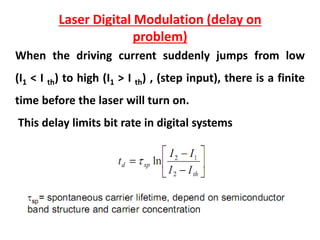
Laser Digital Modulation (delay on
problem)
When the driving current suddenly jumps from low
(I1 < I th) to high (I1 > I th) , (step input), there is a finite
time before the laser will turn on.
This delay limits bit rate in digital systems
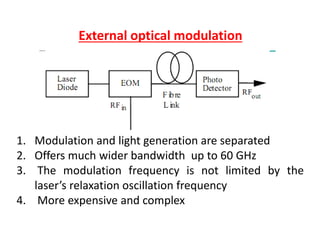
External optical modulation
1. Modulation and light generation are separated
2. Offers much wider bandwidth up to 60 GHz
3. The modulation frequency is not limited by the
laser’s relaxation oscillation frequency
4. More expensive and complex
External optical modulation
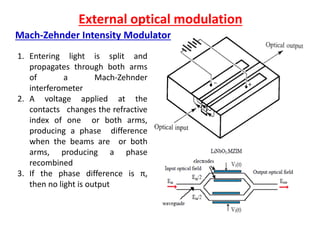
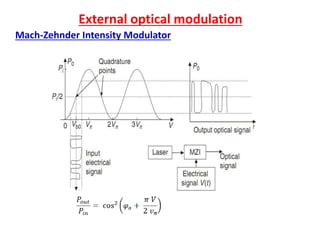
Mach-Zehnder Intensity Modulator
1. Entering light is split and
propagates through both arms
of a Mach-Zehnder
interferometer
2. A voltage applied at the
contacts changes the refractive
index of one or both arms,
producing a phase difference
when the beams are or both
arms, producing a phase
recombined
3. If the phase difference is π,
then no light is output
External optical modulation
Mach-Zehnder Intensity Modulator

Optical Modulation _ external and internal

  • 1.
  • 2.
    Modulation of lightsources 1. Optical sources can be modulated either directly or externally. 2. Direct modulation is done by modulating the driving current according to the message signal (digital or analog) 3. In external modulation, the laser emits continuous wave (CW) light and the modulation is done in the fiber
  • 3.
    Types of OpticalModulation 1. Direct modulation is done by superimposing the modulating (message) signal on the driving current 2. Indirect (external modulation)
  • 4.
    Direct Modulation The messagesignal (ac) is superimposed on the bias current (dc) which modulates the laser
  • 5.
  • 6.
  • 7.
    Limitations of direct modulation 1.Turn on delay and resonance frequency are the two major factors that limit the speed of digital laser modulation 2. Saturation and clipping introduces nonlinear distortion with analog modulation 3. Nonlinear distortions introduce second and third order intermodulation products
  • 8.
    Laser Digital Modulation(Clipping Problem)
  • 9.
  • 10.
    Laser Digital Modulation(delay on problem) When the driving current suddenly jumps from low (I1 < I th) to high (I1 > I th) , (step input), there is a finite time before the laser will turn on. This delay limits bit rate in digital systems
  • 11.
    External optical modulation 1.Modulation and light generation are separated 2. Offers much wider bandwidth up to 60 GHz 3. The modulation frequency is not limited by the laser’s relaxation oscillation frequency 4. More expensive and complex
  • 12.
    External optical modulation Mach-ZehnderIntensity Modulator 1. Entering light is split and propagates through both arms of a Mach-Zehnder interferometer 2. A voltage applied at the contacts changes the refractive index of one or both arms, producing a phase difference when the beams are or both arms, producing a phase recombined 3. If the phase difference is π, then no light is output
  • 13.