Modifications to
Mendel's Classic
Ratios
General Biology II
Jose Amado Ds. Torreda
Mendelian Inheritance
-it is a type of biological inheritance that
follows the laws of Gregor Mendel.
These laws are the:
• Law of Segregation
• Law of Independent Assortment
• Law of Dominance
2
Mendelian Inheritance
Law of Segregation
-during gamete formation, the alleles for
each gene segregates from each other so
that each gamete only carries ONE allele for
each gene.
Aa= 50% A, 50%a
AA= 100% A
aa= 100%a
3
Mendelian Inheritance
Law of Independent Assortment
-genes for different traits can segregate
independently during the formation of
gametes.
AaBb= AB, Ab, aB, ab
4
non-Mendelian Inheritance
-not all traits follow the Mendelian mode of
inheritance
-it is when a trait doesn't follow any of the Laws
of Mendel.
Examples of non-Mendelian Inheritance
1. Co-dominance
2. Incomplete dominance
3. Multiple alleles
5
non-Mendelian Inheritance
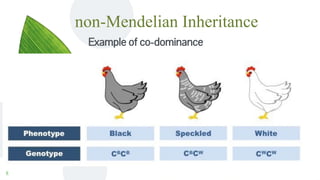
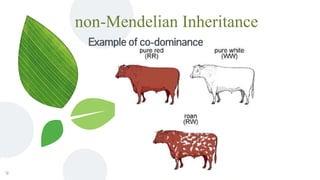
1. Co-dominance
-when two contrasting alleles are present in
the same locus or trait (heterozygous genotype),
both alleles are simultaneously expressed.
6
non-Mendelian Inheritance
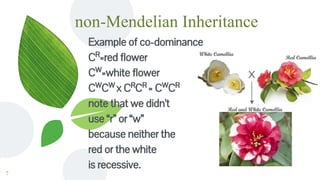
Example of co-dominance
CR
=red flower
CW
=white flower
CW
CW
x CR
CR
= CW
CR
note that we didn't
use “r” or “w”
because neither the
red or the white
is recessive.
7
non-Mendelian Inheritance
Example of co-dominance
8
non-Mendelian Inheritance
Example of co-dominance
9
non-Mendelian Inheritance
2. Incomplete dominance
-when two contrasting alleles are present in
the same locus or trait (heterozygous genotype),
the phenotype expressed is a “blend” of the two
extreme phenotypes.
10
non-Mendelian Inheritance
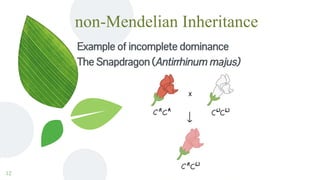
Example of incomplete dominance
In the snapdragon, Antirrhinum majus, a cross
between a homozygous white-flowered plant
(CW
CW
) and a homozygous red-flowered plant (CR
CR
)
will produce offspring with pink flowers (CW
CR
)
11
non-Mendelian Inheritance
Example of incomplete dominance
The Snapdragon (Antirrhinum majus)
12
non-Mendelian Inheritance
3. Multiple alleles
-when there are more than two types of
alleles for a given locus or trait, this will result in
more than two kinds of phenotypes that may be
expressed for that trait.
13
non-Mendelian Inheritance
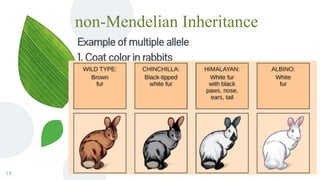
Example of multiple allele
1. Coat color in rabbits
14
non-Mendelian Inheritance
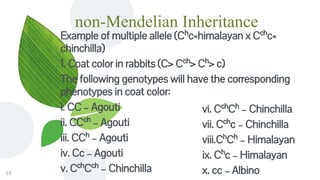
Example of multiple allele (Ch
c=himalayan x Cch
c=
chinchilla)
1. Coat color in rabbits (C> Cch
> Ch
> c)
The following genotypes will have the corresponding
phenotypes in coat color:
i. CC – Agouti
ii. CCch
– Agouti
iii. CCh
– Agouti
iv. Cc – Agouti
v. Cch
Cch
– Chinchilla
15
vi. Cch
Ch
– Chinchilla
vii. Cch
c – Chinchilla
viii.Ch
Ch
– Himalayan
ix. Ch
c – Himalayan
x. cc – Albino
non-Mendelian Inheritance
16
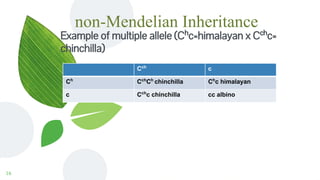
Cch
c
Ch
Cch
Ch
chinchilla Ch
c himalayan
c Cch
c chinchilla cc albino
Example of multiple allele (Ch
c=himalayan x Cch
c=
chinchilla)
non-Mendelian Inheritance
Example of multiple allele
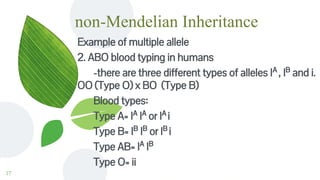
2. ABO blood typing in humans
-there are three different types of alleles IA
, IB
and i.
OO (Type O) x BO (Type B)
Blood types:
Type A= IA
IA
or IA
i
Type B= IB
IB
or IB
i
Type AB= IA
IB
Type O= ii
17
non-Mendelian Inheritance
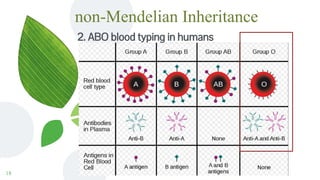
2. ABO blood typing in humans
18
non-Mendelian Inheritance
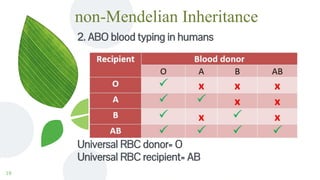
2. ABO blood typing in humans
Universal RBC donor= O
Universal RBC recipient= AB
19
non-Mendelian Inheritance
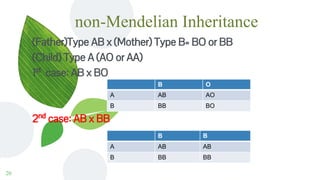
(Father)Type AB x (Mother) Type B= BO or BB
(Child) Type A (AO or AA)
1st
case: AB x BO
2nd
case: AB x BB
20
B O
A AB AO
B BB BO
B B
A AB AB
B BB BB
Activities on non-Mendelian
Inheritance
1. Seatwork
Get the phenotypic ratio and the probability of
having a rabbit with a certain coat color from the
cross below.
CCch
x Cch
Ch
2. Exercise
3. Pedigree of your immediate family based on ABO
blood types.
21
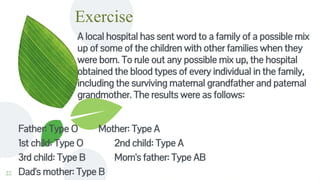
Exercise
A local hospital has sent word to a family of a possible mix
up of some of the children with other families when they
were born. To rule out any possible mix up, the hospital
obtained the blood types of every individual in the family,
including the surviving maternal grandfather and paternal
grandmother. The results were as follows:
22
Father: Type O Mother: Type A
1st child: Type O 2nd child: Type A
3rd child: Type B Mom's father: Type AB
Dad's mother: Type B

Modifications-to-Mendels-Classic-Ratios.pdf

  • 1.
    Modifications to Mendel's Classic Ratios GeneralBiology II Jose Amado Ds. Torreda
  • 2.
    Mendelian Inheritance -it isa type of biological inheritance that follows the laws of Gregor Mendel. These laws are the: • Law of Segregation • Law of Independent Assortment • Law of Dominance 2
  • 3.
    Mendelian Inheritance Law ofSegregation -during gamete formation, the alleles for each gene segregates from each other so that each gamete only carries ONE allele for each gene. Aa= 50% A, 50%a AA= 100% A aa= 100%a 3
  • 4.
    Mendelian Inheritance Law ofIndependent Assortment -genes for different traits can segregate independently during the formation of gametes. AaBb= AB, Ab, aB, ab 4
  • 5.
    non-Mendelian Inheritance -not alltraits follow the Mendelian mode of inheritance -it is when a trait doesn't follow any of the Laws of Mendel. Examples of non-Mendelian Inheritance 1. Co-dominance 2. Incomplete dominance 3. Multiple alleles 5
  • 6.
    non-Mendelian Inheritance 1. Co-dominance -whentwo contrasting alleles are present in the same locus or trait (heterozygous genotype), both alleles are simultaneously expressed. 6
  • 7.
    non-Mendelian Inheritance Example ofco-dominance CR =red flower CW =white flower CW CW x CR CR = CW CR note that we didn't use “r” or “w” because neither the red or the white is recessive. 7
  • 8.
  • 9.
  • 10.
    non-Mendelian Inheritance 2. Incompletedominance -when two contrasting alleles are present in the same locus or trait (heterozygous genotype), the phenotype expressed is a “blend” of the two extreme phenotypes. 10
  • 11.
    non-Mendelian Inheritance Example ofincomplete dominance In the snapdragon, Antirrhinum majus, a cross between a homozygous white-flowered plant (CW CW ) and a homozygous red-flowered plant (CR CR ) will produce offspring with pink flowers (CW CR ) 11
  • 12.
    non-Mendelian Inheritance Example ofincomplete dominance The Snapdragon (Antirrhinum majus) 12
  • 13.
    non-Mendelian Inheritance 3. Multiplealleles -when there are more than two types of alleles for a given locus or trait, this will result in more than two kinds of phenotypes that may be expressed for that trait. 13
  • 14.
    non-Mendelian Inheritance Example ofmultiple allele 1. Coat color in rabbits 14
  • 15.
    non-Mendelian Inheritance Example ofmultiple allele (Ch c=himalayan x Cch c= chinchilla) 1. Coat color in rabbits (C> Cch > Ch > c) The following genotypes will have the corresponding phenotypes in coat color: i. CC – Agouti ii. CCch – Agouti iii. CCh – Agouti iv. Cc – Agouti v. Cch Cch – Chinchilla 15 vi. Cch Ch – Chinchilla vii. Cch c – Chinchilla viii.Ch Ch – Himalayan ix. Ch c – Himalayan x. cc – Albino
  • 16.
    non-Mendelian Inheritance 16 Cch c Ch Cch Ch chinchilla Ch chimalayan c Cch c chinchilla cc albino Example of multiple allele (Ch c=himalayan x Cch c= chinchilla)
  • 17.
    non-Mendelian Inheritance Example ofmultiple allele 2. ABO blood typing in humans -there are three different types of alleles IA , IB and i. OO (Type O) x BO (Type B) Blood types: Type A= IA IA or IA i Type B= IB IB or IB i Type AB= IA IB Type O= ii 17
  • 18.
    non-Mendelian Inheritance 2. ABOblood typing in humans 18
  • 19.
    non-Mendelian Inheritance 2. ABOblood typing in humans Universal RBC donor= O Universal RBC recipient= AB 19
  • 20.
    non-Mendelian Inheritance (Father)Type ABx (Mother) Type B= BO or BB (Child) Type A (AO or AA) 1st case: AB x BO 2nd case: AB x BB 20 B O A AB AO B BB BO B B A AB AB B BB BB
  • 21.
    Activities on non-Mendelian Inheritance 1.Seatwork Get the phenotypic ratio and the probability of having a rabbit with a certain coat color from the cross below. CCch x Cch Ch 2. Exercise 3. Pedigree of your immediate family based on ABO blood types. 21
  • 22.
    Exercise A local hospitalhas sent word to a family of a possible mix up of some of the children with other families when they were born. To rule out any possible mix up, the hospital obtained the blood types of every individual in the family, including the surviving maternal grandfather and paternal grandmother. The results were as follows: 22 Father: Type O Mother: Type A 1st child: Type O 2nd child: Type A 3rd child: Type B Mom's father: Type AB Dad's mother: Type B