NON-
MENDELIAN
PATTERNS OF INHERITANCE
OVERVIE
W
TOPICS
• Law of Incomplete
Dominance
• Law of Codominance
• Law of Multiple Allelism
MENDELIAN VS NON-
MENDELIAN GENETICS
• Mendelian traits are determined by dominant and
recessive alleles of one gene.
• Non-Mendelian traits are not determined by
dominant and recessive alleles and can be governed
by more than one gene.
NON-MENDELIAN
GENETICS
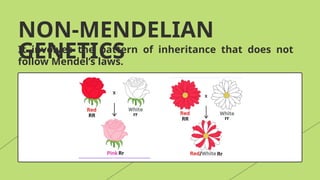
It involves the pattern of inheritance that does not
follow Mendel’s laws.
It is not determined by dominant and recessive alleles
but governed by more than a single gene.
INCOMPLE
TE
DOMINAN
CE
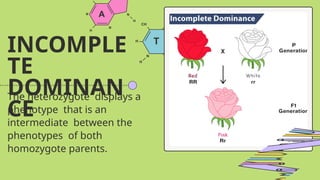
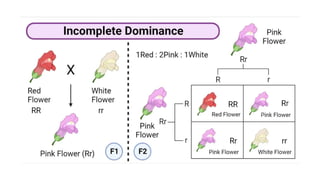
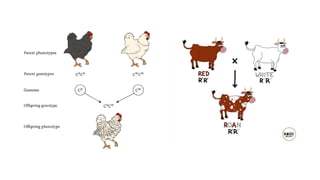
The heterozygote displays a
phenotype that is an
intermediate between the
phenotypes of both
homozygote parents.
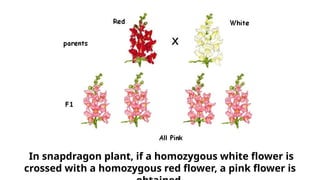
In snapdragon plant, if a homozygous white flower is
crossed with a homozygous red flower, a pink flower is
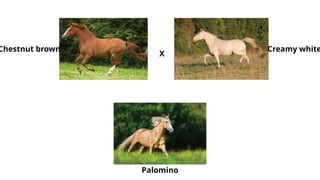
Chestnut brown Creamy white
Palomino
X
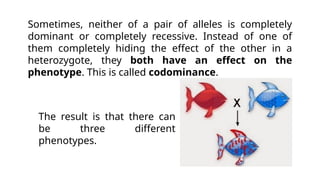
Sometimes, neither of a pair of alleles is completely
dominant or completely recessive. Instead of one of
them completely hiding the effect of the other in a
heterozygote, they both have an effect on the
phenotype. This is called codominance.
The result is that there can
be three different
phenotypes.
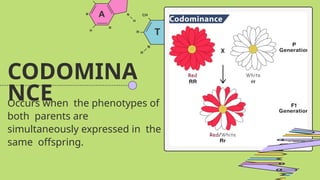
CODOMINA
NCE
Occurs when the phenotypes of
both parents are
simultaneously expressed in the
same offspring.
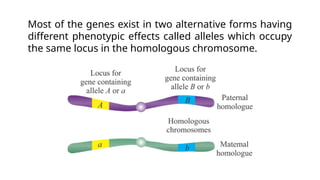
Most of the genes exist in two alternative forms having
different phenotypic effects called alleles which occupy
the same locus in the homologous chromosome.
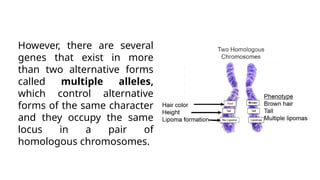
However, there are several
genes that exist in more
than two alternative forms
called multiple alleles,
which control alternative
forms of the same character
and they occupy the same
locus in a pair of
homologous chromosomes.
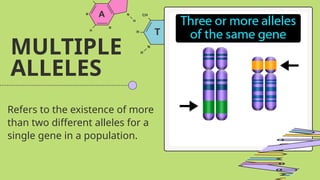
MULTIPLE
ALLELES
Refers to the existence of more
than two different alleles for a
single gene in a population.
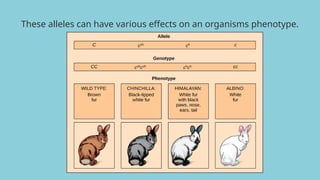
These alleles can have various effects on an organisms phenotype.
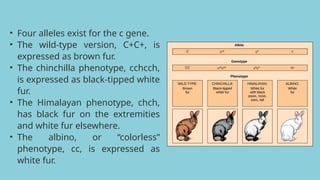
• Four alleles exist for the c gene.
• The wild-type version, C+C+, is
expressed as brown fur.
• The chinchilla phenotype, cchcch,
is expressed as black-tipped white
fur.
• The Himalayan phenotype, chch,
has black fur on the extremities
and white fur elsewhere.
• The albino, or “colorless”
phenotype, cc, is expressed as
white fur.
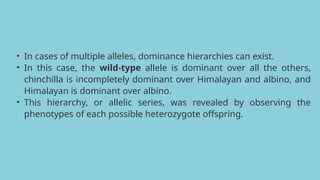
• In cases of multiple alleles, dominance hierarchies can exist.
• In this case, the wild-type allele is dominant over all the others,
chinchilla is incompletely dominant over Himalayan and albino, and
Himalayan is dominant over albino.
• This hierarchy, or allelic series, was revealed by observing the
phenotypes of each possible heterozygote offspring.
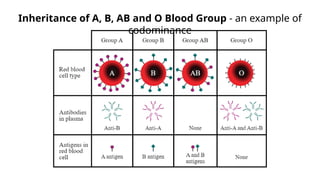
Inheritance of A, B, AB and O Blood Group - an example of
codominance
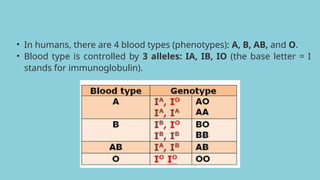
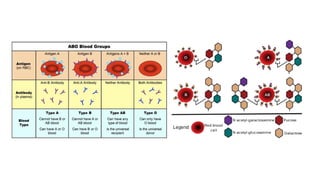
• In humans, there are 4 blood types (phenotypes): A, B, AB, and O.
• Blood type is controlled by 3 alleles: IA, IB, IO (the base letter = I
stands for immunoglobulin).
Can a child with blood type O be produced
from parents with blood types A and B?
What blood types are possible among the children
of a cross between a man who is blood type A and
a woman of blood-type B?
In 1941, Charlie Chaplin met a young actress named, Joan
Barry with whom he had an affair. The affair ended in
February 1942 but 20 months later, Barry gave birth to a
baby girl and claimed that Chaplin was the father. Barry
then sued for child support. At this time, blood typing had
just come into widespread use, and Chaplin’s attorney had
Chaplin, Barry, and the child blood-typed. Barry had blood
type A, her child had blood type B and Chaplin had blood
type O. Could Chaplin have been the father of Barry’s
child?
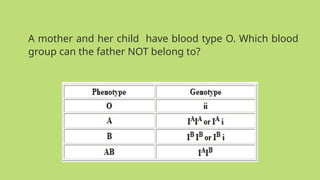
A mother and her child have blood type O. Which blood
group can the father NOT belong to?
THANK
YOU

4.-NON-MENDELIAN-PATTERNS-OF-INHERITANCE.pptx

  • 1.
  • 2.
    OVERVIE W TOPICS • Law ofIncomplete Dominance • Law of Codominance • Law of Multiple Allelism
  • 3.
    MENDELIAN VS NON- MENDELIANGENETICS • Mendelian traits are determined by dominant and recessive alleles of one gene. • Non-Mendelian traits are not determined by dominant and recessive alleles and can be governed by more than one gene.
  • 4.
    NON-MENDELIAN GENETICS It involves thepattern of inheritance that does not follow Mendel’s laws.
  • 5.
    It is notdetermined by dominant and recessive alleles but governed by more than a single gene.
  • 6.
    INCOMPLE TE DOMINAN CE The heterozygote displaysa phenotype that is an intermediate between the phenotypes of both homozygote parents.
  • 7.
    In snapdragon plant,if a homozygous white flower is crossed with a homozygous red flower, a pink flower is
  • 9.
    Chestnut brown Creamywhite Palomino X
  • 10.
    Sometimes, neither ofa pair of alleles is completely dominant or completely recessive. Instead of one of them completely hiding the effect of the other in a heterozygote, they both have an effect on the phenotype. This is called codominance. The result is that there can be three different phenotypes.
  • 11.
    CODOMINA NCE Occurs when thephenotypes of both parents are simultaneously expressed in the same offspring.
  • 13.
    Most of thegenes exist in two alternative forms having different phenotypic effects called alleles which occupy the same locus in the homologous chromosome.
  • 14.
    However, there areseveral genes that exist in more than two alternative forms called multiple alleles, which control alternative forms of the same character and they occupy the same locus in a pair of homologous chromosomes.
  • 15.
    MULTIPLE ALLELES Refers to theexistence of more than two different alleles for a single gene in a population.
  • 16.
    These alleles canhave various effects on an organisms phenotype.
  • 17.
    • Four allelesexist for the c gene. • The wild-type version, C+C+, is expressed as brown fur. • The chinchilla phenotype, cchcch, is expressed as black-tipped white fur. • The Himalayan phenotype, chch, has black fur on the extremities and white fur elsewhere. • The albino, or “colorless” phenotype, cc, is expressed as white fur.
  • 18.
    • In casesof multiple alleles, dominance hierarchies can exist. • In this case, the wild-type allele is dominant over all the others, chinchilla is incompletely dominant over Himalayan and albino, and Himalayan is dominant over albino. • This hierarchy, or allelic series, was revealed by observing the phenotypes of each possible heterozygote offspring.
  • 19.
    Inheritance of A,B, AB and O Blood Group - an example of codominance
  • 20.
    • In humans,there are 4 blood types (phenotypes): A, B, AB, and O. • Blood type is controlled by 3 alleles: IA, IB, IO (the base letter = I stands for immunoglobulin).
  • 23.
    Can a childwith blood type O be produced from parents with blood types A and B?
  • 24.
    What blood typesare possible among the children of a cross between a man who is blood type A and a woman of blood-type B?
  • 25.
    In 1941, CharlieChaplin met a young actress named, Joan Barry with whom he had an affair. The affair ended in February 1942 but 20 months later, Barry gave birth to a baby girl and claimed that Chaplin was the father. Barry then sued for child support. At this time, blood typing had just come into widespread use, and Chaplin’s attorney had Chaplin, Barry, and the child blood-typed. Barry had blood type A, her child had blood type B and Chaplin had blood type O. Could Chaplin have been the father of Barry’s child?
  • 26.
    A mother andher child have blood type O. Which blood group can the father NOT belong to?
  • 27.

Editor's Notes

  • #4 It describes the inheritance of traits linked to a single gene on chromosomes.