Lesson 3: Modification to
Mendel’s Classic
Ratios
Content Standard
 The learners understand Non-Mendelian Modes of Inheritance
Performance Standard
 The learners shall be able to make a research paper/case
study/poster on a non-Mendelian genetic trait
Learning Competency
 The learners shall be able to describe some modifications to
Mendel’s classic ratios (gene interactions) (STEM_BIO11/12-
IIIa-b-3)
Relevant Vocabulary
 I. Co-dominance - When two contrasting alleles are present in
the same locus or trait (heterozygote genotype), then the
phenotype expressed is a “blend” of the two extreme
phenotypes. The two genes interact and the offspring shows
the effects of both alleles.
 II. Incomplete dominance - When two contrasting alleles are
present in the same locus or trait (heterozygote genotype),
then both alleles are expressed in the same phenotype
 III. Multiple alleles - When there are more than two types of
alleles for a given locus or trait, this will result in more than two
kinds of phenotypes that may be expressed for that trait.
1. A local hospital has sent word to a family of a possible mix up of some of
the children with other families when they were born. To rule out any possible
mix up, the hospital obtained the blood types of every individual in the
family, including the surviving maternal grandfather and paternal
grandmother. The results were as follows:
 Father: Type O
 Mother: Type A
 1st child: Type O
 2nd child: Type A
 3rd child: Type B
 Maternal grandfather: Type AB
 Paternal grandmother: Type B
2. Based on the results, is there a possibility that any one of the children is not
a biological offspring of the couple? To answer this question, we must first
understand how blood types, a non-Mendelian trait is inherited.
 Incomplete dominance - When
two contrasting alleles are present
in the same locus or trait
(heterozygote genotype), then
both alleles are expressed in the
same phenotype.
The heterozygote genotype is
expressed as a distinct phenotype (a
“blend” of the two extreme
phenotypes). In this case, the
phenotypic ratio is the same as the
genotypic ratio
e.g., Snapdragon plants (Antirrhinum
majus)
A. RR – red flowers
B. Rr – pink flowers
C. rr – white flowers
Incomplete dominance in snapdragons,
Antirrhinum majus. The cross involving
homozygote red flowers (RR) and homozygote
white flowers (rr) will yield a heterozygote (Rr)
that expresses a different phenotype, which is
pink flowers. The cross between pink-flowered
individuals will produce offsprings where the
genotypic ratio also becomes the phenotypic
ratio (25% red: 50% pink: 25% white).
 Co-dominance - When two contrasting alleles are present
in the same locus or trait (heterozygote genotype), then
the phenotype expressed is a “blend” of the two extreme
phenotypes. The two genes interact and the offspring
shows the effects of both alleles.
The heterozygote genotype is expressed as a distinct
phenotype (both extreme phenotypes are expressed at the
same time). Similar to incomplete dominance, the
phenotypic ratio is the same as the genotypic ratio.
e.g., human MN blood type
 A. MM – type M
 B. MN – type MN
 C. NN – type N
 Multiple alleles - When there are
more than two types of alleles for a
given locus or trait, this will result in
more than two kinds of phenotypes
that may be expressed for that trait.
There are more than two types
of alleles, and the relationship of each
allele with respect to others will
determine the number of phenotypes
that may be expressed.
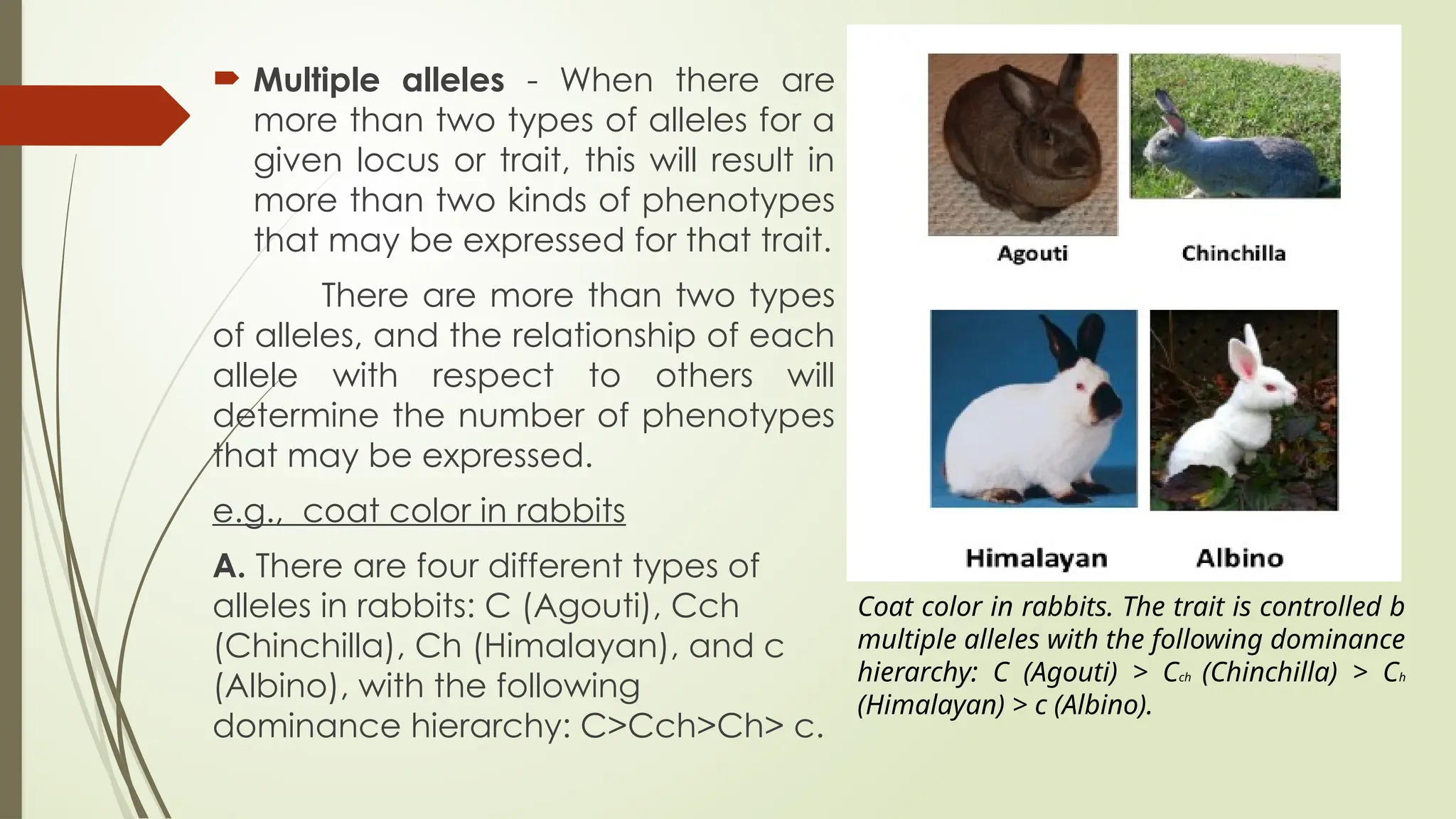
e.g., coat color in rabbits
A. There are four different types of
alleles in rabbits: C (Agouti), Cch
(Chinchilla), Ch (Himalayan), and c
(Albino), with the following
dominance hierarchy: C>Cch>Ch> c.
Coat color in rabbits. The trait is controlled b
multiple alleles with the following dominance
hierarchy: C (Agouti) > Cch (Chinchilla) > Ch
(Himalayan) > c (Albino).
Cont.
B. The following genotypes will have
the corresponding phenotypes in
coat color:
 i. CC – Agouti
 ii. CCch – Agouti
 iii. CCh – Agouti
 iv. Cc – Agouti
 v. CchCch – Chinchilla
 vi. CchCh – Chinchilla
 vii. Cchc – Chinchilla
 viii.ChCh – Himalayan
 ix. Chc – Himalayan
 x. cc – Albino
C. e.g., ABO blood typing in
humans
 i. There are three different types
of alleles A (or IA), B (or IB) and
O (or i)
 ii. The following genotypes will
have the following blood types
(phenotypes):
 iii. AA (or IAIA) – Type A
 iv. AO (or IAi) – Type A
 v. BB (or IBIB) – Type B
 vi. BO (or IBi) – Type B
 vii. AB (IAIB) – Type AB
 viii.OO (ii) – Type O
Go back to the Motivation narrative
i. Father: Type O - OO
ii. Mother: Type A - AO
iii. 1st child: Type O - OO
iv. 2nd child: Type A - AO
v. 3rd child: Type B –?
vi. Maternal grandfather: Type AB - AB
vii. Paternal grandmother: Type B – BO
viii. Possible mix-up? Yes or No?
Go back to the Motivation narrative
i. Father: Type O - OO
ii. Mother: Type A - AO
iii. 1st child: Type O - OO
iv. 2nd child: Type A - AO
v. 3rd child: Type B –?
vi. Maternal grandfather: Type AB - AB
vii. Paternal grandmother: Type B – BO
viii. Possible mix-up? Yes, 3rd child.
Lesson 3 Modification to Mendel’s Classic Ratios.pptx

Lesson 3 Modification to Mendel’s Classic Ratios.pptx

  • 1.
    Lesson 3: Modificationto Mendel’s Classic Ratios
  • 2.
    Content Standard  Thelearners understand Non-Mendelian Modes of Inheritance Performance Standard  The learners shall be able to make a research paper/case study/poster on a non-Mendelian genetic trait Learning Competency  The learners shall be able to describe some modifications to Mendel’s classic ratios (gene interactions) (STEM_BIO11/12- IIIa-b-3)
  • 3.
    Relevant Vocabulary  I.Co-dominance - When two contrasting alleles are present in the same locus or trait (heterozygote genotype), then the phenotype expressed is a “blend” of the two extreme phenotypes. The two genes interact and the offspring shows the effects of both alleles.  II. Incomplete dominance - When two contrasting alleles are present in the same locus or trait (heterozygote genotype), then both alleles are expressed in the same phenotype  III. Multiple alleles - When there are more than two types of alleles for a given locus or trait, this will result in more than two kinds of phenotypes that may be expressed for that trait.
  • 4.
    1. A localhospital has sent word to a family of a possible mix up of some of the children with other families when they were born. To rule out any possible mix up, the hospital obtained the blood types of every individual in the family, including the surviving maternal grandfather and paternal grandmother. The results were as follows:  Father: Type O  Mother: Type A  1st child: Type O  2nd child: Type A  3rd child: Type B  Maternal grandfather: Type AB  Paternal grandmother: Type B 2. Based on the results, is there a possibility that any one of the children is not a biological offspring of the couple? To answer this question, we must first understand how blood types, a non-Mendelian trait is inherited.
  • 5.
     Incomplete dominance- When two contrasting alleles are present in the same locus or trait (heterozygote genotype), then both alleles are expressed in the same phenotype. The heterozygote genotype is expressed as a distinct phenotype (a “blend” of the two extreme phenotypes). In this case, the phenotypic ratio is the same as the genotypic ratio e.g., Snapdragon plants (Antirrhinum majus) A. RR – red flowers B. Rr – pink flowers C. rr – white flowers Incomplete dominance in snapdragons, Antirrhinum majus. The cross involving homozygote red flowers (RR) and homozygote white flowers (rr) will yield a heterozygote (Rr) that expresses a different phenotype, which is pink flowers. The cross between pink-flowered individuals will produce offsprings where the genotypic ratio also becomes the phenotypic ratio (25% red: 50% pink: 25% white).
  • 6.
     Co-dominance -When two contrasting alleles are present in the same locus or trait (heterozygote genotype), then the phenotype expressed is a “blend” of the two extreme phenotypes. The two genes interact and the offspring shows the effects of both alleles. The heterozygote genotype is expressed as a distinct phenotype (both extreme phenotypes are expressed at the same time). Similar to incomplete dominance, the phenotypic ratio is the same as the genotypic ratio. e.g., human MN blood type  A. MM – type M  B. MN – type MN  C. NN – type N
  • 7.
     Multiple alleles- When there are more than two types of alleles for a given locus or trait, this will result in more than two kinds of phenotypes that may be expressed for that trait. There are more than two types of alleles, and the relationship of each allele with respect to others will determine the number of phenotypes that may be expressed. e.g., coat color in rabbits A. There are four different types of alleles in rabbits: C (Agouti), Cch (Chinchilla), Ch (Himalayan), and c (Albino), with the following dominance hierarchy: C>Cch>Ch> c. Coat color in rabbits. The trait is controlled b multiple alleles with the following dominance hierarchy: C (Agouti) > Cch (Chinchilla) > Ch (Himalayan) > c (Albino).
  • 8.
    Cont. B. The followinggenotypes will have the corresponding phenotypes in coat color:  i. CC – Agouti  ii. CCch – Agouti  iii. CCh – Agouti  iv. Cc – Agouti  v. CchCch – Chinchilla  vi. CchCh – Chinchilla  vii. Cchc – Chinchilla  viii.ChCh – Himalayan  ix. Chc – Himalayan  x. cc – Albino C. e.g., ABO blood typing in humans  i. There are three different types of alleles A (or IA), B (or IB) and O (or i)  ii. The following genotypes will have the following blood types (phenotypes):  iii. AA (or IAIA) – Type A  iv. AO (or IAi) – Type A  v. BB (or IBIB) – Type B  vi. BO (or IBi) – Type B  vii. AB (IAIB) – Type AB  viii.OO (ii) – Type O
  • 9.
    Go back tothe Motivation narrative i. Father: Type O - OO ii. Mother: Type A - AO iii. 1st child: Type O - OO iv. 2nd child: Type A - AO v. 3rd child: Type B –? vi. Maternal grandfather: Type AB - AB vii. Paternal grandmother: Type B – BO viii. Possible mix-up? Yes or No?
  • 10.
    Go back tothe Motivation narrative i. Father: Type O - OO ii. Mother: Type A - AO iii. 1st child: Type O - OO iv. 2nd child: Type A - AO v. 3rd child: Type B –? vi. Maternal grandfather: Type AB - AB vii. Paternal grandmother: Type B – BO viii. Possible mix-up? Yes, 3rd child.

Editor's Notes

  • #6 Emphasize that incomplete dominance and codominance are similar in that their phenotypic ratios follow their genotypic ratios. However, they differ in the expression of the heterozygote condition: in co-dominance, the heterozygote expresses both extreme phenotypes; in incomplete dominance, the heterozygote is expressed as a “blend” of the two extreme phenotypes.
  • #10 Blood types O and AB can only have OO and AB genotypes, respectively. The mother must be AO in order to have an offspring that is either A or O. The paternal grandmother must be BO in order to have an offspring (father) who is blood type O. The 3rd child could have been the result of a mix up because the B allele is not present in either parent. Emphasize that blood typing could only be used to exclude/disprove biological parentage, not to prove it.