WRITING
• It is an extremely difficult cognitive activity which requires the learner
to have control over various factors (Nunan, 1989)
• These factors vary from academic background and personal interest
of the writer to various psychological, linguistic and cognitive
phenomena (Dar & Khan, 2015; Haider, 2012)
• It is a cognitive process that tests memory, thinking ability and verbal
command to successfully express the ideas (Kellogg, 2001)
• It is a tool for effective communication of ideas
Difficulties in Writing
• Areas of difficulty for students with writing problems (Troia, 2002: Troia &Graham, 2003 in Papango &
Aguirre, n.d.)
Knowledge Difficulties: students show
a. less awareness of what constitutes good writing and how to produce it
b. restricted knowledge about genre-specific text structure (e.g., setting or plot elements
in a narrative)
c. poor declarative, procedural, and conditional strategy knowledge (e.g., knowing that one should
set goals for writing, how to set specific goals, and when it is most beneficial to alter those goals)
d. limited vocabulary
e. underdeveloped knowledge of word and sentence structure (i.e., phonology, morphology, and
syntax)
f. impoverished, fragmented, and poorly organized topic knowledge
g. difficulty assessing existing topic knowledge
h. insensitivity to audience needs and perspectives, and to the functions their writing is intended
to service
Skill difficulties. Students with writing problems show:
a. often do not plan before or during writing
b. exhibit poor text transcription (e.g., spelling, handwriting, and
punctuation)
c. focus revision efforts (if they revise at all) on superficial
aspects of writing (e.g., handwriting, spelling, and grammar)
d. do not analyze or reflect on writing
e. have limited ability to self-regulate thoughts, feelings, and
actions throughout the writing process
f. show poor attention and concentration
g. have visual motor integration weaknesses and fine motor
difficulties
Motivation difficulties. Students with writing problems:
a. often do not develop writing goals and sub-goals or flexibly
alter them to meet audience, task, and personal demands
b. fail to balance performance goals, which relate to
documenting performance and achieving success, and mastery goals,
which relate to acquiring competence;
c. exhibit maladaptive attributions by attributing academic
success to external and uncontrollable factors such as task ease or
teacher assistance, but academic failure to internal yet uncontrollable
factors such as limited aptitude
d. have negative self-efficacy (competence) beliefs
e. lack persistence
f. feel helpless and poorly motivated due to repeated failure
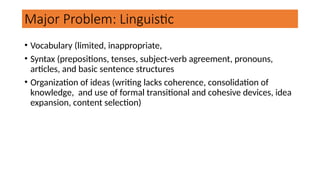
Major Problem: Linguistic
• Vocabulary (limited, inappropriate,
• Syntax (prepositions, tenses, subject-verb agreement, pronouns,
articles, and basic sentence structures
• Organization of ideas (writing lacks coherence, consolidation of
knowledge, and use of formal transitional and cohesive devices, idea
expansion, content selection)
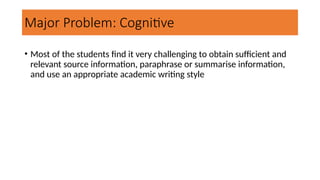
Major Problem: Cognitive
• Most of the students find it very challenging to obtain sufficient and
relevant source information, paraphrase or summarise information,
and use an appropriate academic writing style
Major Problem: Psychological
• students’ lack of confidence and poor motivation
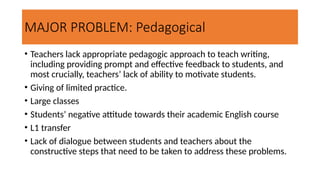
MAJOR PROBLEM: Pedagogical
• Teachers lack appropriate pedagogic approach to teach writing,
including providing prompt and effective feedback to students, and
most crucially, teachers’ lack of ability to motivate students.
• Giving of limited practice.
• Large classes
• Students’ negative attitude towards their academic English course
• L1 transfer
• Lack of dialogue between students and teachers about the
constructive steps that need to be taken to address these problems.
Tips to Improve Writing
1)Reading extensively,
2) Attending workshop,
3) Seek professional’s assistant,
4) Peer-editing,
5) Practice,
6) Brainstorming
7) Conducting group work or discussion.
Reference
• DIFFICULTIES AND WAYS TO IMPROVE ENGLISH WRITING SKILLS
AMONG POSTGRADUATE ESL STUDENTS
M.Y. Yahya, N.H. Hashim https://library.iated.org/view/YAHYA2013DIF
• Troia, 2002: Troia &Graham, 2003 in Papango & Aguirre, n.d.

ENGLISH_MATERIAL 3_Writing- Lesson 2.pptx

  • 1.
    WRITING • It isan extremely difficult cognitive activity which requires the learner to have control over various factors (Nunan, 1989) • These factors vary from academic background and personal interest of the writer to various psychological, linguistic and cognitive phenomena (Dar & Khan, 2015; Haider, 2012) • It is a cognitive process that tests memory, thinking ability and verbal command to successfully express the ideas (Kellogg, 2001) • It is a tool for effective communication of ideas
  • 2.
    Difficulties in Writing •Areas of difficulty for students with writing problems (Troia, 2002: Troia &Graham, 2003 in Papango & Aguirre, n.d.) Knowledge Difficulties: students show a. less awareness of what constitutes good writing and how to produce it b. restricted knowledge about genre-specific text structure (e.g., setting or plot elements in a narrative) c. poor declarative, procedural, and conditional strategy knowledge (e.g., knowing that one should set goals for writing, how to set specific goals, and when it is most beneficial to alter those goals) d. limited vocabulary e. underdeveloped knowledge of word and sentence structure (i.e., phonology, morphology, and syntax) f. impoverished, fragmented, and poorly organized topic knowledge g. difficulty assessing existing topic knowledge h. insensitivity to audience needs and perspectives, and to the functions their writing is intended to service
  • 3.
    Skill difficulties. Studentswith writing problems show: a. often do not plan before or during writing b. exhibit poor text transcription (e.g., spelling, handwriting, and punctuation) c. focus revision efforts (if they revise at all) on superficial aspects of writing (e.g., handwriting, spelling, and grammar) d. do not analyze or reflect on writing e. have limited ability to self-regulate thoughts, feelings, and actions throughout the writing process f. show poor attention and concentration g. have visual motor integration weaknesses and fine motor difficulties
  • 4.
    Motivation difficulties. Studentswith writing problems: a. often do not develop writing goals and sub-goals or flexibly alter them to meet audience, task, and personal demands b. fail to balance performance goals, which relate to documenting performance and achieving success, and mastery goals, which relate to acquiring competence; c. exhibit maladaptive attributions by attributing academic success to external and uncontrollable factors such as task ease or teacher assistance, but academic failure to internal yet uncontrollable factors such as limited aptitude d. have negative self-efficacy (competence) beliefs e. lack persistence f. feel helpless and poorly motivated due to repeated failure
  • 5.
    Major Problem: Linguistic •Vocabulary (limited, inappropriate, • Syntax (prepositions, tenses, subject-verb agreement, pronouns, articles, and basic sentence structures • Organization of ideas (writing lacks coherence, consolidation of knowledge, and use of formal transitional and cohesive devices, idea expansion, content selection)
  • 6.
    Major Problem: Cognitive •Most of the students find it very challenging to obtain sufficient and relevant source information, paraphrase or summarise information, and use an appropriate academic writing style
  • 7.
    Major Problem: Psychological •students’ lack of confidence and poor motivation
  • 8.
    MAJOR PROBLEM: Pedagogical •Teachers lack appropriate pedagogic approach to teach writing, including providing prompt and effective feedback to students, and most crucially, teachers’ lack of ability to motivate students. • Giving of limited practice. • Large classes • Students’ negative attitude towards their academic English course • L1 transfer • Lack of dialogue between students and teachers about the constructive steps that need to be taken to address these problems.
  • 9.
    Tips to ImproveWriting 1)Reading extensively, 2) Attending workshop, 3) Seek professional’s assistant, 4) Peer-editing, 5) Practice, 6) Brainstorming 7) Conducting group work or discussion.
  • 10.
    Reference • DIFFICULTIES ANDWAYS TO IMPROVE ENGLISH WRITING SKILLS AMONG POSTGRADUATE ESL STUDENTS M.Y. Yahya, N.H. Hashim https://library.iated.org/view/YAHYA2013DIF • Troia, 2002: Troia &Graham, 2003 in Papango & Aguirre, n.d.