Presentation by
JONATHAN PASCUAL, LPT.
What is sampling methods?
Home About Us
CORE GATEWAY COLLEGE INC.
P R A C T I C A L R E S E A R C H 2 | 2 0 2 3 - 2 0 2 4
Contact Us
Sampling is one of the most important factors which
determines the accuracy of your research/survey result. If anything
goes wrong with your sample then it will be directly reflected in the
final result (Sigh, 2018).
CGCI P R A C T I C A L R E S E A R C H 2 | 2 0 2 3
Population can be explained as a
comprehensive group of individuals,
institutions, objects and so forth which
have a common characteristic that are
the interest of a researcher
(Rafeedali, n.d.).
Page
Sample is the subset of the
population. The process of selecting a
sample is known as sampling. Number
of elements in the sample is the sample
size (Singh, 2018).
Page
CGCI
P R A C T I C A L R E S E A R C H 2
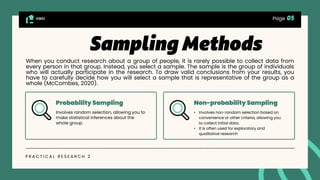
Probability Sampling Non-probability Sampling
Involves random selection, allowing you to
make statistical inferences about the
whole group.
• Involves non-random selection based on
convenience or other criteria, allowing you
to collect initial data.
• It is often used for exploratory and
qualitative research
Page
When you conduct research about a group of people, it is rarely possible to collect data from
every person in that group. Instead, you select a sample. The sample is the group of individuals
who will actually participate in the research. To draw valid conclusions from your results, you
have to carefully decide how you will select a sample that is representative of the group as a
whole (McCombes, 2020).
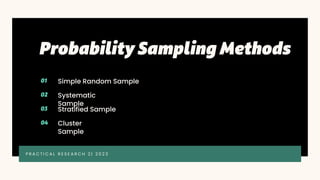
Simple Random Sample
Systematic
Sample
Stratified Sample
Cluster
Sample
P R A C T I C A L R E S E A R C H 2 | 2 0 2 3
Page
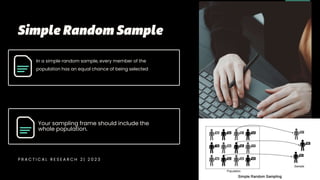
In a simple random sample, every member of the
population has an equal chance of being selected
Your sampling frame should include the
whole population.
P R A C T I C A L R E S E A R C H 2 | 2 0 2 3
Page
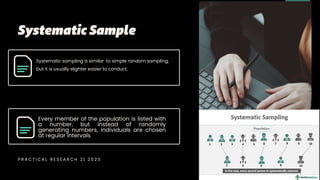
Systematic sampling is similar to simple random sampling,
but it is usually slighter easier to conduct.
Every member of the population is listed with
a number, but instead of randomly
generating numbers, individuals are chosen
at regular intervals
P R A C T I C A L R E S E A R C H 2 | 2 0 2 3
Page
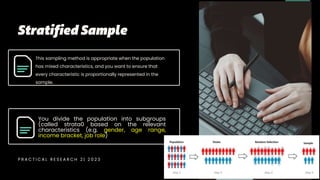
This sampling method is appropriate when the population
has mixed characteristics, and you want to ensure that
every characteristic is proportionally represented in the
sample.
You divide the population into subgroups
(called strata0 based on the relevant
characteristics (e.g. gender, age range,
income bracket, job role)
P R A C T I C A L R E S E A R C H 2 | 2 0 2 3
Page
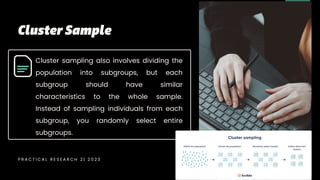
Cluster sampling also involves dividing the
population into subgroups, but each
subgroup should have similar
characteristics to the whole sample.
Instead of sampling individuals from each
subgroup, you randomly select entire
subgroups.
P R A C T I C A L R E S E A R C H 2 | 2 0 2 3
Convenience Sample
Voluntary Response Sample
Purposive Sample
Snowball Sample
P R A C T I C A L R E S E A R C H 2 | 2 0 2 3
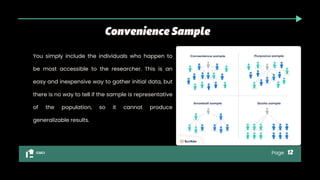
You simply include the individuals who happen to
be most accessible to the researcher. This is an
easy and inexpensive way to gather initial data, but
there is no way to tell if the sample is representative
of the population, so it cannot produce
generalizable results.
CGCI Page
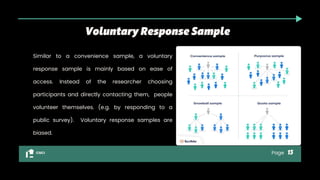
Similar to a convenience sample, a voluntary
response sample is mainly based on ease of
access. Instead of the researcher choosing
participants and directly contacting them, people
volunteer themselves. (e.g. by responding to a
public survey). Voluntary response samples are
biased.
CGCI Page
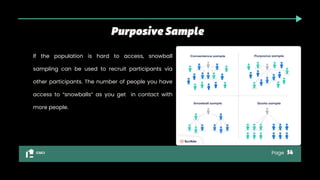
This type of sampling involves the researcher using
their judgment to select a sample that is most
useful to the purposes of the research. An effective
purposive sample must have clear criteria and
rationale for inclusion.
CGCI Page
If the population is hard to access, snowball
sampling can be used to recruit participants via
other participants. The number of people you have
access to “snowballs” as you get in contact with
more people.
CGCI Page
CGCI
C O M P U T E R S C I E N C E | 2 0 2 4 W W W . R E A L L Y G R E A T S I T E . C O M
Page
TRUE OR FALSE
Write A if statement 1 and statement 2 are true.
Write B if statement 1 and statement 2 are false.
Write C if only one statement is true.
1. (1)Sampling design determines the accuracy of the result of your study because
(2) sampling design is where you select your participants who will participate in
your study.
2. (1) Population determines the geographical location of the participants, while
(2) sample is the specific group of individuals that you will collect data.
CGCI
C O M P U T E R S C I E N C E | 2 0 2 4 W W W . R E A L L Y G R E A T S I T E . C O M
Page
TRUE OR FALSE
Write A if statement 1 and statement 2 are true.
Write B if statement 1 and statement 2 are false.
Write C if only one statement is true.
3. (1) Probability sampling is to quantitative as (2) non-probability sampling is to
qualitative.
4. (1) You can draw valid and reliable result if you choose the right sampling
design. Thus, (2) you should first consider your research
CGCI
C O M P U T E R S C I E N C E | 2 0 2 4 W W W . R E A L L Y G R E A T S I T E . C O M
Page
TRUE OR FALSE
Write A if statement 1 and statement 2 are true.
Write B if statement 1 and statement 2 are false.
Write C if only one statement is true.
5. (1) Cluster sample is usually utilized if you will study large sample of population,
while (2) stratified sample is usually used if you want to determine the different
characteristics of a sample.
6. (1) Selecting a sample from a population is optional to the researchers, as (2) it
will not affect the findings or results of the study.
CGCI
C O M P U T E R S C I E N C E | 2 0 2 4 W W W . R E A L L Y G R E A T S I T E . C O M
Page
TRUE OR FALSE
Write A if statement 1 and statement 2 are true.
Write B if statement 1 and statement 2 are false.
Write C if only one statement is true.
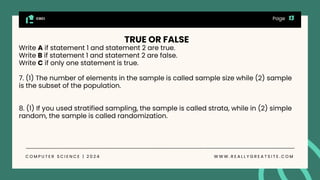
7. (1) The number of elements in the sample is called sample size while (2) sample
is the subset of the population.
8. (1) If you used stratified sampling, the sample is called strata, while in (2) simple
random, the sample is called randomization.
CGCI
C G C I W W W . C G C I . C O M
Page
TRUE OR FALSE
Write A if statement 1 and statement 2 are true.
Write B if statement 1 and statement 2 are false.
Write C if only one statement is true.
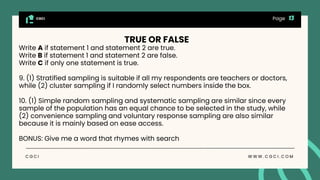
9. (1) Stratified sampling is suitable if all my respondents are teachers or doctors,
while (2) cluster sampling if I randomly select numbers inside the box.
10. (1) Simple random sampling and systematic sampling are similar since every
sample of the population has an equal chance to be selected in the study, while
(2) convenience sampling and voluntary response sampling are also similar
because it is mainly based on ease access.
BONUS: Give me a word that rhymes with search
Presentation by JONATHAN PASCUAL, LPT
Search Here...
Home About Us
CGCI
P R A C T I C A L R E S E A R C H 2 | 2 0 2 3
Contact Us

SAMPLING METHODDDDDDDDDDDDDDDDDDDDDDDDDDDDDDDDDDDDDDDDDDDDDD

  • 1.
    Presentation by JONATHAN PASCUAL,LPT. What is sampling methods? Home About Us CORE GATEWAY COLLEGE INC. P R A C T I C A L R E S E A R C H 2 | 2 0 2 3 - 2 0 2 4 Contact Us
  • 2.
    Sampling is oneof the most important factors which determines the accuracy of your research/survey result. If anything goes wrong with your sample then it will be directly reflected in the final result (Sigh, 2018). CGCI P R A C T I C A L R E S E A R C H 2 | 2 0 2 3
  • 3.
    Population can beexplained as a comprehensive group of individuals, institutions, objects and so forth which have a common characteristic that are the interest of a researcher (Rafeedali, n.d.). Page
  • 4.
    Sample is thesubset of the population. The process of selecting a sample is known as sampling. Number of elements in the sample is the sample size (Singh, 2018). Page
  • 5.
    CGCI P R AC T I C A L R E S E A R C H 2 Probability Sampling Non-probability Sampling Involves random selection, allowing you to make statistical inferences about the whole group. • Involves non-random selection based on convenience or other criteria, allowing you to collect initial data. • It is often used for exploratory and qualitative research Page When you conduct research about a group of people, it is rarely possible to collect data from every person in that group. Instead, you select a sample. The sample is the group of individuals who will actually participate in the research. To draw valid conclusions from your results, you have to carefully decide how you will select a sample that is representative of the group as a whole (McCombes, 2020).
  • 6.
    Simple Random Sample Systematic Sample StratifiedSample Cluster Sample P R A C T I C A L R E S E A R C H 2 | 2 0 2 3
  • 7.
    Page In a simplerandom sample, every member of the population has an equal chance of being selected Your sampling frame should include the whole population. P R A C T I C A L R E S E A R C H 2 | 2 0 2 3
  • 8.
    Page Systematic sampling issimilar to simple random sampling, but it is usually slighter easier to conduct. Every member of the population is listed with a number, but instead of randomly generating numbers, individuals are chosen at regular intervals P R A C T I C A L R E S E A R C H 2 | 2 0 2 3
  • 9.
    Page This sampling methodis appropriate when the population has mixed characteristics, and you want to ensure that every characteristic is proportionally represented in the sample. You divide the population into subgroups (called strata0 based on the relevant characteristics (e.g. gender, age range, income bracket, job role) P R A C T I C A L R E S E A R C H 2 | 2 0 2 3
  • 10.
    Page Cluster sampling alsoinvolves dividing the population into subgroups, but each subgroup should have similar characteristics to the whole sample. Instead of sampling individuals from each subgroup, you randomly select entire subgroups. P R A C T I C A L R E S E A R C H 2 | 2 0 2 3
  • 11.
    Convenience Sample Voluntary ResponseSample Purposive Sample Snowball Sample P R A C T I C A L R E S E A R C H 2 | 2 0 2 3
  • 12.
    You simply includethe individuals who happen to be most accessible to the researcher. This is an easy and inexpensive way to gather initial data, but there is no way to tell if the sample is representative of the population, so it cannot produce generalizable results. CGCI Page
  • 13.
    Similar to aconvenience sample, a voluntary response sample is mainly based on ease of access. Instead of the researcher choosing participants and directly contacting them, people volunteer themselves. (e.g. by responding to a public survey). Voluntary response samples are biased. CGCI Page
  • 14.
    This type ofsampling involves the researcher using their judgment to select a sample that is most useful to the purposes of the research. An effective purposive sample must have clear criteria and rationale for inclusion. CGCI Page
  • 15.
    If the populationis hard to access, snowball sampling can be used to recruit participants via other participants. The number of people you have access to “snowballs” as you get in contact with more people. CGCI Page
  • 16.
    CGCI C O MP U T E R S C I E N C E | 2 0 2 4 W W W . R E A L L Y G R E A T S I T E . C O M Page TRUE OR FALSE Write A if statement 1 and statement 2 are true. Write B if statement 1 and statement 2 are false. Write C if only one statement is true. 1. (1)Sampling design determines the accuracy of the result of your study because (2) sampling design is where you select your participants who will participate in your study. 2. (1) Population determines the geographical location of the participants, while (2) sample is the specific group of individuals that you will collect data.
  • 17.
    CGCI C O MP U T E R S C I E N C E | 2 0 2 4 W W W . R E A L L Y G R E A T S I T E . C O M Page TRUE OR FALSE Write A if statement 1 and statement 2 are true. Write B if statement 1 and statement 2 are false. Write C if only one statement is true. 3. (1) Probability sampling is to quantitative as (2) non-probability sampling is to qualitative. 4. (1) You can draw valid and reliable result if you choose the right sampling design. Thus, (2) you should first consider your research
  • 18.
    CGCI C O MP U T E R S C I E N C E | 2 0 2 4 W W W . R E A L L Y G R E A T S I T E . C O M Page TRUE OR FALSE Write A if statement 1 and statement 2 are true. Write B if statement 1 and statement 2 are false. Write C if only one statement is true. 5. (1) Cluster sample is usually utilized if you will study large sample of population, while (2) stratified sample is usually used if you want to determine the different characteristics of a sample. 6. (1) Selecting a sample from a population is optional to the researchers, as (2) it will not affect the findings or results of the study.
  • 19.
    CGCI C O MP U T E R S C I E N C E | 2 0 2 4 W W W . R E A L L Y G R E A T S I T E . C O M Page TRUE OR FALSE Write A if statement 1 and statement 2 are true. Write B if statement 1 and statement 2 are false. Write C if only one statement is true. 7. (1) The number of elements in the sample is called sample size while (2) sample is the subset of the population. 8. (1) If you used stratified sampling, the sample is called strata, while in (2) simple random, the sample is called randomization.
  • 20.
    CGCI C G CI W W W . C G C I . C O M Page TRUE OR FALSE Write A if statement 1 and statement 2 are true. Write B if statement 1 and statement 2 are false. Write C if only one statement is true. 9. (1) Stratified sampling is suitable if all my respondents are teachers or doctors, while (2) cluster sampling if I randomly select numbers inside the box. 10. (1) Simple random sampling and systematic sampling are similar since every sample of the population has an equal chance to be selected in the study, while (2) convenience sampling and voluntary response sampling are also similar because it is mainly based on ease access. BONUS: Give me a word that rhymes with search
  • 21.
    Presentation by JONATHANPASCUAL, LPT Search Here... Home About Us CGCI P R A C T I C A L R E S E A R C H 2 | 2 0 2 3 Contact Us

Editor's Notes

  • #21 Church, perch, birch, lurch, durch, surge