Assessing
Presented For
Senior High School
Faculty
21st Century
Skills
Assessment
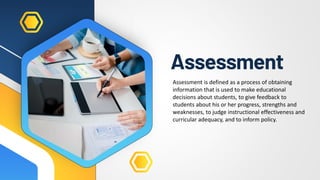
Assessment is defined as a process of obtaining
information that is used to make educational
decisions about students, to give feedback to
students about his or her progress, strengths and
weaknesses, to judge instructional effectiveness and
curricular adequacy, and to inform policy.
21st century skills
Learning and
Innovation Skills.
 Creativity
 Critical Thinking
 Communication
 Collaboration
Literacy Skills
 Media Literacy
 Information Literacy
 Technology Literacy
Life and Career
Skills
 Flexibility and Adaptability
 Leadership and
Responsibility
 Initiative and Self-
Direction
 Productivity and
accountability
 Social and cross-cultural
skill
Assessment
tools
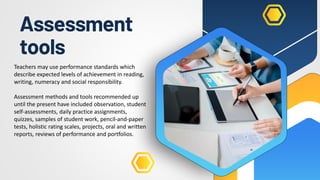
Teachers may use performance standards which
describe expected levels of achievement in reading,
writing, numeracy and social responsibility.
Assessment methods and tools recommended up
until the present have included observation, student
self-assessments, daily practice assignments,
quizzes, samples of student work, pencil-and-paper
tests, holistic rating scales, projects, oral and written
reports, reviews of performance and portfolios.
Goalsof21st century
assessments
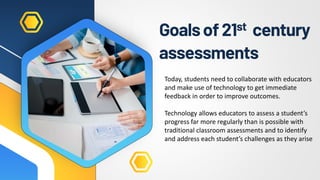
Today, students need to collaborate with educators
and make use of technology to get immediate
feedback in order to improve outcomes.
Technology allows educators to assess a student’s
progress far more regularly than is possible with
traditional classroom assessments and to identify
and address each student’s challenges as they arise
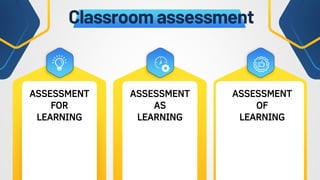
Classroom assessment
ASSESSMENT
FOR
LEARNING
ASSESSMENT
AS
LEARNING
ASSESSMENT
OF
LEARNING
Assessment as
Learning
1
2
Assessment as learning focusses on students and
emphasizes assessment as a process of metacognition.
Assessment as learning comes from the constructivist
idea that learning is an active process that occurs when
students interact with new ideas
Examples of 21st Century assessment as learning tools
include self-assessments, peer assessments, student-
teacher conferences, teacher observations with
feedback and interim product analysis.
Assessment for
Learning
1
2
teachers use assessment as a research tool to find out
as much as they can about what their students know
and are able to do, as well what presumptions and
misunderstandings they may have.
Teachers also use assessment for learning to boost
student's motivation and commitment to learning.
Assessment of
Learning
1
2
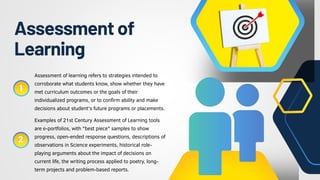
Assessment of learning refers to strategies intended to
corroborate what students know, show whether they have
met curriculum outcomes or the goals of their
individualized programs, or to confirm ability and make
decisions about student's future programs or placements.
Examples of 21st Century Assessment of Learning tools
are e-portfolios, with "best piece" samples to show
progress, open-ended response questions, descriptions of
observations in Science experiments, historical role-
playing arguments about the impact of decisions on
current life, the writing process applied to poetry, long-
term projects and problem-based reports.
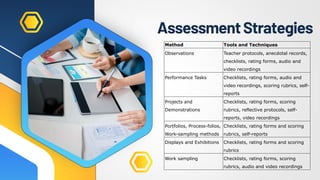
AssessmentStrategies
Method Tools and Techniques
Observations Teacher protocols, anecdotal records,
checklists, rating forms, audio and
video recordings
Performance Tasks Checklists, rating forms, audio and
video recordings, scoring rubrics, self-
reports
Projects and
Demonstrations
Checklists, rating forms, scoring
rubrics, reflective protocols, self-
reports, video recordings
Portfolios, Process-folios,
Work-sampling methods
Checklists, rating forms and scoring
rubrics, self-reports
Displays and Exhibitions Checklists, rating forms and scoring
rubrics
Work sampling Checklists, rating forms, scoring
rubrics, audio and video recordings
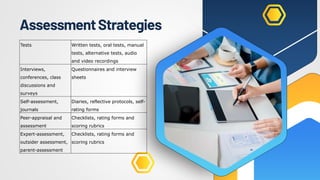
AssessmentStrategies
Tests Written tests, oral tests, manual
tests, alternative tests, audio
and video recordings
Interviews,
conferences, class
discussions and
surveys
Questionnaires and interview
sheets
Self-assessment,
journals
Diaries, reflective protocols, self-
rating forms
Peer-appraisal and
assessment
Checklists, rating forms and
scoring rubrics
Expert-assessment,
outsider assessment,
parent-assessment
Checklists, rating forms and
scoring rubrics
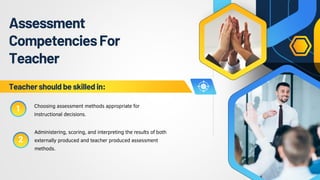
Assessment
CompetenciesFor
Teacher
Teacher should beskilled in:
1
2
Choosing assessment methods appropriate for
instructional decisions.
Administering, scoring, and interpreting the results of both
externally produced and teacher produced assessment
methods.
Assessment
CompetenciesFor
Teacher
Teacher should beskilled in:
3
4
Using assessment results when making decisions about
individual students, planning teaching, and developing
curriculum and school improvement.
Developing valid pupil grading procedures that use pupil
assessment.
Assessment
CompetenciesFor
Teacher
Teacher should beskilled in:
5
6
Communicating assessment results to students, parents,
other lay audiences, and other educators.
Recognizing unethical, illegal, and otherwise inappropriate
assessment methods and uses of assessment information.
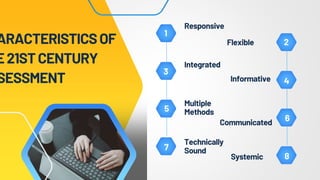
CHARACTERISTICSOF
THE21STCENTURY
ASSESSMENT
Thefollowing eightcharacteristics of21st
centuryassessment,areessentialguidefor
preparation ofassessment activitiesby
educators. Itisnecessarytorefertothese
characteristics toensurethatthelearnersare
beingassessedtowardstheskillsanddemand
ofthe21stcentury.
Responsive
Integrated
Multiple
Methods
Technically
Sound
ARACTERISTICSOF
E21STCENTURY
SESSMENT
Flexible
Informative
Communicated
Systemic
2
1
3
4
8
7
6
5
CHARACTERISTICSOF
THE21STCENTURY
ASSESSMENT examines the nature of learning in schools and the
ways academic assessment can be used responsively
to support learning and provide children with a sure
sense of themselves as learners.
assessment designed to enable and facilitate
student choice, such as in the method or format of
their assessment, or the topics on which they
choose to focus.
Responsive
Flexible
CHARACTERISTICSOF
THE21STCENTURY
ASSESSMENT
assessment design that seeks to combine students'
learning from multiple modules and/or levels into a
single assessment.
focuses on how teachers and students make use of
assessment information to understand and improve
learning.
Integrated
Informative
CHARACTERISTICSOF
THE21STCENTURY
ASSESSMENT
An assessment continuum that includes a spectrum
of strategies is the norm.
Communication of assessment data is clear and transparent
for all stakeholders.
Multiple Methods
Communicated
CHARACTERISTICSOF
THE21STCENTURY
ASSESSMENT
Adjustments and accommodations are made in the
assessment process to meet the students’ needs and
fairness.
21st century assessment is part of a comprehensive and well-
aligned assessment system that is balanced and inclusive of
all students, constituents, and stakeholders and designed to
support improvement at all levels.
Technically Sound
Systemic
THANK YOU
FOR LISTENING
If you have any further questions, ask ALDINE
JAY M. RAYTAN

FACULTY_DEVELOPMENT_ASSESSING-21ST-CENTURY.pptx

  • 1.
    Assessing Presented For Senior HighSchool Faculty 21st Century Skills
  • 2.
    Assessment Assessment is definedas a process of obtaining information that is used to make educational decisions about students, to give feedback to students about his or her progress, strengths and weaknesses, to judge instructional effectiveness and curricular adequacy, and to inform policy.
  • 3.
    21st century skills Learningand Innovation Skills.  Creativity  Critical Thinking  Communication  Collaboration Literacy Skills  Media Literacy  Information Literacy  Technology Literacy Life and Career Skills  Flexibility and Adaptability  Leadership and Responsibility  Initiative and Self- Direction  Productivity and accountability  Social and cross-cultural skill
  • 4.
    Assessment tools Teachers may useperformance standards which describe expected levels of achievement in reading, writing, numeracy and social responsibility. Assessment methods and tools recommended up until the present have included observation, student self-assessments, daily practice assignments, quizzes, samples of student work, pencil-and-paper tests, holistic rating scales, projects, oral and written reports, reviews of performance and portfolios.
  • 5.
    Goalsof21st century assessments Today, studentsneed to collaborate with educators and make use of technology to get immediate feedback in order to improve outcomes. Technology allows educators to assess a student’s progress far more regularly than is possible with traditional classroom assessments and to identify and address each student’s challenges as they arise
  • 6.
  • 7.
    Assessment as Learning 1 2 Assessment aslearning focusses on students and emphasizes assessment as a process of metacognition. Assessment as learning comes from the constructivist idea that learning is an active process that occurs when students interact with new ideas Examples of 21st Century assessment as learning tools include self-assessments, peer assessments, student- teacher conferences, teacher observations with feedback and interim product analysis.
  • 8.
    Assessment for Learning 1 2 teachers useassessment as a research tool to find out as much as they can about what their students know and are able to do, as well what presumptions and misunderstandings they may have. Teachers also use assessment for learning to boost student's motivation and commitment to learning.
  • 9.
    Assessment of Learning 1 2 Assessment oflearning refers to strategies intended to corroborate what students know, show whether they have met curriculum outcomes or the goals of their individualized programs, or to confirm ability and make decisions about student's future programs or placements. Examples of 21st Century Assessment of Learning tools are e-portfolios, with "best piece" samples to show progress, open-ended response questions, descriptions of observations in Science experiments, historical role- playing arguments about the impact of decisions on current life, the writing process applied to poetry, long- term projects and problem-based reports.
  • 10.
    AssessmentStrategies Method Tools andTechniques Observations Teacher protocols, anecdotal records, checklists, rating forms, audio and video recordings Performance Tasks Checklists, rating forms, audio and video recordings, scoring rubrics, self- reports Projects and Demonstrations Checklists, rating forms, scoring rubrics, reflective protocols, self- reports, video recordings Portfolios, Process-folios, Work-sampling methods Checklists, rating forms and scoring rubrics, self-reports Displays and Exhibitions Checklists, rating forms and scoring rubrics Work sampling Checklists, rating forms, scoring rubrics, audio and video recordings
  • 11.
    AssessmentStrategies Tests Written tests,oral tests, manual tests, alternative tests, audio and video recordings Interviews, conferences, class discussions and surveys Questionnaires and interview sheets Self-assessment, journals Diaries, reflective protocols, self- rating forms Peer-appraisal and assessment Checklists, rating forms and scoring rubrics Expert-assessment, outsider assessment, parent-assessment Checklists, rating forms and scoring rubrics
  • 12.
    Assessment CompetenciesFor Teacher Teacher should beskilledin: 1 2 Choosing assessment methods appropriate for instructional decisions. Administering, scoring, and interpreting the results of both externally produced and teacher produced assessment methods.
  • 13.
    Assessment CompetenciesFor Teacher Teacher should beskilledin: 3 4 Using assessment results when making decisions about individual students, planning teaching, and developing curriculum and school improvement. Developing valid pupil grading procedures that use pupil assessment.
  • 14.
    Assessment CompetenciesFor Teacher Teacher should beskilledin: 5 6 Communicating assessment results to students, parents, other lay audiences, and other educators. Recognizing unethical, illegal, and otherwise inappropriate assessment methods and uses of assessment information.
  • 15.
  • 16.
    Thefollowing eightcharacteristics of21st centuryassessment,areessentialguidefor preparationofassessment activitiesby educators. Itisnecessarytorefertothese characteristics toensurethatthelearnersare beingassessedtowardstheskillsanddemand ofthe21stcentury.
  • 17.
  • 18.
    CHARACTERISTICSOF THE21STCENTURY ASSESSMENT examines thenature of learning in schools and the ways academic assessment can be used responsively to support learning and provide children with a sure sense of themselves as learners. assessment designed to enable and facilitate student choice, such as in the method or format of their assessment, or the topics on which they choose to focus. Responsive Flexible
  • 19.
    CHARACTERISTICSOF THE21STCENTURY ASSESSMENT assessment design thatseeks to combine students' learning from multiple modules and/or levels into a single assessment. focuses on how teachers and students make use of assessment information to understand and improve learning. Integrated Informative
  • 20.
    CHARACTERISTICSOF THE21STCENTURY ASSESSMENT An assessment continuumthat includes a spectrum of strategies is the norm. Communication of assessment data is clear and transparent for all stakeholders. Multiple Methods Communicated
  • 21.
    CHARACTERISTICSOF THE21STCENTURY ASSESSMENT Adjustments and accommodationsare made in the assessment process to meet the students’ needs and fairness. 21st century assessment is part of a comprehensive and well- aligned assessment system that is balanced and inclusive of all students, constituents, and stakeholders and designed to support improvement at all levels. Technically Sound Systemic
  • 22.
    THANK YOU FOR LISTENING Ifyou have any further questions, ask ALDINE JAY M. RAYTAN