Ed	
  H.	
  Chi,	
  Principal	
  Scientist	
  and	
  Area	
  Manager	
  

                Augmented	
  Social	
  Cognition	
  Area	
  
                Palo	
  Alto	
  Research	
  Center	


                                                          Hypertext 2010 Keynote at MSM
                2010-06-13                                           Workshop
                                                                                           1
Image from: http://www.flickr.com/photos/ourcommon/480538715/
    Cognition:	
  the	
  ability	
  to	
  remember,	
  think,	
  and	
  reason;	
  the	
  faculty	
  of	
  
     knowing.	
  
    Social	
  Cognition:	
  the	
  ability	
  of	
  a	
  group	
  to	
  remember,	
  think,	
  and	
  
     reason;	
  the	
  construction	
  of	
  knowledge	
  structures	
  by	
  a	
  group.	
  
      –  (not	
  quite	
  the	
  same	
  as	
  in	
  the	
  branch	
  of	
  psychology	
  that	
  studies	
  the	
  
         cognitive	
  processes	
  involved	
  in	
  social	
  interaction,	
  though	
  included)	
  
    Augmented	
  Social	
  Cognition:	
  Supported	
  by	
  systems,	
  the	
  
     enhancement	
  	
  of	
  the	
  ability	
  of	
  a	
  group	
  to	
  remember,	
  think,	
  and	
  
     reason;	
  the	
  system-­‐supported	
  construction	
  of	
  knowledge	
  
     structures	
  by	
  a	
  group.	


Citation:	
  Chi,	
  IEEE	
  Computer,	
  Sept	
  2008	


                                        Hypertext 2010 Keynote at MSM
 2010-06-13                                        Workshop                                                            2
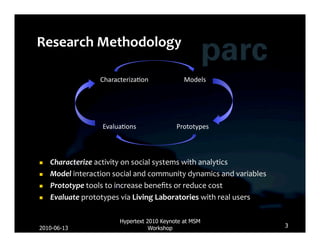
Characteriza*on	
                Models	


                         Evalua*ons	
                 Prototypes	


    Characterize	
  activity	
  on	
  social	
  systems	
  with	
  analytics	
  
    Model	
  interaction	
  social	
  and	
  community	
  dynamics	
  and	
  variables	
  
    Prototype	
  tools	
  to	
  increase	
  benefits	
  or	
  reduce	
  cost	
  
    Evaluate	
  prototypes	
  via	
  Living	
  Laboratories	
  with	
  real	
  users	
  

                                Hypertext 2010 Keynote at MSM
2010-06-13                                 Workshop                                           3
    All	
  models	
  are	
  wrong!	
  
      –  Some	
  are	
  more	
  wrong	
  than	
  others!	
  
    So	
  what	
  are	
  theories	
  and	
  models	
  good	
  for?	
  
    A	
  summary	
  of	
  what	
  we	
  think	
  is	
  happening	
  
      –  Ways	
  to	
  describe	
  and	
  explain	
  what	
  we	
  have	
  learned	
  
      –  Predicts	
  user	
  and	
  group	
  behavior	
  
      –  Helps	
  generate	
  new	
  novel	
  tools	
  and	
  systems	


                                   Hypertext 2010 Keynote at MSM
2010-06-13                                    Workshop                                   4
    For	
  example,	
  for	
  information	
  diffusion,	
  it’s	
  theory	
  of	
  
     influentials	
  [Gladwell,	
  etc.]	
  
      –  reach	
  a	
  small	
  group	
  of	
  influential	
  people,	
  and	
  you’ll	
  reach	
  
         everyone	
  else	


                                                     Figure From: Kleinberg, ICWSM2009

                                    Hypertext 2010 Keynote at MSM
2010-06-13                                     Workshop                                              5
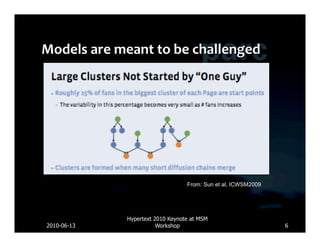
From: Sun et al, ICWSM2009


             Hypertext 2010 Keynote at MSM
2010-06-13              Workshop                               6
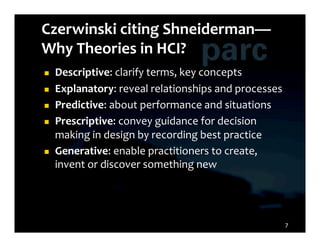
    Descriptive:	
  clarify	
  terms,	
  key	
  concepts	
  
    Explanatory:	
  reveal	
  relationships	
  and	
  processes	
  
    Predictive:	
  about	
  performance	
  and	
  situations	
  
    Prescriptive:	
  convey	
  guidance	
  for	
  decision	
  
     making	
  in	
  design	
  by	
  recording	
  best	
  practice	
  
    Generative:	
  enable	
  practitioners	
  to	
  create,	
  
     invent	
  or	
  discover	
  something	
  new	


                                                                         7
    A	
  tough	
  task	
  to	
  identify	
  models	
  from	
  the	
  
     literature,	
  since	
  it	
  is	
  so	
  spread	
  out	
  in	
  various	
  
     publications	
  
    Just	
  a	
  few	
  examples	
  from	
  our	
  group.	


                                        UIST 2004                                   8
Hypertext 2010 Keynote at MSM
2010-06-13              Workshop             9
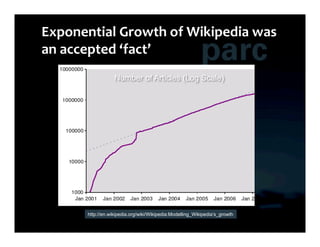
Number of Articles (Log Scale)


http://en.wikipedia.org/wiki/Wikipedia:Modelling_Wikipedia’s_growth
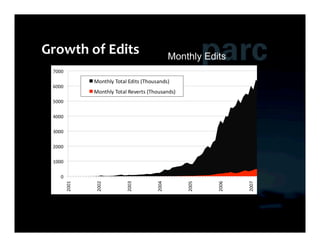
Monthly Edits
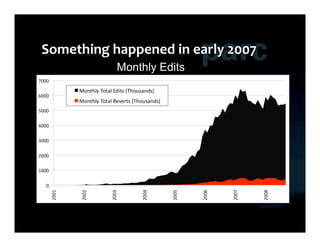
Monthly Edits
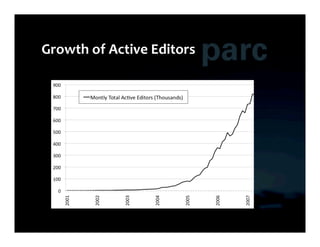
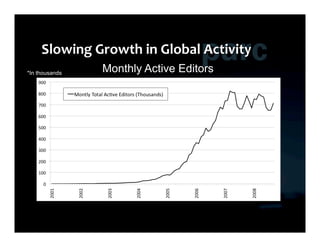
*In thousands   Monthly Active Editors
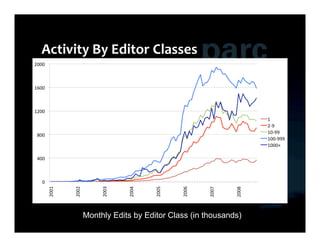
Monthly Edits by Editor Class (in thousands)
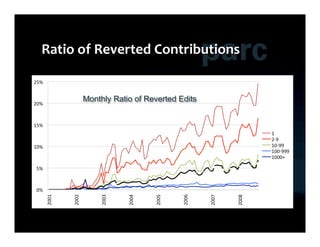
Monthly Ratio of Reverted Edits
Hypertext 2010 Keynote at MSM
2010-06-13              Workshop             18
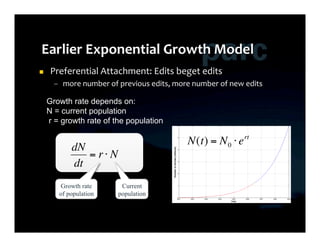
     Preferential	
  Attachment:	
  Edits	
  beget	
  edits	
  
           –  more	
  number	
  of	
  previous	
  edits,	
  more	
  number	
  of	
  new	
  edits	
  

         Growth rate depends on:
         N = current population
         r = growth rate of the population

                                                                   N(t) = N 0 ⋅ e rt
                  dN
                     = r⋅ N
                  dt
              Growth rate              Current
             of population                     €
                                      population

€
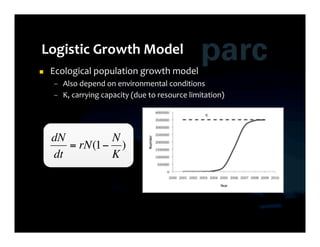
    Ecological	
  population	
  growth	
  model	
  
          –  Also	
  depend	
  on	
  environmental	
  conditions	
  
          –  K,	
  carrying	
  capacity	
  (due	
  to	
  resource	
  limitation)	


         dN        N
            = rN(1− )
         dt        K


€
    Follows	
  a	
  logistic	
  growth	
  curve	


                                               New Article
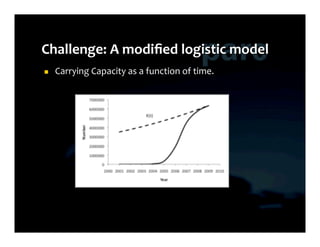
    Carrying	
  Capacity	
  as	
  a	
  function	
  of	
  time.	
  
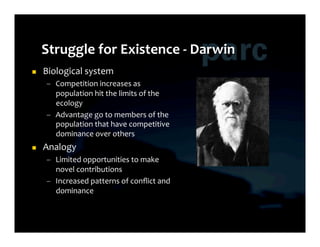
    Biological	
  system	
  
      –  Competition	
  increases	
  as	
  
         population	
  hit	
  the	
  limits	
  of	
  the	
  
         ecology	
  
      –  Advantage	
  go	
  to	
  members	
  of	
  the	
  
         population	
  that	
  have	
  competitive	
  
         dominance	
  over	
  others	
  
    Analogy	
  
      –  Limited	
  opportunities	
  to	
  make	
  
         novel	
  contributions	
  
      –  Increased	
  patterns	
  of	
  conflict	
  and	
  
         dominance	
  	
  
    r-­‐Strategist	
  
      –  Growth	
  or	
  exploitation	
  
                                                                     dN        N
      –  Less-­‐crowded	
  niches	
  /	
  produce	
  many	
             = rN(1− )
         offspring	
                                                  dt        K
    K-­‐Strategist	
  
      –  Conservation	
  
                                                                      [Gunderson & Holling 2001]
      –  Strong	
  competitors	
  in	
  crowded	
  niches	
  /	
  
         invest	
  more	
  heavily	
  in	
  fewer	
  offspring	
  
                                                     €
Hypertext 2010 Keynote at MSM
2010-06-13              Workshop             25
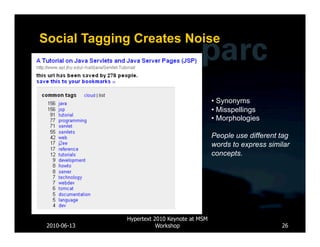
Social Tagging Creates Noise


                                              •  Synonyms
                                              •  Misspellings
                                              •  Morphologies

                                              People use different tag
                                              words to express similar
                                              concepts.


              Hypertext 2010 Keynote at MSM
 2010-06-13              Workshop                                  26
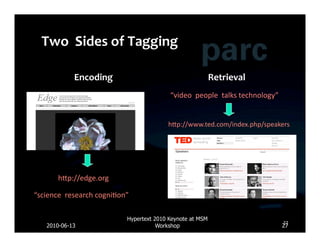
Encoding	
                                             Retrieval
                                                                                	
  
                                                      “video	
  	
  people	
  	
  talks	
  technology”	


                                                     h:p://www.ted.com/index.php/speakers	


          h:p://edge.org	
  

“science	
  	
  research	
  cogni*on”	
  

                                       Hypertext 2010 Keynote at MSM
                                                                                                                 27	
  
     2010-06-13                                   Workshop                                                   27
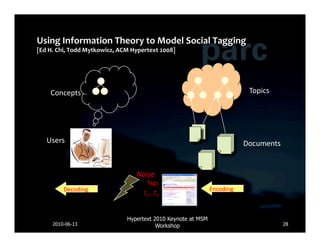
Concepts	
                                                            Topics	


Users	
                                                              Documents	


                         Noise	
  
                             Tags	
  
       Decoding	
                                     Encoding	
  
                            T1…Tn	


                      Hypertext 2010 Keynote at MSM
  2010-06-13                     Workshop                                            28
Hypertext 2010 Keynote at MSM
2010-06-13              Workshop             29
Hypertext 2010 Keynote at MSM
2010-06-13              Workshop             30
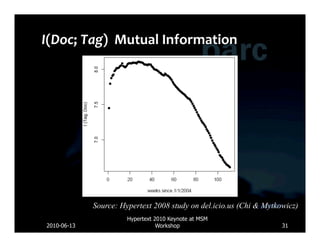
Source: Hypertext 2008 study on del.icio.us (Chi & Mytkowicz)
                       Hypertext 2010 Keynote at MSM
2010-06-13                        Workshop                           31
Hypertext 2010 Keynote at MSM
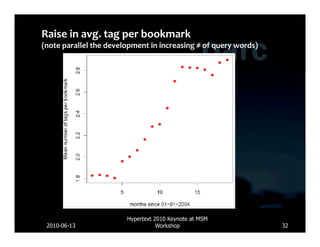
2010-06-13              Workshop             32
Joint	
  work	
  with	
  	
  
Rowan	
  Nairn,	
  Lawrence	
  Lee	
  

Kammerer,	
  Y.,	
  Nairn,	
  R.,	
  Pirolli,	
  P.,	
  and	
  Chi,	
  E.	
  H.	
  2009.	
  Signpost	
  from	
  the	
  masses:	
  learning	
  
effects	
  in	
  an	
  exploratory	
  social	
  tag	
  search	
  browser.	
  In	
  Proceedings	
  of	
  the	
  27th	
  
international	
  Conference	
  on	
  Human	
  Factors	
  in	
  Computing	
  Systems	
  (Boston,	
  MA,	
  USA,	
  
April	
  04	
  -­‐	
  09,	
  2009).	
  CHI	
  '09.	
  ACM,	
  New	
  York,	
  NY,	
  625-­‐634.	


                                                    Hypertext 2010 Keynote at MSM
2010-06-13                                                     Workshop                                                                          33
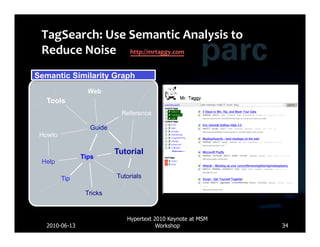
Semantic Similarity Graph
                  Web
   Tools
                            Reference

                  Guide
 Howto

                          Tutorial
                Tips
 Help

         Tip              Tutorials

                 Tricks


                             Hypertext 2010 Keynote at MSM
   2010-06-13                           Workshop             34
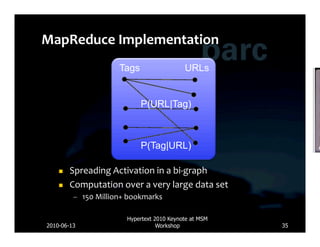
Tags                     URLs


                                   P(URL|Tag)


                                   P(Tag|URL)

        Spreading	
  Activation	
  in	
  a	
  bi-­‐graph	
  
        Computation	
  over	
  a	
  very	
  large	
  data	
  set	
  
          –  150	
  Million+	
  bookmarks	
  

                              Hypertext 2010 Keynote at MSM
2010-06-13                               Workshop                       35
Database                                        Lucene
• Delicious                                      • P(URL|Tag)                                 • Serve up search
• Ma.gnolia                                      • P(Tag|URL)                                   results
                         • Tuples of                                  • Pre-computed
• Other social cues        bookmarks             • Bayesian Network     patterns in a fast    • Well defined APIs
                         • [User, URL, Tags,       Inference            index
                           Time]
       Crawling                                      MapReduce                                     Web Server
                                                                                                     Web
                                                                                                        Server


                                                                                                UI                  Search
                                                                                             Frontend               Results
    •  MapReduce:	
  months	
  of	
  computa*on	
  to	
  a	
  single	
  day	
  
    •  Development	
  of	
  novel	
  scoring	
  func*on	


                                               Hypertext 2010 Keynote at MSM
            2010-06-13                                    Workshop                                                   36
Hypertext 2010 Keynote at MSM
2010-06-13              Workshop             37
Hypertext 2010 Keynote at MSM
2010-06-13              Workshop             38
Hypertext 2010 Keynote at MSM
2010-06-13              Workshop             39
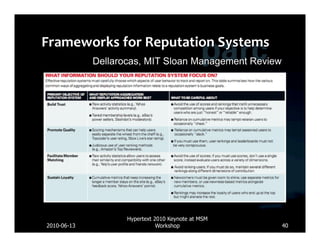
Dellarocas, MIT Sloan Management Review


                    Hypertext 2010 Keynote at MSM
2010-06-13                     Workshop                40
(1)	
  Generate	
  new	
  tools	
  and	
  systems,	
  new	
  techniques	
  
(2)	
  Generate	
  data	
  that	
  looks	
  like	
  real	
  behavioral	
  data	


                             Hypertext 2010 Keynote at MSM
2010-06-13                              Workshop                                     41
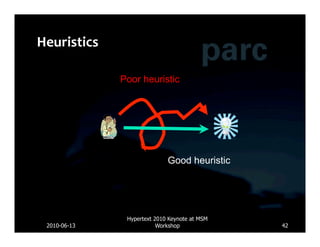
Poor heuristic


                            Good heuristic


              Hypertext 2010 Keynote at MSM
2010-06-13               Workshop             42
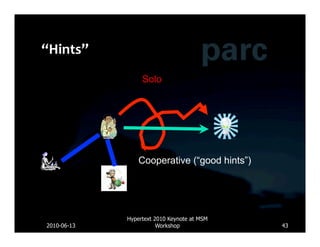
Solo


                 Cooperative (“good hints”)


             Hypertext 2010 Keynote at MSM
2010-06-13              Workshop              43
    Appropriate	
  for	
  
     the	
  occasion	


                              Hypertext 2010 Keynote at MSM
2010-06-13                               Workshop             44
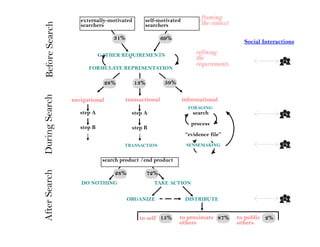
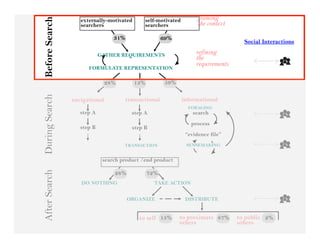
externally-motivated       self-motivated          framing
                                                                      the context


Before Search
                   searchers                  searchers

                                 31%                   69%
                                                                                      Social Interactions

                            GATHER REQUIREMENTS                     refining
                                                                    the
                                                                    requirements
                      FORMULATE REPRESENTATION

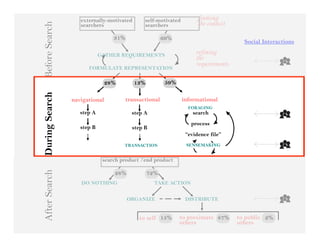
                               28%        13%           59%
During Search


                navigational           transactional           informational
                                                                 FORAGING
                   step A                step A                    search
                                                                  process
                   step B                step B
                                                                “evidence file”
                                     TRANSACTION                SENSEMAKING


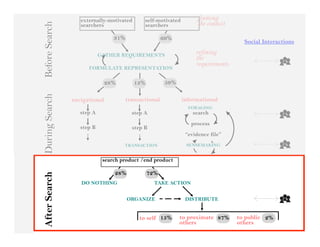
                             search product /end product
After Search


                                 28%            72%
                   DO NOTHING                     TAKE ACTION


                                       ORGANIZE                 DISTRIBUTE


                                            to self 15%       to proximate 87%      to public 2%
                                                              others                others
framing


Before Search
                   externally-motivated       self-motivated
                   searchers                  searchers              the context

                                 31%                   69%
                                                                                     Social Interactions

                            GATHER REQUIREMENTS                     refining
                                                                    the
                                                                    requirements
                      FORMULATE REPRESENTATION

                               28%        13%           59%
During Search


                navigational           transactional           informational
                                                                 FORAGING
                   step A                step A                    search
                                                                  process
                   step B                step B
                                                                “evidence file”
                                     TRANSACTION                SENSEMAKING


                             search product /end product
After Search


                                 28%            72%
                   DO NOTHING                     TAKE ACTION


                                       ORGANIZE                 DISTRIBUTE


                                            to self 15%       to proximate 87%     to public 2%
                                                              others               others
externally-motivated       self-motivated         framing
                                                                     the context


Before Search
                   searchers                  searchers

                                 31%                   69%
                                                                                     Social Interactions

                            GATHER REQUIREMENTS                     refining
                                                                    the
                                                                    requirements
                      FORMULATE REPRESENTATION

                               28%        13%           59%
During Search


                navigational           transactional           informational
                                                                 FORAGING
                   step A                step A                    search
                                                                  process
                   step B                step B
                                                                “evidence file”
                                     TRANSACTION                SENSEMAKING


                             search product /end product
After Search


                                 28%            72%
                   DO NOTHING                     TAKE ACTION


                                       ORGANIZE                 DISTRIBUTE


                                            to self 15%       to proximate 87%     to public 2%
                                                              others               others
externally-motivated       self-motivated         framing
                                                                     the context


Before Search
                   searchers                  searchers

                                 31%                   69%
                                                                                     Social Interactions

                            GATHER REQUIREMENTS                     refining
                                                                    the
                                                                    requirements
                      FORMULATE REPRESENTATION

                               28%        13%           59%
During Search


                navigational           transactional           informational
                                                                 FORAGING
                   step A                step A                    search
                                                                  process
                   step B                step B
                                                                “evidence file”
                                     TRANSACTION                SENSEMAKING


                             search product /end product

                                 28%            72%
After Search


                   DO NOTHING                     TAKE ACTION


                                       ORGANIZE                 DISTRIBUTE


                                            to self 15%       to proximate 87%     to public 2%
                                                              others               others
externally-motivated       self-motivated           framing
                                                                       the context
Before Search
                   searchers                  searchers

                                 31%                   69%
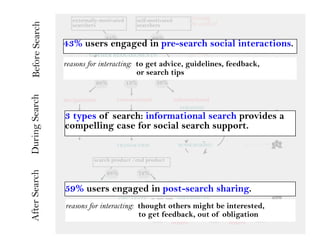
                43% users engaged in pre-search social Social Interactions
                                                        interactions.
                            GATHER REQUIREMENTS          refining
                                                         the
                reasons for interacting: to get advice, guidelines, feedback,
                      FORMULATE REPRESENTATION
                                                         requirements
                                              or search tips
                               28%        13%           59%
During Search


                navigational           transactional           informational
                                                                 FORAGING
                   step A                   search
                                         step A
                3 types of search: informational search provides a
                150 reports of unique search experiences
                compelling caseBfor social search support.
                mapped to a canonical model of social search.
                  step B     step
                                           process
                                                                “evidence file”
                                     TRANSACTION                SENSEMAKING


                             search product /end product
After Search


                                 28%            72%
                   DO NOTHING                     TAKE ACTION
                59% users engaged in post-search sharing.
                                       ORGANIZE                 DISTRIBUTE
                reasons for interacting: thought others might be interested,
                                          to get feedback, out of obligation
                                       to self 15% to proximate 87% to public 2%
                                                              others                 others
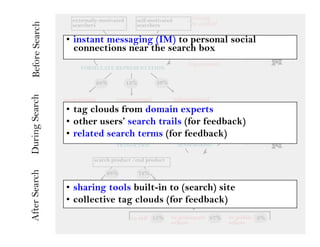
externally-motivated     self-motivated        framing
                                                                  the context
Before Search
                   searchers                searchers

                 •  instant 31%
                            messaging69% to personal social
                                      (IM)            Social Interactions
                    connections near the search box
                                             refining
                         GATHER REQUIREMENTS
                                                                  the
                                                                  requirements
                      FORMULATE REPRESENTATION

                               28%        13%         59%
During Search


                navigational         transactional           informational
                 •  step A clouds from domain FORAGING
                     tag           step A      experts
                                                 search
                 •  step B users’ search trails process feedback)
                     other                       (for
                                   step B
                 •  related search terms (for feedback) Similar to: Glance; Smyth"
                                              “evidence file”
                                     TRANSACTION              SENSEMAKING


                           search product /end product
After Search


                                 28%            72%
                   DO NOTHING                     TAKE ACTION
                 •  sharing tools built-in to (search) site                           Spartag.us"

                 •  collective tag clouds (for feedback)
                               ORGANIZE      DISTRIBUTE
                                                                                      Mr. Taggy"


                                           to self 15%      to proximate 87%     to public 2%
                                                            others               others
Hypertext 2010 Keynote at MSM
2010-06-13              Workshop             51
     Research	
  Vision:	
  Understand	
  how	
  social	
  computing	
  
                       systems	
  can	
  enhance	
  the	
  ability	
  of	
  a	
  group	
  of	
  
                       people	
  to	
  remember,	
  think,	
  and	
  reason.	
  
                      Living	
  Laboratory:	
  Create	
  applications	
  that	
  harness	
  
                       collective	
  intelligence	
  to	
  improve	
  knowledge	
  
                       capture,	
  transfer,	
  and	
  discovery.	
  

                 http://asc-­‐parc.blogspot.com	
  
                 http://www.edchi.net	
  
                 echi@parc.com	


                                                          Hypertext 2010 Keynote at MSM
                2010-06-13                                           Workshop                      52
Image from: http://www.flickr.com/photos/ourcommon/480538715/

Model-Driven Research in Social Computing

  • 1.
    Ed  H.  Chi,  Principal  Scientist  and  Area  Manager   Augmented  Social  Cognition  Area   Palo  Alto  Research  Center   Hypertext 2010 Keynote at MSM 2010-06-13 Workshop 1 Image from: http://www.flickr.com/photos/ourcommon/480538715/
  • 2.
      Cognition:  the  ability  to  remember,  think,  and  reason;  the  faculty  of   knowing.     Social  Cognition:  the  ability  of  a  group  to  remember,  think,  and   reason;  the  construction  of  knowledge  structures  by  a  group.   –  (not  quite  the  same  as  in  the  branch  of  psychology  that  studies  the   cognitive  processes  involved  in  social  interaction,  though  included)     Augmented  Social  Cognition:  Supported  by  systems,  the   enhancement    of  the  ability  of  a  group  to  remember,  think,  and   reason;  the  system-­‐supported  construction  of  knowledge   structures  by  a  group.     Citation:  Chi,  IEEE  Computer,  Sept  2008   Hypertext 2010 Keynote at MSM 2010-06-13 Workshop 2
  • 3.
    Characteriza*on   Models   Evalua*ons   Prototypes     Characterize  activity  on  social  systems  with  analytics     Model  interaction  social  and  community  dynamics  and  variables     Prototype  tools  to  increase  benefits  or  reduce  cost     Evaluate  prototypes  via  Living  Laboratories  with  real  users   Hypertext 2010 Keynote at MSM 2010-06-13 Workshop 3
  • 4.
      All  models  are  wrong!   –  Some  are  more  wrong  than  others!     So  what  are  theories  and  models  good  for?     A  summary  of  what  we  think  is  happening   –  Ways  to  describe  and  explain  what  we  have  learned   –  Predicts  user  and  group  behavior   –  Helps  generate  new  novel  tools  and  systems   Hypertext 2010 Keynote at MSM 2010-06-13 Workshop 4
  • 5.
      For  example,  for  information  diffusion,  it’s  theory  of   influentials  [Gladwell,  etc.]   –  reach  a  small  group  of  influential  people,  and  you’ll  reach   everyone  else   Figure From: Kleinberg, ICWSM2009 Hypertext 2010 Keynote at MSM 2010-06-13 Workshop 5
  • 6.
    From: Sun etal, ICWSM2009 Hypertext 2010 Keynote at MSM 2010-06-13 Workshop 6
  • 7.
      Descriptive:  clarify  terms,  key  concepts     Explanatory:  reveal  relationships  and  processes     Predictive:  about  performance  and  situations     Prescriptive:  convey  guidance  for  decision   making  in  design  by  recording  best  practice     Generative:  enable  practitioners  to  create,   invent  or  discover  something  new   7
  • 8.
      A  tough  task  to  identify  models  from  the   literature,  since  it  is  so  spread  out  in  various   publications     Just  a  few  examples  from  our  group.   UIST 2004 8
  • 9.
    Hypertext 2010 Keynoteat MSM 2010-06-13 Workshop 9
  • 10.
    Number of Articles(Log Scale) http://en.wikipedia.org/wiki/Wikipedia:Modelling_Wikipedia’s_growth
  • 11.
  • 13.
  • 14.
    *In thousands Monthly Active Editors
  • 15.
    Monthly Edits byEditor Class (in thousands)
  • 17.
    Monthly Ratio ofReverted Edits
  • 18.
    Hypertext 2010 Keynoteat MSM 2010-06-13 Workshop 18
  • 19.
      Preferential  Attachment:  Edits  beget  edits   –  more  number  of  previous  edits,  more  number  of  new  edits   Growth rate depends on: N = current population r = growth rate of the population N(t) = N 0 ⋅ e rt dN = r⋅ N dt Growth rate Current of population € population €
  • 20.
      Ecological  population  growth  model   –  Also  depend  on  environmental  conditions   –  K,  carrying  capacity  (due  to  resource  limitation)   dN N = rN(1− ) dt K €
  • 21.
      Follows  a  logistic  growth  curve   New Article
  • 22.
      Carrying  Capacity  as  a  function  of  time.  
  • 23.
      Biological  system   –  Competition  increases  as   population  hit  the  limits  of  the   ecology   –  Advantage  go  to  members  of  the   population  that  have  competitive   dominance  over  others     Analogy   –  Limited  opportunities  to  make   novel  contributions   –  Increased  patterns  of  conflict  and   dominance    
  • 24.
      r-­‐Strategist   –  Growth  or  exploitation   dN N –  Less-­‐crowded  niches  /  produce  many   = rN(1− ) offspring   dt K   K-­‐Strategist   –  Conservation   [Gunderson & Holling 2001] –  Strong  competitors  in  crowded  niches  /   invest  more  heavily  in  fewer  offspring   €
  • 25.
    Hypertext 2010 Keynoteat MSM 2010-06-13 Workshop 25
  • 26.
    Social Tagging CreatesNoise •  Synonyms •  Misspellings •  Morphologies People use different tag words to express similar concepts. Hypertext 2010 Keynote at MSM 2010-06-13 Workshop 26
  • 27.
    Encoding   Retrieval   “video    people    talks  technology”     h:p://www.ted.com/index.php/speakers   h:p://edge.org   “science    research  cogni*on”   Hypertext 2010 Keynote at MSM 27   2010-06-13 Workshop 27
  • 28.
    Concepts   Topics   Users   Documents   Noise   Tags   Decoding   Encoding   T1…Tn   Hypertext 2010 Keynote at MSM 2010-06-13 Workshop 28
  • 29.
    Hypertext 2010 Keynoteat MSM 2010-06-13 Workshop 29
  • 30.
    Hypertext 2010 Keynoteat MSM 2010-06-13 Workshop 30
  • 31.
    Source: Hypertext 2008study on del.icio.us (Chi & Mytkowicz) Hypertext 2010 Keynote at MSM 2010-06-13 Workshop 31
  • 32.
    Hypertext 2010 Keynoteat MSM 2010-06-13 Workshop 32
  • 33.
    Joint  work  with     Rowan  Nairn,  Lawrence  Lee   Kammerer,  Y.,  Nairn,  R.,  Pirolli,  P.,  and  Chi,  E.  H.  2009.  Signpost  from  the  masses:  learning   effects  in  an  exploratory  social  tag  search  browser.  In  Proceedings  of  the  27th   international  Conference  on  Human  Factors  in  Computing  Systems  (Boston,  MA,  USA,   April  04  -­‐  09,  2009).  CHI  '09.  ACM,  New  York,  NY,  625-­‐634.     Hypertext 2010 Keynote at MSM 2010-06-13 Workshop 33
  • 34.
    Semantic Similarity Graph Web Tools Reference Guide Howto Tutorial Tips Help Tip Tutorials Tricks Hypertext 2010 Keynote at MSM 2010-06-13 Workshop 34
  • 35.
    Tags URLs P(URL|Tag) P(Tag|URL)   Spreading  Activation  in  a  bi-­‐graph     Computation  over  a  very  large  data  set   –  150  Million+  bookmarks   Hypertext 2010 Keynote at MSM 2010-06-13 Workshop 35
  • 36.
    Database Lucene • Delicious • P(URL|Tag) • Serve up search • Ma.gnolia • P(Tag|URL) results • Tuples of • Pre-computed • Other social cues bookmarks • Bayesian Network patterns in a fast • Well defined APIs • [User, URL, Tags, Inference index Time] Crawling MapReduce Web Server Web Server UI Search Frontend Results •  MapReduce:  months  of  computa*on  to  a  single  day   •  Development  of  novel  scoring  func*on     Hypertext 2010 Keynote at MSM 2010-06-13 Workshop 36
  • 37.
    Hypertext 2010 Keynoteat MSM 2010-06-13 Workshop 37
  • 38.
    Hypertext 2010 Keynoteat MSM 2010-06-13 Workshop 38
  • 39.
    Hypertext 2010 Keynoteat MSM 2010-06-13 Workshop 39
  • 40.
    Dellarocas, MIT SloanManagement Review Hypertext 2010 Keynote at MSM 2010-06-13 Workshop 40
  • 41.
    (1)  Generate  new  tools  and  systems,  new  techniques   (2)  Generate  data  that  looks  like  real  behavioral  data   Hypertext 2010 Keynote at MSM 2010-06-13 Workshop 41
  • 42.
    Poor heuristic Good heuristic Hypertext 2010 Keynote at MSM 2010-06-13 Workshop 42
  • 43.
    Solo Cooperative (“good hints”) Hypertext 2010 Keynote at MSM 2010-06-13 Workshop 43
  • 44.
      Appropriate  for   the  occasion   Hypertext 2010 Keynote at MSM 2010-06-13 Workshop 44
  • 45.
    externally-motivated self-motivated framing the context Before Search searchers searchers 31% 69% Social Interactions GATHER REQUIREMENTS refining the requirements FORMULATE REPRESENTATION 28% 13% 59% During Search navigational transactional informational FORAGING step A step A search process step B step B “evidence file” TRANSACTION SENSEMAKING search product /end product After Search 28% 72% DO NOTHING TAKE ACTION ORGANIZE DISTRIBUTE to self 15% to proximate 87% to public 2% others others
  • 46.
    framing Before Search externally-motivated self-motivated searchers searchers the context 31% 69% Social Interactions GATHER REQUIREMENTS refining the requirements FORMULATE REPRESENTATION 28% 13% 59% During Search navigational transactional informational FORAGING step A step A search process step B step B “evidence file” TRANSACTION SENSEMAKING search product /end product After Search 28% 72% DO NOTHING TAKE ACTION ORGANIZE DISTRIBUTE to self 15% to proximate 87% to public 2% others others
  • 47.
    externally-motivated self-motivated framing the context Before Search searchers searchers 31% 69% Social Interactions GATHER REQUIREMENTS refining the requirements FORMULATE REPRESENTATION 28% 13% 59% During Search navigational transactional informational FORAGING step A step A search process step B step B “evidence file” TRANSACTION SENSEMAKING search product /end product After Search 28% 72% DO NOTHING TAKE ACTION ORGANIZE DISTRIBUTE to self 15% to proximate 87% to public 2% others others
  • 48.
    externally-motivated self-motivated framing the context Before Search searchers searchers 31% 69% Social Interactions GATHER REQUIREMENTS refining the requirements FORMULATE REPRESENTATION 28% 13% 59% During Search navigational transactional informational FORAGING step A step A search process step B step B “evidence file” TRANSACTION SENSEMAKING search product /end product 28% 72% After Search DO NOTHING TAKE ACTION ORGANIZE DISTRIBUTE to self 15% to proximate 87% to public 2% others others
  • 49.
    externally-motivated self-motivated framing the context Before Search searchers searchers 31% 69% 43% users engaged in pre-search social Social Interactions interactions. GATHER REQUIREMENTS refining the reasons for interacting: to get advice, guidelines, feedback, FORMULATE REPRESENTATION requirements or search tips 28% 13% 59% During Search navigational transactional informational FORAGING step A search step A 3 types of search: informational search provides a 150 reports of unique search experiences compelling caseBfor social search support. mapped to a canonical model of social search. step B step process “evidence file” TRANSACTION SENSEMAKING search product /end product After Search 28% 72% DO NOTHING TAKE ACTION 59% users engaged in post-search sharing. ORGANIZE DISTRIBUTE reasons for interacting: thought others might be interested, to get feedback, out of obligation to self 15% to proximate 87% to public 2% others others
  • 50.
    externally-motivated self-motivated framing the context Before Search searchers searchers •  instant 31% messaging69% to personal social (IM) Social Interactions connections near the search box refining GATHER REQUIREMENTS the requirements FORMULATE REPRESENTATION 28% 13% 59% During Search navigational transactional informational •  step A clouds from domain FORAGING tag step A experts search •  step B users’ search trails process feedback) other (for step B •  related search terms (for feedback) Similar to: Glance; Smyth" “evidence file” TRANSACTION SENSEMAKING search product /end product After Search 28% 72% DO NOTHING TAKE ACTION •  sharing tools built-in to (search) site Spartag.us" •  collective tag clouds (for feedback) ORGANIZE DISTRIBUTE Mr. Taggy" to self 15% to proximate 87% to public 2% others others
  • 51.
    Hypertext 2010 Keynoteat MSM 2010-06-13 Workshop 51
  • 52.
      Research  Vision:  Understand  how  social  computing   systems  can  enhance  the  ability  of  a  group  of   people  to  remember,  think,  and  reason.     Living  Laboratory:  Create  applications  that  harness   collective  intelligence  to  improve  knowledge   capture,  transfer,  and  discovery.   http://asc-­‐parc.blogspot.com   http://www.edchi.net   echi@parc.com   Hypertext 2010 Keynote at MSM 2010-06-13 Workshop 52 Image from: http://www.flickr.com/photos/ourcommon/480538715/