Model serving made easy using
Kedro pipelines
Mariusz Strzelecki
ML Engineer, GetInData
www.ml.dssconf.pl
© Copyright. All rights reserved. Not to be reproduced without prior written consent.
Let’s serve a model!
● Mlflow
● Seldon
● …
● Or just a microservice in python
● https://docs.seldon.io/projects/seldon-core/en/v1.6.0/examples/iris.html
© Copyright. All rights reserved. Not to be reproduced without prior written consent.
Easy, right?
● “Real” models have way more parameters
● “Real” models require some transformations:
○ Values scaling
○ Encoding
● “Real” models should validate input
● “Real” models may depend on data from Feature Store
● “Real” models may require post-processing
© Copyright. All rights reserved. Not to be reproduced without prior written consent.
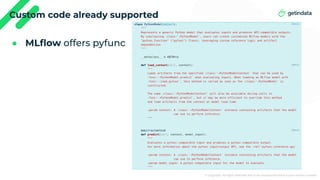
Custom code already supported
● MLflow offers pyfunc
© Copyright. All rights reserved. Not to be reproduced without prior written consent.
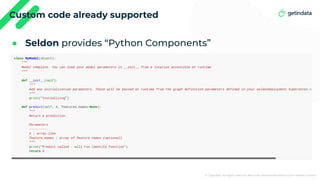
Custom code already supported
● Seldon provides “Python Components”
© Copyright. All rights reserved. Not to be reproduced without prior written consent.
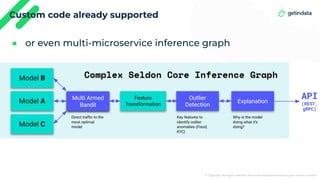
Custom code already supported
● or even multi-microservice inference graph
© Copyright. All rights reserved. Not to be reproduced without prior written consent.
Awesome, right?
● Right!
● But:
○ You keep every model in 2 subprojects: training and serving
○ Either you write tailored code for every model as Python class
○ … or you keep reusable components as multiple separate Docker containers
● Basically: a lot of work to do
© Copyright. All rights reserved. Not to be reproduced without prior written consent.
What if I told you, that:
● There is a way to keep both: training and serving in one
project
● You can test your serving (aka. “inference”) part without
leaving Jupyter
● It glues two existing frameworks
Meet Kedro
© Copyright. All rights reserved. Not to be reproduced without prior written consent.
Why Kedro?
● There is no standard on how ML projects should look like
● …, but, there are known good practices!
● Reproducibility is the key
● Fills the gap between Data Science and software
development
© Copyright. All rights reserved. Not to be reproduced without prior written consent.
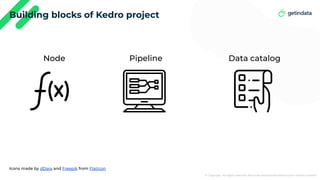
Building blocks of Kedro project
Icons made by dDara and Freepik from Flaticon
Node Pipeline Data catalog
© Copyright. All rights reserved. Not to be reproduced without prior written consent.
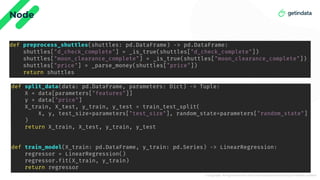
Node
© Copyright. All rights reserved. Not to be reproduced without prior written consent.
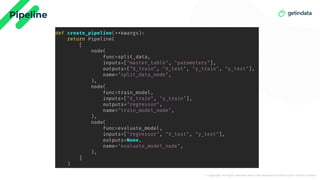
Pipeline
© Copyright. All rights reserved. Not to be reproduced without prior written consent.
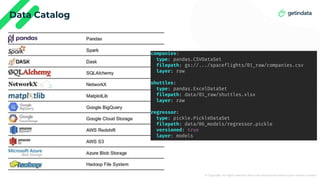
Data Catalog
© Copyright. All rights reserved. Not to be reproduced without prior written consent.
Building blocks of Kedro project
Icons made by dDara and Freepik from Flaticon
Node Pipeline Data catalog
Kedro ⬄ Seldon
integration
© Copyright. All rights reserved. Not to be reproduced without prior written consent.
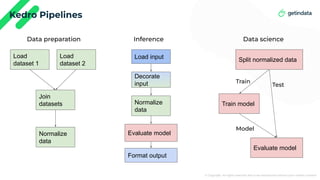
Kedro Pipelines
Data preparation Data science
Load
dataset 1
Load
dataset 2
Join
datasets
Normalize
data
Split normalized data
Train model
Evaluate model
Train
Test
Model
Inference
Load input
Decorate
input
Normalize
data
Evaluate model
Format output
© Copyright. All rights reserved. Not to be reproduced without prior written consent.
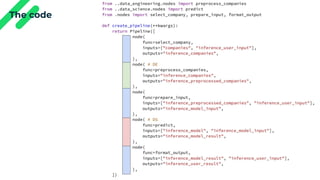
The code
© Copyright. All rights reserved. Not to be reproduced without prior written consent.
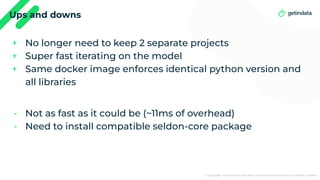
Ups and downs
+ No longer need to keep 2 separate projects
+ Super fast iterating on the model
+ Same docker image enforces identical python version and
all libraries
- Not as fast as it could be (~11ms of overhead)
- Need to install compatible seldon-core package
© Copyright. All rights reserved. Not to be reproduced without prior written consent.
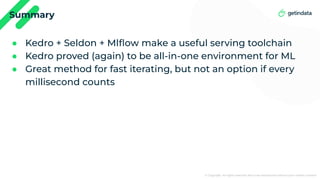
Summary
● Kedro + Seldon + Mlflow make a useful serving toolchain
● Kedro proved (again) to be all-in-one environment for ML
● Great method for fast iterating, but not an option if every
millisecond counts
Thank you!
Questions time

Model serving made easy using Kedro pipelines - Mariusz Strzelecki, GetInData

  • 1.
    Model serving madeeasy using Kedro pipelines Mariusz Strzelecki ML Engineer, GetInData www.ml.dssconf.pl
  • 2.
    © Copyright. Allrights reserved. Not to be reproduced without prior written consent. Let’s serve a model! ● Mlflow ● Seldon ● … ● Or just a microservice in python ● https://docs.seldon.io/projects/seldon-core/en/v1.6.0/examples/iris.html
  • 3.
    © Copyright. Allrights reserved. Not to be reproduced without prior written consent. Easy, right? ● “Real” models have way more parameters ● “Real” models require some transformations: ○ Values scaling ○ Encoding ● “Real” models should validate input ● “Real” models may depend on data from Feature Store ● “Real” models may require post-processing
  • 4.
    © Copyright. Allrights reserved. Not to be reproduced without prior written consent. Custom code already supported ● MLflow offers pyfunc
  • 5.
    © Copyright. Allrights reserved. Not to be reproduced without prior written consent. Custom code already supported ● Seldon provides “Python Components”
  • 6.
    © Copyright. Allrights reserved. Not to be reproduced without prior written consent. Custom code already supported ● or even multi-microservice inference graph
  • 7.
    © Copyright. Allrights reserved. Not to be reproduced without prior written consent. Awesome, right? ● Right! ● But: ○ You keep every model in 2 subprojects: training and serving ○ Either you write tailored code for every model as Python class ○ … or you keep reusable components as multiple separate Docker containers ● Basically: a lot of work to do
  • 8.
    © Copyright. Allrights reserved. Not to be reproduced without prior written consent. What if I told you, that: ● There is a way to keep both: training and serving in one project ● You can test your serving (aka. “inference”) part without leaving Jupyter ● It glues two existing frameworks
  • 9.
  • 10.
    © Copyright. Allrights reserved. Not to be reproduced without prior written consent. Why Kedro? ● There is no standard on how ML projects should look like ● …, but, there are known good practices! ● Reproducibility is the key ● Fills the gap between Data Science and software development
  • 11.
    © Copyright. Allrights reserved. Not to be reproduced without prior written consent.
  • 12.
    © Copyright. Allrights reserved. Not to be reproduced without prior written consent. Building blocks of Kedro project Icons made by dDara and Freepik from Flaticon Node Pipeline Data catalog
  • 13.
    © Copyright. Allrights reserved. Not to be reproduced without prior written consent. Node
  • 14.
    © Copyright. Allrights reserved. Not to be reproduced without prior written consent. Pipeline
  • 15.
    © Copyright. Allrights reserved. Not to be reproduced without prior written consent. Data Catalog
  • 16.
    © Copyright. Allrights reserved. Not to be reproduced without prior written consent. Building blocks of Kedro project Icons made by dDara and Freepik from Flaticon Node Pipeline Data catalog
  • 17.
  • 18.
    © Copyright. Allrights reserved. Not to be reproduced without prior written consent. Kedro Pipelines Data preparation Data science Load dataset 1 Load dataset 2 Join datasets Normalize data Split normalized data Train model Evaluate model Train Test Model Inference Load input Decorate input Normalize data Evaluate model Format output
  • 19.
    © Copyright. Allrights reserved. Not to be reproduced without prior written consent. The code
  • 20.
    © Copyright. Allrights reserved. Not to be reproduced without prior written consent. Ups and downs + No longer need to keep 2 separate projects + Super fast iterating on the model + Same docker image enforces identical python version and all libraries - Not as fast as it could be (~11ms of overhead) - Need to install compatible seldon-core package
  • 21.
    © Copyright. Allrights reserved. Not to be reproduced without prior written consent. Summary ● Kedro + Seldon + Mlflow make a useful serving toolchain ● Kedro proved (again) to be all-in-one environment for ML ● Great method for fast iterating, but not an option if every millisecond counts
  • 22.