Storing State Forever: Why It Can Be
Good For Your Analytics
Yaroslav Tkachenko
👋 Hi, I’m Yaroslav
Staff Data Engineer @ Shopify (Data Platform: Stream Processing)
Software Architect @ Activision (Data Platform)
Engineering Lead @ Mobify (Platform)
Software Engineer → Director of Engineering @ Bench Accounting
(Web Apps, Platform)
sap1ens sap1ens.com
A Story About 150+ Task Managers,
13 TB of State and a Streaming Join
of 9 Kafka Topics...
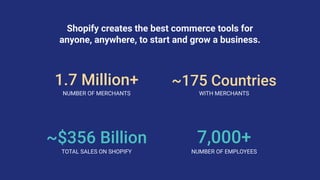
1.7 Million+
NUMBER OF MERCHANTS
Shopify creates the best commerce tools for
anyone, anywhere, to start and grow a business.
~175 Countries
WITH MERCHANTS
~$356 Billion
TOTAL SALES ON SHOPIFY
7,000+
NUMBER OF EMPLOYEES
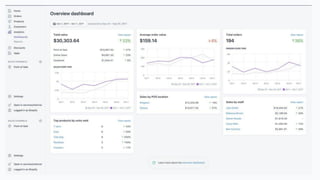
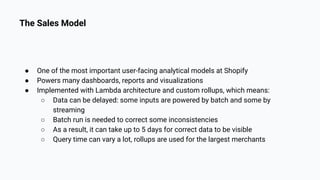
The Sales Model
● One of the most important user-facing analytical models at Shopify
● Powers many dashboards, reports and visualizations
● Implemented with Lambda architecture and custom rollups, which means:
○ Data can be delayed: some inputs are powered by batch and some by
streaming
○ Batch run is needed to correct some inconsistencies
○ As a result, it can take up to 5 days for correct data to be visible
○ Query time can vary a lot, rollups are used for the largest merchants
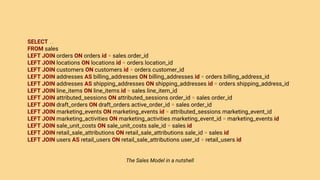
SELECT ...
FROM sales
LEFT JOIN orders ON orders.id = sales.order_id
LEFT JOIN locations ON locations.id = orders.location_id
LEFT JOIN customers ON customers.id = orders.customer_id
LEFT JOIN addresses AS billing_addresses ON billing_addresses.id = orders.billing_address_id
LEFT JOIN addresses AS shipping_addresses ON shipping_addresses.id = orders.shipping_address_id
LEFT JOIN line_items ON line_items.id = sales.line_item_id
LEFT JOIN attributed_sessions ON attributed_sessions.order_id = sales.order_id
LEFT JOIN draft_orders ON draft_orders.active_order_id = sales.order_id
LEFT JOIN marketing_events ON marketing_events.id = attributed_sessions.marketing_event_id
LEFT JOIN marketing_activities ON marketing_activities.marketing_event_id = marketing_events.id
LEFT JOIN sale_unit_costs ON sale_unit_costs.sale_id = sales.id
LEFT JOIN retail_sale_attributions ON retail_sale_attributions.sale_id = sales.id
LEFT JOIN users AS retail_users ON retail_sale_attributions.user_id = retail_users.id
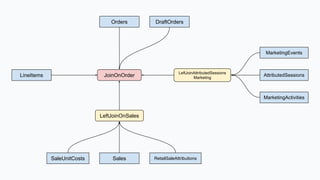
The Sales Model in a nutshell
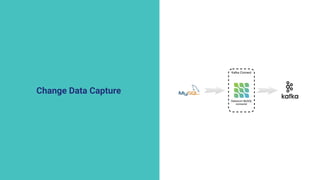
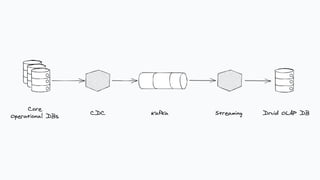
Change Data Capture
8
Orders
JoinOnOrder
DraftOrders
SaleUnitCosts
LineItems
RetailSaleAttributions
Sales
LeftJoinOnSales
LeftJoinAttributedSessions
Marketing
MarketingEvents
AttributedSessions
MarketingActivities
The Streaming Sales Model Requirements
● Streaming joins
● Low latency
● Arbitrarily late-arriving updates for any side of a join
The Streaming Sales Model Requirements
● Streaming joins
● Low latency
● Arbitrarily late-arriving updates for any side of a join
[Arbitrarily] Late-Arriving Updates
● Order edits
● Order imports
● Order deletions
● Refunds
● Session attribution
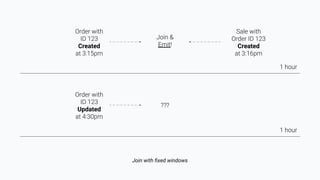
Join with fixed windows
Sale with
Order ID 123
Created
at 3:16pm
Order with
ID 123
Created
at 3:15pm
1 hour
Join &
Emit!
Order with
ID 123
Updated
at 4:30pm
1 hour
???
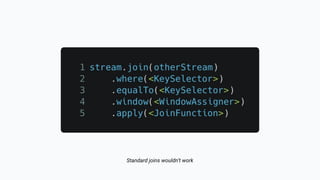
Standard joins wouldn’t work
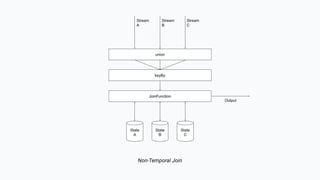
Non-Temporal Join
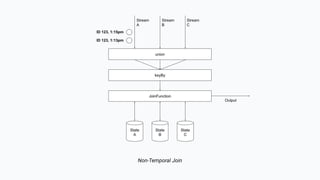
Non-Temporal Join
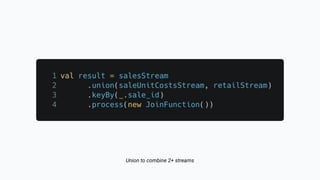
Union to combine 2+ streams
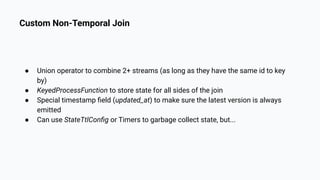
Custom Non-Temporal Join
● Union operator to combine 2+ streams (as long as they have the same id to key
by)
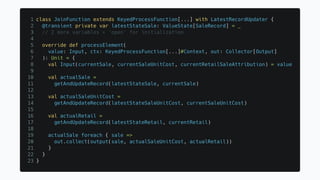
● KeyedProcessFunction to store state for all sides of the join
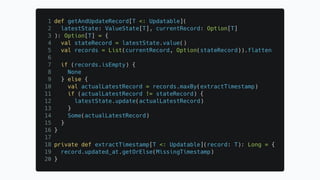
● Special timestamp field (updated_at) to make sure the latest version is always
emitted
● Can use StateTtlConfig or Timers to garbage collect state, but...
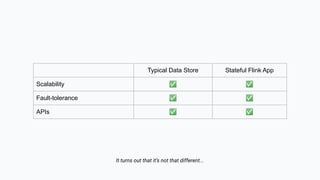
But what if… We keep the state
indefinitely? Is stateful Flink
pipeline that different from Kafka?
Or even MySQL?
Typical Data Store Stateful Flink App
Scalability ✅ ✅
Fault-tolerance ✅ ✅
APIs ✅ ✅
It turns out that it’s not that different...
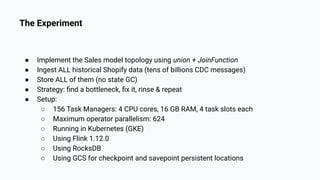
The Experiment
● Implement the Sales model topology using union + JoinFunction
● Ingest ALL historical Shopify data (tens of billions CDC messages)
● Store ALL of them (no state GC)
● Strategy: find a bottleneck, fix it, rinse & repeat
● Setup:
○ 156 Task Managers: 4 CPU cores, 16 GB RAM, 4 task slots each
○ Maximum operator parallelism: 624
○ Running in Kubernetes (GKE)
○ Using Flink 1.12.0
○ Using RocksDB
○ Using GCS for checkpoint and savepoint persistent locations
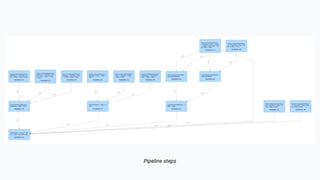
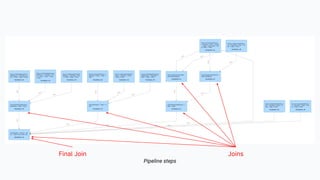
Pipeline steps
Joins
Final Join
Pipeline steps
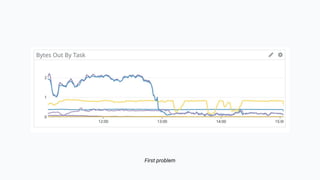
First problem
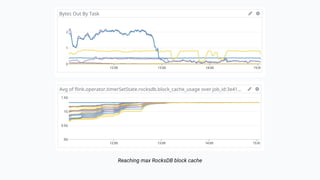
Reaching max RocksDB block cache
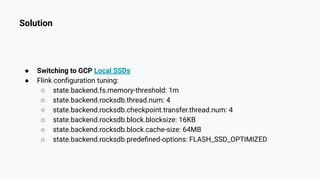
Solution
● Switching to GCP Local SSDs
● Flink configuration tuning:
○ state.backend.fs.memory-threshold: 1m
○ state.backend.rocksdb.thread.num: 4
○ state.backend.rocksdb.checkpoint.transfer.thread.num: 4
○ state.backend.rocksdb.block.blocksize: 16KB
○ state.backend.rocksdb.block.cache-size: 64MB
○ state.backend.rocksdb.predefined-options: FLASH_SSD_OPTIMIZED
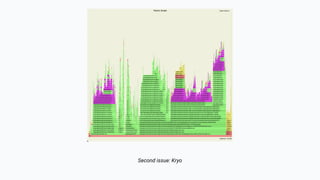
Second issue: Kryo
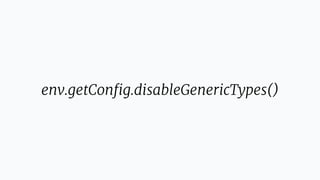
env.getConfig.disableGenericTypes()
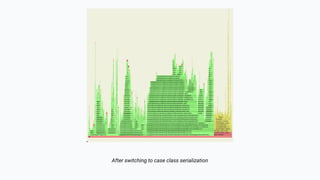
After switching to case class serialization
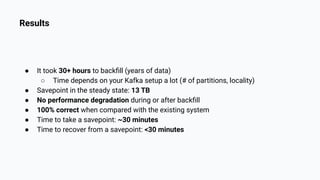
Results
● It took 30+ hours to backfill (years of data)
○ Time depends on your Kafka setup a lot (# of partitions, locality)
● Savepoint in the steady state: 13 TB
● No performance degradation during or after backfill
● 100% correct when compared with the existing system
● Time to take a savepoint: ~30 minutes
● Time to recover from a savepoint: <30 minutes
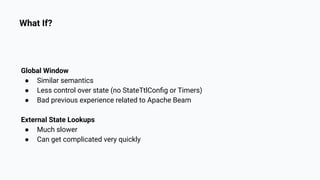
What If?
Global Window
● Similar semantics
● Less control over state (no StateTtlConfig or Timers)
● Bad previous experience related to Apache Beam
External State Lookups
● Much slower
● Can get complicated very quickly
So… Will you actually keep all this
state around?
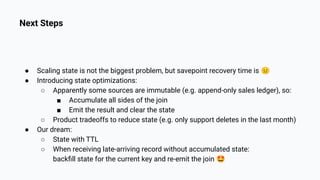
Next Steps
● Scaling state is not the biggest problem, but savepoint recovery time is 😐
● Introducing state optimizations:
○ Apparently some sources are immutable (e.g. append-only sales ledger), so:
■ Accumulate all sides of the join
■ Emit the result and clear the state
○ Product tradeoffs to reduce state (e.g. only support deletes in the last month)
● Our dream:
○ State with TTL
○ When receiving late-arriving record without accumulated state:
backfill state for the current key and re-emit the join 🤩
Questions?
Twitter: @sap1ens

Storing State Forever: Why It Can Be Good For Your Analytics

  • 1.
    Storing State Forever:Why It Can Be Good For Your Analytics Yaroslav Tkachenko
  • 2.
    👋 Hi, I’mYaroslav Staff Data Engineer @ Shopify (Data Platform: Stream Processing) Software Architect @ Activision (Data Platform) Engineering Lead @ Mobify (Platform) Software Engineer → Director of Engineering @ Bench Accounting (Web Apps, Platform) sap1ens sap1ens.com
  • 3.
    A Story About150+ Task Managers, 13 TB of State and a Streaming Join of 9 Kafka Topics...
  • 4.
    1.7 Million+ NUMBER OFMERCHANTS Shopify creates the best commerce tools for anyone, anywhere, to start and grow a business. ~175 Countries WITH MERCHANTS ~$356 Billion TOTAL SALES ON SHOPIFY 7,000+ NUMBER OF EMPLOYEES
  • 6.
    The Sales Model ●One of the most important user-facing analytical models at Shopify ● Powers many dashboards, reports and visualizations ● Implemented with Lambda architecture and custom rollups, which means: ○ Data can be delayed: some inputs are powered by batch and some by streaming ○ Batch run is needed to correct some inconsistencies ○ As a result, it can take up to 5 days for correct data to be visible ○ Query time can vary a lot, rollups are used for the largest merchants
  • 7.
    SELECT ... FROM sales LEFTJOIN orders ON orders.id = sales.order_id LEFT JOIN locations ON locations.id = orders.location_id LEFT JOIN customers ON customers.id = orders.customer_id LEFT JOIN addresses AS billing_addresses ON billing_addresses.id = orders.billing_address_id LEFT JOIN addresses AS shipping_addresses ON shipping_addresses.id = orders.shipping_address_id LEFT JOIN line_items ON line_items.id = sales.line_item_id LEFT JOIN attributed_sessions ON attributed_sessions.order_id = sales.order_id LEFT JOIN draft_orders ON draft_orders.active_order_id = sales.order_id LEFT JOIN marketing_events ON marketing_events.id = attributed_sessions.marketing_event_id LEFT JOIN marketing_activities ON marketing_activities.marketing_event_id = marketing_events.id LEFT JOIN sale_unit_costs ON sale_unit_costs.sale_id = sales.id LEFT JOIN retail_sale_attributions ON retail_sale_attributions.sale_id = sales.id LEFT JOIN users AS retail_users ON retail_sale_attributions.user_id = retail_users.id The Sales Model in a nutshell
  • 8.
  • 10.
  • 11.
    The Streaming SalesModel Requirements ● Streaming joins ● Low latency ● Arbitrarily late-arriving updates for any side of a join
  • 12.
    The Streaming SalesModel Requirements ● Streaming joins ● Low latency ● Arbitrarily late-arriving updates for any side of a join
  • 14.
    [Arbitrarily] Late-Arriving Updates ●Order edits ● Order imports ● Order deletions ● Refunds ● Session attribution
  • 15.
    Join with fixedwindows Sale with Order ID 123 Created at 3:16pm Order with ID 123 Created at 3:15pm 1 hour Join & Emit! Order with ID 123 Updated at 4:30pm 1 hour ???
  • 16.
  • 17.
  • 18.
  • 19.
    Union to combine2+ streams
  • 22.
    Custom Non-Temporal Join ●Union operator to combine 2+ streams (as long as they have the same id to key by) ● KeyedProcessFunction to store state for all sides of the join ● Special timestamp field (updated_at) to make sure the latest version is always emitted ● Can use StateTtlConfig or Timers to garbage collect state, but...
  • 23.
    But what if…We keep the state indefinitely? Is stateful Flink pipeline that different from Kafka? Or even MySQL?
  • 24.
    Typical Data StoreStateful Flink App Scalability ✅ ✅ Fault-tolerance ✅ ✅ APIs ✅ ✅ It turns out that it’s not that different...
  • 25.
    The Experiment ● Implementthe Sales model topology using union + JoinFunction ● Ingest ALL historical Shopify data (tens of billions CDC messages) ● Store ALL of them (no state GC) ● Strategy: find a bottleneck, fix it, rinse & repeat ● Setup: ○ 156 Task Managers: 4 CPU cores, 16 GB RAM, 4 task slots each ○ Maximum operator parallelism: 624 ○ Running in Kubernetes (GKE) ○ Using Flink 1.12.0 ○ Using RocksDB ○ Using GCS for checkpoint and savepoint persistent locations
  • 26.
  • 27.
  • 28.
  • 29.
  • 30.
    Solution ● Switching toGCP Local SSDs ● Flink configuration tuning: ○ state.backend.fs.memory-threshold: 1m ○ state.backend.rocksdb.thread.num: 4 ○ state.backend.rocksdb.checkpoint.transfer.thread.num: 4 ○ state.backend.rocksdb.block.blocksize: 16KB ○ state.backend.rocksdb.block.cache-size: 64MB ○ state.backend.rocksdb.predefined-options: FLASH_SSD_OPTIMIZED
  • 31.
  • 32.
  • 33.
    After switching tocase class serialization
  • 34.
    Results ● It took30+ hours to backfill (years of data) ○ Time depends on your Kafka setup a lot (# of partitions, locality) ● Savepoint in the steady state: 13 TB ● No performance degradation during or after backfill ● 100% correct when compared with the existing system ● Time to take a savepoint: ~30 minutes ● Time to recover from a savepoint: <30 minutes
  • 35.
    What If? Global Window ●Similar semantics ● Less control over state (no StateTtlConfig or Timers) ● Bad previous experience related to Apache Beam External State Lookups ● Much slower ● Can get complicated very quickly
  • 36.
    So… Will youactually keep all this state around?
  • 37.
    Next Steps ● Scalingstate is not the biggest problem, but savepoint recovery time is 😐 ● Introducing state optimizations: ○ Apparently some sources are immutable (e.g. append-only sales ledger), so: ■ Accumulate all sides of the join ■ Emit the result and clear the state ○ Product tradeoffs to reduce state (e.g. only support deletes in the last month) ● Our dream: ○ State with TTL ○ When receiving late-arriving record without accumulated state: backfill state for the current key and re-emit the join 🤩
  • 38.