Model Program
My Best Friend's Closet LGBT Outreach & Thrift
April R. Bayer
University of New England
Contents

Overview of Purpose and Design

Theoretical Framework

Detail of Action Plan

Detail of Evaluation Plan
Overview: Mission

To provide peer and professional
interventions from a community-
based LGBT center with the end
goal of helping individuals cope
and the community to be more
LGBT culturally competent. There
will be a funding component from
an affiliated second-hand retail
outlet.
Overview: Context

To Improve the Mental Health of LGBT Individuals Cope via:

Group and Individual sessions

Resource for Professional Trainings

Inform Community of Cultural Competence

Retail store as Partial Funding Source

Connect Local LGBT Individuals to Bolster Community

Community Sexuality Education for Rape & STD's

Long-term Goal: Use Organization as a Platform to
Advocate Legislatively
Overview: Need

LGBT Community-based Intervention in
Location which has No Duplicate
Services

Disconnect within Community

Safe Place for LGBT Individuals to Share

Clinical Aspect will Serve all Ages

Community Cultural Bias Needs to be
Educated
Overview: Resources

Financial:
• Retail store
• Community
Donations
• Grant Funds
• Bank Loan(s)
Overview: Resources

Human Power:

Community
Involvement

Credentialed
Professional Staff

Qualified Retail Staff

Volunteers
Overview: Resources
 Miscellaneous:
• Structural Facility
• Donated Goods
• Store Fixtures
• Processing Materials
• Office Supplies
• Electronic Equipment
• Educational Materials
• Donation Vehicle
Overview: Constraints

Social Phobia Associated with
LGBT

Funding Availability

Ensured Adequate Operating
Space

Community Resistance Due to
Intolerance
Overview: Activities

Individual/Group Sessions

Social Club(s)

Community Booths

Pride Events Participation

Education on Sexuality, Rape, & STD's

Professional Cultural Competency Trainings

Retail Thrift Shopping Experience
Overview: Effects

Increased Positive Mental Health Status for
Clients and Community

Increased Community/Professional Cultural
Competency

Decreased Hate Crimes

Increased STD/Rape Knowledge

Decrease Prevalence of LGBT Suicide
Overview: Outputs

Cycle of Interventions Processes

Strengthened Community Connections

Macro Advocacy for LGBT Equality

Professionals Gaining from Competency
Trainings

Retail Profit
Overview: Logical Model
Theoretical Framework

Reversed Logic Concept
− Value & Methods of Change are Identified with the Solutions to “How”
Questions are being Answered for the Program Structure

Practice Theory
− Narrative Approach
− Family Systems Approach when Warranted
− Cognitive-Behavioral and/or Dialectical-Behavior Interventions
− Strength-Based Solution-Focused Goals, when Needed
− Modernist Psycho-Dynamic Theory Rooted in Understanding
Developmental Needs
Theoretical Framework Cont.

Evaluation Approach: Empowerment Evaluation Principles
− Improvement by means of Intermittent Efficacy Surveys
− Community Ownership by means of Open Program Planning Meetings
− Inclusion by means of Complete Staff Input for Programs & Policies
− Democratic Participation by means of Robert's Rules During Meetings
− Social Justice by the Pursuit of LGBT Equality in Local Legislature
− Community Knowledge by means of Educational Trainings and Mission Advocacy
− Evidence-Based Strategies by Implementing Scholarly Research into Programming
− Capacity Building by means of Professional Competency Staff Trainings
− Organizational Learning by means of Regular Trainings for All Employees
− Accountability by means of Evaluations and Restructuring, if Needed
(Wandersman et al., 2004)
Action Plan Overview

Plan Steps:
− Step One: Researching Demographic Needs &
Securing Funds
− Step Two: Hiring & Training Staff for Retail &
Clinical Aspects
− Step Three: Securing Merchandise & Method of
Replenishment
− Step Four: Marketing Store & Clinical Services
− Step Five: Maintaining Client Relationships &
Retail Success
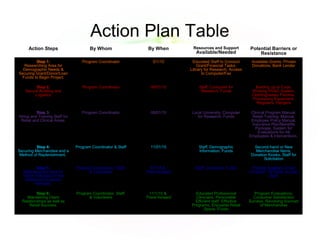
Action Plan Table
Action Steps By Whom By When Resources and SupportResources and Support
Available/Needed
Potential Barriers or
Resistance
Step 1:
Researching Area for
Demographic Needs &
Securing Grant/Donor/Loan
Funds to Begin Project.
Program Coordinator 5/1/15 Educated Staff to Conduct
Grant/Financial Tasks,
Library for Research, Access
to Computer/Fax
Available Grants, Private
Donations, Bank Lender
Step 2:
Secure Building and
Logistics
Program Coordinator 08/01/15 Staff, Computer for
Research, Funds
Building up to Code,
Working HVAC System,
Clothing/wares Fixtures,
Processing Equipment,
Registers, Hangers
Step 3:
Hiring and Training Staff for
Retail and Clinical Areas.
Program Coordinator 08/01/15 Local University, Computer
for Research, Funds
Clinical Program Manual,
Retail Training Manual,
Employee Policy Manual,
Insurance Plan/Benefits
Package, System for
Evaluations for All
Employees & Interventions
Step 4:
Securing Merchandise and a
Method of Replenishment.
Program Coordinator & Staff 11/01/15 Staff, Demographic
Information, Funds
Second-hand or New
Merchandise Items,
Donation Kiosks, Staff for
Solicitation
Step 5:
Marketing the Area for
Those Interested in the
Retail and Outreach
Services.
Program Coordinator, Staff,
& Volunteers
8/1/15 &
There-forward
Staff, Computer, Funds Printing Supplies, Email
Contacts, TV Public Access
Spot
Step 6:
Maintaining Client
Relationships as well as
Retail Success.
Program Coordinator, Staff,
& Volunteers
11/1/15 &
There-forward
Educated Professional
Clinicians, Personable
Efficient staff, Effective
Programs, Enjoyable Retail
Space, Funds
Program Evaluations,
Consumer Satisfaction
Surveys, Revolving Sources
of Merchandise
Evaluation Plan: Subjects

Understanding of Who & How many Individuals Participate, Completes, &
Retained for Programing & Consuming

Client & Consumer Satisfaction

Program Efficacy

Volunteers

Donations

Funding Income

Community Impact
Evaluation Plan: Measures

Structured Interviews

Direct Observation

Archival Records

Case Studies

Surveys

Time Series

Pre/Post Testing
*Program & Retail Efficacy will be Measured at Varying Intervals Based upon Subject &
Need
Evaluation Plan Continued
Key EvaluationKey Evaluation
Question(s)Question(s)
Type of
Management
Information and
Evaluation
Measure(s)
Survey /Survey /
ScaleScale
StructuredStructured
InterviewInterview
SelfSelf
Report /Report /
LogLog
DirectDirect
ObservationObservation
ArchivalArchival
RecordsRecords
CaseCase
StudyStudy
Pre-Pre-
and/orand/or
Post-Post-
testtest
TimeTime
SeriesSeries
Planning and
Implementation
Issues
Descriptive and
Process Measures
1. Who
participates? Is
there diversity
among the
participants?
A. Clinical Clients:
LGBTQ Individuals
and Concerned
Family/Friends
X X X X
B. Retail
Consumers: Open
to All Individuals
X X X
2. Why do
participants
enter and leave
the program?
A. Participants'
Reasons for
Starting/Stopping
Services
X X X
B. Consumers'
Reasons for
Patronage/Goods
Donation
X X
3. Are there a
variety of
service and
alternative
activities
generated?
A. Individual
Interventions,
Perpetual Weekly
Open Group
Sessions, Weekly
Social Club
Meetings
X X X X
Evaluation Plan Continued
Assessing
Attainment of
Objectives
Outcome Measures Survey /Survey /
ScaleScale
StructuredStructured
interviewinterview
SelfSelf
Report /Report /
LogLog
DirectDirect
ObservationObservation
ArchivalArchival
RecordsRecords
CaseCase
StudyStudy
Pre-Pre-
and/orand/or
Post-Post-
testtest
TimeTime
SeriesSeries
1. How many
people
participate?
A. Participation
Numbers for
Individual and Group
Activities
X X X X X
B. Participation
Numbers for
Consumers and
Goods Donors
X X X
2. How many
hours are
participants
involved in
service and
activities?
A. Individual
Sessions Subject to
Need, Groups
Sessions are One to
Two Hours
X X X X X
3. How many
hours are
volunteers
donating to
reduce
overhead?
A. University
Courses/Clubs
which offer
Volunteers
X X X
4. Is retail
revenue
enough to cover
operation
costs?
A. Goods
Donations,
Consumer
Totals/Purchases
X X X
Evaluation Plan Continued
Impact on
Participants &
Consumers
Outcome Measures Survey /Survey /
ScaleScale
StructuredStructured
interviewinterview
SelfSelf
Report /Report /
LogLog
DirectDirect
ObservationObservation
ArchivalArchival
RecordsRecords
CaseCase
StudyStudy
Pre-Pre-
and/orand/or
Post-Post-
testtest
TimeTime
SeriesSeries
1. How do
behavior and
attitudes
change as a
result of
participation in
the program?
A. Individual &
Groups Sessions
Report Positive
Impacts
X X X X X X X
B. Consumers
Supporting Mission
X X X
2. Are
participants
satisfied with
the experience?
A. Satisfaction
Reports from Clients
& Consumers
X X X
3. What is the
long term
participation?
A. Clients
Continuing with
Services and
Completing
Treatment Goals
X X X X X X
B. Consumers
whom Repeat
Patronage
X X X X
Evaluation Plan Continued
Impact on
Community
Outcome Measures Survey /Survey /
ScaleScale
StructuredStructured
interviewinterview
SelfSelf
Report /Report /
LogLog
DirectDirect
ObservationObservation
ArchivalArchival
RecordsRecords
CaseCase
StudyStudy
Pre-Pre-
and/orand/or
Post-Post-
testtest
TimeTime
SeriesSeries
1. What
resulted from
the program?
A. Quality of Life
Improvement for
Clients, Community
Awareness,
Legislative Policy
Changes via
Advocacy (Once
Established)
X X X X X X X
2. Do the
benefits of the
program
outweigh the
costs?
A. Cost Benefit Data X X X
3. Is the
community
satisfied with
the participants
and the service
they provided?
A. Satisfaction
Ratings from
Community at Large
X X
Reference
Wandersman, A., Keener, D. C., Snell-Johns, J., Miller, R. L., Flaspohler, P., Liuet-
Dye, M., Mendez, J., Behrens, T., Bolson, B., & Robinson, L. (2004). The
principles of empowerment evaluation; chapter 8: Empowerment evaluation:
Principles and action. New York: Guilford Publications.

Model program presentation

  • 1.
    Model Program My BestFriend's Closet LGBT Outreach & Thrift April R. Bayer University of New England
  • 2.
    Contents  Overview of Purposeand Design  Theoretical Framework  Detail of Action Plan  Detail of Evaluation Plan
  • 3.
    Overview: Mission  To providepeer and professional interventions from a community- based LGBT center with the end goal of helping individuals cope and the community to be more LGBT culturally competent. There will be a funding component from an affiliated second-hand retail outlet.
  • 4.
    Overview: Context  To Improvethe Mental Health of LGBT Individuals Cope via:  Group and Individual sessions  Resource for Professional Trainings  Inform Community of Cultural Competence  Retail store as Partial Funding Source  Connect Local LGBT Individuals to Bolster Community  Community Sexuality Education for Rape & STD's  Long-term Goal: Use Organization as a Platform to Advocate Legislatively
  • 5.
    Overview: Need  LGBT Community-basedIntervention in Location which has No Duplicate Services  Disconnect within Community  Safe Place for LGBT Individuals to Share  Clinical Aspect will Serve all Ages  Community Cultural Bias Needs to be Educated
  • 6.
    Overview: Resources  Financial: • Retailstore • Community Donations • Grant Funds • Bank Loan(s)
  • 7.
  • 8.
    Overview: Resources  Miscellaneous: •Structural Facility • Donated Goods • Store Fixtures • Processing Materials • Office Supplies • Electronic Equipment • Educational Materials • Donation Vehicle
  • 9.
    Overview: Constraints  Social PhobiaAssociated with LGBT  Funding Availability  Ensured Adequate Operating Space  Community Resistance Due to Intolerance
  • 10.
    Overview: Activities  Individual/Group Sessions  SocialClub(s)  Community Booths  Pride Events Participation  Education on Sexuality, Rape, & STD's  Professional Cultural Competency Trainings  Retail Thrift Shopping Experience
  • 11.
    Overview: Effects  Increased PositiveMental Health Status for Clients and Community  Increased Community/Professional Cultural Competency  Decreased Hate Crimes  Increased STD/Rape Knowledge  Decrease Prevalence of LGBT Suicide
  • 12.
    Overview: Outputs  Cycle ofInterventions Processes  Strengthened Community Connections  Macro Advocacy for LGBT Equality  Professionals Gaining from Competency Trainings  Retail Profit
  • 13.
  • 14.
    Theoretical Framework  Reversed LogicConcept − Value & Methods of Change are Identified with the Solutions to “How” Questions are being Answered for the Program Structure  Practice Theory − Narrative Approach − Family Systems Approach when Warranted − Cognitive-Behavioral and/or Dialectical-Behavior Interventions − Strength-Based Solution-Focused Goals, when Needed − Modernist Psycho-Dynamic Theory Rooted in Understanding Developmental Needs
  • 15.
    Theoretical Framework Cont.  EvaluationApproach: Empowerment Evaluation Principles − Improvement by means of Intermittent Efficacy Surveys − Community Ownership by means of Open Program Planning Meetings − Inclusion by means of Complete Staff Input for Programs & Policies − Democratic Participation by means of Robert's Rules During Meetings − Social Justice by the Pursuit of LGBT Equality in Local Legislature − Community Knowledge by means of Educational Trainings and Mission Advocacy − Evidence-Based Strategies by Implementing Scholarly Research into Programming − Capacity Building by means of Professional Competency Staff Trainings − Organizational Learning by means of Regular Trainings for All Employees − Accountability by means of Evaluations and Restructuring, if Needed (Wandersman et al., 2004)
  • 16.
    Action Plan Overview  PlanSteps: − Step One: Researching Demographic Needs & Securing Funds − Step Two: Hiring & Training Staff for Retail & Clinical Aspects − Step Three: Securing Merchandise & Method of Replenishment − Step Four: Marketing Store & Clinical Services − Step Five: Maintaining Client Relationships & Retail Success
  • 17.
    Action Plan Table ActionSteps By Whom By When Resources and SupportResources and Support Available/Needed Potential Barriers or Resistance Step 1: Researching Area for Demographic Needs & Securing Grant/Donor/Loan Funds to Begin Project. Program Coordinator 5/1/15 Educated Staff to Conduct Grant/Financial Tasks, Library for Research, Access to Computer/Fax Available Grants, Private Donations, Bank Lender Step 2: Secure Building and Logistics Program Coordinator 08/01/15 Staff, Computer for Research, Funds Building up to Code, Working HVAC System, Clothing/wares Fixtures, Processing Equipment, Registers, Hangers Step 3: Hiring and Training Staff for Retail and Clinical Areas. Program Coordinator 08/01/15 Local University, Computer for Research, Funds Clinical Program Manual, Retail Training Manual, Employee Policy Manual, Insurance Plan/Benefits Package, System for Evaluations for All Employees & Interventions Step 4: Securing Merchandise and a Method of Replenishment. Program Coordinator & Staff 11/01/15 Staff, Demographic Information, Funds Second-hand or New Merchandise Items, Donation Kiosks, Staff for Solicitation Step 5: Marketing the Area for Those Interested in the Retail and Outreach Services. Program Coordinator, Staff, & Volunteers 8/1/15 & There-forward Staff, Computer, Funds Printing Supplies, Email Contacts, TV Public Access Spot Step 6: Maintaining Client Relationships as well as Retail Success. Program Coordinator, Staff, & Volunteers 11/1/15 & There-forward Educated Professional Clinicians, Personable Efficient staff, Effective Programs, Enjoyable Retail Space, Funds Program Evaluations, Consumer Satisfaction Surveys, Revolving Sources of Merchandise
  • 18.
    Evaluation Plan: Subjects  Understandingof Who & How many Individuals Participate, Completes, & Retained for Programing & Consuming  Client & Consumer Satisfaction  Program Efficacy  Volunteers  Donations  Funding Income  Community Impact
  • 19.
    Evaluation Plan: Measures  StructuredInterviews  Direct Observation  Archival Records  Case Studies  Surveys  Time Series  Pre/Post Testing *Program & Retail Efficacy will be Measured at Varying Intervals Based upon Subject & Need
  • 20.
    Evaluation Plan Continued KeyEvaluationKey Evaluation Question(s)Question(s) Type of Management Information and Evaluation Measure(s) Survey /Survey / ScaleScale StructuredStructured InterviewInterview SelfSelf Report /Report / LogLog DirectDirect ObservationObservation ArchivalArchival RecordsRecords CaseCase StudyStudy Pre-Pre- and/orand/or Post-Post- testtest TimeTime SeriesSeries Planning and Implementation Issues Descriptive and Process Measures 1. Who participates? Is there diversity among the participants? A. Clinical Clients: LGBTQ Individuals and Concerned Family/Friends X X X X B. Retail Consumers: Open to All Individuals X X X 2. Why do participants enter and leave the program? A. Participants' Reasons for Starting/Stopping Services X X X B. Consumers' Reasons for Patronage/Goods Donation X X 3. Are there a variety of service and alternative activities generated? A. Individual Interventions, Perpetual Weekly Open Group Sessions, Weekly Social Club Meetings X X X X
  • 21.
    Evaluation Plan Continued Assessing Attainmentof Objectives Outcome Measures Survey /Survey / ScaleScale StructuredStructured interviewinterview SelfSelf Report /Report / LogLog DirectDirect ObservationObservation ArchivalArchival RecordsRecords CaseCase StudyStudy Pre-Pre- and/orand/or Post-Post- testtest TimeTime SeriesSeries 1. How many people participate? A. Participation Numbers for Individual and Group Activities X X X X X B. Participation Numbers for Consumers and Goods Donors X X X 2. How many hours are participants involved in service and activities? A. Individual Sessions Subject to Need, Groups Sessions are One to Two Hours X X X X X 3. How many hours are volunteers donating to reduce overhead? A. University Courses/Clubs which offer Volunteers X X X 4. Is retail revenue enough to cover operation costs? A. Goods Donations, Consumer Totals/Purchases X X X
  • 22.
    Evaluation Plan Continued Impacton Participants & Consumers Outcome Measures Survey /Survey / ScaleScale StructuredStructured interviewinterview SelfSelf Report /Report / LogLog DirectDirect ObservationObservation ArchivalArchival RecordsRecords CaseCase StudyStudy Pre-Pre- and/orand/or Post-Post- testtest TimeTime SeriesSeries 1. How do behavior and attitudes change as a result of participation in the program? A. Individual & Groups Sessions Report Positive Impacts X X X X X X X B. Consumers Supporting Mission X X X 2. Are participants satisfied with the experience? A. Satisfaction Reports from Clients & Consumers X X X 3. What is the long term participation? A. Clients Continuing with Services and Completing Treatment Goals X X X X X X B. Consumers whom Repeat Patronage X X X X
  • 23.
    Evaluation Plan Continued Impacton Community Outcome Measures Survey /Survey / ScaleScale StructuredStructured interviewinterview SelfSelf Report /Report / LogLog DirectDirect ObservationObservation ArchivalArchival RecordsRecords CaseCase StudyStudy Pre-Pre- and/orand/or Post-Post- testtest TimeTime SeriesSeries 1. What resulted from the program? A. Quality of Life Improvement for Clients, Community Awareness, Legislative Policy Changes via Advocacy (Once Established) X X X X X X X 2. Do the benefits of the program outweigh the costs? A. Cost Benefit Data X X X 3. Is the community satisfied with the participants and the service they provided? A. Satisfaction Ratings from Community at Large X X
  • 24.
    Reference Wandersman, A., Keener,D. C., Snell-Johns, J., Miller, R. L., Flaspohler, P., Liuet- Dye, M., Mendez, J., Behrens, T., Bolson, B., & Robinson, L. (2004). The principles of empowerment evaluation; chapter 8: Empowerment evaluation: Principles and action. New York: Guilford Publications.