
converting g
         g good ideas into
           effective action


          charlesPhillips, PhD
          donnaLenaghan, PhD
          d    L    h
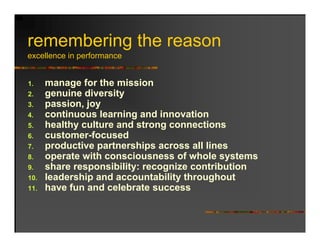
remembering the reason
excellence in performance


1.    manage for the mission
2.    genuine diversity
3.    p
      passion, joy
              ,j y
4.    continuous learning and innovation
5.    healthy culture and strong connections
6.    customer-focused
7.    productive partnerships across all lines
8.    operate with consciousness of whole systems
9.    share responsibility: recognize contribution
               p         y      g
10.   leadership and accountability throughout
11.   have fun and celebrate success
reflecting on your experience:
   fl ti                 i
A.   what are the key leadership
      h t     th k l d hi
     opportunities for nonprofit
     organizations?
1)

2)
 )

notes:
reflecting on your experience:
   fl ti                 i
B.   what are the key leadership challenges
      h t     th k l d hi h ll
     for nonprofit organizations?
1)

2)

notes:
reflecting on your experience:
   fl ti                 i
C.   what contributes to successful
      h t    t ib t t           f l
     development and implementation of a
     strategic plan? what is the leader’s
     role?
1)

2)

notes:
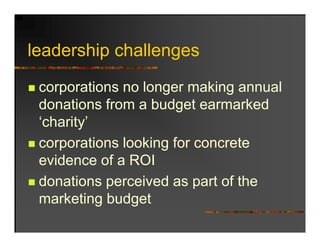
leadership h ll
l d hi challenges

 corporations no longer making annual
 donations from a budget earmarked
 ‘charity’
 corporations l ki f concrete
           ti looking for       t
 evidence of a ROI
 donations perceived as part of the
 marketing budget
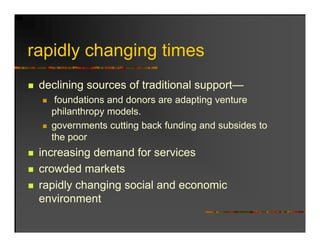
rapidly changing ti
   idl h     i times
 declining sources of traditional support—
    foundations and donors are adapting venture
   philanthropy models.
     hil th        d l
   governments cutting back funding and subsides to
   the poor
 increasing demand for services
 crowded markets
 rapidly changing social and economic
 environment
life in
lif i a post modern world
           t   d       ld
 individuals (recipients of nonprofit
 services, volunteers, donors) want more
                               )
 choice, more control and more
 accountability.
               y
 access to internet eases communication
 increases need for brand-name
                     brand name
 recognition
organizational challenges
     i ti    l h ll
 death by group think
 remaining relevant in a rapidly changing
 world
 identifying and documenting the social
 impact of programs and services
the 5 Drucker questions
      Dr cker q estions
1.   what is our mission?
2.   who is our customer?
      h i           t    ?
3.   what does the customer value?
4.   what are our results?
5.   what is our plan?
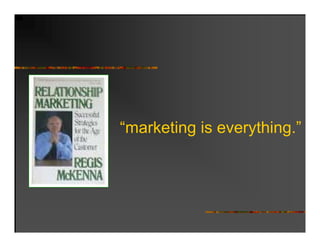
“marketing is everything.”
marketing is everything.
the purpose of any organization is to create
value
to create value it needs resources
to acquire resources it must ask for or warrant
them
resource givers - donors, customers, employees,
foundations - have a choice (to give or not to
give or to give to another organization)
the task of every organization is to
differentiate, be more relevant, be more
              ,                  ,
desirable
1. hat o r
1 what is our mission?

 why you do what you do; the
 organization’s reason for being, its
 pu pose
 purpose. says in t e e d what you
                   the end    at
 want to be remembered for.
1.
1 what is our mission?
“a mission cannot be impersonal; it has
to have deep meaning, be something you
            p         g,           gy
believe in—something you know is right.
a fundamental responsibility of
leadership is to make sure that
everybody knows the mission,
      b d k        th      i i
understands it, lives it.”
2. ho o r c stomer?
2 who is our customer?
 those who must be satisfied in order for
 the organization to achieve results. the
 primary customer is the person whose
 life is changed through the
 organization s work.
 organization’s work supporting
 customers are volunteers, members,
 partners, founders,
 partners founders referral sources
                             sources,
 employees, and others who must be
 satisfied.
 satisfied
what is marketing?
 h ti      k ti ?
 facilitation of exchange
 relationships linking an organization that
             p       g      g
 produces products or services to:
   customers or recipients
   donors
   governments
   media
   tax payers
   other organizations
facilitation f
f ilit ti of exchange
                h
 often not of a monetary nature—such as a
 g
 good feeling, a sense of community or
             g                    y
 social prestige
 multiparty exchanges more complex than
 the private sector
2. ho o r c stomer?
2 who is our customer?
 “time and again you will have to ask,
 ‘Who is our customer?’ because
  Who         customer?
 customers constantly change. the
 organization that is devoted to
 results—always with regard for its
 basic integrity—will adapt and change
 as they do.”
market constituents
   k t     tit   t
 resource provision market
   volunteers
   donors
   d
   funders
   g
   government g
              grantors
 resource allocation market
   clients
   patients
   legislators
   general public
marketing tasks
   k ti t k
 attracting funding from government
 agencies
 attracting funding from p
          g        g       private donors
 attracting clients for services
 attracting volunteers
 persuading legislators to change laws
 advocating changes in public opinion
relationship marketing
  l ti   hi     k ti
 the focus of the exchange is NOT to
 trigger an isolated transaction.
    gg
 long term focus on the interface between
 the customer and the organization is
 paramount.
3. h t d
3 what does the customer value?
            th     t       l ?

 that which satisfies customers’ needs
 (physical and psychological well being)
                              well-being),
 wants (where, when, and how service
 is provided), and aspirations (desired
 long term results).
 long-term results)
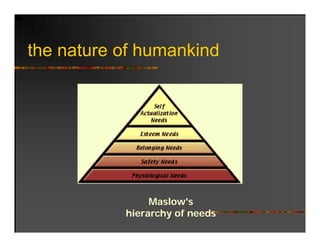
the t
th nature of humankind
           fh     ki d


                Maslow s
                Maslow's
           hierarchy of needs
marketing research
   k ti          h
 formal investigations in nonprofits are rare.
 NPO leaders believe they already have an
 informed relationship with the population served.
   NPOs operate on a small scale in local markets
   NPOs frequently deal directly with end users
   service providers may be in a better position to
   specify an appropriate product—mentally challenged
   child
cautions
   ti
 perception that clients are unqualified to
 have opinions on the treatments they
        p                              y
 receive can lead professionals to be
 inattentive to the legitimate wishes of
                      g
 those they intend to serve.
 often no direct feedback between funders
 and clients as in business
simple probes
 i l      b
 collecting and collating information from
 frontline staff
 research available secondary information
 from United Way of a municipal-in-house
                         municipal in house
 survey
 joint projects with organizations with a
 common interest
3. h t d
3 what does the customer value?
            th     t       l ?
 “people are so convinced they are doing the
 rights things and so committed to their
 cause that they come to see the institution
 as an end in itself. but that’s a bureaucracy.
 instead f ki ‘d
 i t d of asking ‘does it deliver value to our
                            d li       l t
 customers?’ they as, ‘does it fit our rules?’
 and that not only inhibits performance but
 also destroys vision and dedication.”
4. hat
4 what are our results?
           o r res lts?
 the organization’s bottom line.
 defined in changed lives people’s
                     lives—people s
 behavior, circumstances, health,
 hopes, competence, or capacity.
 results are always outside the
 organization.
4. hat
4 what are o r res lts?
           our results?
 “people are no longer interested to
 know, ‘Is it a good cause?’ instead
         Is          cause?
 they ask, ‘what is being achieved? Is
 this a responsible organization worthy
 of my investment? what difference is
 being made in society, in this
 community, in the life of individuals.”
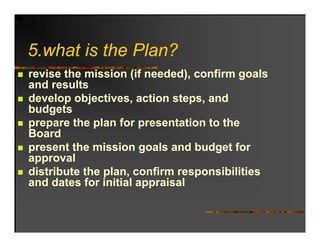
5.what is the Plan?
5 h t i th Pl ?
revise the mission (if needed), confirm goals
and results
develop objectives, action steps, and
budgets
prepare the plan for presentation to the
Board
present the mission goals and budget for
approval
distribute the plan, confirm responsibilities
               plan
and dates for initial appraisal
principles
 make it your own
  embed diversity
 broad participation and communication
 meaningful information
 focus on results
 shared commitment to action
“St. Augustine said, ‘One prays for
 miracles but works for results.’ Your
   i   l b t      k f        lt ’ Y
 p a eads
 plan leads you to work for results. It
                     o   o esu ts t
 converts intentions into actions.”
thank you!
           y
cphillips@serviceforpeace.org

Converting Good Ideas Into Effective Action [Compatibility Mode]

  • 1.
    converting g g good ideas into effective action charlesPhillips, PhD donnaLenaghan, PhD d L h
  • 2.
    remembering the reason excellencein performance 1. manage for the mission 2. genuine diversity 3. p passion, joy ,j y 4. continuous learning and innovation 5. healthy culture and strong connections 6. customer-focused 7. productive partnerships across all lines 8. operate with consciousness of whole systems 9. share responsibility: recognize contribution p y g 10. leadership and accountability throughout 11. have fun and celebrate success
  • 3.
    reflecting on yourexperience: fl ti i A. what are the key leadership h t th k l d hi opportunities for nonprofit organizations? 1) 2) ) notes:
  • 4.
    reflecting on yourexperience: fl ti i B. what are the key leadership challenges h t th k l d hi h ll for nonprofit organizations? 1) 2) notes:
  • 5.
    reflecting on yourexperience: fl ti i C. what contributes to successful h t t ib t t f l development and implementation of a strategic plan? what is the leader’s role? 1) 2) notes:
  • 6.
    leadership h ll ld hi challenges corporations no longer making annual donations from a budget earmarked ‘charity’ corporations l ki f concrete ti looking for t evidence of a ROI donations perceived as part of the marketing budget
  • 7.
    rapidly changing ti idl h i times declining sources of traditional support— foundations and donors are adapting venture philanthropy models. hil th d l governments cutting back funding and subsides to the poor increasing demand for services crowded markets rapidly changing social and economic environment
  • 8.
    life in lif ia post modern world t d ld individuals (recipients of nonprofit services, volunteers, donors) want more ) choice, more control and more accountability. y access to internet eases communication increases need for brand-name brand name recognition
  • 9.
    organizational challenges i ti l h ll death by group think remaining relevant in a rapidly changing world identifying and documenting the social impact of programs and services
  • 10.
    the 5 Druckerquestions Dr cker q estions 1. what is our mission? 2. who is our customer? h i t ? 3. what does the customer value? 4. what are our results? 5. what is our plan?
  • 11.
  • 12.
    marketing is everything. thepurpose of any organization is to create value to create value it needs resources to acquire resources it must ask for or warrant them resource givers - donors, customers, employees, foundations - have a choice (to give or not to give or to give to another organization) the task of every organization is to differentiate, be more relevant, be more , , desirable
  • 13.
    1. hat or 1 what is our mission? why you do what you do; the organization’s reason for being, its pu pose purpose. says in t e e d what you the end at want to be remembered for.
  • 14.
    1. 1 what isour mission? “a mission cannot be impersonal; it has to have deep meaning, be something you p g, gy believe in—something you know is right. a fundamental responsibility of leadership is to make sure that everybody knows the mission, b d k th i i understands it, lives it.”
  • 15.
    2. ho or c stomer? 2 who is our customer? those who must be satisfied in order for the organization to achieve results. the primary customer is the person whose life is changed through the organization s work. organization’s work supporting customers are volunteers, members, partners, founders, partners founders referral sources sources, employees, and others who must be satisfied. satisfied
  • 16.
    what is marketing? h ti k ti ? facilitation of exchange relationships linking an organization that p g g produces products or services to: customers or recipients donors governments media tax payers other organizations
  • 17.
    facilitation f f ilitti of exchange h often not of a monetary nature—such as a g good feeling, a sense of community or g y social prestige multiparty exchanges more complex than the private sector
  • 18.
    2. ho or c stomer? 2 who is our customer? “time and again you will have to ask, ‘Who is our customer?’ because Who customer? customers constantly change. the organization that is devoted to results—always with regard for its basic integrity—will adapt and change as they do.”
  • 19.
    market constituents k t tit t resource provision market volunteers donors d funders g government g grantors resource allocation market clients patients legislators general public
  • 20.
    marketing tasks k ti t k attracting funding from government agencies attracting funding from p g g private donors attracting clients for services attracting volunteers persuading legislators to change laws advocating changes in public opinion
  • 21.
    relationship marketing l ti hi k ti the focus of the exchange is NOT to trigger an isolated transaction. gg long term focus on the interface between the customer and the organization is paramount.
  • 22.
    3. h td 3 what does the customer value? th t l ? that which satisfies customers’ needs (physical and psychological well being) well-being), wants (where, when, and how service is provided), and aspirations (desired long term results). long-term results)
  • 23.
    the t th natureof humankind fh ki d Maslow s Maslow's hierarchy of needs
  • 24.
    marketing research k ti h formal investigations in nonprofits are rare. NPO leaders believe they already have an informed relationship with the population served. NPOs operate on a small scale in local markets NPOs frequently deal directly with end users service providers may be in a better position to specify an appropriate product—mentally challenged child
  • 25.
    cautions ti perception that clients are unqualified to have opinions on the treatments they p y receive can lead professionals to be inattentive to the legitimate wishes of g those they intend to serve. often no direct feedback between funders and clients as in business
  • 26.
    simple probes il b collecting and collating information from frontline staff research available secondary information from United Way of a municipal-in-house municipal in house survey joint projects with organizations with a common interest
  • 27.
    3. h td 3 what does the customer value? th t l ? “people are so convinced they are doing the rights things and so committed to their cause that they come to see the institution as an end in itself. but that’s a bureaucracy. instead f ki ‘d i t d of asking ‘does it deliver value to our d li l t customers?’ they as, ‘does it fit our rules?’ and that not only inhibits performance but also destroys vision and dedication.”
  • 28.
    4. hat 4 whatare our results? o r res lts? the organization’s bottom line. defined in changed lives people’s lives—people s behavior, circumstances, health, hopes, competence, or capacity. results are always outside the organization.
  • 29.
    4. hat 4 whatare o r res lts? our results? “people are no longer interested to know, ‘Is it a good cause?’ instead Is cause? they ask, ‘what is being achieved? Is this a responsible organization worthy of my investment? what difference is being made in society, in this community, in the life of individuals.”
  • 30.
    5.what is thePlan? 5 h t i th Pl ? revise the mission (if needed), confirm goals and results develop objectives, action steps, and budgets prepare the plan for presentation to the Board present the mission goals and budget for approval distribute the plan, confirm responsibilities plan and dates for initial appraisal
  • 31.
    principles make ityour own embed diversity broad participation and communication meaningful information focus on results shared commitment to action
  • 32.
    “St. Augustine said,‘One prays for miracles but works for results.’ Your i l b t k f lt ’ Y p a eads plan leads you to work for results. It o o esu ts t converts intentions into actions.”
  • 33.
    thank you! y cphillips@serviceforpeace.org